February 23

GUEST CURATOR:  Mary Aldrich

Who were the subjects of advertisements in a colonial newspaper 250 years ago this week?
Feb 23 - 2:20:1766 Massachusetts Gazette
Massachusetts Gazette (February 20, 1766).

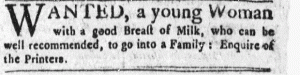
“WANTED, a young Woman with a good Breast of Milk.”

“A Very good WET-NURSE is willing to take a Child.”

These two advertisements are interesting in the fact that they relate to the same service but come from different angles. The first is an advertisement for a wet nurse while the second is advertising a woman’s willingness to be a wet nurse. Using a wet nurse was a common practice among European elite women that was not as popular across the pond in the colonies.

Feb 23 - 2:24:1766 New-York Gazette
New-York Gazette (February 24, 1766)

There were cases when a wet nurse was needed, such as the death of the mother or if she was too busy to take care of her child or some kind of ailment that prevented her from breastfeeding. Women generally used breastfeeding as a form of contraception, albeit unreliable, but it did give them some control over the spacing of their pregnancies.

The first advertisement is looking for “a young woman with a good breast of milk” to “go into a family.” It is interesting that this advertisement is seeking to incorporate this wet nurse into the family whereas the second gives the option of nursing “abroad,” which meant not in the house.

**********

ADDITIONAL COMMENTARY:  Carl Robert Keyes

I noted last week that women offering goods and services (shopkeepers, milliners, schoolmistresses, and the like) were disproportionately underrepresented in newspaper advertisements in colonial America. Today, Mary has selected two notices that illustrate the most common reason women were featured in advertisements for goods and services during the eighteenth century: offering or seeking assistance from wet nurses.

Note that even though both advertisements testify to labor (pun not necessarily intended) undertaken by women, they both also obscure the identity of the woman seeking or offering this service. Instructions to “Enquire of the Printers” or “Inquire of W. Weyman” (the printer of the New-York Gazette) rendered these women anonymous, perhaps by their own choice as a means of retaining their privacy. These advertisements figuratively put women’s bodies on display for public consumption, making it understandable why the advertisers might not have desired further identifying information.

Mary notes that these advertisements speak about two sides of the same transaction. I would like to suggest that each also incorporates concerns specific to the woman who placed the notice. For the first, seeking a wet nurse, it is quite possible that the advertisement was a last resort. A woman and her family may have first exhausted a network of family and trusted friends and neighbors before looking more broadly for a wet nurse. For the second, offering services as a wet nurse, Mary comments on the distinction between “in the House or abroad.” The advertiser demonstrated her willingness to adapt to conditions set by a potential employer. In looking for employment, she likely had to acclimate to the wishes of potential employers, whereas those seeking to hire wet nurses may have felt that they had more flexibility to set the terms.

February 16

GUEST CURATOR:  Elizabeth Curley

Who was the subject of an advertisement in a colonial newspaper 250 years ago this week?

Feb 16 - 2:14:1766 New-Hampshire Gazette
New-Hampshire Gazette (February 14, 1766).

“TO BE SOLD … A NEGRO LAD, about Seventeen Years of Age.”

As we know from the previous week’s advertisements, even the northern colonies embraced the slave trade. This advertisement has no information about the owner, only that if interested readers should inquire of the printer for more information. We do know that the boy is being sold for lumber or on “short credit.”

At about seventeen the boy had been owned by the advertiser for four years. He could “speak good English.” However, the advertisement goes on that he was not being bought for his “BEAUTY or GOOD QUALITIES.” He would have made a good worker or “labouring Servant.” This means that he would have probably worked outside, perhaps on docks or a farm or assisting with carpentry or masonry. If he had been pretty he could have been placed as a house servant, which might have included duties such as footman, general house staff, and, if the family was wealthy enough, a coach or stable man.

The comment about his looks and beauty go beyond what type of work he would be doing though. Those comments point to the view that his owner and many others had.   They believed that African Americans were inferior and had only bad intentions. However much this makes me upset as a human being, this is an advertisement that needs to be brought up for the discussion that will follow. Many people believe that racism is not as relevant or present today, and, though African Americans thankfully are not property any more, as a nation we have a long way to go until we as a people are united in equality.

**********

ADDITIONAL COMMENTARY:  Carl Robert Keyes

As historians have worked since the era of the modern civil rights movement to better incorporate race, class, and gender into our narratives and interpretations of the American past, some critics (both within and, especially, beyond the academy) have accused us of so-called revisionism. Most historians agree that acknowledging our complicated past tells a richer and fuller story. Furthermore, it is a patriotic endeavor in that it challenges us as a nation to recognize when we have fallen short of the rhetoric of the Revolution so we can strive to do better. But in order to do better, we must be fully aware of both current events and the actions, attitudes, and ideas that have produced and shaped those current events over decades and centuries.

Yet there are other reasons to tell a story of the past that includes as many perspectives as possible. Earlier this semester, Elizabeth and her peers in our Public History course read this passage:

“Students’ lack of historical knowledge about the past results in an inability to see themselves, their families, and their communities as part of the larger process of American history. If students fail to see their own histories as important, they do not believe that they can have an impact on their environments. One of the ways in which people ‘learn to be members of society’ is to feel engaged in it. History is central to identifying, analyzing, and interpreting the values upon which civil society depends. All historians should remember that they are citizens as well as scholars and that they possess some responsibility to the larger civic community.”[1]

Many critics of so-called revisionism yearn for historical narratives they consider patriotic. They envision history as a means of inculcating civics in students. Although I disagree with the shape of the narrative many critics wish to impose, I wholeheartedly agree that civic participation is one of the most important purposes of studying the past. As the passage above argues, we need history with as much breadth and depth as possible in order to empower ALL Americans to engage in thoughtful citizenship and compassionate service to their communities.

The advertisement Elizabeth selected for today is important in its own right for what it tells us about the history of slavery in America and the depictions of Africans and African Americans in colonial New England. There is so much more to say about an advertisement that denigrates a seventeen-year-old boy for a supposed lack of both “BEAUTY or GOOD QUALITIES,” but I appreciate that Elizabeth has challenged us also to think about why it is important that we analyze this kind of advertisement and include it in our historical narrative.

**********

[1] Patricia Mooney-Melvin, “Professional Historians and the Challenge of Redefinition,” in Public History: Essays from the Field, rev. ed., ed. James B. Gardner and Peter S. LaPaglia, (Malabar, FL: Krieger Publishing Company, 2006), 17.

February 12

GUEST CURATOR:  Kathryn J. Severance

Who was the subject of an advertisement in a colonial newspaper 250 years ago this week?

Feb 12 - 2:10:1766 New-York Gazette
New-York Gazette (February 10, 1766).

“TO BE SOLD, For Want of Employ.”

This advertisement was put forth by a master looking to sell a slave due to the fact that they no longer could use their work.  Advertisements for slaves were common since slaves were commodities during the Colonial period.  In the eyes of many at the time, selling slaves was not much different than selling oxen or horses.

Feb 12 - Abolition Map
Map of Slave States and Free States in 1800.

The slave featured within this particular advertisement seems to be nineteen years old.  At twenty myself, I took a look at this advertisement and, for a second, imagine my own life.

I imagine that many members of the public would be interested to know that a newspaper in what came to be known as the North, advertised slavery in the 1760s.  These types of advertisements also continued in New England’s newspapers for at least 10 years until Vermont, inspired by the Declaration of Independence, was the first to ban slavery in its 1777 state constitution.  Other New England states followed suit.  By 1800 all the states within New England’s borders abolished slavery.

**********

ADDITIONAL COMMENTARY:  Carl Robert Keyes

Today Kathryn has selected a type of advertisement that surprises many students who enroll in my courses on early America, whether the introductory survey or advanced electives on colonial and Revolutionary America or the capstone research seminar on slavery in America. As Kathryn points out, many are shocked when looking through the pages of eighteenth-century newspapers to discover just how often enslaved men, women, and children were advertised, either to be bought and sold or because they ran away from their masters.

Many students (and I would venture to guess many New Englanders as well as other Americans) imagine a strict North-South divide. Slavery as an institution was something that existed in the South, they assume, but not in the North. Such assumptions conflate nineteenth-century America and earlier periods by grafting the antebellum era over the realities of seventeenth- and eighteenth-century America.

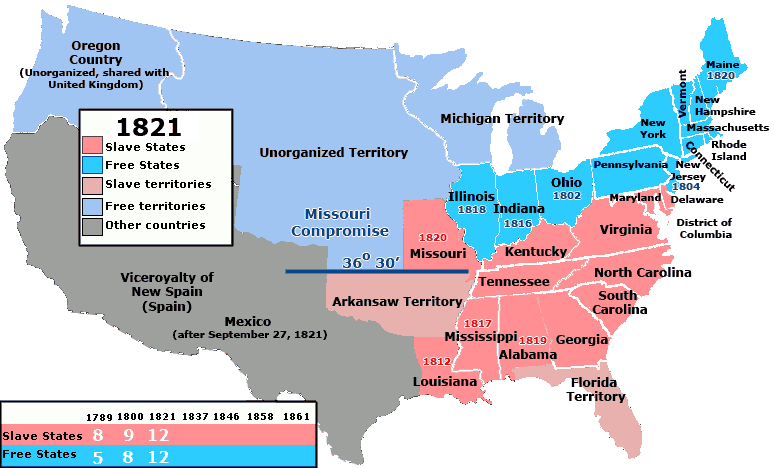
Feb 12 - Abolition Map 1821
Map of Slave States and Free State in 1821.  Note that New Jersey and New York merit additional explanation and clarification due to gradual emancipation.

Even the history of abolition is messier than simply stating that after a certain year slavery had been abolished in Northern states. Not every state adopted immediate abolition. New York (1799) and New Jersey (1804) each enacted gradual emancipation intended to phase out slavery over time. As a result, slaves resided in New York as late as 1824 and in New Jersey until the Civil War ended in 1865.

This advertisement reminds us of a history of slavery that is all too often hidden: its widespread practice throughout all the colonies in the seventeenth and eighteenth centuries and its continuation in some Northern states well into the nineteenth century.

January 26

Who was the subject of an advertisement in a colonial newspaper 250 years ago this week?

Jan 26 - 1:24:1766 New-London Gazette
New-London Gazette (January 24, 1766)

“A Boy 12 or 14 Years old, that can be well Recommended, is wanted as an Apprentice in this Town.  Enquire of the Printer.”

Employment advertisements regularly appeared in eighteenth-century newspapers.  Men and women regularly sought to buy and sell their services and labor or the services, assistance, and labor of others.  In that regard, employment advertisements could be considered variations on advertisements for enslaved people or indentured servants, which also marketed labor.  They are also variations on advertisements that promote the skills and services offered by artisans.  All of these kinds of advertisements often rely on similar language and appeals.

This advertisement seeking an apprentice, though brief, includes one of the standard phrases in notices arranging for an exchange of services:  “well Recommended.”  A person’s reputation in and of itself was an increasingly valuable commodity in the eighteenth century, an attribute that facilitated all kinds of social interactions in addition to commercial exchanges.

I also chose this advertisement because it raises an interesting question.  What kind of trade would the prospective apprentice learn?  “Enquire of the Printer” suggests that he might have learned that trade.  However, it was not uncommon for advertisers to remain anonymous and simply instruct that anybody interested in responding to their notices should “Enquire of the Printer.”

Given its ambiguity, who would have responded to this advertisement?  Some job seekers in the twenty-first century are sometimes willing to try their hand at anything that will give them a chance to gain some experience and make a living.  Perhaps a young man — or his family — adopted a similar approach in New London in the eighteenth century upon seeing an advertisement like this one.

Once again, I find myself intrigued by the partial stories told in the advertisements, wondering about the lives of those who placed and responded to such notices.

January 4

What was advertised in a colonial newspaper 250 years ago this week?

Jan 4 - 1:3:1766 New-Hampshire Gazette
New-Hampshire Gazette (January 3, 1766)

“Loaf Sugar to be sold for CASH … by the Loaf.”

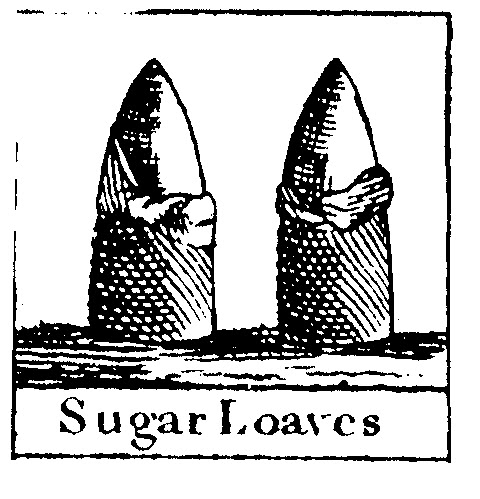
Advertisements and other eighteenth-century sources demonstrate that some staple foods that seem very familiar to us today were packaged much differently in the colonial era.  Granulated sugar and cubes were introduced in the late nineteenth century, but prior to that the sugar loaf was the traditional form in which refined sugar was produced and sold.

Sugar LoavesEnjoying this product required investing in other household goods, especially sugar nippers.  Advertisements for sugar often conceal other purchases consumers needed to make, specialized equipment they needed to buy and possess in order to make use of some everyday grocery items.  Some consumers may have purchased utilitarian sugar nippers to meet their basic needs, but others likely moved beyond mere practicality to collect and display accoutrements that adhered to the latest fashions or matched companion pieces in a tea set.
As part of my ongoing research, I am interested in all kinds of media used to market goods in the eighteenth century, including labels.  Sugar loafs were wrapped in paper.  If you happen to know of any loaf papers with printed labels, please let me know.

Follow these instructions if you would like to make your own sugar loaf.

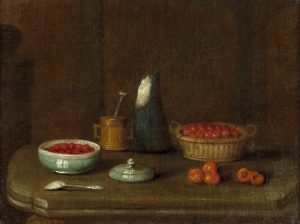
Still Life with Fruit and Sugar Loaf, ca. 1720.jpg
Still Life with Fruit and Sugar Loaf (Unknown Artist, ca. 1720)