April 18

GUEST CURATOR: Jonathan Bisceglia

Who was the subject of an advertisement in a colonial American newspaper 250 years ago today?

Apr 18 - 4:18:1767 Providence Gazette
Providence Gazette (April 18, 1767).

“A Negro Woman who understands all Sorts of houshold Work.”

I chose this advertisement because slavery in northern colonies and states is often overlooked when discussing slavery in American history. For the most part, slavery and the slave trade in the southern colonies get more attention. However, slavery was not only used in the northern colonies (see the census from 1774) but Rhode Island was also a hub for the slave trade. According to historians at the John Carter Brown Library, “Not only did Rhode Islanders have slaves—they had more per capita than any other New England state—but also entered with gusto into the trade.” Rhode Islanders gained so many profits from slavery that “[b]y the close of the eighteenth century, Rhode Islanders had mounted at least a thousand voyages from Africa to the Americas.” Voyages like these not only kept the institution of slavery going but encouraged it. I found this advertisement quite surprising, learning that slavery was so important so close to home.

Apr 18 - Census
Rhode Island Census for 1774 (Newport: Solomon Southwick, 1774). Courtesy John Carter Brown Library.

**********

ADDITIONAL COMMENTARY: Carl Robert Keyes

Recovering the lives of enslaved men, women, and children can be an extremely difficult task. Historians consult many different kinds of sources in their efforts to reconstruct the experiences of slaves, including advertisements like the one Jonathan selected to feature today. That advertisement offers frustratingly few details, but it does reveal the presence of an enslaved woman in Rhode Island. It includes her approximate age and suggests the type of labor she performed for her master, “all Sorts of houshold Work.” The advertisement does not, however, include the enslaved woman’s name nor the name of the slaveholder who wished to sell her. The conditions of the sale were camouflaged by instructions to interested parties: “For further Particulars enquire at the Printing-Office.” This advertisement appeared immediately below another one that revealed the presence of slavery in Rhode Island but advanced few details: “TO BE SOLD, A Likely, healthy Negro Boy, about Fifteen Years old, fit for either Town or Country, having been used to Farming Business.” It also concluded with instructions to “enquire at the Printing-Office in Providence.” Such advertisements aid historians in making generalizations about the experiences of enslaved men, women, and children, even in the absence of enough evidence to sketch more complete biographies.

On the other hand, other sorts of advertisements for slaves tell much more complete stories about their subjects. Advertisements for runaways frequently incorporated extensive descriptions of enslaved men, women, and children, from their physical appearance to their clothing to any goods they carried off. They elaborated on their ethnicity and the languages they spoke. They specified any special skills runaways possessed or trades they practiced. They revealed relationships within slave communities and among others, black and white, that might attempt to aid runaways. In some cases, they even told stories of previous attempts to abscond. Although written by white masters attempting to regain their human property, some scholars consider advertisements for runaways to be the first slave narratives. It would be difficult to deny the agency exhibited by slaves who chose to flee from those who kept them in bondage.

February 26

GUEST CURATOR: Samuel Birney

What was advertised in a colonial American newspaper 250 years ago today?

feb-26-2261767-massachusetts-gazette
Massachusetts Gazette (February 26, 1767).

“TO BE SOLD A standing Top-Chaise … and a very neat Sulkey.”

The advertisement featured today offered two types of carriages, “A standing Top-Chaise” and “a very neat Sulkey.” As the colonies expanded and populations grew, carriages became an important means of travel within cities and between colonies. Colonists made, bought, and used a variety of carriages, also commonly referred to as chairs, chaises, chariots, gigs, whiskeys, and sulkies.

According to Mary R.M. Goodwin, a chaise, which was interchangeable with the term chair, was a “light open carriage for one or two persons, often having a top or calash; those with four wheelers resembling a phaeton, those with two the curricle; also loosely used for pleasure carts and light carriages generally.” Goodwin consulted William Felton’s Treatise on Carriages, published in London in 1796, to describe sulkies. Sulkies were single seated “small, light four-wheeled vehicle, ‘built exactly in the form of a Post-chaise, Chariot, or Demi-Landau.’” Although some accounts referred to them as two-wheelers, the defining feature of the sulkey was its single person carrying capacity, basically making it a private and personal means of transportation. (For more information about the different kinds of carriages Goodwin mentions, see “Wheeled Carriages in Eighteenth-Century Virginia.”)

Carriages were either privately owned by the wealthy who could afford to purchase either locally built or imported carriages. By the 1760s, sometimes they were operated by local companies that charged for transportation.

**********

ADDITIONAL COMMENTARY: Carl Robert Keyes

As Sam indicates, affluent colonists imported carriages of all sorts from England, but by the 1760s coachmakers set up shops and advertised their wares in the largest American cities, sometimes noting that they consulted imported pattern books in order to produce carriages of the same style and quality as those available in London and other English cities. For instance, just a few days after today’s featured advertisement appeared in the Massachusetts Gazette, Hawes and Company, “Coach-makers,” inserted a lengthy notice about their services in the Supplement to the South-Carolina Gazette.

Today’s advertisement does not indicate the place of production for any of the conveyances it offered, but it does reveal a significant aspect of the marketplace in the revolutionary era. Just as many colonists acquired secondhand clothing and other goods, a market for used carriages emerged. The previous summer Adino Paddock, who followed “the Coach and Chaise-making Business” at a shop in Boston, advertised that he “always [had] a Number of second-hand Chaises to dispose of, very cheap.” Similarly, Hawes and Company’s advertisement noted that in addition to new carriages they also sold “on the most reasonable Terms, TWO second hand POST-CHAISES, a FAMILY COACH, and several CHAIRS.” Consumers who could not afford new carriages could discover a bargain when considering used ones instead.

The anonymous seller of “a very neat Sulkey” and a “standing Top-Chaise” may have found that maintaining these carriages was no longer practical or affordable. Alternately, the seller may have been in the process of acquiring a new – perhaps more impressive or fashionable – carriage and hoped to apply the proceeds from the sale of the chaise and sulkey to the purchase. If that was the case, the seller presumably was not dealing with Paddock, who pledged that he “will take old Chaises as Part of Pay for new.” These examples reveal that the marketing and financing of cars in twentieth and early twenty-first century resemble techniques launched by coachmakers in the eighteenth century.


October 19

GUEST CURATOR: Lindsay Hajjar

What was advertised in a colonial American newspaper 250 years ago this week?

oct-19-10171766-new-hampshire-gazette
New-Hampshire Gazette (October 17, 1766).

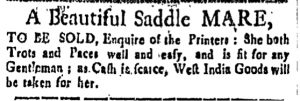
“A Beautiful Saddle MARE”

Owning nice things was a luxury that not every colonist had the opportunity to experience because of their financial situation. This advertisement targeted someone who could afford the extravagance of having a horse that was intended to be an accessory and a marker of status. When the seller described the mare he said,“She Both Trots and Paces well and easy.” This showed that the mare was in good condition, was even tempered, and could be ridden for leisure and pleasure. The mare was probably not meant to be a working house. This seems clear because the seller did not provide her age and weight, whether she had had any colts, or whether she was healthy and fit to work and breed. He described her as “A Beautiful Saddle MARE,” one ready to be shown off.

Conspicuous consumption of this sort suggests a growing sense of individuality among the colonists. As time went on and as their farms and businesses flourished and grew many had the financial stability to purchase goods that they would not have been able to afford had they stayed in Europe. The colonists’ sense of self was starting to shine through more and more as their wealth grew. Many colonists were able to make purchases that reflected their desires rather than just obtaining necessities.

**********

ADDITIONAL COMMENTARY: Carl Robert Keyes

Newspapers advertisements provide revealing glimpses of how the colonial marketplace operated, but sometimes they fall frustratingly short of revealing all the details that would allow us to make sense of the transactions they promoted. Lindsay has selected an advertisement that tells only a portion of a longer story.

An unknown seller sought a buyer for “A Beautiful Saddle MARE,” noting that she was “fit for any Gentleman.” In this case, referring to the purchaser as a “Gentleman” most likely was not a courtesy but rather an indication that the owner of such a horse would be an individual of some stature in the community, somebody with the resources to maintain the mare as a status symbol.

The same was presumably true of the current owner of the “Beautiful Saddle MARE,” yet the advertisement does not reveal the seller’s identity. Instead, it merely stated “Enquire of the Printers.” Who was the seller? Why was the horse offered for sale? Why did the seller conceal his identity?

A dozen different stories and scenarios spring to mind, each of them pure conjecture because the advertisement offers so few clues. In that regard, this advertisement seems ideal for working on a project with students. It demonstrates the historians must work within the limits of the documents available to us. We can work imaginatively but responsibly with our sources. We can make inferences from the language and context, as Lindsay has done in positing that this was not a workhorse intended for labor on a farm. Doing so allowed her to imagine what else could be learned from this advertisement, even if it was not stated explicitly. In the process, she reconstructed the social meanings of colonists’ possessions, extrapolating from the advertisement.

In that regard, Lindsay demonstrates that this advertisement tells us more about colonial society than might have initially seemed apparent. However, some aspects of the advertisement remain out of reach. I was drawn to this advertisement because it indicated that since “Cash is scarce, West India Goods will be taken for her.” What did the seller intend to do with a quantity of “West India Goods” exchanged for “A Beautiful Saddle MARE” that was “fit for any Gentleman?” Would those goods have been put to personal use or would they have been traded or sold to other consumers? That is a story of the colonial marketplace that will remain untold.


October 17

GUEST CURATOR: Lindsay Hajjar

Who was the subject of an advertisement in a colonial American newspaper 250 years ago today?

oct-17-10171766-new-london-gazette
New-London Gazette (October 17, 1766).

“ALSO, An able body’d hearty Wench 16 Years old (with a sucking Child.”

This advertisement started with the sale of a twenty-nine-year old slave, described as “strong and healthy.” The seller then indicated where he was born and that he has skills in farming. Next, he stated he was selling a “Wench” who was sixteen years old. By calling her a wench he degraded her status as a woman even further. In this case, a female slave was held at even lower regard than a male slave, perhaps because of the fact that when she had a child it took away from her ability to do work. The girl being sold was “able-bodied” and could “do all Sorts of House Work,” but was being sold because of “her breeding.” The words “breeding” and “wench” show the seller’s opinion about women, especially enslaved women, as well as an assumption that because she was a women and a slave she should be good at housework because that was what she was born to do.

In “Work, Pregnancy, and Infant Mortality among Southern Slaves,” John Campbell talks about how in the South slave owners placed value not on the gender of slaves but rather their age and physical condition. Campbell also points out that both male and female slaves were “harvesting equal proportions of cotton,” showing that in the South it did not matter to the slave owners the gender of the slave as long as they were capable of doing the work.[1] However, this advertisement was printed in the northern colony of Connecticut during an earlier period; the seller’s tone was different. It changed, becoming more aggressive and angry when going from depicting the man to the girl being sold. It is as if the seller was annoyed that she had a child that was now going to be a burden on him and he had to sell them because the child would be a distraction to her. He was not willing to make the long-term investment in the child, showing that Northern slave owners in the colonial period were not as ambivalent about their slaves’ genders as Southern slave owners were in the nineteenth century. In his advertisement the seller said the young woman came “with a sucking child.” He seemed upset with the fact that she had a child and that the child was nothing but an inconvenience, because the child was still breastfeeding. Female slaves could be looked at as beneficial because they had the ability to produce more slaves for their owners but that could also be a shortcoming because when they were pregnant and while the child was dependent mothers were not able to work to the same capacity.

**********

ADDITIONAL COMMENTARY: Carl Robert Keyes

I appreciate how Lindsay compares the sentiments expressed in today’s advertisement to the attitudes adopted by slaveholders in another region during another period, underscoring that there was not a monolithic experience of slavery in America. Instead, different people (both enslaved and free) faced very different circumstances depending on the period and place in which they lived.

oct-17-10171766-puff-piece-new-london-gazette
New-London Gazette (October 17, 1766).

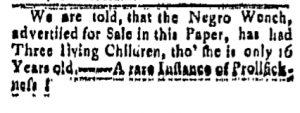
Another notice that appeared on the same page of the New-London Gazette further complicates today’s advertisement. “We are told,” an anonymous narrator (perhaps the printer) proclaimed, “that the Negro Wench advertised for Sale in this Paper, has had Three living Children, tho’ she is only 16 Years old. — A rare Instance of Prollfickness!” (Presumably the last word was supposed to be “prolificness.”) As Lindsay noted, the seller wished to be rid of this young woman solely because of her “breeding” and the inconveniences that it caused. The other notice, however, seemed to celebrate the young enslaved woman’s ability to produce children, promoting her fecundity as a selling point for potential buyers.

Who was responsible for the announcement that the sixteen-year-old “hearty Wench” already had three children? Was this an advertisement – a puff piece – placed by the current owner of the young woman in hopes of generating interest and making a sale? Or did the printer insert it of his own volition, as a point of interest he hoped would inform and entertain readers? The placement on the page makes it difficult to reach any particular conclusion. The notice appeared among the advertisements included in that issue of the New-London Gazette, but it appears at the bottom of the column immediately to the left of the column in which the advertisement for the “hearty Wench” was printed. It may have been positioned to prime readers to consider purchasing the young woman, but it also could have been intended as amusing filler when news and advertising did not completely fill the column. Either way, it now provides disheartening evidence concerning the levels of degradation one enslaved woman experienced at the hands of her captor and his community.

When Lindsay first presented this advertisement for my approval, I thought I might contemplate whether it suggested a family was being separated. When I examined it in the context of the rest of the issue, however, I discovered a much more revolting situation.

**********

[1] John Campbell, “Work, Pregnancy, and Infant Mortality among Southern Slaves,” Journal of Interdisciplinary History 14, no. 4 (Spring 1984): 797.

September 16

Who was the subject of an advertisement in a colonial American newspaper 250 years ago today?

sep-16-9161766-south-carolina-gazette-and-country-journal
South-Carolina Gazette and Country Journal (September 16, 1766).

“A LIKELY young Negro Fellow, who is a good Ship-Carpenter and Caulker.”

As this advertisement vividly demonstrates, enslaved people contributed far more than just involuntary labor to the developing economies of the American colonies. The unnamed “LIKELY young Negro Fellow” offered for this sale in this advertisement was “a good Ship-Carpenter and Caulker” who possessed very specialized skills that could be gained only through training and experience. His work required knowledge of various materials and resources as well as proficiency with an assortment of tools. This “LIKELY young Negro Fellow” was an artisan in his own right, even if his master and other colonists did not accord him that status but instead chose to think of him as a laborer.

In addition to illustrating the expertise possessed by some slaves in colonial America, this advertisement also testifies to the relationship between print and slavery in the eighteenth century. My students recently read an article by David Waldstreicher, “Reading the Runaways.”[1] Although Waldstreicher examined the Middle Colonies, advertisements like this one suggest that his arguments extend to other regions in British mainland North America. For instance, printers enjoyed financial gains thanks to slavery and the slave trade every time they included advertisements for runaways or seeking to buy and sell slaves in their newspapers. It was not necessary to own slaves or sell slaves to benefit from the enslavement of Africans.

Also note that this advertisement directs interested parties that “For farther Particulars, enquire of the Printer of this Paper.” Such maneuvers placed printers, rather than slave traders or auctioneers, at the center of some networks for buying and selling slaves. Printers often facilitated and oversaw the sales of enslaved men, women, and children. In addition, this advertisement did not name the seller or the slave. Waldstreicher points out that this allowed potential sales to remain secret from those who might be sold. Some slaves were literate and shared the contents of newspapers with their peers, but the absence of names meant that the “LIKELY young Negro Fellow” would not be tipped off about an impending sale and choose to avoid it by running away.

This short advertisement, only five lines, opens up a much broader world of colonial commerce, labor, and culture than might be readily apparent at first glance.

**********

[1] David Waldstreicher, “Reading the Runaways: Self-Fashioning, Print Culture, and Confidence in Slavery in the Eighteenth-Century Mid-Atlantic,” William and Mary Quarterly, 3rd ser., 56, no. 2 (April 1999): 243-272.

March 16

Who was the subject of an advertisement in a colonial newspaper 250 years ago this week?

Mar 16 - 3:14:1766 New-Hampshire Gazette
New-Hampshire Gazette (March 14, 1766).

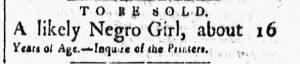
“A likely Negro Girl, about 16 Years of Age.”

I’ve previously made it clear that I wish to feature a new and different advertisement every day. This short advertisement is indeed new to the Adverts 250 Project, though it looks so similar to several others that it’s easy to understand why somebody might question whether it appeared here before.

So why choose it as today’s advertisement? How does it help us to understand early American advertising, consumer culture, or slavery better than any of the previous advertisements for enslaved men, women, and children analyzed here?

Part of the answer lies in the fact that this has become such a familiar type of advertisement. I have not disproportionately selected advertisements seeking to buy or sell enslaved Africans and African Americans. If advertisements for enslaved people have become a familiar part of this project, imagine just how commonplace they appeared to colonists in the eighteenth century. Any reader of a colonial newspaper would have seen far more advertisements for enslaved people than have appeared here, and far more regularly. An advertisement for “A likely Negro Girl” and its counterparts may startle many modern readers, but those advertisements would have been just part of the commercial and cultural landscape in early America.

Only six advertisements for consumer goods and services appeared in this issue of the New-Hampshire Gazette. Two of them offered to sell enslaved youths, “A likely Negro Girl” here and “A NEGRO BOY” (printed just below an advertisement for “BARBADOS whitest LOAF SUGAR,” as featured last week).

These are some of the reasons that I consider it important to continue to feature advertisements for enslaved people. Even in colonial New Hampshire, far removed geographically from the plantations of the Chesapeake, the Lower South, and the Caribbean, slavery was an integral part of advertising as well as commerce more generally. To overlook or ignore these advertisements because they resemble or replicate others would be to misconstrue the past.

March 8

What was advertised in a colonial newspaper 250 years ago this week?

Mar 8 - 3:7:1766 New-Hampshire Gazette
New-Hampshire Gazette (March 7, 1766).

“This masterly Performance merits the closest Attention and Consideration of every true SON OF AMERICA, the Propriety of imposing TAXES on free Subjects.”

Yesterday’s advertisements from the New-Hampshire Gazette testified to the connections between slavery and consumer culture in eighteenth-century America. Slavery was discussed elsewhere on the same page of that issue, though it was slavery of a different sort. The printers inserted several letters forwarded by the “true born Sons of Liberty” concerning the continuing controversy over the Stamp Act. The American protestors were “determined to use there utmost Efforts to prevent even the Appearance of Slavery.” Meanwhile, readers who glanced two columns to the left would have seen the advertisements for “BARBADOS whitest LOAF SUGAR” and “A NEGRO BOY.”

Today’s advertisement appeared on the previous page. It does not include the word “slavery,” but other items published in the same issue demonstrate that many readers consciously linked the Stamp Act and enslavement (even as they may have attempted to eschew associations between sugar and slavery). In American Slavery, American Freedom (1975), Edmund S. Morgan explored the paradox of the founding of the American nation: the rhetoric of freedom and equality during the Revolution and after occurred with the enslavement of black laborers as its backdrop throughout the colonial era and beyond. The liberty of white Americans was contingent in many ways on the enslavement of Africans and African Americans, a distressing contradiction.

Today’s advertisement is certainly evidence that advertising and consumer culture took on a political valence in the years of the imperial crisis, but a story of patriotic advertising would be an incomplete story. Just as yesterday’s advertisements for sugar and an enslaved boy were bound together, the stories of Americans advocating (and eventually fighting) for their liberties and simultaneously continuing to practice slavery cannot be separated from each other.

March 7

What was advertised in a colonial newspaper 250 years ago today?

Mar 7 - 3:7:1766 New-Hampshire Gazette
New-Hampshire Gazette (March 7, 1766).

“BARBADOS whitest LOAF SUGAR.”

“A NEGRO BOY.”

Today I have chosen two advertisements whose proximity on the page resonated with me. When I scanned this issue of the New-Hampshire Gazette to make my selection, particular portions of each advertisement seemed to jump off the page:

  • “BARBADOS whitest LOAF SUGAR”
  • “A NEGRO BOY”

Two separate advertisements, but each inextricably bound with the other.

Considered on its own, the first advertisement seems to hide the connection between a finished product available for purchase in an increasingly vibrant eighteenth-century marketplace and the labor of enslaved Africans on plantations in faraway Barbados – at least to twenty-first-century readers unfamiliar with the networks of production, exchange, and consumption in the early modern Atlantic world. Consumers in Portsmouth, New Hampshire, in 1766, on the other hand, would have certainly been aware of the origins of the sugar they consumed, even if advertisements and conversations politely avoided the topic.

Yet that connection could hardly be ignored here, not when an advertisement for “BARBADOS whitest LOAF SUGAR” was followed immediately by an advertisement for “A NEGRO BOY.” Slavery was not only a labor system practiced far away in other parts of the British Empire. It was not only an invisible (but not really invisible) foundation of commercial networks and consumer culture in the eighteenth century. Slavery was part of colonial culture even in the northernmost colonies in British mainland North America, even in those colonies with relatively few slaves compared to their counterparts in the Chesapeake and the Lower South.

Even for consumers who might have wished to ignore the connections between sugar and slavery, the juxtaposition of these two advertisements would have made that very difficult, if not impossible.

March 5

GUEST CURATOR:  Trevor Delp

What was advertised in a colonial newspaper 250 years ago this week?

Mar 5 - 3:3:1766 Boston-Gazette
Boston-Gazette (March 3, 1766).

“A Handsome Brick House.”

Today’s advertisement is different from others that I have analyzed because it offers no specified author. This was something I found interesting because it is unclear who is selling the house and why. Furthermore, at the end of the advertisement it requests that interested buyers “Inquire of the Printers.” This then leads me to question if the printer is the one selling the house?

One modern real estate brokerage reports that realtors did not become popular until the late nineteenth century so it is unlikely that a professional was helping to sell the house. The information surrounding the house provided in the advertisement is very basic and only gives a simplistic description of where the house is located. Also, the advertisement does not provide the price of the house for potential buyers. Overall, this advertisement seems a little out of place to me. I wonder if the advertisement was rushed or if the author did not have the financial means to support something larger.

**********

ADDITIONAL COMMENTARY:  Carl Robert Keyes

Trevor suggests that this advertisement raises more questions than it answers, especially for modern readers accustomed to a very different real estate industry and its marketing methods. Because it does not meet our expectations of what belongs in an advertisement offering a house for sale, today’s advertisement demonstrates how much advertising for real estate has changed over the past 250 years. Even the brief history of realtors Trevor consulted came from a website advertising a modern real estate company! How awesome is that?

Even for the 1760s, however, this advertisement was rather bare bones. Others from the period provided much more detail. Many advertisements to sell or rent houses also included woodcuts. On the whole, eighteenth-century real estate advertisements were more likely to feature an image than advertisements for consumer goods and services. Printers had a several types of stock woodcuts (including houses, ships, and runaway slaves) that could be inserted when appropriate. (On the other hand, shopkeepers and artisans, if they wanted a visual image as part of their advertisement, were responsible for commissioning it themselves.) Although these woodcuts did not provide an image of the actual house for sale, they did help to draw the eye to real estate advertisements, proving a form of organization on pages that largely were not organized or “classified,” as we think of today’s print advertising.

While this advertisement lacks many of the bells and whistles we expect today (it’s certainly not a refrigerator magnet with a calendar of all the New England Patriots games my realtor sends me every year), it does offer some appeals that seem familiar. Readers learned that the house was “Handsome” and included a garden and “Many Accommodations, fit for a Gentleman.” As Trevor notes, the price was not listed, but the advertiser did mention financing: “Only one fourth Part is required to be paid down.” I suspect that mentioning that the house was “near the North Latin School” was offered merely to suggest the location, unlike modern real estate websites that promote a home’s school district.

Mar 5 - 3:3:1766 Boston Evening-Post
Boston Evening-Post (March 3, 1766).

I recently discussed some of the reasons that so many advertisements instructed those interested to “Inquire of the Printers,” a part of the process that seems rather unusual to us today. That was such a common way of doing business in the 1760s that the version of this advertisement that ran the same day in the Boston Evening-Post did not even include that final sentence. Even without such instructions, colonial readers would have known that was what they needed to do to get more information.

February 24

GUEST CURATOR:  Mary Aldrich

Who was the subject of an advertisement in a colonial newspaper 250 years ago today?

Feb 24 - 2:24:1766 Boston Post-Boy
Boston Post-Boy (February 24, 1766).

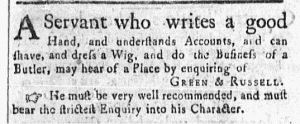
“A Servant who writes a good Hand … may hear of a Place.”

Having a servant “who writes a good Hand” would be most valuable to his master, along with the other duties that he would perform: shaving, dressing a wig, helping with the accounts, and “the Business of a Butler.” Having a servant doing these tasks would have freed up his master to pursue other activities and would have provided standing among his peers. The emphasis on writing implies that the person who placed the advertisement was keen to find a servant that would possibly assist in managing his household by doing his writing for him as well as keeping track of his accounts.

This person that the advertiser was going to hire could not be just anyone; he needed to be well recommended. Recommendations in some cases had more weight than experience, especially in a busy port city like Boston with people coming and going.

In this case, it seems like the man looking for a servant did not want to deal directly with those responding to the advertisement but instead went though the newspaper printers, Green and Russell.

**********

ADDITIONAL COMMENTARY:  Carl Robert Keyes

When I decided to combine my own research with my teaching duties by inviting students in my Public History course to take on responsibilities as guest curators for the Adverts 250 Project I hoped that their relative unfamiliarity with eighteenth-century print and consumer culture would uncover elements of various advertisements that I take for granted.

I have appreciated, for instance, how some of the guest curators have interrogated the language used in the advertisements they selected, demonstrating how usage has changed over time. Similarly, for today’s featured advertisement Mary suggested in her first draft that Green and Russell were an employment agency of some sort, not realizing that “enquiring of GREEN & RUSSELL” was a variant of “Enquire of the Printers.” Other guest curators have reached similar conclusions when working with advertisements that directed readers to printers when those men were identified by name rather than occupation. Given the modern process for matching applicants with jobs through agencies, this seems like a natural assumption.

In turn, it opens the door for productive conversations about the role of printers in eighteenth-century America. Their print shops were hubs of activity – commercial and political. Many printers also served as postmasters in addition to publishing their newspapers, which meant that people visited their offices to send and pick up letters. Information, including employment possibilities, circulated through printing offices. Local residents, unlike twenty-first-century readers, would have recognized the printers by name and would have been familiar with the practice of instructing interested parties to gain more information at the local print shop.

In this regard, today’s advertisement is a nice companion to the two advertisements concerning wet nurses featured yesterday. In each of them printers played a role as intermediaries after the advertisements were published.

“May hear of a Place by enquiring of GREEN & RUSSELL.”

“Enquire of the Printers.”

“Inquire of W. Weyman.”