December 26

What was advertised in a colonial American newspaper 250 years ago today?

Massachusetts Spy (December 26, 1771).

“AMES’s ALMANACK, for 1772.  Sold by EDES & GILL, and T. & J. FLEET.”

Ebenezer Russell correctly anticipated that some of his competitors would produce and sell a pirated edition of “AMES’s ALMANACK, for 1772.”  He warned consumers, running advertisements that proclaimed that he published “THE original Copy” of the popular almanac yet suspected that other printers planned to market their own editions.  On December 26, 1771, the Massachusetts Spy carried advertisements for both.  In a fairly lengthy advertisement, Russell described the contents to entice consumers.  He also listed nearly twenty booksellers in Boston, Salem, Newburyport, and Portsmouth who sold his edition.  A shorter advertisement simply announced, “This day published, AMES’s ALMANACK, for 1772.  Sold by EDES & GILL, and T. & J. FLEET.”

Isaiah Thomas, the printer of the Massachusetts Spy, appeared on Russell’s list of booksellers.  That did not prevent him from running an advertisement for the pirated edition.  He also inserted his own advertisement advising readers of “AMES’s, Low’s, Bicker[st]aff’s, Massachusetts and Sheet ALMANACKS, to be sold by I. THOMAS, near the Mill Bridge.”  Conveniently, that notice was the only advertisement on the second page, making it the first that readers encountered as they perused the December 26 edition.  Almanacs had the potential to generate significant revenues for printers in the early American marketplace.

It was not the first time that Benjamin Edes and John Gill, printers of the Boston-Gazette, and Thomas Fleet and John Fleet, printers of the Boston Evening-Post, pirated Ame’s Almanack.  In 1768, a cabal of printers issued a pirated copy of William Alpine’s legitimate edition of Nathaniel Ames’s Astronomical Diary, or, Almanack for the Year of Our Lord Christ 1769.  The conspirators included Edes and Gill and the Fleets as well as Ricard Draper, the printer of the Massachusetts Gazette and Boston Weekly News-Letter.  This time around, however, Draper did not join his fellow printers in that endeavor.  Instead, Russell included him among the authorized sellers of “THE original Copy” in his advertisements.

As the new year approached, consumers still in the market for purchasing almanacs had a variety of choices.  In addition to choosing from among a variety of popular and familiar titles, those who followed the dispute between Russell and his competitors that unfolded in newspaper advertisements faced decisions about whether they wished to acquire an “original Copy” or reward the printers and booksellers who sold a pirated edition.

December 23

What was advertised in a colonial American newspaper 250 years ago today?

Massachusetts Gazette and Boston Post-Boy (December 23, 1771).

Give him the Preference of buying his Ames’s Genuine Almanack before any PIRATED Edition.”

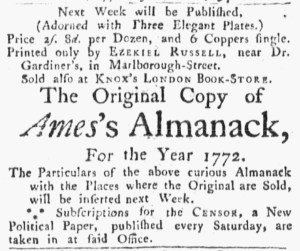
Ezekiel Russell claimed that he published “The Original Copy of Ames’s Almanack, For the Year 1772.”  On December 9, 1771, he announced that he would print the almanac the following week, as well as disseminate new advertisements that included the “Particulars of the above curious Almanack with the Places where the Original are sold.”  True to his word, he placed much more extensive advertisements in the Massachusetts Gazette and Boston Post-Boy on December 16 and 23.  Those notices included an overview of the contents, such as “Eclipses” and “Courts in the Massachusetts-Bay, New-Hampshire, Connecticut, and Rhode-Island,” as well as a list of nearly twenty printers and booksellers who carried copies, many of them in Boston, but others in Salem, Newburyport, and Portsmouth.

Russell also took an opportunity to air a grievance with other printers in hopes of convincing consumers to purchase his edition of Ames’s Almanack.  He asserted that he “purchased of Doctor AMES, at a great Expence, the true Original Copy of his Almanack.”  That being the case, he hoped that “the Publick, with their usual Impartiality,” would buy “hisAmes’s Genuine Almanack before any PIRATED Edition.”  Furthermore, he accused “some of his Elder Typographical Brethren,” other printers in Boston, of attempting to “prejudice the Interest of a YOUNGER BROTHER.”  In other words, Russell declared that his competitors, men with much greater experience as printers, unfairly attempted to sabotage his endeavor and ruin his business.  It was not the first time that residents of Boston witnessed disputes over which printers published the “Original” or the most accurate version of Ames’s Almanack.  In a crowded marketplace, several printers aimed to profit from the popular title.  Russell sought to convince consumers that the character of the printer mattered as much as the contents of the almanac.  At the very least, he wanted those who purchased copies of Ames’s Almanack to make informed decisions about what kind of behavior they were willing to tolerate from printers who produced and sold the almanac.

December 9

What was advertised in a colonial American newspaper 250 years ago today?

Massachusetts Gazette and Boston Post-Boy (December 9, 1771).

“Subscriptions for the CENSOR, a New Political Paper.”

In a crowded market for selling almanacs, Ezekiel Russell advertised “The Original Copy of Ames’s Almanack, For the Year 1772” in the December 9, 1771, edition of the Massachusetts Gazette and Boston Post-Boy.  Russell claimed that only he printed that version of the popular almanac and announced that he would publish it, along with “Three Elegant Plates,” at his printing office on Marlborough Street the following week.  In addition, he advised prospective customers to look for an updated advertisement that included the “Particulars of the above curious Almanack with the Places where the Original are Sold.”

Although Russell opted not to include that information in his current advertisement, he did devote space to promoting another publication that he recently launched on November 23.  “Subscriptions for the CENSOR, a New Political Paper, published every Saturday,” he declared, “are taken in at said Office.”  According to newspaper historian and bibliographer Clarence Brigham, The Censor was more of a magazine than a newspaper, though the advertising supplements that sometimes accompanied it resembled those distributed with newspapers.

Isaiah Thomas, printer of the Massachusetts Spy at the time Russell published The Censor, declared that “those who were in the interest of the British government” supported The Censor “during the short period of its existence” in his History of Printing in America (1810).[1]  Thomas credited his own newspaper with inspiring The Censor.  “A dissertation in the Massachusetts Spy, under the signature of Mucius Scaevola,” he explained, “probably occasioned the attempt to establish this paper.”  The piece “attached Governor Hutchinson with a boldness and severity before unknown in the political disputes of this country.”  In turn, it “excited great warmth among those who supported the measures of the British administration, and they immediately commenced the publication of the Censor; in which the governor and the British administration were defended.”

Thomas, one of the most ardent patriots among Boston’s printers, had little use for The Censor.  Neither did most other residents of the city.  According to Thomas, “the circulation of the paper was confined to a few of their own party.  As the Censor languished, its printer made an effort to convert it into a newspaper; and, with this view, some of its last numbers were accompanied with a separate half sheet, containing a few articles of news and some advertisements.”  In the end, Russell discontinued The Censor “before the revolution of a year from its first publication.”[2]  The last known issue bears the date May 2, 1772.  Despite Russell’s attempts to attract subscribers, he did not manage to establish a market for a publication, whether magazine or newspaper or amalgamation of the two, that defended the governor and British policies.

**********

[1] Isaiah Thomas, The History of Printing in America: With a Biography of Printers and an Account of Newspapers, ed. Marcus McCorison (1810; New York: Weathervane Books, 1970), 153.

[2] Thomas, History of Printing, 284-285.

November 25

What was advertised in a colonial American newspaper 250 years ago today?

Massachusetts Gazette and Boston Post-Boy (November 25, 1771).

“Last Saturday was published … The CENSOR, No. 1.”

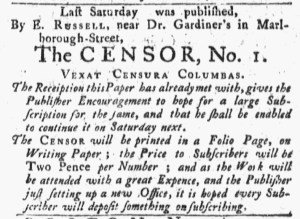
Ezekiel Russell distributed the first issue of The Censor on November 23, 1771.  Two days later, he promoted his new publication in an advertisement in the Massachusetts Gazette and Boston Post-Boy.  Russell announced that he published the inaugural issue “Last Saturday” and invited prospective subscribers to reserve their copies.  “The Receiption this Paper has already met with,” he confided, “gives the Publisher Encouragement to hope for a large Subscription for the same, and that he shall be enabled to continue it on Saturday next.”

Russell apparently had some doubts about whether The Censor would achieve a second issue.  It did, but publication lasted less than six months.  Russell distributed the last known issue on May 2, 1772.  In his monumental History and Bibliography of American Newspapers, 1690-1820, Clarence Brigham describes The Censor as “a political magazine rather than a newspaper, somewhat in the style of the ‘Tatler’ or ‘Spectator.’”  Frank Luther Mott indicates that it was one of only three American magazines founded between 1760 and 1774, but otherwise gives The Censor little attention beyond including it in a chronological list of magazines in an appendix.  “The political state of the Colonies was unfavorable to literature,” Mott intones.[1]  Brigham present a more sanguine view of The Censor, especially “its occasional ‘Postscripts’ [which] bore every appearance of being newspapers and contained certain local news and a large number of advertisements.”[2]

If such a Postscript accompanied the first issue, it has not survived.  Unlike printers who launched newspapers during the period, including Richard Draper and the Pennsylvania Packet in the fall of 1771, Russell did not seek advertisers in his notice.  Instead, he focused on attracting subscribers, expressing his desire that “every Subscriber will deposit something on subscribing” in order to defray the “great Expence” associated with the publication and “setting up a new Office.”  As Brigham notes, advertising supplements accompanied certain subsequent issues.  In the coming months, the Adverts 250 Project will examine some of those Postscripts to the Censor.

**********

[1] Frank Luther Mott, A History of American Magazines, 1741-1850 (Cambridge, Massachusetts: Harvard University Press, 1939), 26, 788.

[2] Clarence S. Brigham, History and Bibliography of American Newspapers, 1690-1820 (Worcester: Massachusetts: American Antiquarian Society, 1947), 275.

August 19

What was advertised in a colonial American newspaper 250 years ago today?

Boston Evening-Post (August 19, 1771).

“Will make as good Allowance to Travelling Traders, &c. as if purchased of the Printer.”

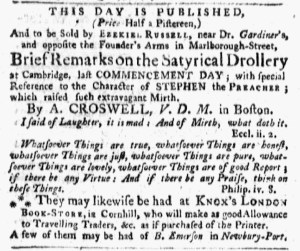
A portion of the commencement exercises at Harvard in 1771 generated such enthusiasm in some quarters and outrage in others that printer Ezekiel Russell decided to publish Andrew Croswell’s “Brief Remarks on the Satyrical Drollery at Cambridge, last COMMENCEMENT DAY; with special Reference to the Character of STEPHEN the PREACHER; which raised such extravagant Mirth.”  (Read the British Museum’s copy.)  For those who attended the event, this publication served as a counterbalance to the “vain laughter, and clapping” that “gave great offence” (at least to Croswell).  For others who had not heard the “Satyrical Drollery” and witnessed “such extravagant Mirth,” the pamphlet gave them an opportunity to learn more about what had transpired, though through the lecturing tone of a critic who had not appreciated the behavior he saw exhibited at the commencement.  For Russell, this represented an opportunity to generate revenues and increase foot traffic in his shop.

Yet Russell’s shop on Marlborough Street in Boston was not the only location where consumers could acquire copies of the pamphlet.  An advertisement in the August 19, 1771, edition of the Boston Evening-Post advised that they “may likewise be had at KNOX’S LONDON BOOK-STORE, in Cornhill.”  Henry Knox, the bookseller who later became a senior general in the Continental Army during the American Revolution and the new nation’s first Secretary of War, had recently placed his own advertisements in the city’s newspapers.  In addition, residents of Newburyport and the surrounding towns could instead visit B. Emerson, who stocked a limited number of copies.  The following day, and advertisement in the Essex Gazette advised readers in Salem that Samuel Hall also sold the pamphlet.

Russell also envisioned other means of distribution.  In his advertisement, he indicated that Knox “will make as good Allowance to Travelling Traders, &c. as if purchased of the Printer.”  In other words, itinerant peddlers as well as booksellers and shopkeepers received discounts for buying in volume for the purposes of retailing to their own customers.  Knox offered them the same prices they would have otherwise received by purchasing directly from Russell.  The printer and his associates worked together to incite demand by disseminating copies of the pamphlet and offering deals to retailers.  The newspaper advertisement alerted prospective customers to three locations that carried the “Brief Remarks,” but also encouraged them to ask for it from “Travelling Traders” and others who might have also added it to their inventories.

October 11

What was advertised in a colonial American newspaper 250 years ago today?

Massachusetts Spy (October 11, 1770).

“AN Elegiac POEM, on the Death of … GEORGE WHITEFIELD … By PHILLIS.”

On October 11, 1770, coverage of George Whitefield’s death on September 30 continued to radiate out from Boston with news appearing in the New-York Journal, the Pennsylvania Gazette, and the Pennsylvania Journal.  The commodification of Whitefield’s death intensified as well.  Both newspapers printed in Boston on that day, the Massachusetts Gazette and Boston Weekly Mercury and the Massachusetts Spy, carried advertisements for “AN Elegiac POEM, on the Death of that celebrated Divine, and eminent servant of Jesus Christ, the reverend and learned GEORGE WHITEFIELD.”

Phillis Wheatley, now recognized as one of the most significant poets in eighteenth-century America, composed the poem, though in the advertisements she was known as “PHILLIS, A servant girl of seventeen years of age, belonging to Mr. J. Wheatley, of Boston.”  Referring to the young woman as a “servant girl” obscured the fact that she was enslaved by the Wheatley family.  The advertisements further explained that she “has been but nine years in this country from Africa.”  This event brought together Whitefield, the influential minister following his death, and Wheatley, the young poet near the beginning of her literary career.  Although both are well known to historians and others today, much of Wheatley’s acclaim came after her death at the age of thirty-one in 1784.  Arguably, Wheatley is more famous than Whitefield in twenty-first-century America, reversing their relative status compared to the eighteenth century.

In addition to the novelty of an African poet, Ezekiel Russell and John Boyles also promoted the image that adorned the broadside, proclaiming that it was “Embellished with a plate, representing the posture in which the Rev. Mr. Whitefield lay before and after his interment at Newbury-Port.”  Examine the Library Company of Philadelphia’s copy of Wheatley’s “Elegiac Poem,” including an introduction that doubled as the copy for the advertisement in the Massachusetts Spy, the woodcut depicting Whitefield, and black borders that symbolized mourning in the eighteenth century.

Massachusetts Gazette and Boston Weekly News-Letter (October 11, 1770).

Wheatley’s poem sold by Russell and Boyles was not the only one advertised on October 11.  In a notice in the Massachusetts Gazette and Boston Weekly Mercury, Richard Draper announced that he published “An Elegy to the Memory of that pious and eminent Servant of JESUS CHRIST The Rev. Mr. GEORGE WHITEFIELD.”  Exercising he prerogative as printer of that newspaper, Draper placed his advertisement before the one for the broadside with Wheatley’s poem and the woodcut of Whitefield.

Both poems celebrated Whitefield’s life and ministry.  Both gave colonial consumers an opportunity to mourn for Whitefield and feel better connected to his ministry, even if they had never had the chance to hear him preach.  Especially for those who had not witnessed Whitefield deliver a sermon, purchasing one of these broadsides allowed them to have an experience closely associated with Whitefield’s life by commemorating his death.  The printers who produced, marketed, and sold these broadsides simultaneously honored Whitefield’s memory and commodified his death, merging mourning and making money.