February 9

What was advertised in a colonial American newspaper 250 years ago today?
Rivington’s New-York Gazetteer (February 9, 1774).

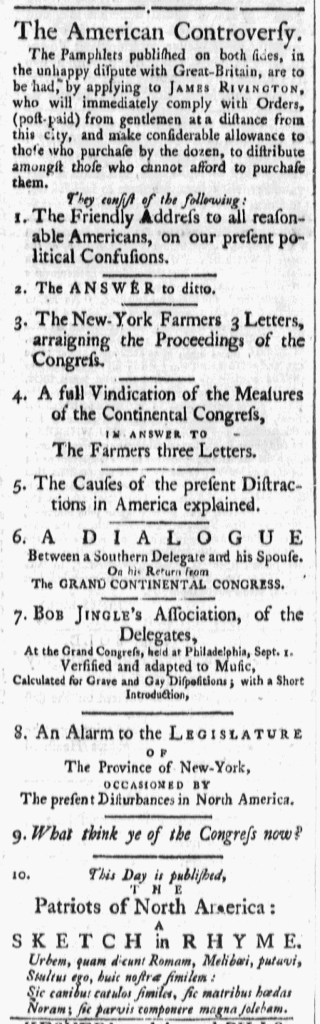
“Pamphlets published on both sides, in the unhappy dispute with Great-Britain.”

As the imperial crisis intensified in the winter of 1775, James Rivington continued to print a newspaper “at his OPEN and UNINFLUENCED PRESS” in New York.  He also ran a bookstore, peddling “Pamphlets published on both sides, in the unhappy dispute with Great-Britain.”  Both Patriot and Tory printers professed to operate free presses that delivered news and editorials from various perspectives, yet the public associated most newspapers with supporting one side over the other and even actively advocating for their cause.  Tory printers invoked freedom of the press as a means of justifying their participation in public discourse rather than allowing Patriot printers to have the only say.  When it came to advertising books and pamphlets about current events, Tory printers, especially Rivington, took the more balanced approach.

For Rivington, it was a matter of generating revenue as much as political principle.  He saw money to be made from printing and selling pamphlets about “The American Controversy.”  That was the headline he used for an advertisement that listed ten pamphlets in the February 9, 1775, edition of Rivington’s New-York Gazetteer.  He previously ran a similar advertisement for “POLITICAL PAMPHLETSon the Whig and Tory Side of the Question” and another about “The American Contest” that included some of the same pamphlets as well as others.  In his “American Controversy” advertisement, Rivington once again offered some familiar titles and new ones.  He made clear that the first two represented different positions, “The Friendly Address to all reasonable Americans, on our present political Confusions” and “The ANSWER to ditto,” though he did not indicate which took which side.

The printer positioned this venture as a service that kept the public better informed of the arguments “on both sides.”  He sought to disseminate his pamphlets beyond New York to “gentlemen at a distance from this city,” promising to “immediately comply with Orders.”  In turn, customers could do their part in making the pamphlets available far and wide since Rivington made “considerable allowance” or deep discounts “to those who purchase by the dozen, to distribute amongst those who cannot afford to purchase them.”  Though he portrayed himself as a fair dealer who marketed pamphlets “on both sides,” he did not express any expectation that customers would purchase or distribute both Patriot and Tory pamphlets.  Rivington presented readers with the freedom to consume (and further disseminate) the ideas they wished, seemingly hoping the public would allow him the same freedom in printing the content that he wished.  Whether he was sincere in such idealism or sought to justify printing editorials and pamphlets that many found objectionable, Rivington increasingly ran afoul of Patriots who did not share his outlook on freedom of the press when it came to disseminating news and opinion that favored the Tory side in “the unhappy dispute with Great-Britain.”
February 4

What was advertised in a colonial American newspaper 250 years ago today?

Pennsylvania Ledger (February 4, 1775).

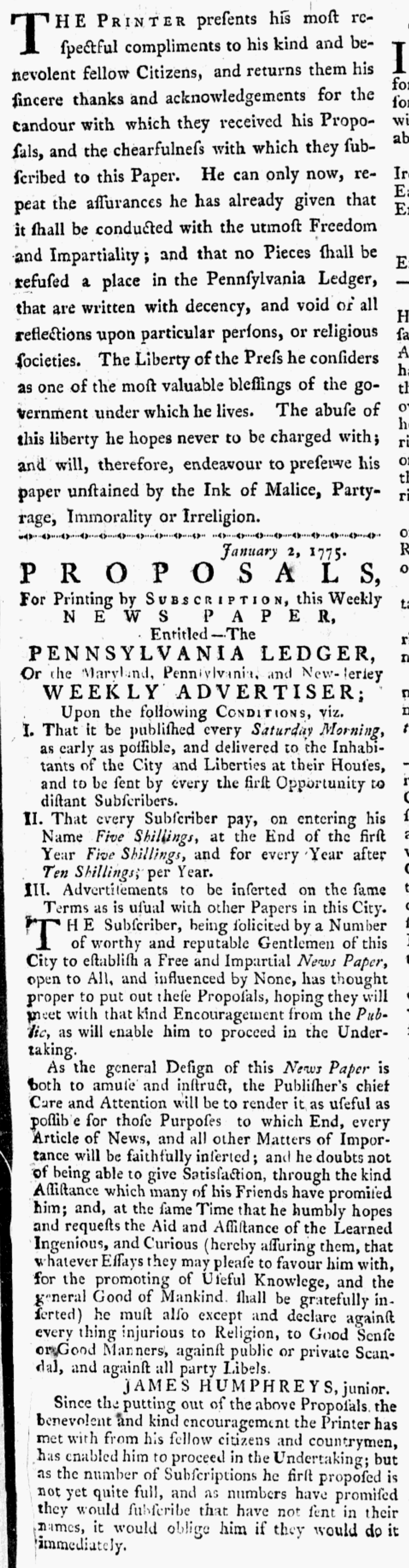
“Numbers have promised they would subscribe that have not sent in their names.”

The second issue of the Pennsylvania Ledger began with the same notice from the printer, James Humphreys, Jr., that appeared as the first item in the first column on the first page of the inaugural issue a week earlier.  He apparently considered it worth running again, especially since the new publication had not yet achieved as wide a circulation as he hoped.  Humphreys’s message to “his kind and benevolent fellow Citizens” thus bore repeating to reach as many readers (and prospective subscribers) as possible as copies of Philadelphia’s newest newspaper found their way into coffeehouses and taverns or passed from hand to hand.

In that address, the printer “repeat[ed] the assurances he has already given” in proposals for the newspaper “that it shall be conducted with the utmost Freedom and Impartiality; and that no Pieces shall be refused a place in the Pennsylvania Ledger, that are written with decency, and void of all reflections upon particular persons, or religious societies.”  Printers often asserted that their publications would represent multiple perspectives when they addressed the public in the decade before the Revolutionary War, though many did not follow through on that promise.  Some privileged their own political views while others responded to what they perceived to be the overwhelming sense (or the most vocal voices) in the communities where they operated their printing presses.  In his subscription proposals, Humphreys promoted a “FREE and IMPARTIAL” newspaper.  In his monumental History of Printing in America (1810), Isaiah Thomas acknowledged that Humphreys purported to publish an impartial newspaper, yet “[i]t was supposed that Humphrey’s paper would be in the British interest” and the Pennsylvania Evening Post, founded by Benjamin Towne at the same time, “took the opposite ground.”[1]  In his address, Humphreys proclaimed that he considered “Liberty of the Press … one of the most valuable blessings of the government under which he lives,” though his ideas about what constituted “Liberty of the Press” may have differed from that of other colonizers.  As the imperial crisis intensified, more and more newspapers became associated with either Patriots or Loyalists.

Still, Humphreys wanted to make a go of it with the Pennsylvania Ledger.  In that second issue, he inserted the proposals immediately below his address to the public, filling the remainder of the column.  He explained in even more detail that “the general Design of this News Paper is both to amuse and instruct” so “every Article of News, and all other Matters of Importance will be faithfully inserted.”  In billing his newspaper as “Free and Impartial,” Humphreys may have intended to make a point that readers should expect to encounter pieces representing a variety of views, but, as Thomas suggested, many were suspicious of Humphreys’s intentions when it came to disseminating content from the Tory perspective.  That could have contributed to a note that the printer added to the proposals.  He claimed that he received enough “encouragement … to proceed in the Undertaking,” but “numbers have promised they would subscribe that have not sent in their names.”  As they learned more about the positions the Pennsylvania Ledger would likely take, some prospective subscribers apparently decided they did not wish to support the newspaper.

**********

[1] Isaiah Thomas, The History of Printing in America: With a Biography of Printers and an Account of Newspapers (1810; New York: Weathervane Books, 1970), 399.

January 1

What was advertised in a colonial American newspaper 250 years ago this week?

Rivington’s New-York Gazetteer (December 29, 1774).

“The American Contest.”

In the final issue of Rivington’s New-York Gazetteer for 1774, James Rivington continued advertising pamphlets “written on the Whig and Tory Side of the Question.”  He inserted an advertisement similar to the “POLITICAL PUBLICATIONS” catalog that he ran on December 15.  Both listed nine tracts that Rivington sold to readers or to “Gentlemen living at a Distance … to distribute amongst their Friends.”  Some of the titles appeared a second time.  Rivington eliminated some, added others, and reorganized the order accordingly.

For instance, a pamphlet documenting the Continental Association, a nonimportation agreement adopted by the First Continental Congress had been first in the previous iteration, but Rivington listed it fourth in the new one.  A new entry led the catalog: “The Congress Canvassed, OR, An Examination into the Conduct of the Delegates, At the Grand Continental Congress, Addressed to the Merchants of New-York, By the FARMER, A.W.”  Rivington had previously advertised that he would soon publish that piece, having included “Free Thoughts on the Proceedings of the Continental Congress” among the “POLITICAL PUBLICATIONS” in his earlier catalog.  That item appeared once again, paired this time with “A full Vindication of the Measures of the Continental Congress IN ANSWER TO Free Thoughts on the Proceedings of the said Congress.”  Again, Rivington had previously advertised “A full Vindication” separately, but collated together “Free Thoughts” and the pamphlet that responded to it in the new catalog.  The enterprising printer aimed to help prospective customers craft a narrative when selecting among his offerings.

Rivington gave this catalog a new headline.  Instead of “POLITICAL PUBLICATIONS,” he called it “The American Contest.”  That dramatic flourish did not exaggerate the tensions in New York and other colonies as the imperial crisis intensified.  Within months, the Revolutionary War would commence with battles at Lexington and Concord in Massachusetts.  As Rivington reported on current events and political debates, he often took a more balance approach than many of his fellow printers who made their support for the Patriot cause very plain.  The masthead for his newspaper proclaimed that it was “PRINTED at his OPEN and UNINFLUENCED PRESS.”  Rivington enacted the same policy for the pamphlets he printed, marketed, and sold.  No other American printer so vigorously represented both perspectives in “The American Contest” in the advertisements in their newspapers.

**********

January 1, 1775, fell on a Sunday.  Colonial printers distributed newspapers every day except Sunday.  The Adverts 250 Project will commence examining advertisements from 1775 tomorrow.

December 18

What was advertised in a colonial American newspaper 250 years ago this week?

Rivington’s New-York Gazetteer (December 15, 1774).

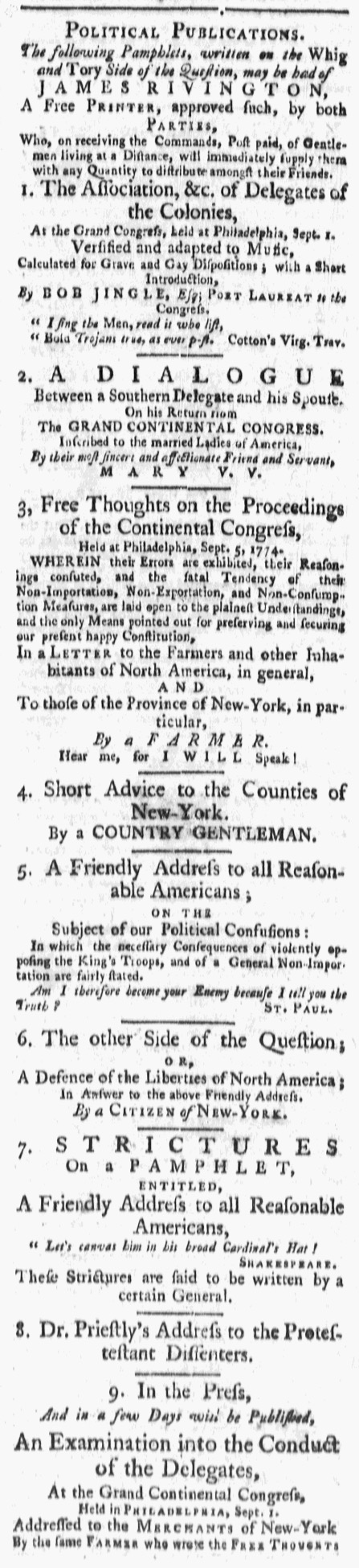
“POLITICAL PUBLICATIONS … written on the Whig and Tory Side of the Question.”

In chronicling the momentous events of 1774, the Adverts 250 Project has frequently featured advertisements for books, pamphlets, and other items related to the imperial crisis as it intensified following the Boston Tea Party and the Coercive Acts passed by Parliament in retaliation.  Most printers increasingly privileged the Patriot’s perspective, both in terms of the news and editorials they selected for their newspapers and the works that they published, advertised, and sold.  Yet they did not uniformly do so.

James Rivington, a Loyalist, proclaimed in the masthead of Rivington’s New-York Gazetteer that his newspaper was “PRINTED at his OPEN and UNINFLUENCED PRESS.”  In Revolutionary Networks: The Business and Politics of Printing the News, 1763-1789, Joseph M. Adelman notes that “Rivington’s bookselling career was about making money rather than promoting a political ideology, so much so that he wanted to capitalize on relatively popular anti-imperial political tracts.”[1]  One of his advertisements in the December 15, 1774, edition of his newspaper listed nine “POLITICAL PUBLICATIONS” that he sold.  He explained that he stocked pamphlets “written on the Whig and Tory Side of the Question.”  He demonstrated that was the case in the descriptions of some of those tracts.  For instance, he carried “A Friendly Address to all Reasonable Americans; ON THE Subject of our Political Confusions: In which the necessary Consequences of violently opposing the King’s Troops, and of a General Non-Importation are fairly stated” and “The other Side of the Question; OR, A Defence of the Liberties of North America; In Answer to the above Friendly Address.”  Debates over current events extended beyond the town common and newspaper editorials into pamphlet wars during the imperial crisis.

Those nine “POLITICAL PUBLICATIONS” included “Free Thoughts on the Proceedings of the Continental Congress,” in which “a FARMER” commented on the widely published and advertised account of the meetings held in Philadelphia in September and October.  In that pamphlet, “their Errors are exhibited, their Reasonings confuted, and the fatal tendency of their Non-Importation, Non-Exportation, and Non-Consumption Measures, are laid open to the plainest Understandings, and the only Means pointed out for preserving and securing our present happy Constitution.”  On the first page of the same issue, Rivington advertised “A full Vindication of the Measures of the Continental Congress, IN ANSWER TO Free Thoughts on the Proceedings of the said Congress.”  The advertisement mocked “a FARMER” and his pamphlet, stating that in this response “his Sophistry is exposed, his Cavils confuted, his Artifices detected, and his Wit ridiculed.”  Rivington added his own note: “The Printer, with humble Deference, presumes that this answer will meet with a gracious reception at the hands of every reader who has expressed disapprobation to the Freethoughts of Farmer.”  For those who appreciated that pamphlet, however, Rivington announced that he would soon publish “THE CONGRESS CANVASSED; OR, An Examination into the Conduct of the Delegates … By the FARMER … Who wrote Free Thoughts on their Proceedings.”  Rivington believed that political controversy meant business as he published, advertised, and sold works “on the Whig and Tory Side of the Question.”  Seeking to maximize revenues, he suggested that “Gentlemen living at a Distance” submit orders for “any Quantity to distribute amongst their Friends.”

Rivington simultaneously asserted that he was “A Free PRINTER, approved such, by both PARTIES,” yet many observers did not care for his “OPEN and UNINFLUENCED” approach that undermined the Patriots’ perspective.  Adelman explains that “Patriots eventually targeted Rivington and intended to destroy his business, by force if necessary.”  In December 1774, as Rivington published these advertisements, an anonymous group of Patriots sent a letter to Stephen Ward and Stephen Hopkins in Newport.  They “urged Ward and Hopkin to obtain a general agreement in Rhode Island not to purchase his New-York Gazetteer or deal with anyone advertising in it.”[2]  Less than a year later, a contingent from the Sons of Liberty marched from New Haven to New York to capture Loyalist leaders and silence Rivington.  They seized his types, reportedly melting them down for shot, and destroyed his press.  Seeking to represent both sides (and generate revenues while doing so) came with consequences for the printer.

**********

[1] Joseph M. Adelman, Revolutionary Networks: The Business and Politics of Printing the News, 1763-1789 (Baltimore: Johns Hopkins University Press, 2019), 127.

[2] Adelman, Revolutionary Networks, 129.