November 5

What was advertised in a revolutionary American newspaper 250 years ago this week?

Pennsylvania Evening Post (November 4, 1775).

“A NIGHT SCHOOL.”

“FRENCH ACADEMY.”

Two advertisements in the November 4, 1775, edition of the Pennsylvania Evening Post and its supplement offered opportunities for learning and self-improvement.  In the first notice, Matthew Maguire announced that he had opened a “NIGHT SCHOOL” for “youth of both sexes.”  The curriculum included “the various branches of READING, WRITING and ARITHMETIC,” subjects that both boys and girls typically learned.  Maguire also indicated that he taught “ACCOMPTS [or accounts] in all their different forms, after the latest and most approved methods,” though he did not mention whether he reserved that subject for male students.  Learning how to keep daybooks and ledgers may have been useful for some of the girls and young women who attended Maguire’s school, especially those that attended in the evening because they assisted in running the family business during the day.  Maguire also provided lessons during the day “as usual,” but he specified in a nota bene that he continued admitting “Young ladies only.”  In addition to giving female students a homosocial setting with fewer chances of disruptions, he may he reasoned that most boys and young men who would attend the school he kept in his house in Carter’s Alley did indeed have apprenticeships and other responsibilities during the day.

Supplement to the Pennsylvania Evening Post (November 4, 1775).

In the other advertisement, Francis Daymon, “MASTER of the French and Latin Languages” and “LIBRARIAN of the Philadelphia Public Library” (or the Library Company of Philadelphia), advised prospective pupils that he “HAS opened his FRENCH ACADEMY for the winter season.”  Classes began “punctually at seven o’clock every evening (Saturday excepted),” though it went without saying that he did not give lessons on Sundays.  Daymon delivered lessons “in the Library Room in Carpenters Hall,” the Library Company having moved to the second floor of that building from the Pennsylvania State House when it was completed in 1773.  He presumably admitted students of both sexes since he did not indicate otherwise in his advertisement.  He did note that “Ladies and Gentlemen may be instructed at their places of abode as usual,” an arrangement that allowed his pupils or their parents to determine who would be present.  Unlike Maguire, Daymon offered private lessons, likely setting rates for his students for the convenience of learning in their homes accordingly.

While some of the students who learned reading, writing, arithmetic, and accounts from Maguire could have also sought out French lessons from Daymon, the two schoolmasters cultivated different clienteles.  Maguire emphasized basic skills for everyday use by a wide range of colonizers, while Daymon’s French lessons appealed to genteel residents of Philadelphia and those aspiring to gentility.  With the Continental Association, a nonimportation and nonconsumption agreement, in effect, discourses about fashion had shifted.  Learning French gave some colonizers an alternate way to assert their status.

June 20

What was advertised in a colonial American newspaper 250 years ago today?

Massachusetts Gazette and Boston Post-Boy (June 20, 1774).

“The polite and useful ART of FENCING.”

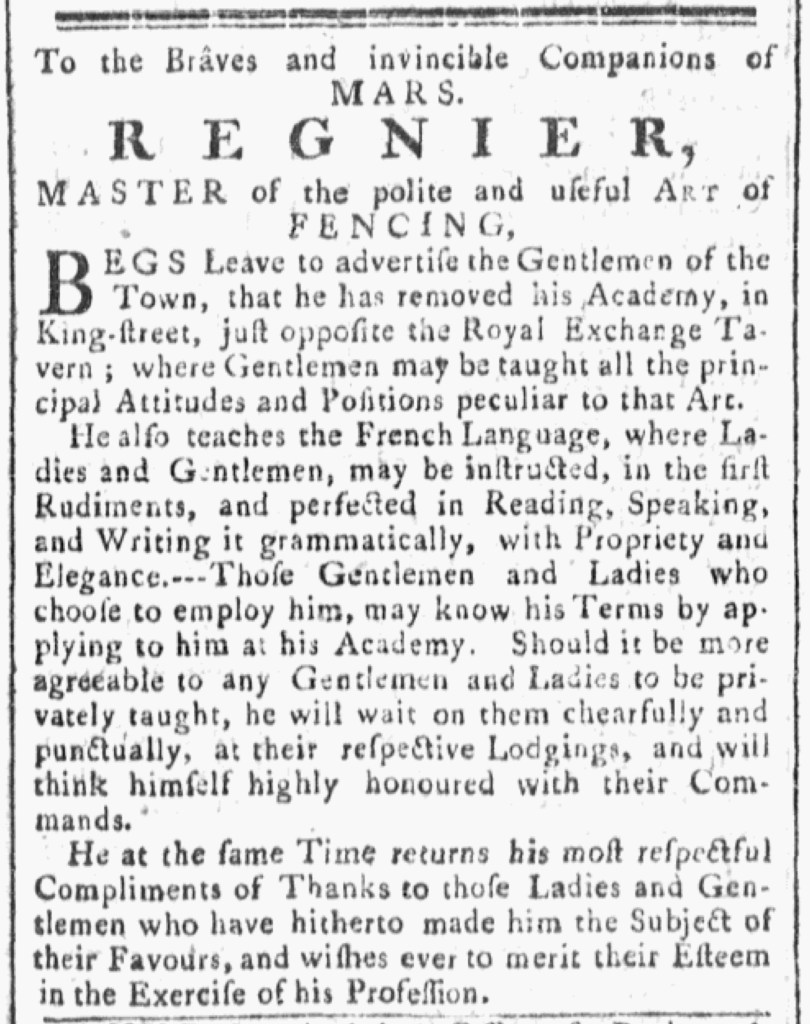
Two fencing masters dueled for pupils in the pages of the Massachusetts Gazette and Boston Post-Boy in June 1774. Each of them addressed prospective students with a flourish.  Donald McAlpine called on “all Lovers of the noble Science of DEFENCE,” while Monsieur Regnier, “MASTER of the polite and useful ART of FENCING,” was even more elaborate in addressing “the Braves and invincible Companions of MARS.”  Those headlines set their advertisements apart from others that read “TO BE SOLD” or “SPRING GOODS” or “THOMAS YOUNG.”

McAlpine specialized in teaching “the Art commonly called the BACKSWORD,” a “Science” that he would impart to the “entire Satisfaction” of “GENTLEMEN who choose to be instructed” by him.  He offered lessons on King Street from the early morning, commencing at sunrise, through the early evening, concluding with sunset, with a few hours set aside for meals and conducting other business.  He also visited gentlemen at their lodgings to give private lessons.  McAlpine indicated that he previously instructed “Gentlemen who have encouraged him” in his endeavor, while suggesting that he might not remain in Boston if other pupils did not engage his services.  He claimed that he “is strongly urged to go to another place” to teach the gentlemen there, yet it “would be most agreeable to him” to remain in Boston.  That would only happen, however, if he “Meets with such further Encouragement and Approbation” to convince him to stay.  If any gentlemen who considered themselves “Lovers of the noble Science of DEFENCE” had hesitated in seeking out McAlpine’s services, they needed to remedy that soon or risk him moving to another city.

Massachusetts Gazette and Boston Post-Boy (June 20, 1774).

That appeal might have been more effective if Regnier had not simultaneously advertised that he taught fencing at “his Academy, in King-street, just opposite the Royal Exchange Tavern.”  He bestowed on his pupils “all the principal Attitudes and Positions peculiar to that Art.”  He made clear that learning to fence was not solely about using a sword but also entailed attaining graceful comportment that distinguished pupils as they pursued their everyday activities beyond his school.  To that end, he also taught French to both ladies and gentlemen, asserting that his pupils learned to read, speak, and write “with Propriety and Elegance.”  Regnier’s students became more genteel thanks to his lessons.  In addition, they could feel more confident in putting these markers of sophistication on display thanks to the careful instruction they received.  Like McAlpine, Regnier extended “his most respectful Compliments of Thanks” to those “who have hitherto made him the Subject of their Favours.”  Such remarks did more than reveal his success in cultivating a clientele in Boston; they also suggested to anyone who had not previously taken lessons or thought that they might benefit from brushing up that they needed to engage Regnier’s services to keep up with friends and acquaintances who already had the good sense to hire him.

As they competed with each other for pupils, McAlpine and Regnier also subtly encouraged the ladies and, especially, gentlemen they addressed to think of themselves in competition with each other.  Those “Lovers of the noble Science of DEFENCE” and those “invincible Companions of MARS” could enhance their social standing through displays of fencing, but they needed instruction from masters of the art to develop and to refine their skills.  More than mere lessons, McAlpine and Regnier marketed a means for achieving and demonstrating status.

April 15

What was advertised in a colonial American newspaper 250 years ago today?

New-Hampshire Gazette (April 15, 1774).

“Taught in such a Manner as to add Grace and Beauty to the Deportment of either Sex.”

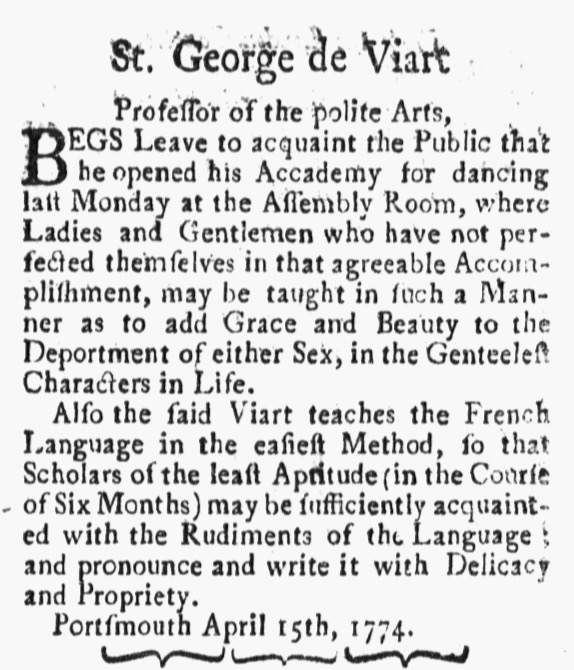
Monsieur Viart once again took to the pages of the New-Hampshire Gazette in the spring of 1774, announcing that he “opened his Accademy for dancing last Monday at the Assembly Room” in Portsmouth.  Viart had previously advertised in that newspaper in the summer of 1772 and as spring approached in 1773, but by the end of the summer he was running notices in the Pennsylvania Journal.  Perhaps he had experienced too much competition with Edward Hackett and decided that he might have better prospects in Philadelphia, the largest and most genteel city in British North America.  Whatever his motivation, Viart’s time in the Quaker City did not last long.  That city had plenty of dancing masters and French tutors, a factor that may have influenced Viart’s decision to return to a place where he had cultivated a reputation among prospective students.

His presence in Portsmouth suggests a market for his services even in smaller towns, not just the largest urban ports like Boston, Charleston, New York, and Philadelphia.  Viart described himself as a “Professor of the polite Arts,” signaling that his instruction aided students in maintaining or improving their status as they strove to display their gentility to others.  He provided dancing lessons to “Ladies and Gentlemen who have not perfected themselves in that agreeable Accomplishment,” promising that he taught “in such a Manner as to add Grace and Beauty to the Deportment of either Sex, in the Genteelest Characters in Life.”  In addition to dancing, Viart “teaches the French Language in the easiest Method.”  He reassured even the most anxious prospective students, those “Scholars of the least Aptitude,” that in just six months they “may be sufficiently acquainted with the Rudiments of the Language” that they would “pronounce and write it with Delicacy and Propriety.”  Viart’s advertisements in the New-Hampshire Gazette demonstrate that just as the consumer revolution reached far beyond major port cities and into smaller towns and even the countryside, so too did concerns with refinement of character and comportment.  As colonizers acquired more goods and associated meaning with them, they also recognized that dancing well and speaking French testified to their gentility and validated their choices to wear fine clothing and purchase fashionable housewares.  As a “Professor of the polite Arts,” Viart marketed skills that helped his students complete the picture of their “Genteelest Characters.”

March 3

What was advertised in a colonial American newspaper 250 years ago today?

FRENCH SCHOOL.”

Massachusetts Gazette and Boston Weekly News-Letter (March 3, 1774).

In late February 1774, Mr. Delile, a French tutor, returned to the pages of Boston’s newspapers to alert readers that he had returned to the area and “continues to teach French and Latin.”  In an advertisement in the February 24 edition of the Massachusetts Gazette and Boston Weekly News-Letter, he reminded residents that “for these two Years past [he] has taught the French language in Boston, Cambridge, Providence and Newport.”  He had previously taken to the public prints in two colonies to keep current and prospective pupils advised to his whereabouts, explaining to students in Massachusetts, some of them presumably enrolled at Harvard College, that the “Present Vacation at Cambridge” meant “he can be absent without an Injury to his Pupils.”  He pledged to return to the area to guide them in their studies.  His new advertisement underscored his previous affiliation with Harvard students and his desire to once again teach them and their peers.  He declared that he provided lessons “after the Manner of Academies, Universities and Colleges of the Learning World, amongst which Places he has spent his Time.”  Delile offered a proper curriculum, drawing on his own experience and familiarity with educational institutions of the era.

Massachusetts Gazette and Boston Weekly News-Letter (March 3, 1774).

A week after Delile’s notice appeared, Francis Vandale published his own advertisement for a “FRENCH SCHOOL” in the March 3 edition of the Massachusetts Gazette and Boston Weekly News-Letter.  Although they competed for some of the same clients, Vandale took a different approach than Delile.  Rather than targeting young men studying at Harvard, Vandale sought “Gentlemen or Ladies” as pupils.  Instead of promoting his method of instruction, he emphasized the genteel qualities of the French language and the social standing his students could achieve under his direction.  He conjured an image of how “the French Language when taught agreeable to its native Purity & Elegance, is acquired with that becoming Ease and Gracefulness, as renders it truly Ornamental.”  His pupils, through the “Ease and Gracefulness” that Vandale’s tutelage instilled in them, took on the qualities of the language itself.  He did not mention any prior affiliations with academies or colleges, instead “profess[ing] to be a compleat Master of [French] in all its original Beauty and Propriety, entirely free from any false Mixture or bad Pronunciation.”  For Vandale, speaking French was not an academic exercise but rather a means of artistic expression.

Residents of Boston, Cambridge, and nearby towns who wished to learn or improve their French encountered more than one option when they perused the pages of the Massachusetts Gazette and Boston Weekly News-Letter.  They could take into account both the reputations and methods of Delile and Vandale when deciding if they wished to hire the services of either French tutor.

October 17

What was advertised in a colonial American newspaper 250 years ago this week?

New-York Journal (October 14, 1773).

“He continues to teach … whatever is requisite to fit the young Students for Admission into any College or University.”

In the fall of 1773, J. Peter Tetard sought students for the boarding school he operated “near King’s Bridge,” about fifteen miles outside of New York.  In an advertisement in the October 14 edition of the New-York Journal, he expressed his appreciation for “the encouragement” he received since opening the school over the summer, suggesting both that the enterprise earned the approval of prominent colonizers and that some parents already enrolled their children in the school.  Yet he still had space for more students.

To entice parents to send their sons to his boarding school, Tetard made an appeal that continues to resonate today.  His curriculum encompassed “whatever is requisite to fit the young Students for Admission into any College or University.”  Tetard depicted matriculating at his academy as preparation that would lead to subsequent academic success.  To that end, he taught “the French Language in the most expeditious Manner, together with some of the most useful Sciences.”  Those included geography, ancient and modern history, logic, and “the learned Languages.”  His pupils acquired the ability to engage in “the skilful reading of the Classics.”  All of this set Tetard’s students on the path for further study at one of the colleges in the colonies or perhaps even a university in Europe, depending on their status and wealth.

Beyond the curriculum, Tetard emphasized his own role as instructor.  He described himself as “Late Minister of the Reformed French Church” in New York.  Most colonizers in New York remained deeply suspicious of both the French and Catholicism at the time, making it imperative that Tetard establish his commitment to Protestantism.  For parents unfamiliar with his reputation, he stated that his “Character and Capacity are well-known” as a result of residing “with Credit in the City of New-York for upwards of fifteen Years.”  Parents of prospective pupils who had concerns about Tetard’s faith or acumen as an instructor could make inquiries of friends and acquaintances who had lived in the city at the same time as the minister-turned-schoolmaster.  Tetard pledged that “Gentlemen who will entrust him with the Education of their Children, may depend on their Expectations being properly answered,” in terms of academic instruction, moral formation, and spiritual guidance.

Tetard also commented briefly on the building that housed his boarding school, noting that it “is remarkable for its healthy Situation, commanding one of the finest Prospects” in the colony.  In his advertisement, he introduced three elements that remain important in marketing education in the twenty-first century.  Tetard emphasized the quality of the faculty, the benefits associated with the facilities, and the preparation necessary to succeed in subsequent endeavors.

August 15

What was advertised in a colonial American newspaper 250 years ago this week?

Massachusetts Gazette and Boston Weekly News-Letter (August 12, 1773).

“On Account of the present Vacation at Cambridge … he can be absent without an Injury to his Pupils.”

Mr. Delile, “Professor of the French Language in Boston and Cambridge,” spent August, September, and October in Providence and Newport in 1773.  He used newspaper advertisements in each location to advise current pupils of his departure and plans to return or his arrival and plans to offer lessons for a limited time only.

On August 7, he advised readers of the Providence Gazette that “several Gentlemen of this Town and Newport” invited him to spend three months in Rhode Island “for the Purpose of teaching said Languages in those Places.”  Rather than establish a school or academy where he would teach multiple students simultaneously, Delile confined his efforts to private lessons.  He underscored that “Gentlemen or Ladies who please to employ him” needed to do so quickly because he “is under absolute Engagements to return to Boston by the last of October.”  On August 16, he inserted a similar advertisement in the Newport Mercury, having arrived in that town.  In a slight variation, he stated that he hoped that me met with “encouragement equal to that he had in Boston for 16 months past.”

Before he left Boston and Cambridge, Delile arranged for an advertisement in the Massachusetts Gazette and Boston Weekly News-Letter.  He relayed the same story, that he had been “invited by several Gentlemen at Providence and Newport, to teach the French Language in those Places” for three months.  He also explained that “on Account of the present Vacation at Cambridge,” referring to Harvard College, “and the Season of the Year,” he believed that he “can be absent without an Injury to his Pupils.”  The French tutor vowed to return, hoping that his students would be “in the best Dispositions to pursue their Studies” when he did.

Delile’s advertisement first appeared on August 5 and repeated a week later.  He did not insert it any of the other newspapers published in Boston at the time.  With notices running in the Massachusetts Gazette and Boston Weekly News-Letter, the Providence Gazette, and the Newport Mercury, he incurred significant expense, perhaps as much as he dared risk on a stay in Rhode Island that would last only three months.  Delile may have believed that a notice in just one newspaper in Boston was sufficient to alert some of his pupils and then the news would spread to others in the course of everyday conversations.  He likely also informed many or most of his pupils before he departed, placing the newspaper advertisement as a means of informing the general public and prompting prospective students to consider engaging his services when he returned in the fall.

August 7

What was advertised in a colonial American newspaper 250 years ago today?

Providence Gazette (August 7, 1773).

“He is under absolute Engagements to return to Boston by the last of October.”

At the same time that Mr. Bates waged his limited-time-only marketing campaign for his final performances exhibiting feats of horsemanship in newspapers in New York, Mr. Delile, “Professor of the French Language,” utilized a similar advertising strategy in Providence.  On August 7, 1773, the tutor introduced himself to readers of the Providence Gazette.  He stated that he taught French in Boston and Cambridge, but planned to spend three months in Providence and Newport.  An invitation “by several Gentlemen” in the two towns convinced him to spend the late summer and early fall in Rhode Island “for the Purpose of teaching said Language.”

Most language tutors who placed advertisements in colonial newspapers did so when they opened schools or academies with set days and times for classes.  They hoped to provide instruction to multiple students simultaneously, collecting tuition from several pupils for each lesson they taught.  Most also promoted an option for private instruction, either at the school or in the homes of families who engaged their services.  Delile did not mention any sort of academy; instead, he offered private lessons exclusively.  He advised that “those Gentlemen or Ladies who please to employ him” should “send a Line to Mrs. Westran’s, when he will immediately wait on them.”  Delile scheduled tutoring sessions around the “several Appointments” or schedules of his students.

Whether they wished to start learning French, continue lessons taken at another time, or brush up on their skills, prospective pupils had only a limited time to benefit from Delile’s instruction.  In a nota bene he underscored that he “is under absolute Engagements to return to Boston by the last of October.”  He could not tarry in Providence and Rhode Island.  A couple of days earlier, he placed an advertisement in the Massachusetts Gazette and Boston Weekly News-Letter to alert his pupils in Boston and Cambridge that he planned to spend three months in Rhode Island and return after “the present Vacation at Cambridge.”  Delile apparently taught Harvard students while classes were in session there, lucrative and steady employment that explained his resolve to return to Boston after only a few months.  Colonizers in Providence and Newport had only a limited time to engage his services.

February 11

What was advertised in a colonial American newspaper 250 years ago today?

Massachusetts Gazette and Boston Weekly News-Letter (February 11, 1773).

“His French and English Rudiments, by the help of which a scholar may learn French with very little assistance from a master.”

In February 1773, Mr. Delile, a “Professor of the French Language” Boston, published an advertisement in which he confided to the public, especially the “Encouragers of LITERATURE,” that he had “always been desirous of meriting the esteem of the learned world … by the cultivation of the BELLES LETTRES.”  To that end, he issued a subscription proposal for printing several of his “performances” in the French language.  The two volumes would include the “French and English Rudiments” that he devised, an address that he delivered at “the Academy,” the school he operated, the previous December, and two “French Odes, in the manner of Pindar.”  In addition, he planned to add a “Latin discourse, on the arts and sciences, against several paradoxes of the celebrated Jean Jacques Rousseau.”

To further entice prospective subscribers to reserve copies, Delile elaborated on most of those items.  He declared that “the public favor’d him with the kindest testimony of their benevolence” after hearing his oration at the school, so much so that “many Gentlemen” had “earnestly requested a copy.”  Delile commodified that address, giving those gentlemen and others an opportunity to purchase that address.  For those not yet fluent in French, the “most eloquent fragments … will be translated into English.”  Delile also inserted two stanzas of the French odes, providing a preview for prospective subscribers and allowing them to judge the quality of the work.  In promoting the “French and English Rudiments,” he asserted that “a scholar” could consult that “performance” and “learn French with very little assistance from a master.”  Those “Rudiments” supplemented, but did not completely replace, working with a French tutor.

Delile was prepared to provide the necessary assistance to “those Gentlemen, who study under him” and others who wished to enroll in his classes.  He concluded his subscription proposal with an announcement that he “gives constant Attendance at the Academy” throughout the day and into the evenings on Mondays, Wednesdays, and Fridays.  Such an extensive schedule made it possible for pupils to attend lessons “as their business will admit of their leisure to attend.”  Even if Delile did not garner enough subscribers to make publishing his French and Latin “performances” a viable venture, he likely hoped that the enterprising spirit and commitment to belles lettres demonstrated in his subscription proposal would resonate with current and prospective pupils to convince them to make their way to “the Academy” for lessons.

June 12

What was advertised in a colonial American newspaper 250 years ago today?

New-Hampshire Gazette (June 12, 1772).

“Those Accomplishments which are so necessary for entring the World with Advantage.”

Many colonizers sought to demonstrate that they belonged to genteel society through their fashions, possessions, and comportment.  They participated in the consumer revolution, purchasing textiles, garments, accessories, and housewares according to the latest tastes in English cities, especially London.  They also concentrated on their comportment, putting into practice good manners and learning a variety of genteel skills, including dancing, fencing, speaking French, and playing musical instruments.  Merchants, shopkeepers, artisans, and tutors aided colonizers in acquiring both the things and the knowledge necessary for displaying their gentility.

This was not solely an urban phenomenon.  Far beyond the major port cities of Boston, Charleston, New York, and Philadelphia, purveyors of goods advertised their wares and consumers acquired them.  Similarly, colonizers in smaller towns had opportunities to take lessons in dancing, fencing, and other genteel pursuits.  As summer arrived in 1772, Monsieur Viart placed an advertisement in the New-Hampshire Gazette to inform the public, especially parents, that he taught “DANCING, FENCING, the FRENCH LANGUAGE, and the VIOLIN … in the most perfect and polite manner.”  He cautioned parents against overlooking the benefits of enrolling their children in his classes, arguing that his curriculum yielded “those Accomplishments which are so necessary for entring the World with Advantage.”  Even colonizers in Portsmouth, Viart declared, needed these skills.

Viart listed the tuition for each kind of lesson, both an initial entrance fee and additional payment for each quarter.  He also offered a discount if “a Scholar learns in two Branches,” encouraging pupils and their parents to sign up for more than one subject.  He anticipated the most interest in dancing and French, holding “School” for each at set times on Mondays, Thursdays, and Saturdays.  He may have also provided private tutoring, but he did not mention those lessons in his advertisement.  He gave fencing and violin lessons “at such times as may be convenient for his Scholars.”

Tutors like Viart attempted to entice colonizers to become even more immersed in the consumer revolution and the culture of gentility and cosmopolitanism often associated with it.  He expected that his pronouncement that learning to dance or speak French was “so necessary” in preparing children to successfully make their way in the world that it would resonate with parents and other readers in Portsmouth and nearby towns.  Such skills, he suggested, were not reserved for the gentry in New York and Philadelphia.

September 5

What was advertised in a colonial American newspaper 250 years ago today?

Pennsylvania Journal (September 5, 1771).

“The French academy.”

Francis Daymon, “Master of the FRENCH, LATIN,” placed newspaper advertisements to offer his services as a tutor to the “ladies and gentlemen” of Philadelphia.  His notice in the September 5, 1771, edition of the Pennsylvania Journalfocused primarily on teaching French.  Daymon declared that he taught “the useful and polite French language in the newest and most expeditious method.”  Furthermore, he utilized techniques “agreeable to the latest improvements of the French academy.”  He made these claims in order to convince prospective students that he provided effective instruction that incorporated methods approved by authorities in his field.

Daymon offered lessons in two settings.  Students could “choose to be instructed at their respective places of abode” during the day or they could “choose to attend his regular class” in the evenings.  He described that class as the “French academy,” though his students gathered at his house across the street from the London Coffee House on Front Street.  Those lessons had already commenced, but the tutor welcomed newcomers.  He had not yet booked private lessons during the day, but encouraged prospective students who desired individual instruction “speedily to apply” in order to hire his services “at convenient hours.”

In addition to lessons, Daymon also offered to sell books to his pupils.  Most schoolmasters and tutors did not mention that sort of ancillary service in their newspaper advertisements.  Daymon, on the other hand, devoted a nota bene to informing readers that “received by one of the last ships from London, a choice collection of French, &c. books, very suitable for his scholar.”  In addition, he expected another three hundred volumes to arrive soon via another vessel.  Prospective students did not need to visit booksellers seeking out books appropriate for Daymon’s curriculum.  Instead, he acquired and sold them as a convenience, one that made his lessons even more accessible for his scholars.

In his efforts to cultivate a clientele, Daymon promoted his methods of instruction, offered lessons in multiple settings to suit the preferences of his students, and supplied texts (at an additional fee) to aid his pupils in their studies.  He promoted these various resources so prospective students could envision successful language acquisition if they gave the French tutor a chance.