September 28

What was advertised in a colonial American newspaper 250 years ago today?

Sep 28 - 9:28:1768 Georgia Gazette
Georgia Gazette (September 28, 1768).

“BOOKS to be sold at the Printing-Office.”

Like other printers throughout colonial America, James Johnston, the printer of the Georgia Gazette, often used his own publication to promote books, pamphlets, and other printed materials that he sold. Although printers sought to generate additional revenues as a result of running their own advertisements in their newspapers, Johnston frequently had an additional motive. Short advertisements for books or advertisements also served as filler to complete an otherwise short column in the Georgia Gazette. Such was the case for a two-line advertisement at the bottom of the first column on the third page of the September 28, 1768, edition of that newspaper. The notice, which Johnston inserted frequently, read in its entirety: “A FEW COPIES of the ACTS of the GENERAL ASSEMBLY passed last session to be sold by the printer of this paper.” Johnston had another slightly longer advertisement, that one for printed blanks (or forms), which he also inserted regularly. It appears that the type for both remained set so the compositor could simply insert them as necessary when an issue ran short of other content.

Given those circumstances, a lengthier advertisement for “BOOKS to be sold at the Printing-Office” that filled half a column (or one-quarter of a page) departed from the usual format for advertisements placed by the printer of the Georgia Gazette. The advertisement divided the column, creating two narrower columns that listed dozens of books by title. A price, neatly justified to the right, accompanied each title. For instance, “Revolutions in Portugal” sold for three shillings and six pence. “Gullivers travels, 2 vols.” sold for eight shillings. In that regard Johnston’s advertisement differed from those placed by other printers and booksellers. Most merely listed titles; very few informed prospective customers in advance what they could expect to pay. Although Johnston rarely published such an extensive catalog of books he sold, when he chose to do so he made a significant innovation to the standard method deployed by printers and booksellers who advertised in other newspapers published in other colonies. If he had sought only to fill remaining space in an issue that lacked sufficient content, a list of “BOOKS to be sold” would have served the purpose. Including the prices, as well as the format for doing so, required additional time, effort, and creative energy in writing the copy and setting the type.

September 21

What was advertised in a colonial American newspaper 250 years ago today?

Sep 21 - 9:21:1768 Georgia Gazette
Georgia Gazette (September 21, 1768).

“Whoever is inclinable to purchase the said sloop may treat with Mrs. Germain at her house in Savannah.”

The September 21, 1768, edition of the Georgia Gazette included several estate notices. The executors of Robert Adams’s estate informed readers about the sale of “ALL THE HOUSEHOLD GOODS” scheduled to take place at the end of October. Similarly, the executors of James Love’s estate announced an auction of “A LARGE QUANTITY of MAHOGANY, RED BAY, and WALNUT PLANK, an ASSORTMENT of CABINET-MAKERS and JOINERS TOOLS, and SOME HOUSEHOLD FURNITURE” to be held in early November at the shop he formerly occupied. Another estate notice described a “SLOOP called the BUTTERFLY, lately the property of Mr. Michael Germain, deceased.”

Each of these estate notices identified a female executor. “ANN ADAMS, Administratrix,” was presumably the widow of Robert Adams, given that the notice advised that the sale would take place “at the house of Mrs. Adams in Savannah.” The notice concerning the Butterfly did not formally specify that Michael Germain’s widow was an executor, but it did advise that “Whoever is inclinable to purchase the said sloop may treat with Mrs. Germain at her house in Savannah.” The notice concerning James Love’s estate does not reveal the relationship connecting “ELIZABETH WHITEFILED, Executrix,” and the deceased cabinetmaker, but she may have been a daughter or sister. In each instance, a woman assumed important legal and financial responsibilities and turned to the public prints to carry them out.

Yet they did not do so alone. “ANN ADAMS, Administratrix,” fulfilled her duties in coordination with “JAMES HERIOT, Administrator.” “ELIZABETH WHITEFIELD, Executrix,” worked with “PETER BLYTH, Executor” to settle Love’s estate. Mrs. Germain had a male counterpart as well. Those interested in purchasing the Butterfly had the option of negotiating “with Hugh Ross” instead of the widow. None of these advertisements reveal the division of labor undertaken by the executors, but they do demonstrate that colonial women were not excluded from these important duties. Their male counterparts may have provided oversight, but wives and other female relations likely possessed more knowledge about family finances and the commercial activities of deceased men than just about anybody else. Even when adult sons or former business partners also served as executors, women made invaluable contributions in the process of settling estates.

September 14

What was advertised in a colonial American newspaper 250 years ago today?

Sep 14 - 9:14:1768 Georgia Gazette
Georgia Gazette (September 14, 1768).

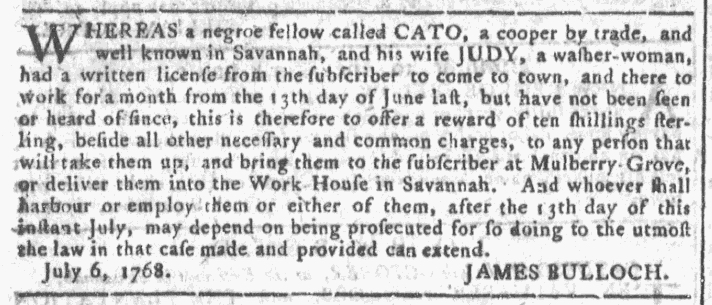
“A negroe fellow called CATO … and his wife JUDY … had a written license … to come to town.”

James Bulloch’s advertisement concerning an enslaved man and woman who tricked him into issuing them a pass so they could hire themselves out in Savannah for a month and then ran away became a regular feature in the Georgia Gazette in 1768. Dated July 6, it first appeared in the July 13 edition. It then ran every week, with the exception of August 3, for the next six months, making its final appearance on January 4, 1768, in the first issue of the new year. Overall, Bulloch inserted this advertisement in the Georgia Gazette twenty-five times. It would have been impossible for regular readers to remain unaware of Cato and Judy’s subterfuge and flight, but Bulloch published the notice often enough that even those who read the Georgia Gazette only occasionally were likely to encounter the story of the runaway cooper and laundress.

In that regard, Bulloch’s advertisement did not differ from many other notices about runaway slaves in the Georgia Gazette and other newspapers printed throughout the colonies. The account of Cato and Judy’s escape appeared alongside other advertisements for runaway slaves that also ran for months at a time, including one about “THREE NEW NEGROE MEN, called NEPTUNE, BACCHUS, and APOLLO … and ONE STOUT SEASONED FELLOW, called LIMERICK” who ran away from a plantation near Pensacola, Florida, and were suspected of making way “through the Creek nation.” Bulloch and others made significant investments as they attempted to reclaim runaway slaves. In addition to the “reward of ten shilling sterling, beside all other necessary and common charges” that he offered for the capture and return of Cato and Judy, Bulloch financed an advertising campaign that lasted for six months.

Why did these advertisements cease on January 4, 1769? Had Cato and Judy been captured? Or had they successfully made their escape, at least for the moment, having used the “written license” they finagled from Bulloch to move freely and as far away as possible before he even realized they were gone? The slaveholder may have decided to cut his losses by suspending the advertisements. By then, however, colonists throughout Georgia and beyond would have been familiar with Cato and Judy’s story because they saw it repeated in the Georgia Gazette so many times. Even though the advertisements did not continue, the runaways were not safe. Bulloch had used the power of the press for months to encourage others to engage in the surveillance necessary to bring and end to Cato and Judy’s flight for freedom.

September 7

What was advertised in a colonial American newspaper 250 years ago today?

Sep 7 - 9:7:1768 Georgia Gazette
Georgia Gazette (September 7, 1768).

“THE subscriber WILL OPEN A SCHOOL FOR DANCING.”

Compared to bustling cities like Boston, Charleston, New York, and Philadelphia, the more recent settlement at Savannah was a relatively small port with significantly fewer residents in 1768. Yet it was not so small that dancing masters thought it futile to attempt to cultivate a market for their services among the local elite and those who aspired to join their ranks. John Revear, for instance, placed an advertisement in the September 7, 1768, edition of the Georgia Gazette to announce that he would “OPEN A SCHOOL FOR DANCING” on the following day.

Revear welcomed various types of pupils. The majority of his advertisement focused on his lessons for children, but a brief nota bene indicated that he took “grown persons” as pupils as well. The dancing master offered daytime classes for children on Thursdays and Fridays “from the hours of ten to twelve, and from three to five.” This allowed him time to provide private lessons throughout the rest of the week. Such lessons could take place at the school, but Revear advised that “Any gentleman or lady may be taught at their own house” if they preferred. In addition, he kept “an evening school … from six to nine” for adults who did not have leisure time during the day for private lessons.

In crafting his advertisement, Revear played on the anxieties of parents who might send their children to his dancing school. He noted that he taught “all the celebrated dances that are used in polite academies,” signaling that young people needed his instruction or they risked public embarrassment when they displayed their lack of familiarity with this genteel pastime. Yet Revear likely intended that this warning resonate with others besides parents attending to the best interests of their children. Adults who had concerns about whether they had mastered the latest steps could ease their minds by signing up for lessons themselves. The option for private instruction in the home further reduced the possibility of awkward comportment in public spaces. Once students had mastered the steps they could gracefully display their skills.

Revear encouraged a sense of uneasiness even as he provided a means for relieving it. He prompted prospective pupils to imagine “polite assemblies” and the many sorts of “celebrated dances” that were part of their gatherings. He leveraged existing worries, realizing that some residents of Savannah did not wish to think of themselves as any less sophisticated than those who participated in the “polite assemblies” in Charleston or Philadelphia or other cosmopolitan American ports (just as residents of those cities constantly strove to demonstrate that they were as fashionable and genteel as if they lived in London).

August 24

What was advertised in a colonial American newspaper 250 years ago today?

Aug 24 - 8:24:1768 Georgia Gazette
Georgia Gazette (August 24, 1768).

“He HATH OPENED A WRITING OFFICE.”

James Johnston, the printer of the Georgia Gazette, regularly inserted advertisements for the blanks (or forms) that he printed and sold to supplement the revenues from operating the colony’s only newspaper. The purposes of those blanks ranged widely, including “bonds, bills of sale, mortgages, powers of attorney, bonds of arbitration, indentures, bills of lading, articles of agreement between masters of vessels and seamen, [and] indico certificates.” Making use of printed blanks allowed colonists to enter into a variety of commercial and legal agreements on their own.

Some colonists, however, did not wish to enter into such arrangements without consulting someone with greater expertise in drawing up agreements and other legal devices, especially when the complexity of their situation exceeded the circumstances anticipated on the standardized forms. In those instances, Benjamin Prime offered his services.

In the summer of 1768, Prime inserted advertisements in the Georgia Gazette to announce that he “HATH OPENED A WRITING OFFICE” conveniently located near the Assembly House in Savannah. There he drew up a variety of “Instruments,” including “Wills, Deeds, Mortgages, Leases, Letters of Attorney, Articles of Agreement,” and much more, as indicated by “&c. &c.” (invoking the eighteenth-century abbreviation for et cetera twice). Prime’s services paralleled many of those achieved by the printed blanks sold at the printing office on Broughton Street.

Yet contracting Prime’s services conferred additional value for his clients, as he underscored in the introductory remarks in his advertisement. He explained that he “hath been bred to the Law, and hath been a practitioner for several years in the province of North Carolina.” He contributed experience and expertise to the transactions and agreements he oversaw, according greater peace of mind to clients who may have been hesitant to rely on printed blanks alone. Given that he had only recently opened his office in Savannah, he publicized his credentials as a means of assuring prospective clients that they could depend on his competence in serving them.

August 17

What was advertised in a colonial American newspaper 250 years ago today?

Aug 17 - 8:17:1768 Georgia Gazette
Georgia Gazette (August 17, 1768).

“LEWIS JOHNSON Has just imported … AN ASSORTMENT of MEDICINES.”

When readers of the Georgia Gazette perused the August 17, 1768, edition they encountered an advertisement for “AN ASSORTMENT of MEDICINES, and sundry other Articles” that may have looked familiar. Lewis Johnson had placed his notice listing an extensive array of goods as soon as they arrived in his shop. The shipping news in the June 29 issue indicated that the “Ship Charming Sally, Peter Rainier” from London had “ENTERED INWARDS at the CUSTOM-HOUSE” on June 28. Johnson’s advertisement listing merchandise “just imported for Sale from LONDON, By the CHARMING SALLY, Capt. RAINIER” appeared in the Georgia Gazette the following day. It ran for three consecutive weeks, a standard length of time according to the fee structure for advertising in many colonial newspapers.

Johnson’s advertisement then disappeared from the next four issues before returning in the August 17 issue. Why did Johnson suddenly decide to insert his advertisement again? Just as its initial run coincided with the shipping news that confirmed the Charming Sally had just arrived with a cargo of goods imported from London, its return to the pages of the Georgia Gazette occurred when the shipping news reported the vessel’s departure. Among the other entries from the Customs House, the “Ship Charming Sally, Peter Rainier” had “CLEARED” and sailed for Martinique. For the past three weeks, the Charming Sally had been listed with those that had “ENTERED OUTWARDS” in preparation of leaving Savannah. Either from the shipping news or his interactions with the captain, Johnson would have known when the ship that transported his goods was leaving. The August 17 issue would be the last issue that carried information about the Charming Nancy provided by the Customs House. It was also Johnson’s last chance to underscore that he had indeed “just imported” his wares on a ship that had recently arrived in port.

His advertisement did not appear the following week, nor did the shipping news mention the Charming Nancy. Johnson had seized the opportunity when it presented itself, but withdrawn his advertisement when the news items printed elsewhere in newspaper made one of the appeals in his advertisement look outdated.

August 10

Who was the subject of an advertisement in a colonial American newspaper 250 years ago today?

Aug 10 - 8:10:1768 Georgia Gazette
Georgia Gazette (August 10, 1768).

“TO BE SOLD at YAMMACRAW, A PARCEL OF NEW NEGROES.”

Several advertisements in the August 10, 1768, edition of the Georgia Gazette offered slaves for sale. Some concerned individual slaves (“A VERY HANDY YOUNG COUNTRY BORN WENCH”) or small groups of slaves (“Four Prime Negroes” and “ONE NEGROE WENCH, and TWO CHILDREN”) to be sold by their owners, but colonists who made their livelihood from trading in human property placed other advertisements for larger quantities of enslaved men, women, and children. The latter included a brief notice inserted by John Graham and Company announcing the sale of “A PARCEL OF NEW NEGROES” slated for sale at Yamacraw Bluff, the site where James Oglethorpe landed when he founded the Georgia colony in 1733. The place named for and formerly inhabited by the Yamacraw, a group of Creek Indians, became the point of arrival in North America for Africans involuntarily transported across the Atlantic.

Yet Georgia was not the first colony where these captives from Africa entered port on the western side of the Atlantic. Graham and Company’s advertisement indicated that these “NEW NEGROES” from Gambia were “Part of the Cargo of the Schooner Fortune.” Voyages: The Trans-Atlantic Slave Trade Database provides more information about the experiences of the human cargo aboard the Fortune. After acquiring 121 Africans in Gambia, James Baird and his crew set sail for Barbados. Only 109 of the captives survived the Middle Passage to disembark at some point after the Fortune arrived at an unspecified port in Barbados on June 25, 1768. The Fortune returned directly to Africa to trade for more slaves.

Some of the slaves who disembarked in Barbados then experienced what Gregory E. O’Malley has termed transshipment. Surviving the Middle Passage was not the end of their journey. Instead, lacking sufficient buyers at their original port of arrival in the Americas, they were loaded aboard other vessels and shipped between colonies to other markets for purchase. Graham and Company’s advertisement does not indicate how many of the 109 “NEW NEGROES” who disembarked in Barbados then made another journey to Georgia, nor does it indicate how many friends and relatives who survived the Middle Passage to the island colony only then found themselves separated from each other by slave traders who dispersed them to even more distant places in hopes of finding buyers.

August 3

What was advertised in a colonial American newspaper 250 years ago today?

Aug 3 - 8:3:1768 Georgia Gazette
Georgia Gazette (August 3, 1768).

“A LARGE ASSORTMENT OF WHITE AND BLUE NEGROE CLOTH.”

The shipping news in the August 3, 1768, edition of the Georgia Gazette reported that five ships had “ENTERED OUTWARD” from the customs house at Savannah in the previous week, including the “Snow Pitt, [captained by] John Copithorn” bound for London. That was not, however, the only mention of the Pitt in that issue of Georgia’s only newspaper. As Copithorn and his crew prepared for their departure, local merchants sold the recently imported goods transported from Bristol aboard the Pitt. They also wrote copy for advertisements and submitted their notices to James Johnston’s printing office on Broughton Street.

The partnership of Inglis and Hall, prominent merchants and slave traders, stocked a variety of goods delivered to the colony by Copithorn and the Pitt. Their inventory included an assortment of textiles as well as “Ironmongery, of all kinds; … Saddlery; … Glass Ware of most kinds; … With many other Articles.” As tall as it was wide, their substantial advertisement occupied a fair amount of space on the page, especially compared to many of the other paid notices comprised of only two to five lines.

Read and Mossman placed one of those other advertisements. In it, they announced: “JUST IMPORTED by the subscribers, in the Snow Pitt, John Copithorn, from Bristol, A LARGE ASSORTMENT OF WHITE AND BLUE NEGROE CLOTH.” In comparison to such brevity, Inglis and Hall listed twenty different textiles as well as “suitable Trimmings” to adorn them according to the latest fashions. Current tastes did not matter nearly as much, if at all, when outfitting slaves for domestic labor or work in the fields. The “WHITE AND BLUE NEGROE CLOTH” sold by Read and Mossman would have been osnaburg or a similarly rough fabric, one valued more for its durability than its comfort or attractiveness.

The “Snow Pitt, John Copithorn, from Bristol” delivered a variety of goods to the Georgia marketplace. Some merited more marketing efforts than others. Inglis and Hall’s extensive list of textiles and other goods conjured images of vast consumer choices for those who would purchase and use the items themselves. On the other hand, Read and Mossman realized that “A LARGE ASSORTMENT OF WHITE AND BLUE NEGROE CLOTH” required no additional marketing, especially since those who would be wearing garments made of the cloth would not make the choice when it came to purchasing it. Although both partnerships focused primarily on fabrics imported on the same ship, Inglis and Hall advertised consumer goods while Read and Mossman advertised commodities.

July 27

What was advertised in a colonial American newspaper 250 years ago today?

Jul 27 - 7:27:1768 Georgia Gazette
Georgia Gazette (July 27, 1768).

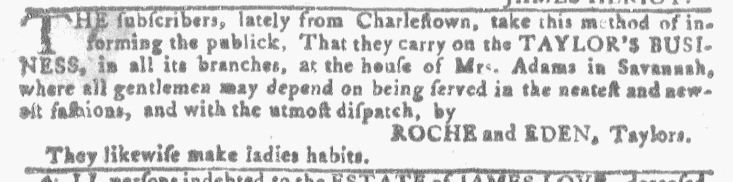
“THE subscribers … take this method of informing the publick, That they carry on the TAYLOR’S BUSINESS.”

Many colonial printers often had more content, especially advertising, than they could fit in the pages of their newspapers. A standard issue consisted of four pages created by printing two on each side of a broadsheet and folding it in half. Although newspapers published in the largest American cities achieved daily publication by the end of the eighteenth century, newspapers published before the Revolution were generally limited to one issue per week. That meant that subscribers and other readers expected one four-page issue every seven days. Excess content, however, sometimes prompted printers to publish additional material in a supplement, a postscript, or an extraordinary. The most successful newspapers, those published in the largest and busiest port cities, regularly distributed two-page supplements along with their standard four-page issues in the 1760s. Often those supplements consisted entirely or almost entirely of advertising. When they acquired news that could not wait on the weekly publication schedule, printers issued separate supplements. Advertisements appeared less prominently in those publications.

James Johnston, printer of the Georgia Gazette in the 1760s, did not often find himself in the enviable position of having to issue an advertising supplement, but even in the relatively small port of Savannah he sometimes received sufficient paid notices that made doing so necessary. Such was the case during the week of July 27, 1768. Johnston’s advertising supplement had a rather different appearance than its counterparts that accompanied other newspapers. It did not feature a masthead that identified it as an additional publication affiliated with the Georgia Gazette. Instead, “No. 252” appeared at the bottom of the page, indicating that it belonged with the rest of the issue published on July 27. Like other supplements, it was only half of a broadsheet. Unlike other supplements, it was printed on only one side, creating one page rather than two. Given the price and scarcity of paper, this was notable for not using the available resources to their capacity. It indicates that even though Johnston had so many paid notices that demanded he publish an untitled supplement that either he did not have sufficient content, neither news nor advertising, to fill a second page or he did not have ample time to print the second side of the supplementary half sheet.

Printers in larger cities were better prepared to issue supplements, in large part because doing so was such a regular occurrence that they incorporated the necessary workers and other resources into their business practices. The revenues from a steady stream of advertising helped make that possible. For Johnston and others, however, the flow of advertising was much more uneven, justifying an occasional advertising supplement but not so many that they were always equipped to distribute full supplements that replicated those issued by their counterparts in the busiest urban ports.

July 20

What was advertised in a colonial American newspaper 250 years ago today?

Jul 20 - 7:20:1768 Georgia Gazette
Georgia Gazette (July 20, 1768).

“Said Winter has all sorts of garden seeds to dispose of.”

Robert Winter advertised “all sorts of garden seeds” almost as an afterthought in a notice he placed in the July 20, 1768, edition of the Georgia Gazette. Winter served as the caretaker for several gardens – Pleasant Oak, Mulberry Hill, and Spring Gardens – that belonged to Dr. James Cuthbert. In the course of performing his duties he noticed a series of robberies committed by “several very indiscreet persons.” In turn, the caretaker took measures to prevent further thefts on the premises. He also turned to the public prints to warn fellow colonists about those measures, proclaiming that “he has guns, dogs, and other snares laid for such as may trespass there for the future.” Furthermore, should he catch anyone defacing any of the gardens Winter was “resolved to bring them to justice. The caretaker imagined a variety of possible suspects, including “apprentices, servants, and negroes.” He requested that “masters will caution” them “against the like errors.”

Only after signing his name to this notice did the caretaker insert an additional line that deviated from his primary purpose of preventing further robberies: “Said Winter has all sorts of garden seeds to dispose of.” Compared to extensive advertisements placed by others who specialized in selling seeds, this portion of Winter’s notice was exceptionally short. He did not elaborate on any of the varieties he offered for sale. He assumed that potential customers were already familiar with the gardens he tended and did not need further explanation. Indirectly, the series of robberies indicated a certain level of demand for the plants that sprang from his seeds.

Winter put virtually no effort into marketing his garden seeds. He merely made an appeal to choice by noting that he sold “all sorts.” Yet he did follow another convention common to many eighteenth-century advertisements. Often colonists placed notices with two purposes. In many cases, the primary purpose revolved around some sort of announcement, such as estate notices, calls to settle accounts before advertisers left town, or, in this instance, cautioning robbers against further attempts. Having purchased space in the newspaper, some advertisers opted to pursue a secondary purpose: selling consumer goods and services. Having attracted attention for their primary purpose, but not wishing to distract from it too much, they appended short invitations for readers to make purchases, whether the contents of the rest of the notice applied to them or not.

Winter’s story of “guns, dogs, and other snares” intended to ward off the “several very indiscreet persons” who “made a practice of robbing the gardens” he tended likely garnered interest among readers solely because it was so different that the rest of the contents among the advertisements in the Georgia Gazette. The caretaker seized that opportunity to encourage sales of his seeds.