July 13

What was advertised in a colonial American newspaper 250 years ago today?
Jul 13 - 7:13:1768 Georgia Gazette
Georgia Gazette (July 13, 1768).

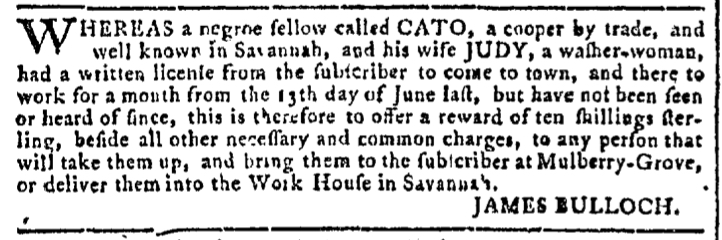
“A negroe fellow called CATO … and his wife JUDY … have not been seen or heard of.”

James Bulloch, a slaveholder, regretted trusting “a negroe fellow called CATO … and his wife JUDY.” The two took advantage of that trust, at least from Bulloch’s perspective, when they decided to run away after he had issued them a pass to go to Savannah. Cato and Judy, for their part, likely had little sympathy when it came to betraying the trust of a man who held them in bondage. Bulloch briefly told their story in an advertisement he inserted in the July 13, 1768, edition of the Georgia Gazette.

Cato and Judy were both skilled workers. Bulloch described Cato as “a cooper by trade” and Judy as “a washer-woman.” Cato had apparently practiced his trade in the colony’s largest port town; Bulloch indicated that he was “well known in Savannah.” That being the case, it may not have been difficult for Cato to find work when he wished, providing that Bulloch allowed him to participate in the hiring out system. Judy also possessed a skill often in demand, especially in ports. Hiring out his slaves accrued certain benefits for Bulloch, especially if he did not have sufficient work to keep them occupied. By hiring out the cooper and laundress, allowing them to seek their own employment for a specified period, Bulloch reduced his responsibilities for providing food and shelter. He also generated additional income since their wages belonged to him. Slaveholders who thought of themselves as generous sometimes gifted a small portion of the wages to the enslaved men and women who earned them, but usually little more than a token.

Bulloch apparently had no misgivings about this system, at least not as far as Cato and Judy were concerned. Perhaps they had cultivated his trust over time, anticipating when they might have an opportunity to make their escape. Bulloch issued he couple “a written license … to come to town, and thee to work for a month from the 13th day of June last.” He expected them to return after a month, with their wages to hand over to him. To Bulloch’s dismay, however, Cato and Judy “have not been seen or heard of since.” Apparently the couple did not make any pretense of arriving in Savannah and seeking work. Instead, they fled at the earliest opportunity in order for their disappearance to go unnoticed as long as possible, increasing their chances for making good on their escape. Bulloch eventually discovered the subterfuge and offered a reward for their capture and return.

Although filtered through the perspective of slaveholders, advertisements for runaway slaves present striking stories of survival and resistance by enslaved men and women. The same issue of the Georgia Gazette that first provided an account of Cato and Judy’s escape also included three other advertisements for runaway slaves: Pedro “of the Angola country,” who “has the upper part of his right ear cut off,” possibly as a disciplinary measure; Chloe, who “has her country marks on both her cheeks” and spoke little English; and Ben, who “has been for some time sickly.” The advertisements do not provide as much information about any of these fugitives, making it more difficult to reconstruct their stories. Still, these advertisements demonstrate that enslaved men and women did not meekly accept their fate but instead sought to change their condition.
July 6

What was advertised in a colonial American newspaper 250 years ago today?

Jul 6 - 7:6:1768 Georgia Gazette
Georgia Gazette (July 6, 1768).

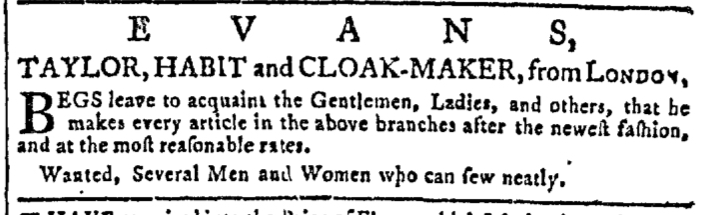
“EVANS, TAYLOR, HABIT and CLOAK-MAKER, from LONDON.”

Except for the mononym, this advertisement by Evans in the July 6, 1768, edition of the Georgia Gazette was not flashy. Nor was it particularly lengthy. Yet despite the economy of prose, Evans, a “TAYLOR, HABIT and CLOAK-MAKER,” managed to work several appeals into his short advertisement. In that regard, he met the standards for advertising established by many of his contemporaries throughout the colonies.

Like many other artisans, especially those in the garments trades, he first informed prospective clients of his origins. Evans was “from LONDON,” though he did not indicate how long it had been since he had lived there or how long he had pursued his trade in that city. Still, establishing a connection to the cosmopolitan center of the empire likely afforded him some cachet among the residents of Savannah and its environs.

Asserting that connection also provided a foundation for one of his other appeals. He promised potential customers that “he makes every article in the above branches after the newest fashion.” It went without saying that he meant the newest fashion in London. The tailor played on colonists’ anxieties that they lived in a provincial backwater, one separated from the metropole not only by distance but also by taste and style. Evans assured them that when they wore his clothing that they donned the current trends not only in the largest and most sophisticated urban ports on this side of the Atlantic but also the fashions in London. Yet it was not prohibitively expensive to rival the styles in those places. Evans pledged that he charged “the most reasonable rates” for the garments he made.

The tailor incorporated a brief employment advertisement at the end of his notice: “Wanted, Several Men and Women who can sew neatly.” Doing so communicated to readers that his services were in such demand that he needed more help in his shop, not just a single assistant but instead several to handle the volume of clients he served. Just as prospective clients desired to keep up with “the newest fashion” they also derived status from having their apparel made by a popular tailor.

Evans’s advertisement may seem sparse at first glance, but the savvy tailor inserted several appeals that recommended his services to customers. Without going into great detail, he played on several currents in consumer culture already quite familiar to eighteenth-century readers.

June 29

What was advertised in a colonial American newspaper 250 years ago today?

Jun 29 - 6:29:1768 Georgia Gazette
Georgia Gazette (June 29, 1768).

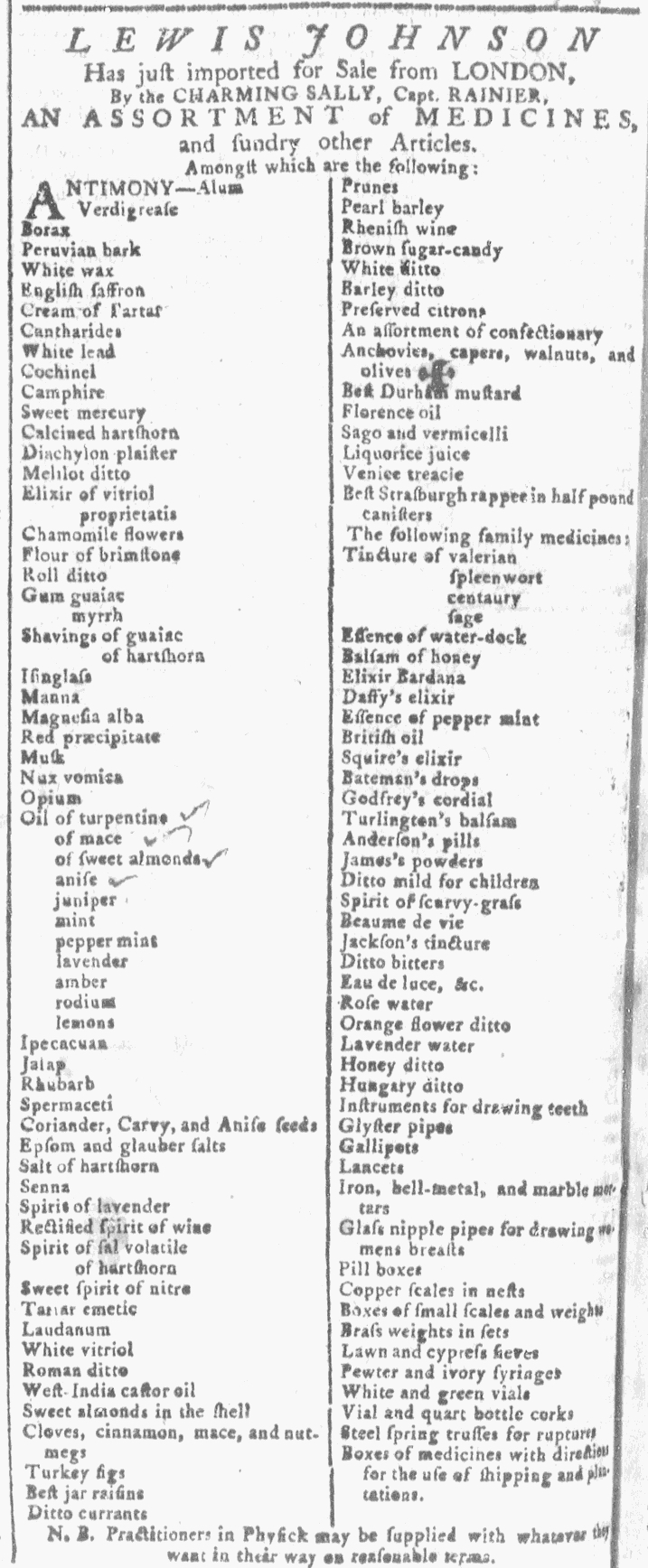
“Has just imported for Sale from LONDON, By the CHARMING SALLY, Capt. RAINIER.”

To inform residents of Savannah and the rest of the colony that he now stocked “AN ASSORTTMENT of MEDICINES, and sundry other Articles,” Lewis Johnson placed an extensive advertisement in the June 29, 1768, edition of the Georgia Gazette. In it, Johnson listed everything from “Peruvian bark” to “West India castor oil” to “Spirit of lavender.” In addition to ingredients for compounding remedies, Johnson also carried several popular patent medicines, including “Bateman’s drops,” “Godfrey’s cordial,” “Turlington’s balsam,” and “Anderson’s pills.”

Johnson must have rushed his advertisement to press, though he may have written the copy in advance of receiving a new shipment of merchandise. Before listing his wares, he informed prospective customers that he “Has just imported for Sale from LONDON, By the CHARMING SALLY, Capt. RAINIER,” the dozens of items he enumerated. Johnson’s advertisement filled most of a column on the second page. The facing page featured a variety of advertisements and news items, including the shipping news for the previous week. Among the arrivals and departures at the port, on June 28 the “Ship Charming Sally, Peter Rainier” had ENTERED INWARDS at the CUSTOM-HOUSE” from London. The vessel that carried Johnson’s new inventory arrived the day before his advertisement ran in the Georgia Gazette. The shipping news that appeared elsewhere in the newspaper bolstered his assertion that he carried fresh goods rather than leftovers that had sat on shelves or in storage. This also suggests one manner in which readers engaged with newspapers; Johnson may have expected readers to move back and forth between news items and his advertisement to tell a more complete story.

The copy of this issue of the Georgia Gazette that has been preserved, photographed, and digitized provides other evidence about how some readers used newspapers. Four of the items in the left column have small checkmarks next to them. Why? This was not an indication for the printer or compositor to remove those items in subsequent insertions. All four appear throughout the entire run of Johnson’s advertisement. Instead, someone took note of those items in particular. Perhaps a prospective customer used the advertisement to make a shopping list. Perhaps a competitor marked items of interest. We will probably never know what those checkmarks signified, but they do testify that the advertisement garnered notice. It was not merely published and overlooked by readers of the Georgia Gazette.

June 22

What was advertised in a colonial American newspaper 250 years ago today?

Jun 22 - 6:22:1768 Georgia Gazette
Georgia Gazette (June 22, 1768).

“A FEW COPIES of the ACTS of the GENERAL ASSEMBLY passed last session to be sold by the printer of this paper.”

James Johnston squeezed as much content as possible onto the pages of the June 22, 1768, edition of the Georgia Gazette. In addition to news items and paid advertisements, he inserted his own short notices – none more than four lines – at the bottom of columns on the second, third, and fourth pages. In the lengthiest, he sought an apprentice: “WANTED, AN honest, sober and industrious LAD, as an APPRENTICE to the PRINTING BUSINESS. Such a one will meet with good encouragement by applying to the printer of this paper.” In another, he announced, “A FEW COPIES of the ACTS of the GENERAL ASSEMBLY passed last session to be sold by the printer of this paper.” The shortest, an advertisement Johnston inserted frequently, simply stated, “BLANKS of most sorts to be sold at the Printing-Office.” In addition to those notices, the printer incorporated an advertisement into the colophon that appeared on the final page of each issue of the Georgia Gazette: “SAVANNAH: Printed by JAMES JOHNSTON, at the Printing-Office in Broughton-Street, where Advertisements, Letters of Intelligence, and Subscriptions for this Paper, are taken in.—Hand-Bills, Advertisements, &c. printed at the shortest Notice.”

Johnston did not need to insert these advertisements to fill the already densely formatted columns of the June 22 issue. He could have instead inserted more space between advertisements or news items that appeared on the page, a strategy that he sometimes deployed when he fell far short of sufficient content to complete an issue. His need for an apprentice may have been pressing, convincing him to run the longest of his notices in hopes of acquiring more assistance in the day-to-day operations of the printing office as quickly as possible. He may have also considered the shorter notices concerning items for sale urgent for generating revenue. After all, he had not published the Georgia Gazette the previous week, perhaps a symptom of financial difficulties or a potential cause of future disruptions that some additional sales in the printing office might remedy. Whatever the reasons for inserting these short advertisements, Johnston’s decision to do so demonstrates that eighteenth-century printers considered the pages of their newspapers malleable to their own needs. They earned a living and served their communities by publishing news and advertising, but they also tailored the format and contents to accommodate their own interests.

June 15

What was advertised in a colonial American newspaper 250 years ago this week?

Jun 15 - 6:14:1768 South-Carolina Gazette and Country Journal
Supplement to the South-Carolina Gazette and Country Journal (June 14, 1768).

“ALL Person who are anywise indebted to the Estate of JOHN DUTARQUE, deceased, are desired to make payment.”

The “missing” Georgia Gazette from June 15, 1768, presents an opportunity to discuss methodology. Each day the Adverts 250 Project republishes an advertisement originally published in an American newspaper exactly 250 years ago that day, along with a short essay that provides historical context and analysis of the contents of the advertisement. These advertisements are drawn from databases of eighteenth-century newspapers that have been digitized: the Virginia Gazette from Colonial Williamsburg’s Digital Library, newspapers published in Charleston from Accessible Archives’s South Carolina Newspapers, and an extensive array of newspapers from throughout the colonies from Readex’s America’s Historical Newspapers.

If no newspaper was published on a particular day (or if no newspaper published on a particular day has been digitized as part of one of those databases), the Adverts 250 Project instead features an advertisement printed sometime during the previous week. Although colonial printers clustered newspaper publications on Mondays and Thursdays in the late 1760s, at least one newspaper was published somewhere in the colonies on every day of the week except Sundays. This means that usually there is only one day of the week that the Adverts 250 Project needs to feature an advertisement not published exactly 250 years to the day.

The clustering of publications on Mondays and Thursdays means that some days offer many more choices for both newspapers and advertisements. During most weeks, the South-Carolina Gazette and Country Journal was the only [extant and digitized] newspaper printed on Tuesdays, the Georgia Gazette was the only newspaper printed on Wednesdays, and the Providence Gazette was the only newspaper printed on Saturdays. As a result, the Adverts 250 Project features an advertisement from each of these publications once a week. During the rest of the week the project draws from among more than a dozen other newspapers, attempting an informal rotation to feature as many as possible.

This methodology causes some newspapers to be featured much more often than others. Even though it carried relatively little advertising compared to some of its counterparts published in the largest port cities, the Georgia Gazette contributes an advertisement to the Adverts 250 Project once a week because it was only newspaper published in the colonies on Wednesdays in the late 1760s. (Dates that fell on Wednesdays in 1768 fall on Fridays in 2018.)

Jun 15 - Georgia Gazette Calendar
This calendar indicates which issues of the Georgia Gazette from 1768 have been digitized for Readex’s America’s Historical Newspapers database.

Today’s advertisement should have come from the Georgia Gazette, but the issue for June 15, 1768, is “missing.” Note the availability of other issues summarized in the calendar provided via Readex’s America’s Historical Newspapers. On closer investigation of some of those other issues it turns out that the June 15 edition is not missing after all. The June 8 edition is numbered 246. June 22 is numbered 247. June 29 is numbered 248, indicating that the June 22 edition is indeed numbered correctly and not the result of the printer or compositor neglecting to advance the number if there had been a June 15 edition (that would have been 247). For whatever reason, printer James Johnston did not issue the Georgia Gazette on June 15, 1768. Despite the noticeable gap in the calendar depicting publication in 1768, complete runs of the Georgia Gazette for that year have been preserved in archives and reproduced via America’s Historical Newspapers.

Rather than examine an advertisement published sometime during the previous week, the not-missing-after-all issue of the Georgia Gazette presents an opportunity to discuss the Advert 250 Project’s methodology in greater detail as well as describe the schedule of publication throughout the colonies in the late 1760s. This should give readers a better sense of why advertisements from some newspapers appear so frequently and advertisements from other newspapers are featured much less often.

June 1

What was advertised in a colonial American newspaper 250 years ago today?

Jun 1 - 6:1:1768 Georgia Gazette
Georgia Gazette (June 1, 1768).

“His method of teaching children being well known in the town of Savannah.”

In anticipation of opening a school on the following Monday, Peter Gandy inserted an advertisement in the Wednesday, June 1, 1768, edition of the Georgia Gazette. Compared to many other advertisements placed by schoolmasters and –mistresses in the 1760s, Gandy’s notice was fairly sparse. He provided little information about the subjects he intended to teach, his methods of instruction, or the accommodations for students. Instead, he invoked his prior experience and the reputation he had already established in the community. He called on “those gentlemen and ladies who formerly favoured him with the tuition of their children” to enroll them once again. Addressing all parents of prospective students, whether they previously attended his school or not, he confidently stated that because “his method of teaching children being well known in the town of Savannah” it “therefore needs no farther explanation.”

Gandy did not commence promoting his school in the public prints much in advance of the first day of classes. His advertisement first ran in the May 25 edition of the Georgia Gazette, less than two weeks before he planned to “OPEN SCHOOL.” It appeared again the following week in the June 1 edition, allowing Gandy only two opportunities to attract students via the only newspaper published in the colony. On June 8, Gandy published a slightly revised version of the advertisement, announcing that he had indeed “OPENED SCHOOL” earlier in the week. Beyond notices in the Georgia Gazette, he almost certainly relied on other means, including word of mouth and speaking directly to the parents of former pupils, to inform prospective students and their families that he offered lessons at “Mrs. Cuningham’s house.”

Though Gandy did not offer many particulars in his advertisement, expecting that readers were already aware of many of the details, he did extend some general promises to those who entrusted their children to his tutelage. He declared that parents could “depend upon sobriety, due care, diligence, and constant attendance” toward their children at his school. Parents who previously enrolled their children in Gandy’s school would have been aware of these aspects of his instruction, but the schoolmaster sought to reassure others who may not have been as familiar with his methods as he suggested earlier in his advertisement. He realized that he needed to do more than merely rely on his reputation to attract a sufficient number of students to “OPEN SCHOOL” in Savannah.

May 25

What was advertised in a colonial American newspaper 250 years ago today?

May 25 - 5:25:1768 Georgia Gazette
Georgia Gazette (May 25, 1768).

“MANCHESTER and BIRMINGHAM WARES, daily expected from Bristol.”

In an advertisement they placed in the May 25, 1768, edition of the Georgia Gazette, merchants Inglis and Hall promoted merchandise they already had on hand. In addition, they attempted to stoke anticipation for inventory that would be available soon but had not yet arrived at their store in Savannah.

Inglis and Hall proclaimed that they “have just imported” an assortment of goods “from London.” They named the ships and captains that had transported that “QUANTITY of EUROPEAN and EAST-INDIA GOODS” across the Atlantic so readers could consult the shipping news or their own memories to confirm that they did indeed sell wares that had recently arrived in the colony.

At the same time, Inglis and Hall reported that they had ordered a “GENERAL ASSORTMENT of LINENS, WOOLENS, MANCHESTER and BIRMINGHAM WARES” that they expected to add to their stock soon since the vessel carrying them was “daily expected from Bristol.” Given that the Georgia Gazette, like every other newspaper published in the American colonies in 1768, appeared only once a week, it was quite possible that Inglis and Hall would make those goods available for sale before the next issue scheduled for publication on June 1. Previewing the merchandise might have drawn customers into the store for an initial visit to see what was available as well as a return visit to check for new arrivals, increasing foot traffic and potential sales.

This strategy also conditioned some prospective customers to read the weekly list of ships “ENTERED INWARDS at the CUSTOM-HOUSE” printed elsewhere in the Georgia Gazette as an extension of Inglis and Hall’s advertisement. The merchants created the possibility that anyone reading that a vessel had arrived from Bristol would associate that news with their advertisement trumpeting a much more extensive inventory. Although they did not have any authority over the other content in the newspaper, Inglis and Hall harnessed the shipping news as an auxiliary component of their own advertisement.

May 18

What was advertised in a colonial American newspaper 250 years ago today?

May 18 - 5:18:1768 Response Georgia Gazette
Georgia Gazette (May 18, 1768).

“If propagating injurious reports be at all commendable …”

Whether or not advertisements achieved the intended purposes of those who placed them in colonial newspapers, they did generate revenue for the printers who published them. At least that was the case once advertisers paid for their advertisements; colonial printers frequently inserted their own notices calling on subscribers and advertisers alike to settle accounts long overdue.

If his clients did indeed pay, James Johnston, the printer of the Georgia Gazette, generated significant revenue by publishing two series of advertisements between feuding colonists in the spring of 1768. It began with the dispute between Lachlan McGillivray and John Joachim Zubly. Over the course of several lengthy advertisements, the two men published point and counterpoint among the advertisements in the Georgia Gazette. They spilled so much ink making accusations and defending their reputations that Johnston even published a two-page supplement devoted entirely to their quarrel because including their notices in the regular issue would have crowded out both news and other advertisements. That they thrust and parried in the pages of the Georgia Gazette week after week over the course of a month likely provided entertainment for some readers not involved in their disagreement.

May 18 - 5:11:1768 Georgia Gazette
Georgia Gazette (May 11, 1768).

That exchange had barely died down before another found its way into the Georgia colony’s only newspaper. Upon receiving a letter from John Mullryne informing her of his intention to publish “a short dissertation upon Slanders” and “the danger of envenomed tongues,” Heriot Crooke opted to promptly place her own advertisement in the Georgia Gazette for public view rather than respond privately to her correspondent. In so doing, she preempted Mullryne and shaped the narrative by suggesting that she had had nothing to hide when it came to his accusations about how she had comported herself when discussing the candidates standing for election to become “Member of Assembly for Vernonburgh.” Crooke’s advertisement ran in the May 11 edition of the Georgia Gazette. It appeared again the following week, but by then Mullryne had composed a lengthy response. In it, he accused Crooke of being a pawn who acted “under the influence of a prompter or prompters.” He then defended himself against accusations leveled in an affidavit that had been included in Crooke’s original advertisement.

Together, the two advertisements filled approximately two-thirds of a column, a significant amount of space in a newspaper comprised of only eight columns. Assuming that Johnston, like many other printers, charged by the length of the advertisement, he stood to profit from the feud that unfolded among the advertisements in his newspaper. This also benefited the advertisers who wished to draw attention to the legal issues they litigated in their notices. By paying to have their advertisements inserted, Crooke and Mullryne (as well as McGillivray and Zubly) sidestepped the editorial process involved in selecting which news items to publish. In publishing advertisements, they made sure the content they wanted to see in the Georgia Gazette was indeed available for consideration by the public.

May 11

What was advertised in a colonial American newspaper 250 years ago today?

May 11 - 5:11:1768 Georgia Gazette
Georgia Gazette (May 11, 1768).

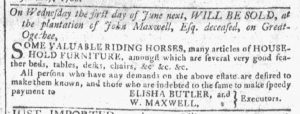
WILL BE SOLD … many articles of HOUSEHOLD FURNITURE.”

Advertisements for goods and services, especially newspaper notices, helped to stimulate the consumer revolution in eighteenth-century America. Colonial newspapers featured countless advertisements placed by merchants, shopkeepers, and artisans hawking countless new goods. Yet purchasing those items was not the only manner in which colonists acquired goods. Other advertisements testify to alternate means for participating in the consumer revolution. Many notices promoted vendues or auctions where savvy bidders stood to benefit from even greater bargains than they might experience in shops and warehouses. Customers purchased both new and used goods at auction. Other advertisements announced secondhand goods for sale, often as the result of sellers planning to leave the colony. Some advertisements also alerted colonists about thefts from homes and shops, warning them to be careful when purchasing secondhand goods because they might have been stolen.

When it came to opportunities to obtain secondhand goods, colonists most frequently encountered advertisements for estate sales, such as this advertisement from the May 11, 1768, edition of the Georgia Gazette in which the executors for “John Maxwell, Esq. deceased, on Great-Ogechee” sought to sell “many articles of HOUSEHOLD FURNITURE, amongst which are several very good feather beds, tables, desks, chairs.” Other advertisements in the same issue also promoted secondhand consumer goods that entered the marketplace via estate sales. The executors of “the ESTATE of FREDERICK HOLZENDORFF,” for instance, simultaneously called for his associates to settle accounts and announced the sale of “Household Goods and sundry other Articles.” Compared to newspapers published in Boston, Charleston, New York, Philadelphia, and other larger ports, the Georgia Gazette featured relatively few advertisements placed by merchants, shopkeepers, and artisans looking to sell inventories of new merchandise. In most issues, readers were as likely to find advertisements for estate sales as any other sort of notices presenting opportunities to acquire consumer goods. In eighteenth-century America, buying and selling the baubles of Britain and other items radiated far beyond shops and warehouses.

April 27

What was advertised in a colonial American newspaper 250 years ago today?

Apr 27 - 4:27:1768 Georgia Gazette
Georgia Gazette (April 27, 1768).

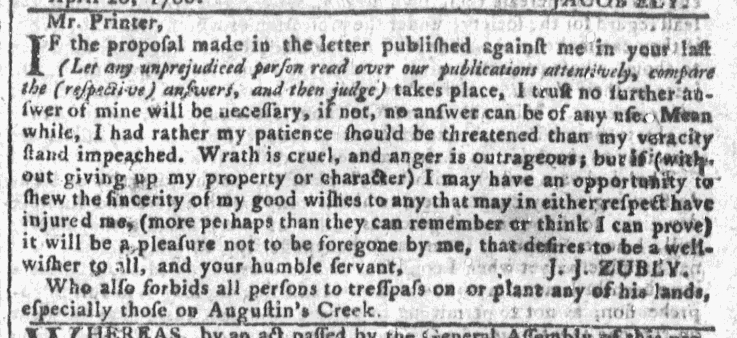
“The proposal made in the letter published against me in your last.”

When last we saw Lachlan McGillivray and John Joachim Zubly the rivals had composed such extensive advertisements accusing each other of misconduct in their real estate enterprises and interactions with one another that James Johnston published a supplement to the Georgia Gazette that consisted entirely of their dispute. Zubly had concluded his lengthy retort by stating, “Nothing shall ever be wanting on my part to shew that with a me a law-suit was not a matter of choice, but painful necessity; and whatever you may think or say of me, or do against me, I shall be glad of every opportunity to approve myself your real wel[l] wisher, till then I bid you right heartily FAREWELL.”

Apr 27 - 4:20:1768 Georgia Gazette
Georgia Gazette (April 20, 1768).

Yet it was not time for farewell quite yet. Two weeks after the supplement carried all three advertisements so far published by the adversaries, McGillivray inserted yet another notice in the April 20, 1768, edition of the Georgia Gazette. He could not pass up responding to Zubly’s “very elaborate performance.” Indeed, Zubly’s most recent advertisement had extended more than a page (or one-quarter of the length of a standard issue of the newspaper that carried it). McGillivrary described Zubly’s “very elaborate performance” as “such a piece of scurrility, (truly worthy of the author)” that it “does not deserve an answer in the Gazette.” Yet McGillivray published a response that extended more than half a column, not for his own benefit but in order to defend the reputation of McGillivray’s associate (who had so far declined to inject himself into the argument unfolding among the advertisements in the Georgia Gazette). McGillivray concluded his newest public missive by echoing Zubly: “I will thank you for your kind wishes when I think them sincere. In my turn bid you farewell.”

Having previously “bid you right heartily FAREWELL” to McGillivray, Zubly chose not to engage him directly when he decided to publish yet another advertisement. He could not let the notice from April 20 pass unremarked, but he addressed his new response to “Mr. Printer” and made an appeal to readers of the Georgia Gazette to review the series of advertisements and judge for themselves that he was the aggrieved party who had been abused by McGillivray. He ended his advertisement by returning to the real estate dispute that had launched the entire exchange, issuing instructions that he “forbids all persons to trespass on or plant any of his lands, especially those on Augustin’s Creek.”

This exchange was a windfall for James Johnston, the printer of the Georgia Gazette. At the very least, it generated significant advertising revenue that supported the newspaper, but it may have yielded other benefits. Readers who had no stake in the real estate dispute may have been entertained, amused, or infuriated by the antics of McGillivray and Zubly as their dispute played out in a series of advertisements. As a result, readers may have anticipated new issues to find out what happened next. Non-subscribers may have made greater efforts to obtain copies of the new issues in hopes of encountering more advertisements that prolonged the feud. In the process, they would have been exposed to the remainder of the news and advertising, benefiting both the printer and the advertisers. McGillivray and Zubly produced their own serial in the middle of the eighteenth century.