January 6

What was advertised in a revolutionary American newspaper 250 years ago today?
Virginia Gazette [Dixon and Hunter] (January 6, 1776).

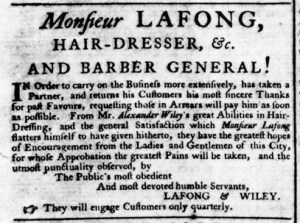
Monsieur LAFONG, HAIR-DRESSER, &c. AND BARBER GENERAL!”

George Lafong, a “French HAIR-DRESSER” in Williamsburg, occasionally placed newspaper advertisements in the early 1770s.  When he took to the pages of the first issue of John Dixon and William Hunter’s Virginia Gazette for 1776, he presented himself as “Monsieur LAFONG, HAIR-DRESSER, &c. AND BARBER GENERAL!”  That elaborate and spectacular title served as the headline for his advertisement.  He had not previously dropped his first name in favor of referring to himself as “Monsieur LAFONG,” but apparently decided that circumstances merited this affectation.

That may have been because he jointly placed the advertisement with his new partner, Alexander Wiley, explaining that they went into business together “IN Order to carry on the business more extensively.”  Wiley possessed “great Abilities in Hair-Dressing,” according to the advertisement, yet neither his name nor reputation seemed to suggest any connection to French styles.  Hairdressers frequently benefited from the cachet that their clientele associated with French fashion, something that Lafong understood when he introduced himself as a “French HAIR-DRESSER” and there in a French phrase, “TOUT A LA MODE,” in 1770.  He doubled down on that in his new advertisement, naming himself “Monsieur Lafong” in the body as well as “Monsieur LAFONG” in the headline.

The new partners hoped that the combination of Wiley’s “great Abilities in Hair-Dressing, and the general Satisfaction which Monsieur Lafong flatters himself to have hitherto given” would yield “Encouragement” (or appointments) “from the Ladies and Gentlemen of this City.”  Lafong deserved to lean on his reputation.  According to the entry on wigmakers from the Williamsburg Craft Series, Lafong operated one of the premiere wig shops in the town in the early 1770s.[1]  In his own marketing, he declared that he “makes Head Dresses for Ladies, so natural as not to be distinguished by the most curious Eye.”  If former clients (or their acquaintances who knew who dressed their hair) agreed with that assessment, it did indeed suggest a “general Satisfaction” with Lafong’s work.  Furthermore, Lafong and Wiley promised that “the greatest Pains will be taken” to earn the approval of their clients.

**********

[1] Thomas K. Bullock and Maurice B. Tinkin, Jr., The Wigmaker in Eighteenth-Century Williamsburg: An Account of his Barbering, Hair-Dressing, and Peruke-Making Services, and Some Remarks on Wigs of Various Styles (Colonial Williamsburg: 1959, 1987).

September 26

What was advertised in a revolutionary American newspaper 250 years ago today?

New-Hampshire Gazette (September 26, 1775).

“Gentlemen Travellers inclining to have their Hair or Wigs dressed before they go to Town.”

As the siege of Boston continued to the south in the fall of 1775, John Williams took to the pages of the New-Hampshire Gazette to inform the public that he “has opened a House of Entertainment in Greenland,” just outside Portsmouth, “at the Sign of the SALUTATION.”  The image that marked the location of his tavern and inn may have depicted two or more colonizers greeting each other or perhaps a generous host welcoming patrons to his establishment.  Few signs for shops, taverns, and other businesses survive from the era of the American Revolution.  Instead, references to them in newspaper advertisements remain the only vestiges of most of them.

Whatever scene the “Sign of the SALUTATION” may have shown, Williams wanted prospective customers to know that he “will do his utmost to wait on such Gentlemen and Ladies as will oblige him with their Favours and Custom.”  To that end, he “Has provided himself with the best of Liquors and every other Necessary for the Accommodation of Travellers & their Horses.”  When it came to hospitality, Williams would not be outdone by tavernkeepers, coffeehouse proprietors, and innkeepers in other cities and towns.  He planned to see to his guests’ every need and “promises the best Attendance & Care of them.”

That included a service that most men and women who ran similar establishments did not offer.  In a nota bene, Williams noted that “Any Gentlemen Travellers inclining to have their Hair or Wigs dressed before they go to Town, may have it done by said WILLIAMS in the genteelest and most fashionable Manner.”  After enduring the trials of the road, his patrons did not have to worry about entering Portsmouth looking disheveled or out of sorts.  They certainly did not need to seek out the services of William Stanwood, a “PERUKE [or Wig] MAKER and HAIR DRESSER” in Portsmouth who advertised in the same issue of the New-Hampshire Gazette.  Their host at the “Sign of the SALUTATION” would help them look presentable for conducting business and making social calls.

May 26

What was advertised in a revolutionary American newspaper 250 years ago today?

New-Hampshire Gazette (May 26, 1775).

“HAIR-DRESSERS … The Business is still carried on in the same Shop.”

William Knight, a “PERUKE MAKER and HAIR DRESSER,” placed advertisements for the wigs he made and the services he provided on several occasions.  In the January 22, 1773, edition of the New-Hampshire Gazette, for instance, he announced that he “open’d SHOP near LIBERTY BRIDGE” in Portsmouth, where he will be ready to serve any Persons on reasonable Terms.”  Six months later, he established a partnership with Peter Man.  On July 30, they published an advertisement to advise prospective clients that they “carry on their Business in all its Branches, at their Shop on the Parade in Portsmouth.”  They continued together for nearly two years, but as the Revolutionary War began Man and Knight decided to part ways.

That prompted another newspaper advertisement, one that deployed standard language for such circumstances.  Upon “having agreed to dissolve the Partnership which was between them,” they called on “all Persons with whom they have Accounts open to close them as soon as possible.”  They did not indicate why they ended their partnership, though perhaps Knight retired or moved to another town.  He did not place any more advertisements in the New-Hampshire Gazette.  Man, on the other hand, used the notice about the partnership ending for a second purpose.  With a manicule to draw attention, he proclaimed, “The Business is still carried on in the same Shop, on the Parade and constant Attendance given.”  Even as one iteration of the business closed, Man hoped to maintain the clientele that he and Knight had established over the past two years as well as attract new customers for wigs and styling.

He was not the only one to advertise such services.  In an advertisement for the inn that he operated in nearby Greenland, John Williams added a nota bene to inform “Amy Gentlemen Travellers inclining to have their Hair or Wigs dressed before they go to Town, may have it done by said WILLIAMS in the genteelest and most fashionable Manner.”  Even as the New-Hampshire Gazette carried the “Freshest ADVICES FOREIGN AND DOMESTIC” about the imperial crisis, advertisers catered to ladies and gentlemen who wanted their hair or wigs presentable for appearing in public.

February 10

What was advertised in a colonial American newspaper 250 years ago today?

South-Carolina and American General Gazette (February 10, 1775).

“JOHN HERRDENG, HAIR-DRESSER and PERFUMER.”

“MRS. HERRDING carries on the MANTUA-MAKING Business.”

“MISS HERRDENG will undertake to teach YOUNG LADIES the French Language.”

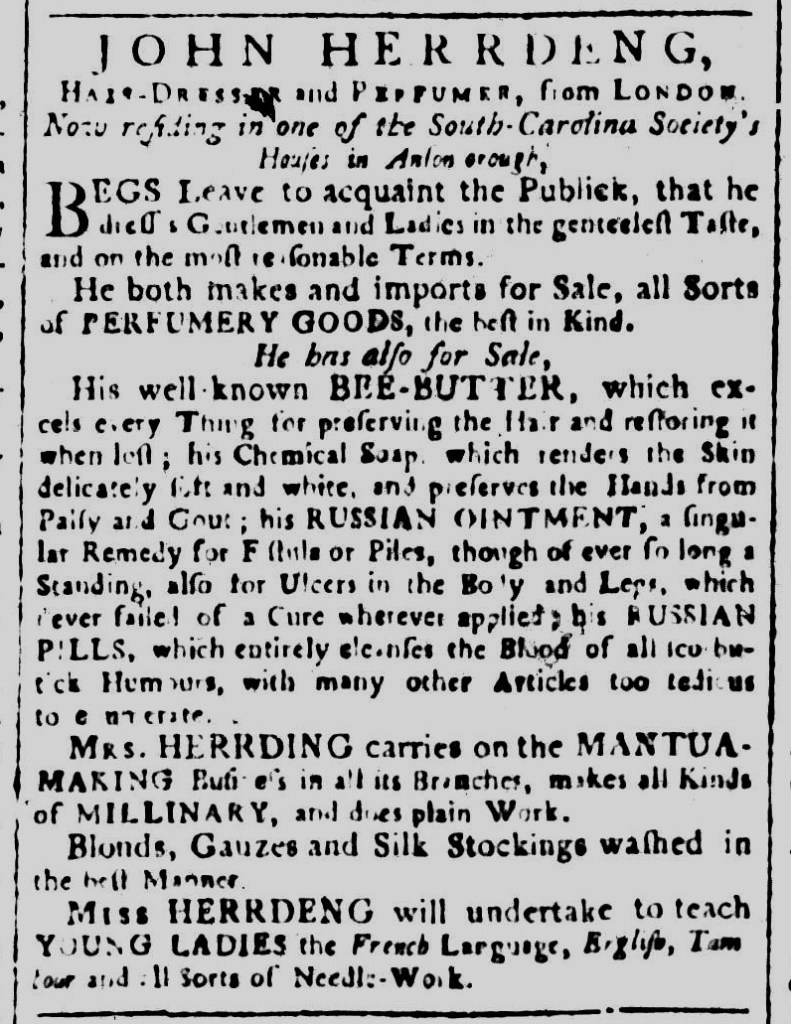
At a glance, the headline for an advertisement in the February 10, 1775, edition of the South-Carolina and American General Gazette promoted goods and services provided by John Herrdeng, a “HAIR-DRESSER and PERFUMER, from LONDON,” yet when they perused it more closely readers discovered that the notice also included entrepreneurial activities undertaken by other members of the Herrdeng household.  Descriptions of “PERFUMERY GOODS” and medicines that Herrdeng made and sold accounted for the first two thirds of the advertisements.  The final third outlined Mrs. Herrdeng’s “MANTUA-MAKING Business” and Miss Herrdeng offering lessons in French, English, and Needlework to the “YOUNG LADIES” of Charleston.

On occasion, the Adverts 250 Project has examined newspaper advertisements jointly placed by husbands and wives, brothers and sisters, or other relations residing in the same household.  This unusual advertisement, however, featured three family members who each pursued their own occupations.  As was often (but not always) the case, the man of the household received top billing.  Not only did the description of John Herrdeng’s goods and services take up the most space in the advertisement, his name, in larger font, appeared as the headline.  The order that the other members of the household appeared indicated their status and, likely, their experience.

Mrs. Herrdeng and Miss Herrdeng were not the only female entrepreneurs who advertised in that issue of the South-Carolina and American General Gazette.  Ann Fowler ran an advertisement for paper hangings and textiles that she also placed in the South-Carolina Gazette and Country Journal.  It filled almost as much space as the Herrdengs’ notice.  At the top of the column, Jane Thomson, a milliner, encouraged consumers to avail themselves of her services.  These advertisements made Fowler’s and Thomson’s presence in the marketplace much more visible in the public prints than Mrs. Herrdeng and Miss Herrdeng.  The Herrdengs made different decisions about how to depict themselves as entrepreneurs, yet their advertisement testifies to the contributions they made to their household beyond assisting a husband and father in his occupation.  The Herrdeng women practiced their own trades, engaged with their own clients, and resorted to advertising to facilitate their work.

June 27

What was advertised in a colonial American newspaper 250 years ago today?

Massachusetts Gazette and Boston Post-Boy (June 27, 1774).

“Purified Almond Soap, … Violet shaving Powder, … Lip-Salve of Tea Blossoms.”

An advertisement for “CARPENTER’s PERFUME SHOP” in the June 27 edition of the Massachusetts Gazette and Boston Post-Boy revealed that the establishment stocked a variety of cosmetics in addition to perfumes.  Carpenter divided the inventory into several categories – “WASH BALLS,” “New invented and improved SOAPS,” “POWDERS,” “PERFUMED WATERS,” “OILS,” and “ESSENCES” – to aid readers in navigating everything available at the shop.  In addition, the proprietor provided short descriptions about the use and purpose of some of the products, hoping to convince consumers to give them a try.  Those included “The True Italian Hair Water, which changes red or grey Hair to a fine black or brown,” “Royal Liquid to prevent the Hair from coming Grey, or falling off,” and “A Composition to take off superfluous Hair from the Forehead, Cheeks and Eye-brows, it takes it away instantly.”  In the most extensive product description, Carpenter marketed “Cream of Roses” for many purposes: “it prevents Tanning, it smooths, whitens and clears the Skin from Heat, Redness or Pimples, and will be of great Use to Children after the Measles or Small-Pox; Gentlemen that are tender or difficult to shave by using it afterwards, will take off the Smarting and prevent Choping for the future.”  In addition to that product, Carpenter stocked other items that catered to male shoppers, such as “Violet shaving Powder, adapted for the Army and Navy,” “Razor Straps of different sorts,” and “Shaving Boxes and Brushes, filled with sweet Soap.”  The “PERFUME SHOP” was not an establishment exclusively for women.

Neither was the shop where Carpenter and Winter “carry on Hair-dressing and Wig-making.”  In a continuation of the advertisement, they promised that “Gentlemen and Ladies will be waited on at the shortest Notice.”  Those availed themselves of Carpenter and Winter’s services could depend on having their hair done “with the greatest Taste and Elegance.”  The partners assured prospective clients that they had “laid in every Implement and Material necessary,” just as the “PERFUME SHOP” was fully stocked with everything from “Purified Almond Soap” and “Lavender Water” to “Lip-Salve of Tea Blossoms” and “Soft Pomatum of all Sorts.”  Carpenter and Winter acquired their supplies “from the best Hands in England.”  They made a point of highlighting “a very valuable Stock of the best Hairs” that one of the partners “culled out of a great Variety.”  The hairdressers aimed to demonstrate an attention to detail that began long before clients entered their shop and continued throughout their visit so they emerged with hair and wigs that testified to their own “Taste and Elegance.”  No doubt they also encouraged clients to purchase some of the items available at the “PERFUME SHOP,” just as modern hairdressers sell a variety of products to clients to maintain their styles and to tend to other aspects of hygiene and beauty.  Many eighteenth-century advertisements for consumer goods and services emphasized fashion, yet an emerging beauty industry was also on the scene to promote related products to both men and women as part of the total package.

December 15

What was advertised in a colonial American newspaper 250 years ago today?

Pennsylvania Journal (December 15, 1773).

“Gentlemen’s natural wigs … and all other fashioned wigs now worn in England.”

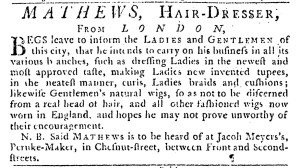
In December 1773, “MATHEWS, HAIR-DRESSER, FROM LONDON,” introduced himself to prospective clients in Philadelphia via advertisements in the Pennsylvania Gazette and the Pennsylvania Journal.  He informed “LADIES and GENTLEMEN of this city, that he intends to carry on his business in all its various branches.”  That included “dressing Ladies in the newest and most approved taste,” no doubt drawing on his connections to London to make sure they followed the latest trends, and “making Ladies new invented tupees, in the neatest manner.”  He also made “natural wigs” for gentlemen, “so as not to be discerned from a real head of hair,” as well as “other fashioned wigs now worn in England.”  His clients, Mathews suggested, could depend on looking as sophisticated as their cosmopolitan cousins in the capital of the empire.

Mathews had several choices for disseminating this message.  He opted for two newspapers, increasing the number of readers who would see his advertisement compared to publishing it in just one.  In addition to the Pennsylvania Gazetteand the Pennsylvania Journal, he could have placed it in the Pennsylvania Chronicle and the Pennsylvania Packet.  The cost of advertising may have prevented him from running notices in all four English-language newspapers published in Philadelphia at the time (and he likely considered advertising in the Wöchtenliche Pennsylvanische Staatsboteimpractical, even though the printer translated advertisements gratis).  Yet why did he choose the Pennsylvania Gazetteand the Pennsylvania Journal over the others?  The printers distributed those two newspapers on Wednesdays, while the printers of the Pennsylvania Chronicle and the Pennsylvania Packet distributed their publications on Mondays.  Mathews did not aim to have his advertisements spread out on different days, but that may not have mattered much in the context of weekly rather than daily publication.  Perhaps the cost of advertising influenced his decision, but that may not have been the case.  Although none of the printers included advertising fees in their colophons, they likely offered competitive rates.  All of them except for the Pennsylvania Gazette did include the annual subscription cost in their colophon.  The consistency, ten shilling for each of them, suggests that they set similar fees for advertising.  Perhaps Mathews selected the Pennsylvania Gazette and the Pennsylvania Journal because he believed they had a wider circulation or reached more of the local gentry that he hoped to cultivate as clients.  His example raises a larger question about why any advertiser in cities with multiple newspapers (including Boston, Charleston, New York, and Williamsburg) chose one over another or some over others to run their notices.

September 3

What was advertised in a colonial American newspaper 250 years ago today?

Connecticut Journal (September 3, 1773).

“Amos Morrisson, Wigg-Maker & Hair-Dresser.”

“Just published … THE MACARONIE JESTER.”

Amos Morrisson may not have been very happy about where his advertisement appeared in the September 3, 1773, edition of the Connecticut Journal.  The “Wigg-Maker & Hair-Dresser” likely did not appreciate that an advertisement for “THE MACARONIE JESTER” appeared immediately below his notice directed to fashionable ladies and gentlemen.  Eighteenth-century readers would have immediately recognized the derogatory term for a man who took current fashions, both clothing and hair, to absurd and preposterous lengths.  The Oxford English Dictionary explains that this synonym for dandy or fop was especially popular in the second half of the eighteenth century to describe “a member of a set of young men who travelled in Europe and extravagantly imitated Continental tastes and fashions.”  On both sides of the Atlantic, the term broadened to refer to any man whose overindulgence in fashion suggested idleness and vice.

Given such negative associations with too much luxury, Morrisson may have been dismayed by the proximity of his advertisement and one for The Macaroni Jester, “Just published, And to be sold by the Printers.”  The wigmaker and hairdresser promoted “various modes” of wigs and hairstyles for men and women, such as “Bagg Wiggs and Spencer Bobs” and “Ladies Roles and French Curls,” as well as accoutrements to adorn hair, including ribbons.  Furthermore, he confided, “If the above Articles should not happen to suit, Gentlemen can be suited in any Taste whatever, in the best Manner and at the shortest Notice.”  Morrisson catered to his clients, but the advertisement for The Macaroni Jester raised suspicions about the “Macaroni beau,” others who luxuriated in current fashions and consumerism, and the purveyors of goods and services who outfitted them.  According to the staff at the Library of the Society of Friends, the book include “includes a ditty on ‘The Origin of Macaronies,” [but] there’s little else of the Macaroni in it: the word has been used simply as a synonym for humour, satire and above all absurdity.”  The “original stories, witty repartees, comical and original Bull’s, [and] entertaining Anecdotes” promised in the advertisement “poke fun at many stock figures.”  Still, that would not have been apparent to readers of the Connecticut Journal, especially since the advertisement emphasized that “the origin of a Macaroni” was “illustrated with a curious and neat copperplate frontispiece of a Macaroni beau.”

Morrisson almost certainly did not want such associations with the goods and services he provided as wigmaker and hairdresser.  Did he complain to the printing office about the juxtaposition of the two advertisements?  In the next issue, Morrisson’s advertisement ran on the front page, while the advertisement for The Macaroni Jester appeared on the final page.  That may have been the result of the usual sort of reorganization that took place between issues.  Compositors regularly moved around advertisements that ran for multiple weeks.  All the same, nothing prevented Morrisson from voicing his concerns about the unfortunate proximity of the two advertisements.

January 24

What was advertised in a colonial American newspaper 250 years ago this week?

Virginia Gazette [Purdie and Dixon] (January 21, 1773).
“He likewise makes Head Dresses for Ladies, so natural as not to be distinguished by the most curious Eye.”

George Lafong described himself as a “Hair Cutter and Dresser” in an advertisement he placed in the January 21, 1773, edition of the Virginia Gazette.  He aimed to generate business by suggesting that he already served a satisfied clientele, extending his “humble Thanks to such Ladies and Gentlemen as have been pleased to honour him with their Commands.”  In addition, he invited new clients to engage his services.

Lafong deployed several appeals in his efforts to convince residents of Williamsburg and nearby towns to hire him.  For instance, he did not require that clients visit his shop.  Instead, they could schedule appointments in advance “by giving timely Notice” and the hairdresser traveled to their homes and “waited upon [them] at any Distance from Town.”  He did not charge exorbitant prices, but instead set “very reasonable Terms” for such excursions.

In addition, Lafong promoted an associate that he recently hired, reporting that he “has engaged a Man from London who dresses in the newest and most elegant Taste.”  That gave Lafong an advantage over other hairdressers who relied on correspondence to learn about the latest trends in the cosmopolitan center of the empire.  His associate had firsthand knowledge and experience with the latest styles in London.  That advantage transferred to clients; not only did their appearance testify to making good choices in selecting a hairdresser but they could also boast about that hairdresser to friends and acquaintances.

In case that was not enough to convince prospective clients, Lafong also indicated that someone in his shop, either his new associate or Lafong himself, “makes Head Dresses for Ladies, so natural as not to be distinguished by the most curious eye.”  In other words, he created wigs and extensions, such as the popular high roll, that withstood close scrutiny.  Observers would not be able to tell which portions, if any, of his client’s hairstyle was not her actual hair.  Such authenticity helped in projecting grace, elegance, and other genteel attributes.

Fashion found its way to places far removed from London as colonizers participated in a transatlantic consumer revolution in the eighteenth century.  Hairdressers offered their services in major urban ports, like Charleston, New York, and Philadelphia, while also seeking to generate demand among prospective clients in the countryside “any Distance from Town.”  Fashion, both as a practice and as a motivation, was not confined to early American cities.

August 28

What was advertised in a colonial American newspaper 250 years ago today?

New-Hampshire Gazette (August 28, 1772).

“HAIR DRESSERS FROM LONDON.”

Fashion was not solely the domain of elites who resided in London, the cosmopolitan center of the empire, or the gentry in urban ports like New York and Philadelphia.  Instead, colonizers in places like Portsmouth, New Hampshire, also styled themselves according to the newest trends.  To do so, they often relied on the advice and guidance of the purveyors of goods and services, including shopkeepers, milliners, tailors, and hairdressers.

In an advertisement in the August 28 edition of the New-Hampshire Gazette, James Deacon and Robert Hughes described themselves as “HAIR DRESSERS FROM LONDON.”  They did not indicate how recently they settled in Portsmouth, though many readers would have known if Deacon and Hughes were new arrivals or had been in town for some time.  Asserting a connection to London bestowed some cachet on the hairdressers.  It implied experience serving clients who set the latest styles or adopted them quickly as they emerged.  It simultaneously intimated exposure to the newest trends, knowledge that gave hairdressers and others “FROM LONDON” an advantage over competitors who labored solely in the colonies.  When Deacon and Hughes declared that they made “Gentlemen’s Perriwigs … in the genteelest Taste,” they suggested that they could advise clients what constituted that standard in London.  When they stated that they made “Ladie’s Curls & Toupees … on a new Construction,” they hinted that they used methods not previously known in Portsmouth.  Prospective clients, Deacon and Hughes insinuated, benefited from hiring hairdressers with connections to London.

Deacon and Hughes hoped such appeals would convince clients to commit to longer terms of service than a single visit to their shop.  They offered “to dress Ladies and Gentlemen by the Month Quarter or Year,” cultivating and strengthening relationships.  Dressing hair over several months provided many opportunities to advise clients on the newest fashions, convincing them of the value of consulting with Deacon and Hughes.  The hairdressers marketed knowledge as well as skill in their efforts to attract clients.

April 17

What was advertised in a colonial American newspaper 250 years ago today?

Connecticut Journal (April 17, 1772).

“He continues to cut and dress Gentlemen and Ladies Hair in Taste, either antient or modern.”

Amos Morrisson described himself as a “Peruke-Maker and Dresser.”  He made wigs and styled hair for colonizers in and near New Haven in the early 1770s.  He placed an advertisement in the April 17, 1772, edition of the Connecticut Journal to inform current and prospective clients that he “lately removed from the Place where he formerly work’d, to a new Shop on the Church Land, next to Mr. Fairchild’s.”  That amounted to sufficient direction for patrons to find his new location.

Morrisson incorporated several marketing appeals into the remainder of his advertisement.  He addressed fashion and customer satisfaction simultaneously when he stated that he “continues to cut and dress Gentlemen and Ladies Hair in Taste, either antient or modern.”  In so doing, he hinted at debates about hairstyles that colonizers took seriously during the era of the American Revolution.  Men and women who adopted “modern” styles faced accusations that they indulged in luxury at the expense of good character.  Women wore high rolls, their hair and extensions elaborately arranged atop their heads.  Some men adopted a similar style, prompting critics to refer to them as “macaronis” as a critique of hairstyles, garments, and comportment associated with Italy.  Morrisson did not take a position in the debate.  Instead, he signaled that he was proficient in the “modern” style for those who wished to wear it, but he also served clients who preferred more conservative or “antient” styles.  Either way, his clients could depend on having their hair done “in Taste” at his shop.

In addition to styling hair, Morrisson “carried on Wigg-Making in all its Branches.”  He once again emphasized customer service, promising that “Gentlemen (both of Town and Country) … may depend upon being used in the best Manner.”  He constructed his wigs “of the best Materials” and set lower prices than prospective clients would find anywhere in the vicinity.  Morrisson declared that he sold his wigs “much cheaper … than has formerly been sold in Town.”  He also highlighted his experience and roots in the community, referencing clients “that have favoured him with their good Custom” in the past and inviting them to “continue the same.”

Morrisson’s advertisement was not particularly lengthy, but he managed to include a variety of appeals to incite demand for his services.  In so doing, he replicated aspects of advertisements placed by his counterparts in larger urban ports like New York and Philadelphia.  Fashion was not the province of the elite in those places.  Instead, purveyors of goods and services, including a “Peruke-Maker and Dresser” like Morrisson, served consumers throughout the colonies.