June 26

What was advertised in a revolutionary American newspaper 250 years ago today?
Pennsylvania Gazette (June 26, 1776).

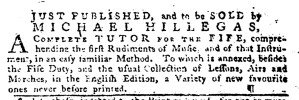
“A COMPLETE TUTOR FOR THE FIFE.”

The June 26, 1776, edition of the Pennsylvania Gazette carried an advertisement in which Michael Hillegas announced the publication and sale of “A COMPLETE TUTOR FOR THE FIFE, comprehending the first Rudiments of Music, and of the Instrument, in an easy familiar Method.”  That was not all that was in the manual.  This American edition included “the Fife Duty, and the usual Collections of Lessons, Airs and Marches, in the English Edition, [and] a Variety of new favourite ones never before printed.”  Hillegas may have hoped that the promise of tunes not previously available would entice even customers who already knew how to play the fife or had a copy of another edition of the musical manual.

According to JoAnn Taricani, Hillegas is “[p]erhaps best known as the First Treasurer of the United States,” yet he “maintained a number of mercantile enterprises during his lifetime, one of which was the music store he operated from approximately 1759 to 1779.”  At the time he advertised an American edition of “A COMPLETE TUTOR FOR THE FIFE,” his music shop, “the first business devoted specifically to musical merchandise in Philadelphia” and “the only specialty store for music in the colonies prior to the Revolutionary war,” had been open for more than fifteen years, likely making it familiar to many residents of the busy urban port.  “Virtually all printed music had to be imported,” Taricani notes, with “only a few efforts at music printing … attempted prior to the war.”[1]  A series of nonimportation agreements interrupted trade before the war, prompting American entrepreneurs to produce and to promote “domestic manufactures” or goods made in the colonies.  Hillegas apparently joined that effort with an American edition of a manual for learning to play the fife, though the advertisement did not make clear whether he published “A COMPLETE TUTOR FOR THE FIFE” or merely sold copies of it.  Eighteenth-century readers knew to separate the phrases “JUST PUBLISHED” and “to be SOLD,” with the latter referring to the advertisers but not necessarily the former.  Taricani suggests that the partnership of Hall and Sellers, the printers of the newspaper in which the advertisement appeared, published the musical manual.[2]  While Hillegas did not print “A COMPLETE TUTOR FOR THE FIFE,” he may have collaborated with Hall and Sellers in publishing it.  Neither the advertisement nor the imprint allows for a definitive conclusion.  What they do reveal is that the publisher believed a market exited for an American edition of the manual as the Revolutionary War continued and Hillegas attempted to incite even greater demand.

**********

[1] JoAnn Taricani, “Musical Commerce in Eighteenth-Century Philadelphia: The Letters of Michael Hillegas,” Pennsylvania Magazine of History and Biography 113, no. 4 (October 1989): 609-610.

[2] Taricani, “Musical Commerce,” 618.

September 15

What was advertised in a colonial American newspaper 250 years ago this week?

Pennsylvania Gazette (September 12, 1771).

“Just Published … POOR RICHARD’S ALMANACK, for the YEAR 1772.”

It was a familiar sign of the changing seasons when advertisements for almanacs first appeared in colonial newspapers in the fall.  Two such advertisements ran in the September 12, 1771, edition of the Pennsylvania Gazette.  The printers of that newspaper, David Hall and William Sellers, hawked “POOR RICHARD’S ALMANACK, for the YEAR 1772,” the popular almanac they published.  Isaac Collins advertised the “BURLINGTON ALMANACK” available at his printing office in Burlington, New Jersey.

Neither advertisement provided much additional information, the printers likely not considering it necessary at the time.  After all, prospective customers had more than four months to purchase copies before the new year began.  The brief advertisements drew attention to these almanacs before competitors began marketing their own publications.  John Fleeming adopted a similar strategy for “Bickerstaff’s Almanack For the Year 1772” when he placed an advertisement in the August 15, 1771, edition of the Massachusetts Gazette and Boston Weekly News-Letter to announce that the almanac “Will be published in September next.”  As fall progressed, more advertisements for almanacs would appear in newspapers from New England to South Carolina.  Each year, printers placed increasing elaborate advertisements in October, November, and December as competition for customers intensified.

For the moment, however, Hall and Sellers simply announced that they “Just publishedPoor Richard’s Almanackat theNew Printing-Office, in Market-street, Philadelphia.”  Collins offered a little more information, stating that his almanac contained “besides the usual astronomical Calculations, a Variety of useful and entertaining Matter, both in Prose and Verse.”  Collins also declared that he sold the Burlington Almanac “Wholesale and Retail,” encouraging booksellers, shopkeepers, and others to acquire copies to retail in their own shops.  Although Hall and Sellers did not mention wholesale transactions, alerting customers that they could add Poor Richard’s Almanack to their inventory may have been one of the primary purposes of publishing the almanac and advertising its availability so early.

Daylight hours diminished in September compared to the summer months.  Temperatures became colder.  Yet the natural world did not offer the only evidence that fall would soon arrive.  Readers of the Pennsylvania Gazette and other newspapers began encountering advertisements for almanacs for the coming year, another sure sign that summer was in its final days.

February 28

What was advertised in a colonial American newspaper 250 years ago today?

Pennsylvania Gazette (February 28, 1771).

”All Persons … who may incline to have their Advertisements published in the Pennsylvania Gazette … are requested to send the Money with them.”

Advertisements accounted for an important revenue stream for early American printers … when advertisers opted to pay for the notices they inserted in newspapers.  Printers regularly called on their customers to settle accounts.  In most instances, they addressed subscribers, advertisers, and others, but on occasion they singled out advertisers.  Such was the case when David Hall and William Sellers directed a missive to prospective advertisers in the February 28, 1771, edition of the Pennsylvania Gazette.

“NOTICE is hereby given,” Hall and Sellers proclaimed, “to all Persons, living at a Distance from this City, who may incline to have their Advertisements published in the Pennsylvania Gazette, that they are requested to send the Money with them.”  Apparently, the printers experienced particular frustration with advertisers who lived far from Philadelphia. In the era of the American Revolution, newspapers served entire colonies or regions rather than just the cities in which they were printed.  The same issue of the Pennsylvania Gazette that included this notice from the printers also carried real estate notices from other parts of the colony and advertisements offering rewards for apprentice and convict servants who ran away from masters in Maryland and Virginia.  In their efforts to convince customers to pay their bills, Hall and Sellers had more difficulty contacting faraway advertisers than their local counterparts.  Another issue exacerbated the situation.  The printers asked advertisers “also to pay the Postage of Letters in which they may be contained,” warning that “otherwise they will not be inserted.”  Colonists often sent letters with the expectation that the recipients would pay for postage upon receiving them.  That cut into the revenues gained by printing advertisements.  Hall and Sellers lamented that they had “already been great Sufferers in that Respect.”

This notice ran among the other advertisements in the February 28 edition.  The printers placed it at the top of a column, perhaps to give it greater visibility.  Beyond the stories told in ledgers and account books, this notice and others inserted by printers in newspapers from New England to Georgia reveal eighteenth-century business practices and some of the challenges of running printing offices.

February 12

What was advertised in a colonial American newspaper 250 years ago today?

feb-12-2121767-pennsylvania-gazette
Pennsylvania Gazette (Februar 12, 1767).

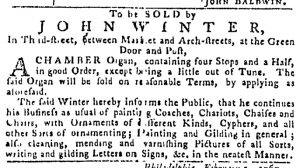
“To be SOLD by JOHN WINTER …”

Yesterday I questioned whether an advertisement for an escaped slave appeared regularly in the Georgia Gazette for six months because the aggrieved master wanted his human property returned so badly or because the printer needed content to fill the pages of the newspaper. Recently I have been contrasting the volume of advertising that appeared in newspapers published in major urban ports compared to those published in smaller cities and towns, usually noting how little advertising appeared in the latter.

Today I am featuring a newspaper at the other end of the spectrum. The Pennsylvania Gazette, founded in 1728 by Samuel Keimer but transformed into one of the most important and influential newspapers in the colonies after Benjamin Franklin in the decades after purchased it in 1729, often served as a vehicle for delivering advertising, sometimes at the expense of other content (including news items),

feb-12-supplement-pennsylvania-gazette
First page of Supplement to the Pennsylvania Gazette (February 12, 1767).

Consider the issue published 250 years ago today. David Hall and William Sellers, the printers of the Pennsylvania Gazette in 1767, placed at least some advertising on every page of the newspaper. Advertisements accounted for a quarter of a column on the second page and column and a half on the front page. Except for the colophon at the bottom of the last page, only advertisements appeared on the third and fourth pages. Nearly sixty advertisements of varying lengths filled just shy of eight columns, out of twelve total, in the February 12, 1767, issue of the Pennsylvania Gazette.

But wait: there’s more! A half sheet supplement accompanied the issue. Hall and Sellers granted a little space for the masthead. Otherwise, advertising filled all six columns of the two-page supplement. Many, but not all, were shorter than those in the regular issue, which allowed Hall and Sellers to squeeze in nearly sixty more paid notices. Unlike their counterparts in other cities, the printers of the Pennsylvania Gazette did not to insert advertisements about the goods and services they provided just to fill the page.

Historians of print culture in early America have long argued that any profits derived from printing a newspaper in the colonies derived from advertising revenue rather than subscriptions. By that measure, Hall and Sellers seemed to be doing very well for themselves as they published the Pennsylvania Gazette in 1767, presumably content to let advertisements sometimes crowd out other content. On the other hand, their decision to do so might also explain why William Goddard underscored that he intended “to give his readers a weekly relation of the most remarkable and important occurrences, foreign and domestic, collected from the best magazines and papers in Europe and America” when he issued his proposals for printing the Pennsylvania Chronicle, a competitor to the Pennsylvania Gazette. Perhaps Goddard suspected that some readers of the Gazette sometimes felt shortchanged when it came to reading actual news, rather than advertising, in their newspaper.