October 30

What was advertised in a revolutionary American newspaper 250 years ago today?
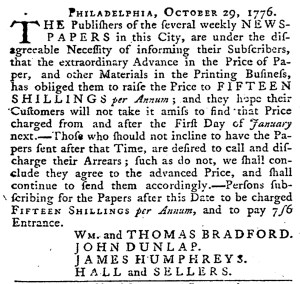
Pennsylvania Gazette (October 30, 1776).

“The extraordinary Advance in the Price of Paper … has obliged them to raise the Price.”

In the fall of 1776, William Hall, David Hall, and William Sellers announced that they would raise the price of their newspaper, the Pennsylvania Gazette, starting on January 1, 1777.  William Bradford and Thomas Bradford made the same decision about the Pennsylvania Journal.  So did John James Humphreys, Jr., for the Pennsylvania Ledger and John Dunlap for Dunlap’s Pennsylvania Packet.  Although they competed for subscribers and advertisers, the printers of those newspapers collaborated in setting a new price and informing current and prospective subscribers.  They placed a joint notice, dated October 29, that appeared in each newspaper.

It first ran in the Pennsylvania Gazette and the Pennsylvania Journal on October 30.  The Halls and Sellers made it the first item in the first column on the first page of the Pennsylvania Gazette to increase the chances that readers saw it.  The Bradfords did the same in the Pennsylvania Journal.  Humphreys followed their lead in the Pennsylvania Ledger on November 2.  When Dunlap’s Pennsylvania Packet came out on November 5, it also featured the joint advertisement in the same spot on the first page.

By announcing this change together, the “Publishers of the several weekly NEWS-PAPERS in this City” showed solidarity in the face of “the extraordinary Advance in the Price of Paper, and other Materials in the Printing Business” that “obliged them to raise the Price to FIFTEEN SHILLINGS per Annum.”  Printers throughout the new nation reported similar challenges during the Revolutionary War.  The printers in Philadelphia “hope[d] that their Customers will not take it amiss to find that Price charged from and after the First Day of January next,” yet they recognized that some subscribers would likely wish to withdraw.  For those “who should not incline to have the Papers sent after that Time,” the printers requested that they visit the appropriate office to settle accounts.  Otherwise, it was an opt out system rather than an opt in system.  If subscribers did not opt out, then the printers “shall conclude they agree to the advanced Price” and would continue to deliver newspapers for the higher subscription fee.  In placing a joint advertisement, the printers may have intended to reduce anger or frustration directed from their own subscribers directed at their newspaper by making it clear that the printers of several weekly newspapers found the price increase necessary and none set a higher price than any of the others.

This agreement among the “Publishers of the several weekly NEWS-PAPERS in this City” did not include Henrich Miller and Henrich Millers Pennsylvanischer Staatsbote, a German newspaper, nor Benjamin Towne’s Pennsylvania Evening Post that came out three times a week on Tuesdays, Thursdays, and Saturdays.
February 12

What was advertised in a colonial American newspaper 250 years ago today?

feb-12-2121767-pennsylvania-gazette
Pennsylvania Gazette (Februar 12, 1767).

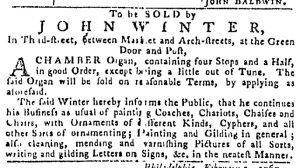
“To be SOLD by JOHN WINTER …”

Yesterday I questioned whether an advertisement for an escaped slave appeared regularly in the Georgia Gazette for six months because the aggrieved master wanted his human property returned so badly or because the printer needed content to fill the pages of the newspaper. Recently I have been contrasting the volume of advertising that appeared in newspapers published in major urban ports compared to those published in smaller cities and towns, usually noting how little advertising appeared in the latter.

Today I am featuring a newspaper at the other end of the spectrum. The Pennsylvania Gazette, founded in 1728 by Samuel Keimer but transformed into one of the most important and influential newspapers in the colonies after Benjamin Franklin in the decades after purchased it in 1729, often served as a vehicle for delivering advertising, sometimes at the expense of other content (including news items),

feb-12-supplement-pennsylvania-gazette
First page of Supplement to the Pennsylvania Gazette (February 12, 1767).

Consider the issue published 250 years ago today. David Hall and William Sellers, the printers of the Pennsylvania Gazette in 1767, placed at least some advertising on every page of the newspaper. Advertisements accounted for a quarter of a column on the second page and column and a half on the front page. Except for the colophon at the bottom of the last page, only advertisements appeared on the third and fourth pages. Nearly sixty advertisements of varying lengths filled just shy of eight columns, out of twelve total, in the February 12, 1767, issue of the Pennsylvania Gazette.

But wait: there’s more! A half sheet supplement accompanied the issue. Hall and Sellers granted a little space for the masthead. Otherwise, advertising filled all six columns of the two-page supplement. Many, but not all, were shorter than those in the regular issue, which allowed Hall and Sellers to squeeze in nearly sixty more paid notices. Unlike their counterparts in other cities, the printers of the Pennsylvania Gazette did not to insert advertisements about the goods and services they provided just to fill the page.

Historians of print culture in early America have long argued that any profits derived from printing a newspaper in the colonies derived from advertising revenue rather than subscriptions. By that measure, Hall and Sellers seemed to be doing very well for themselves as they published the Pennsylvania Gazette in 1767, presumably content to let advertisements sometimes crowd out other content. On the other hand, their decision to do so might also explain why William Goddard underscored that he intended “to give his readers a weekly relation of the most remarkable and important occurrences, foreign and domestic, collected from the best magazines and papers in Europe and America” when he issued his proposals for printing the Pennsylvania Chronicle, a competitor to the Pennsylvania Gazette. Perhaps Goddard suspected that some readers of the Gazette sometimes felt shortchanged when it came to reading actual news, rather than advertising, in their newspaper.