September 13

What was advertised in a revolutionary American newspaper 250 years ago today?
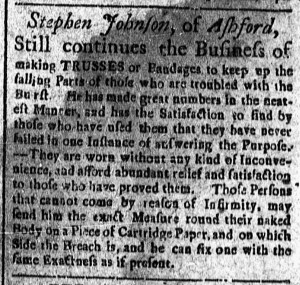
Connecticut Gazette (September 13, 1776).

“Send him the exact Measure round their naked Body on a Piece of Cartridge Paper.”

In September 1776, Stephen Johnson published an advertisement in the Connecticut Gazette to inform the public that he “Still continues the Business of making TRUSSES or Bandages to keep up the falling Parts of those who are troubled with the Burst.”  In other words, Johnson made hernia belts to relieve the discomfort of his clients.  Some readers may have previously been aware that Johnson made and sold trusses.  He had previously advertised in the Connecticut Gazette in April 1774.  That notice featured a testimonial signed by eight of Johnson’s former customers who addressed the printer and requested that he “insert the following in your next Paper.”  Given that they were so satisfied with their trusses that they took that step, they may have also promoted Johnson’s hernia belts via word of mouth.

In his new advertisement, Johnson declared that he “has made great numbers in the neatest Manner,” emphasizing both his experience and skill.  Furthermore, he “has the Satisfaction to find by those who have used them that they have never failed in one Instance of answering the Purpose.”  That may have been the most important appeal.  Johnson proclaimed that his trusses were effective, that they offered relief to his customers who purchased and wore them.  New customers could depend on wearing their trusses “without any kind of Inconvenience,” suggesting that they were not bulky or unnecessarily constrictive of movement.  Those who did would discover that the devices “afford abundant relief and satisfaction,” just as they had done for his customers in the past.

Johnson realized that not all prospective customers could visit him in Ashford for a fitting.  For those who wished to place orders from a distance, he offered these instructions: “send him the exact Measure round their naked Body on a Piece of Cartridge Paper, and on which Side the Breach is.”  He gave similar directions in his previous advertisement.  Such customers did not need to worry that they had not been precise in taking and recording their own measurements if they sent a length of paper that they had wrapped around their body and cut accordingly.  Johnson devised that means of increasing sales by filling order received from a distance, an eighteenth-century precursor to mail order medicine.

April 1

What was advertised in a colonial American newspaper 250 years ago today?

Connecticut Gazette (April 1, 1774).

“We the Subscribers have received such unexpected and unheard of Relief, and final Cures.”

It looked like a letter to the editor, but actually it was a testimonial advertising “Trusses or Bandages” for treating hernias.  The notice opened with a salutation, “Mr. GREEN, Please to insert the following in your next Paper,” addressing Timothy Green, the printer of the Connecticut Gazette.  Had it appeared only once on March 25, 1774, it might have been intended as an interesting news item selected by Green or it might have been an advertisement quickly discontinued.  That it ran in three consecutive issues, however, confirms that it was a paid notice that took an unusual format compared to most other advertisements for goods and services.  Testimonials about medicines and medical services appeared occasionally, though not regularly, in colonial newspapers in the 1760s and 1770s.

Eight “Subscribers [who] have received such unexpected and unheard of Relief, and final Cures, of the Difficulty of the Burst” (or hernia) extolled the efficacy of treatment provided by Stephen Johnson of Ashford.  They proclaimed that “by so many infallible Proofs, he hath the greatest Skill in that Business of any Man we ever heard of.”  Johnson had been so successful in alleviating their discomfort that those he assisted stated that they “Do think it our Duty, for the Benefit of Mankind, to publish” their endorsement of the “Trusses or Bandages, made and applied” by Johnson.  Furthermore, they encouraged “Any Person needing his Help” to contact Johnson, promising that if they sent “an exact Measure of their Body or Waist, with the Side in which the Breach is made, [they] may be as exactly fitted as present.”  Johnson possessed such great skill, the eight “Subscribers” insisted, that he could provide effective treatment even without consulting with patients in person.  He offered a precursor to mail order home health care supplies and equipment.

No doubt Daniel Holt, Samson Keyes, Amos Babcock, and five other “Subscribers” would testify to their experiences with Johnson and his trusses if asked by friends and neighbors who saw the notice in the Connecticut Gazette, but most likely they did not decide on their own to collaborate in writing and publishing that testimonial.  Instead, Johnson probably coordinated the effort, composed the copy himself, polled satisfied clients for permission to include their names, and paid top insert the advertisement in the newspaper.  Perhaps one or more of those clients enthusiastically thanked him for his assistance, planting the idea for the testimonial.  Inspired by their gratitude, Johnson may have seen an opportunity to leverage his prior experience into a marketing effort that would garner new clients.