September 25

What was advertised in a revolutionary American newspaper 250 years ago today?

New-York Gazette and Weekly Mercury (September 25, 1775).

“Illustrated with a beautiful Plan of Boston, and the Provincial Camp.”

When fall arrived, it was time to market almanacs for the coming year.  It was an annual ritual in American newspapers from New England to Georgia.  Hugh Gaine, the printer of the New-York Gazette and Weekly Mercury, began advertising “HUTCHIN’s Improv’d: BEING AN ALMANACK … For the Year of our LORD 1776” on September 18, 1775, and then inserted his extensive notice in subsequent issues.  The almanac’s contents included the usual astronomical data, such as “Length of Days and Nights” as well as a schedule of the courts, a description of roads to other cities and towns, and “useful Tables, chronological Observations and entertaining Remarks.”  Gaine enumerated thirty-one of those items, such as a “Very comical, humorous, and entertaining Adventure of a young LADY that used to walk in her sleep,” an essay on the “evil Consequences of Sloth and Idleness,” and a “Method for destroying Caterpillars on Trees.”

If all of that was not enough to entice customers, Gaine made sure that they knew that the almanac was “Illustrated with a beautiful Plan of Boston, and the Provincial Camp.”  That proclamation led the advertisement, appearing immediately above the title of the almanac.  Gaine then devoted the greatest amount of space to describing the map: “13. A very neat Plan of the Town of Boston, shewing at one View, the Provincial Camp, Boston Neck, Fortification, Commons, Battery, Magazines, Charlestown Ferry, Mill Pond, Fort Hill, Corps Hill, Liberty Tree, Windmill Point, South Battery, Long Wharf, Island Wharf, Hancock’s [Wharf], Charlestown, Bunker’s Hill, Winter Hill, Cobble Hill, Forts, Prospect Hill, Provincial Lines, Lower Fort, Upper [Fort], Main Guard, Cambridge College, Charles River, Pierpont’s Mill, Fascine Battery, Roxbury Hill Lines, General Gage’s Lines, Dorchester Hill and Point, and Mystick River.”  As the siege of Boston continued, Daine realized that colonizers in Boston would be interested in supplementing what they read in newspapers and heard from others with a map that would help them envision and better understand recent events.

What was the source for the map?  According to the catalog description for the almanac by PBA Galleries, Auctioneers and Appraisers, the map, “titled a ‘Plan of Boston,’ details Boston’s Shawmut Peninsula and with a smaller inset of the greater Boston area.  Both maps appear to be based on the ‘New and Correct Plan of the Town of Boston and Provincial Camp,’ which appeared in the Pennsylvania Magazine for July, 1775.”  The image that Aitken marketed to spur magazine sales found its way into another periodical publication.  Another printer used it to generate demand for an item produced on his press.

Gaine also listed “11. The whole Process of making SALT PETRE, recommended by the Hon. The Continental Congress, for the making of which there is a Bounty now given both in this and the neighbouring Provinces” and “12. The Method of making Gun-Powder, which at this Juncture may be carried into Execution in a small Way, by almost every Framer in his own Habitation.”  The auction catalog further clarifies that the almanac contains “the Resolution of Congress, July 28, 1775 on the necessity of making gunpowder in the colonies, signed in print by John Hancock, with a recipe for gunpowder on the reverse of the map.”  More than ever, current events played a part in compiling the contents and then marketing almanacs.

“Plan of Boston,” in Hutchins Improved: Being an Almanack and Ephemeris … For the Year of Our Lord 1776 (New York: Hugh Gaine, 1775). Courtesy PBA Galleries, Auctioneers and Appraisers.

July 24

What was advertised in a revolutionary American newspaper 250 years ago today?

New-York Gazette and Weekly Mercury (July 24, 1775).

“For the LADIES. MRS. GIBSON’s CURIOUS COMPOUND.”

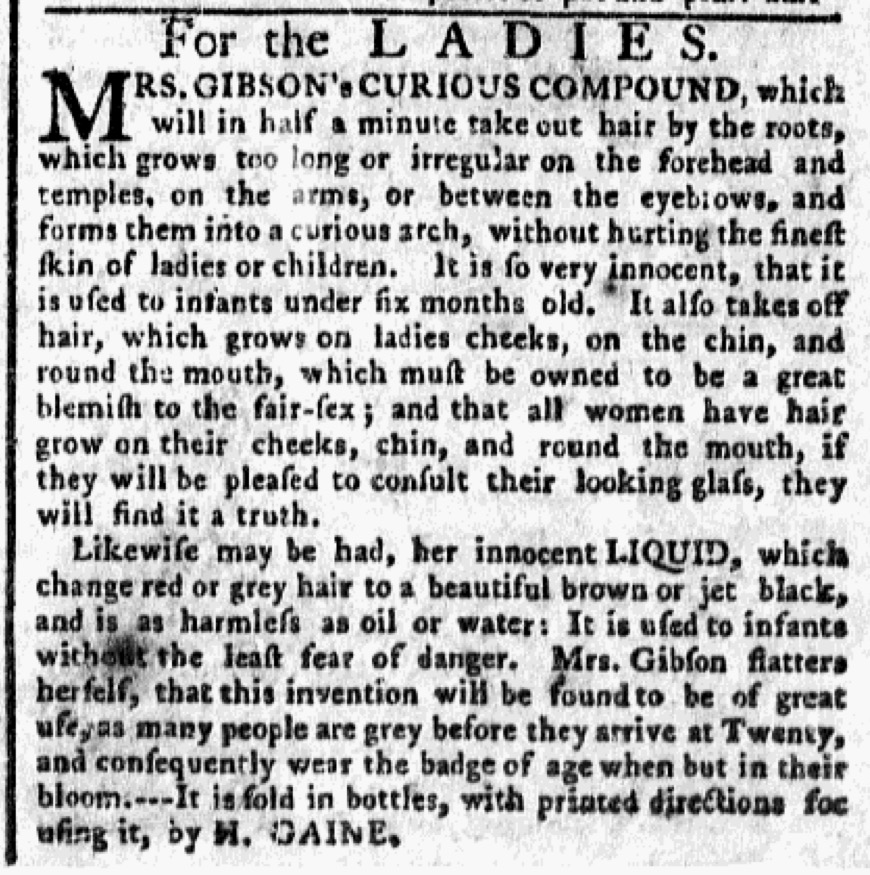
Cosmetics advertisements occasionally appeared in newspapers during the era of the American Revolution, such as one about “MRS. GIBSON’s CURIOUS COMPOUND” in the July 24, 1775, edition of the New-York Gazette and Weekly Mercury.  The headline, “For the LADIES,” made clear the target audience.  The copy explained that the product “will in half a minute take out hair by the roots, which grows too long or irregular on the forehead and temples, on the arms, or between the eyebrows, and forms them into a curious arch.”  Even more appealing, it did so “without hurting the finest skin of ladies or children.”  Indeed, Mrs. Gibson’s Curious Compound was so gentle and “so very innocent, that it is used [on] infants under six months old.”

Yet the pitch did not end there.  According to the advertisement, the product “also takes off hair, which grows on ladies cheeks, on the chin, and round the mouth, which must be owned to be a great blemish to the fair-sex.”  Lest any female readers to feel too confident about their appearance, the advertisement asserted that “all women have hair grow on their cheeks, chin, and round the mouth.”  That was not a matter of conjecture but something they could prove with their own eyes: “if they will be pleased to consult their looking glass, they will find it a truth.”  The marketing for Mrs. Gibson’s Curious Compound relied on making women feel anxiety about their bodies, not unlike the marketing undertaken by staymakers who addressed “Ladies who are uneasy in their shapes.”

In addition to her hair removal compound, Mrs. Gibson produced an “innocent LIQUID, which change[s] red or grey hair to a beautiful brown or jet black.”  Safety once again played a role in promoting the product.  The advertisement claimed it was “as harmless as oil or water” and could even be “used [on] infants without the least fear of danger.”  The marketing for Mrs. Gibson’s products seemed to have a formula.  After a description of the purpose of Mrs. Gibson’s Liquid and a note about safety, the copy attempted to incite feelings of discomfort and self-consciousness among readers.  “[T]his invention will be found to be of great use,” the advertisement declared, “as many people are grey before they arrive at Twenty, and consequently wear the badge of age when but in their bloom.”  Yet young ladies did not need to appear prematurely old, nor did older ladies need to look their age if they applied Mrs. Gibson’s Liquid to their hair.

Where could women acquire Mrs. Gibson’s Curious Compound and Mrs. Gibson’s Liquid?  Hugh Gaine sold both products, along with “printed directions,” at the printing office where he published the New-York Gazette and Weekly Mercury.  The printer also supplemented his income by marketing Keyser’s Famous Pills once again.  Both advertisements appeared in the final column of the first page of his newspaper.  Printers often stocked, marketed, and sold patent medicines as an additional revenue stream, but they did not promote cosmetics nearly as often.  The printed directions, however, made Mrs. Gibson’s products easy to sell since nobody in the printing office needed to have any direct knowledge of them, just as printed directions made it unnecessary to know much about patent medicines sold in printing offices.

November 14

What was advertised in a colonial American newspaper 250 years ago today?

New-York Gazette and Weekly Mercury (November 14, 1774).

“The great Demand for the Proceedings of the Continental Congress, has caused a second Edition to be printed.”

Hot off the press and flying off the shelf!  Hugh Gaine, the printer of the New-York Gazette and Weekly Mercury, reported a high level of public interest in the Extracts from the Votes and Proceedings of the American Continental Congress.  On November 14, 1774, he took the unusual measure of inserting an advertisement among the news to inform readers that the “great Demand for the Proceedings of the Continental Congress, has caused a second Edition to be printed; — which is this Day published, and sold by Hugh Gaine, in Hanover-Square.”  Although news and advertisements often appeared next to each other in colonial newspapers, printers did not ordinarily intersperse advertisements and news.  That made it noteworthy that Gaine’s advertisement appeared below local news from New York and above shipping news from the custom house.

Although Gaine published and sold a “second Edition” of the Extracts, he was not responsible for the first edition printed in New York.  On November 3, John Holt, the printer of the New-York Journal, ran a notice advising of “THE PROCEEDINGS OF THE CONTINENTAL CONGRESS, With their Letter to the People of QUEBEC, To be sold by the Printer.”  Unlike an advertisement for a Philadelphia edition in the Pennsylvania Journal the previous day, Holt’s notice did not list the contents.  He apparently considered the meeting of the First Continental Congress sufficient recommendation for marketing a pamphlet that gave an overview of the decisions made by the delegates.  He ran the same advertisement, without update, a week later.  Not long after that, Gaine advertised a “second Edition” that seems to have been a competing edition.  He had not previously advertised the Extracts in the New-York Gazette and Weekly Mercury, suggesting that he had witnessed the popularity of Holt’s edition and decided to generate revenue by printing and selling his own edition.  The political pamphlet had not necessarily sold out, as Gaine’s advertisement suggested, but instead a second printer entered the market.  In his History of Printing in America (1810), patriot printer Isaiah Thomas remarked that “Gaine’s political creed, it seems, was to join the strongest party.”[1]  Gaine may not have held to any political principles as strongly as Holt, who had incorporated the “Unite or Die” political cartoon into the masthead of his newspaper, yet his actions did serve the purposes of the First Continental Congress.  The delegates had ordered the publication of the Extracts.  Disseminating that political pamphlet did not require sincere belief on the part of Gaine or any other printer, though most who published and marketed it did tend to vocally support the American cause throughout the imperial crisis.

**********

[1] Isaiah Thomas, The History of Printing in America: With a Biography of Printers and an Account of Newspapers (1810; New York: Weathervane Books, 1970), 472.

February 21

What was advertised in a colonial American newspaper 250 years ago today?

New-York Gazette and Weekly Mercury (February 21, 1774).

“☛K ☛E ☛Y ☛S ☛E ☛R’s Famous Pills.”

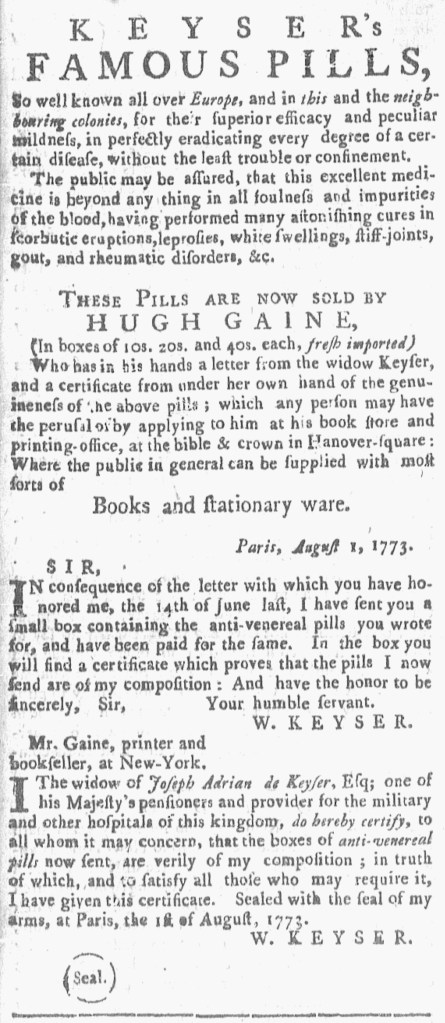
Hugh Gaine, “PRINTER, BOOKSELLER, and STATIONER” (as he described himself in the masthead of the New-York Gazette and Weekly Mercury), continued marketing “KEYSER’s Famous Pills,” a remedy for syphilis, in the February 21, 1774, edition of his newspaper.  He gave his advertisement a privileged place.  It was the first item in the first column on the first page, making it difficult for readers to miss.  The advertisement consisted of several portions, collectively extending half a column.  The first two portions, enclosed within a border composed of decorative type, provided a description of the efficacy of the pills in “eradicating every Degree of a certain DISEASE” and curing other maladies and offered an overview of “a Letter from the Widow Keyser, and a Certificate from under her own Hand” testifying to the “Genuineness” of the pills Gaine sold.  In recent months, both apothecaries and printers in New York and Philadelphia engaged in public disputes about who stocked authentic pills and who peddled counterfeits.  Even though Gaine invited the public to examine the letter and certificate at his store in Hanover Square (where they could shop for “Books and Stationary Ware”), the final two portions of his advertisement consisted of transcriptions of those items and a representation of the widow’s “Seal of my Arms.”

The decorative border, the only one in that issue of the New-York Gazette and Weekly Mercury, made Gaine’s advertisement more visible among the contents of the newspaper, yet that was not his only innovative use of graphic design.  For several weeks he had been playing with manicules as a means of drawing attention to his advertisements.  In this instance, a manicule appeared before each letter of “KEYSER,” pointing to the right.  Such had been the case when the advertisement ran on January 24 and 31 and February 7 and 14.  The first time he incorporated manicules into his advertisement for “KEYSER’s FAMOUS PILLS,” however, he had twelve pairs pointing at each other, six pairs above the name of the product and six pairs below the name of the product.  That version appeared just once, on November 1, 1773.  Subsequently, Gaine positioned manicules above each letter of “KEYSER,” pointing down, in six issues.  That arrangement ran on November 8, 15, and 22 and December 6 and 13, each time with a border.  When Gaine used it again on January 17, 1774, he did not include a border but once again had six manicules pointing down, one above each letter of “KEYSER.”  He apparently did not expect the appeals in his advertisements to do all the work of marketing the patent medicine.  Instead, Gaine believed that graphic design aided his efforts to reach prospective customers who much preferred fingers literally pointing at the name of the pills in advertisements over fingers figuratively pointing at them by others who suspected them of being afflicted with “a certain DISEASE.”

New-York Gazette and Weekly Mercury (November 1, 1773).

**********

New-York Gazette and Weekly Mercury (January 17, 1774).

November 29

What was advertised in a colonial American newspaper 250 years ago today?

Newport Mercury (November 29, 1773).

“THESE PILLS ARE NOW SOLD BY HUGH GAINE.”

Colonial printers often supplemented the revenues they generated from subscriptions, advertising, and job printing by selling books, stationery, blanks, … and patent medicines.  Hugh Gaine, the printer of the New-York Gazette and Weekly Mercury, and James Rivington, the printer of Rivington’s New-York Gazetteer, competed with each other and with apothecaries to sell “KEYSER’s FAMOUS PILLS,” a cure for syphilis and other maladies, in the fall of 1773.  Rivington also supplied William Bradford and Thomas Bradford, the printers of the Pennsylvania Journal, with pills that he imported.  As he perused newspapers printed in Philadelphia, Rivington noticed that Townsend Speakman and Christopher Carter, chemists and druggists in that city, advertised that they sold Keyser’s Pills acquired directly from James Cowper, “Doctor of Physick” and “the only legal proprietor” of that medicine in England.  Rivington sent the Bradfords a letter testifying that he received the pills he forwarded to them directly from the son of the late Keyser, residing in Paris.  The Bradfords promptly published that letter in an advertisement that ran immediately below the one placed by Speakman and Carter.

Rivington was not alone in his efforts to gain as much of the market beyond New York as he could.  Gaine looked to the north, advertising in the Newport Mercury.  His notice appeared at the top of the first column on the first page of the November 29 edition of that newspaper, a place of prominence that likely garnered some attention.  A headline in a larger font than anything else on the page except the title of the newspaper in the masthead also enhanced the visibility of the product that Gaine peddled.  This advertisement replicated the copy of Gaine’s notice in the New-York Gazette and Weekly Mercury a week earlier, though it did not retain the format.  Gaine’s advertisement in the Newport Mercury lacked a decorative border and the multiple manicules that pointed to each letter in “KEYSER,” though it still featured a representation of a “Seal” at the end of the transcription of the certificate of authenticity sent to Gaine by Keyser’s widow.  Gaine did not list Solomon Southwick, the printer of the Newport Mercury, or any other associates in Newport as local agents who sold Keyser’s Pills on his behalf.  He apparently expected that readers would submit orders to him in New York, an eighteenth-century version of mail order medications.

November 22

What was advertised in a colonial American newspaper 250 years ago today?

New-York Gazette and Weekly Mercury (November 22, 1773).

“A Certificate from under her own Hand of the Genuineness of the above Pills.”

Hugh Gaine, the printer of the New-York Gazette and Weekly Mercury, and James Rivington, the printer of Rivington’s New-York Gazetteer, competed to sell subscriptions, to sell advertising, to sell books, to sell stationery, to sell printed blanks, to do job printing orders, … and to sell patent medicines.  In particular, they marketed and sold “KEYSER’s FAMOUS PILLS” for “perfectly eradicating every Degree of a certain Disease.”  Eighteenth-century readers understood that those code words referred to syphilis.

In November 1773, Gaine published a new salvo in the ongoing advertising war over Keyser’s Pills.  He expanded on his earlier advertisements, noting that he now “has in his Hands a Letter from the Widow Keyser, and a Certificate under her own Hand of the Genuineness of the above Pills.”  Furthermore, he declared that “any Person may have the Perusal of [those documents] by applying to him at his Book Store and Printing Office.”  That portion of the advertisement appeared within a decorative border.  Gaine also called attention to his notice with six manicules, one pointing to each letter of “KEYSER.”

Yet he still did not consider that sufficient to attract the attention of prospective customers and convince them to purchase the remedy from him rather than from Rivington or other purveyors.  Gaine’s primary competitor had been publishing advertisements that included descriptions of patients successfully treating that “DISEASE, not to be mentioned in a News-Paper” as well as rheumatism, apoplexies, asthma, and a “WHITE SWELLING.”  Rivington has also supplied William Bradford and Thomas Bradford, printers of the Pennsylvania Journal in Philadelphia, with a letter attesting that he supplied them with Keyser’s Pills imported “immediately from Mr. Keyser himself,” the son of the late doctor, “at Paris.”  That answered claims by Speakman and Carter, “Chemists and Druggists,” that they acquired their supply of Keyser’s Pills from James Cowper, “the only importer in London.”  In his most recent advertisement, Rivington proclaimed that he had “Certificates and Letters of the old Doctor, and Madame W. KEYSER, his Widow, and likewise of their Son, the present Monsieur Keyser, who has many Years prepared all the Pills sold by his Father.”  Like Gaine, Rivington invited the public to examine those documents at his printing office.

That apparently prompted Gaine to expand his advertisement once again.  Instead of merely presenting the option of seeing the letter and certificate he received from Keyser’s widow at his shop, he published transcriptions of both documents in his newspaper notice.  In the letter, Madame Keyser acknowledged her correspondence with Gaine and explained that the certificate “proves that the Polls I now send are of my Composition.”  The certificate was “Sealed with the Seal of my Arms, at Paris.”  Gaine included a representation of the seal to underscore the authenticity of the medicines he peddled.

When it came to advertising the goods and services available at their printing offices, Gaine and Rivington invested a significant amount of time and energy in promoting a particular patent medicine.  Their efforts suggest that Keyser’s Pills accounted for an important revenue stream to supplement their earnings from selling newspapers, advertising, books, stationery, blanks, and job printing.  They also seemed to follow and respond to advertisements placed by each other as well as others who sold the famous patent medicine.

October 7

What was advertised in a colonial American newspaper 250 years ago today?

New-York Gazette and Weekly Mercury (October 7, 1771).

“High Gaine has for sale, a great variety of books.”

Although some colonial printers reserved the final pages of their newspapers for advertising, not all did so.  In many newspapers, paid notices could and did appear on any page, including the front page.  Such was the case in Hugh Gaine’s New-York Gazette and Weekly Mercury.  Consider the issue for October 7, 1771.  Gaine divided the first page between news items and advertising, filling the first two columns with the former and the last two with the latter.  He did the sane on the second page.  On the third page, he arranged news in the first column and into the second, but the bottom half of the second column as well as the remaining two columns consisted entirely of advertising.  Gaine gave over the entire final page to paid notices.

In general, Gaine placed news and advertising next to each other, but, like other printers who followed that method, he did not intersperse news and advertising on the page.  He delineated space intended for news and space intended for advertising rather than having paid notices appear among news items and editorials … with one exception.  He inserted an advertisement for books, stationery, and other items available at his printing office among the news on the third page. That advertisement appeared below a death notice for “Mrs. Cooke, Wife of the Rev. Mr. Cooke, Missionary at Shrewsbury,” and above the shipping news from the New York Custom House.  A line of ornamental type then separated the news (and Gaine’s advertisement) from the advertisements that completed the column and filled the remainder of the page.  In choosing this format, Gaine increased the likelihood that readers perusing the newspaper for news and skipping over the sections for advertising would see his own advertisement.  He was not the only colonial printer who sometimes adopted that strategy, leveraging his access to the press to give his own advertisement a privileged place.  Gaine inserted other advertisements elsewhere in the October 7 edition, most of them short notices intended to complete a column, but he exerted special effort in drawing attention to his most extensive advertisement by embedding it among the news.  His customers who purchased space for their notices did not have the same option.

September 25

What was advertised in a colonial American newspaper 250 years ago this week?

New-York Gazette and Weekly Mercury (September 23, 1771).

“[The particulars are ommitted this week for want of room.]”

When the ship America arrived in New York as summer turned to fall in 1771, merchants and shopkeepers received new merchandise from their associates in England.  Many of them placed newspaper advertisements to alert prospective customers that they had new inventory.  Purveyors of goods were not alone, however, in welcoming new opportunities to do business.  For Hugh Gaine, the printer of the New-York Gazette and Weekly Mercury, the America delivered more than just news for him to publish but also opportunities to generate advertising revenue.

Henry Remsen and Company placed an advertisement announcing that they “Have imported in the America, Capt. Hervey, from Hull … a general assortment of seasonable goods.”  Similarly, Daniel Phoenix noted that he “Has just imported in the America, Capt. Hervey, from Hull … the following goods” and then, like Remsen and Company listed dozens of items.  Henry Williams ran a shorter advertisement, but he also declared that he “HATH imported by theAmerica, Captain Hervey,” a variety of textiles that he would sell for low prices.

Gerret Keteltas and Wynandt Keteltas also published a short advertisement in the September 23 edition of the New-York Gazette and Weekly Mercury, after receiving “a neat and general assortment of European and India goods” via “the America, Capt. Hervey.”  Unlike the others, their advertisement did not appear in its entirety.  Instead, Gaine truncated their notice and included an explanation that “The particulars are ommitted this week for want of room.”  The printer could have made room for the advertisement, but at the expense of publishing news from London received by ships that recently arrived in New York.  Instead, he gave the Keteltases’ advertisement a privileged spot in the next edition placing it at the top of one of the columns on the third page.  It appeared immediately below the chart of high tides and prices current that Gaine regularly incorporated into the masthead, making it even more likely that readers would take note of the advertisement.

Like other printers, Gaine faced editorial decisions about the balance of news and advertising.  Paid notices accounted for significant revenue for many printers, especially for Gaine since he regularly issued a two-page supplement devoted entirely to advertising.  Yet subscribers who wanted to read the news were also an important part of the equation.  If they discontinued their subscriptions because they did not receive as much news content as they wished, then newspapers became less attractive to advertisers who wished to reach as many prospective customers as possible.  In this instance, Gaine attempted to chart a course to satisfy both readers and advertisers when both news and imported good arrived on the America.

September 23

What was advertised in a colonial American newspaper 250 years ago today?

Supplement to the Boston-Gazette (September 23, 1771).

A large and compleat Assortment of ENGLISH, INDIA, and SCOTCH GOODS.”

Benjamin Edes and John Gill, printers of the Boston-Gazette, had more content than would fit in the standard issue on September 23, 1771.  Like other newspapers published during the colonial era, an issue of the Boston-Gazette consisted of four pages.  Edes and Gill printed two pages on each side of a broadsheet and then folded it in half.  On occasion, however, they had sufficient content to merit publishing a supplement to accompany the standard issue.  They did so on September 23.  Hugh Gaine, printer of the New-York Gazette and Weekly Mercury, did so as well.

Both supplements consisted of two pages.  Both contained advertisements exclusively.  Despite these differences, Gaine adopted a slightly different strategy in producing the supplement for his newspaper than Edes and Gill did.  The standard issue of the New-York Gazette and Weekly Mercury featured four columns per page.  The supplement did as well.  Gaine used a half sheet that matched the size of the standard issue; all six pages were the same size.  Edes and Gill, on the other hand, did not.  A standard issue of the Boston-Gazette had three columns, but only two columns for the supplement.  The printers chose a smaller sheet to match the amount of content and conserve paper.  They generated revenue from the advertisements in the supplement, but kept costs down in producing it.

The relative sizes of the supplements compared to the standard issues would be readily apparent when consulting originals, but not when working with digitized images.  As a result of remediation, digital images become the size of the screen and change as readers zoom in and zoom out.  The size of the page of a digital image is not permanent, unlike the size of the page of the original newspaper.  In the process of remediation, information about originals gets lost if those creating new images do not record and make metadata accessible.  In this case, modern readers consulting digitized images can deduce that Edes and Gill used a different size sheet for the supplement, but have a much more difficult time imagining the experience of eighteenth-century subscribers who received sheets of two different sizes.

January 16

What was advertised in a colonial American newspaper 250 years ago this week?

Supplement to the New-York Gazette and Weekly Mercury (January 14, 1771).

“Said Morton has to dispose of, a large and very neat assortment of gilt and plain frame looking-glasses and sconces.”

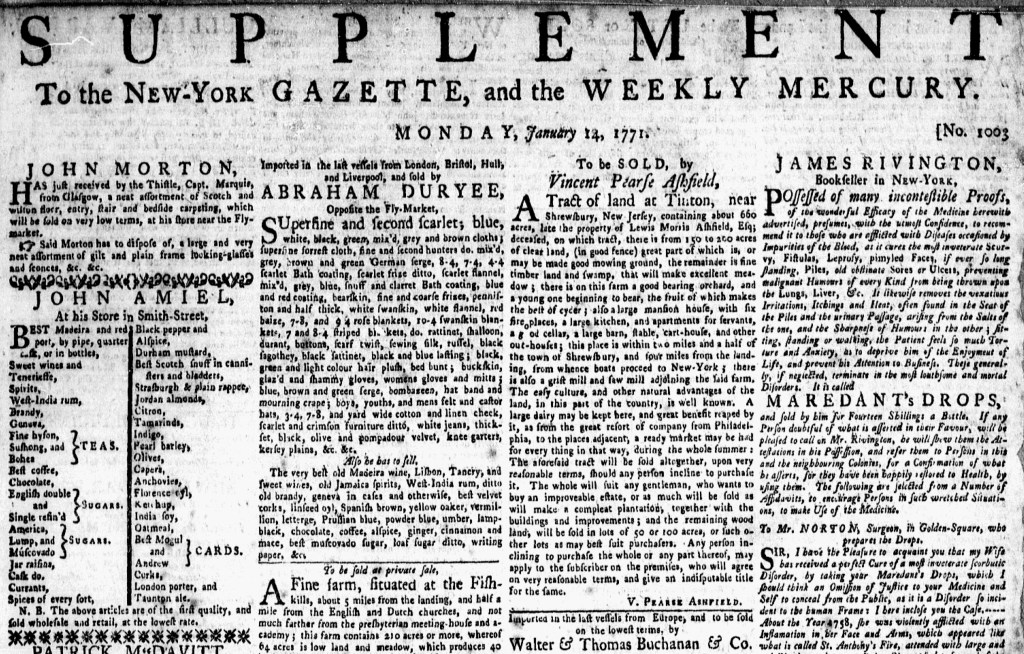
Hugh Gaine, “Printer, Bookseller, and Stationer, at the Bible and Crown, in Hanover-Square,” printed the New-York Gazette and Weekly Mercury, one of several newspapers published in the city in the early 1770s.  On many occasions, Gaine devoted more space to disseminating advertising than news articles, letters and editorials, prices current, and shipping news from the customs house.  Such was the case for the January 14, 1771, edition.

Like other eighteenth-century newspapers, that issue consisted of four pages created by printing two on each side of a broadsheet and folding it in half.  Some printers reserved advertising for the final pages, but Gaine distributed paid notices throughout his newspaper.  The first two columns on the first page of the January 14 edition contained advertising.  News accounted for most of the third and fourth columns, but five short advertisements concluded the fourth column.  News filled the first three columns of the second page before giving way to advertising in the final column.  On the third page, readers encountered news in the first two columns and advertising in the last two.  The final page consisted entirely of paid notices.  Overall, nine of the sixteen columns, more than half of the issue, delivered advertising to readers.

Yet that was not all.  Gaine had so many advertisements that did not fit in the standard issue that he also published a two-page supplement to accompany it.  With the exception of the masthead, that supplement contained nothing but paid notices, another eight columns of advertising.  Considered together, this amounted to seventeen of the twenty-four columns in the standard issue and supplement.  More than two-thirds of the content that Gaine delivered to subscribers and other readers that week consisted of advertising.

For many newspaper printers in eighteenth-century America, advertising generated revenues that rivaled or surpassed subscription fees.  For Gaine, that was almost certainly the case, thought the volume of advertising also suggests impressive circulation numbers.  Advertisers would not have chosen to insert their notices in his newspaper if they were not confident that they would reach the general public.