May 27

What was advertised in a revolutionary American newspaper 250 years ago today?
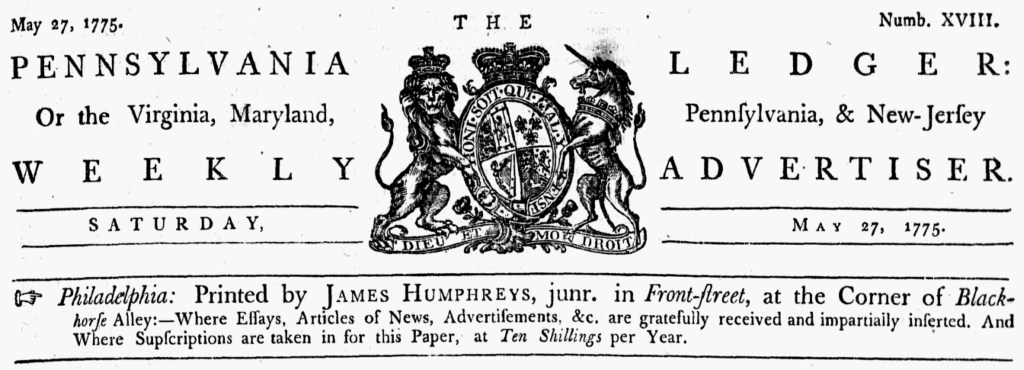
Pennsylvania Ledger (May 27, 1775).

“Essays, Articles of News, Advertisements, &c. are gratefully received and impartially inserted.”

Among newspapers published during the era of the American Revolution, those that included a colophon usually featured it at the bottom of the final page.  A few, including the Pennsylvania Ledger, incorporated the colophon into the masthead.  James Humphreys, Jr., the printer, also used the colophon as a perpetual advertisement for subscriptions and advertisements.  After all, the full title of the newspaper was the Pennsylvania Ledger: Or the Virginia, Maryland, Pennsylvania, & New Jersey Weekly Advertiser.  Accordingly, the colophon gave more than just place of publication and the name of the printer (“Philadelphia: Printed by JAMES HUMPHREYS, junr. in Front-street, at the Corner of Black-horse Alley”); it also informed readers that “Essays, Articles of News, Advertisements, &c. are gratefully received and impartially inserted” and “Subscriptions are taken in for this Paper, at Ten Shillings per Year.”  The enhanced colophon did not, however, give prices for advertising, though Humphreys stated that he set “the same terms as is usual with the other papers in the city” in the subscription proposals he distributed in January 1775.

What did Humphreys mean when he declared that he “impartially inserted” essays (or editorials), news, and advertisements?  In the proposals t, he asserted that “a number of worthy and reputable Gentlemen” in Philadelphia had encouraged him “to establish a Free and Impartial NEWS PAPER, open to All, and influenced by None.”  Furthermore, he proclaimed that he was “determined to act on the most impartial principles, and not render himself liable to be influenced by any party whatever.”  Such idealism stood in stark contrast to the partisanship of most newspapers as the imperial crisis intensified.  Humphreys’s determination to print essays and news from various perspectives amounted to sufficient proof for many Patriots that the printer was a Loyalist since he did not uniformly promote the American cause.  Decades later, Isaiah Thomas, the patriot printer who published the Massachusetts Spy at the same time Humphreys published the Pennsylvania Ledger, took a more evenhanded approach in his History of Printing of America: “The publisher announced his intention to conduct his paper with political impartiality; and perhaps, in times more tranquil than those in which it appeared, he might have succeeded in his plan.  …  The impartiality of the Ledger did not comport with the temper of the times.”[1]  Thomas seemed to consider Humphreys’s commitment to freedom of the press authentic rather than a rationalization for printing Loyalist views.  He was not so kind in his descriptions of other printers whose politics did not align with his own.

Still, the “temper of the times” likely prompted Humphreys to adjust his own advertising for political pamphlets available at his printing office.  When it came to “impartially insert[ing]” advertisements submitted by others, he gave assurances that he neither took an editorial stance when it came to the information they disseminated nor gave some more prominent placement on the page than others.  He did not rank newspapers notices but instead gave advertisers equal access to his press.

**********

[1] Isaiah Thomas, The History of Printing in America: With a Biography of Printers and an Account of Newspapers (1810; New York: Weathervane Books, 1970), 439-440.

February 11

What was advertised in a colonial American newspaper 250 years ago today?

Supplement to the Pennsylvania Ledger (February 11, 1775).

“POLITICAL PAMPHLETS … on Both Sides of the Question.”

As the imperial crisis intensified in late 1774 and early 1775, most American newspapers became increasingly partisan, even those that claimed that they did not take a side in the contest between Patriots and Parliament.  Printers sometimes ran advertisements for pamphlets that did not align with the principles most often espoused in their publications, but few made a point of declaring that they did so.  James Rivington, printer of Rivington’s New-York Gazetteer and a noted Loyalist, took the most strident approach in a series of advertisements for “POLITICAL PUBLICATIONSwritten on the Whig and the Tory Side of the Question.”  Sporting headlines like “The American Contest” and “The American Controversy,” those advertisements listed several pamphlets, many of them written in response to others also advertised.

Yet Rivington was not alone.  In the supplement that accompanied the third issue of the new Pennsylvania Ledger, James Humphreys, Jr., the printer, inserted a short notice that announced, “Most of the POLITICAL PAMPHLETS That have been published, on Both Sides of the Question, May be had of the Printer hereof.”  On the first page, he once again ran the proposals for the newspaper, stating that he established a “Free and Impartial News Paper, open to All, and Influenced by None.”  Despite that assertion, “[i]t was supposed that Humhreys’s paper would be in the British interest,” according to Isaiah Thomas in his History of Printing in America (1810).[1]  He further explained that “in times more tranquil than those in which it appeared, [Humphreys] might have succeeded in his plan” to “conduct his paper with political impartiality.”[2]

When it came to marketing strategies for political pamphlets, printers associated with supporting the Tory “Side” took the more evenhanded approach of drawing attention to their commitment to selling and disseminating work on “Both Sides of the Question.”  In Rivington’s case, doing so was a matter of generating revenue as much as operating an impartial press and bookstore.  For Humphreys, on the other hand, doing so seemed to fall in line with the commitment he made in his proposals for the Pennsylvania Ledger.  Even taking those motivations into account, both printers may have considered it necessary to profess that they sold pamphlets on “Both Sides” to justify how many titles they sold that argued from the Tory perspective.

**********

[1] Isaiah Thomas, The History of Printing in America: With a Biography of Printers and an Account of Newspapers (1810; New York: Weathervane Books, 1970), 399.

[2] Thomas, History of Printing, 439.

December 16

What was advertised in a colonial American newspaper 250 years ago today?

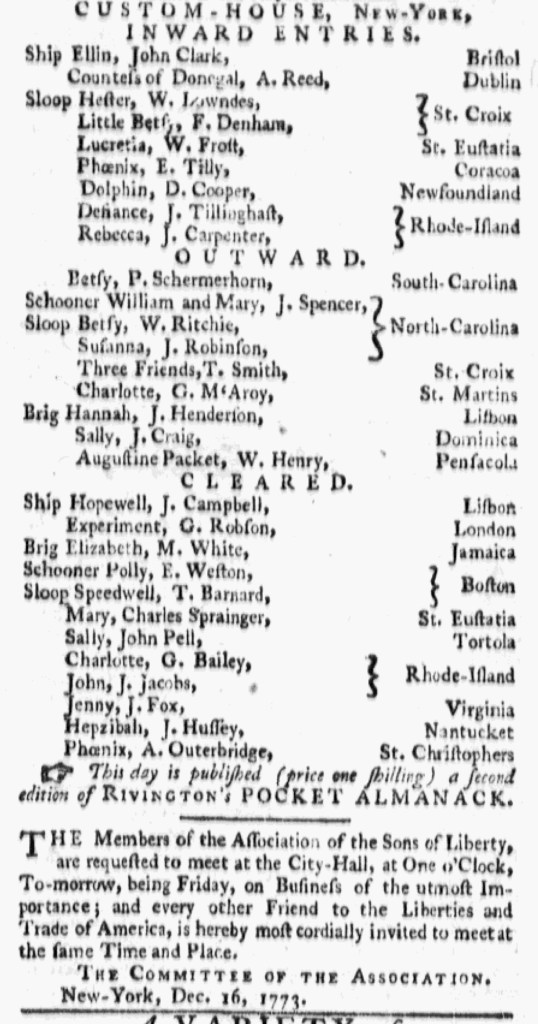
Rivington’s New-York Gazetteer (December 16, 1773).

“The Sons of Liberty, are requested to meet at the City-Hall.”

James Rivington, bookseller and printer of Rivington’s New-York Gazetteer, is most often remembered as a Loyalist.  He began publishing his newspaper in April 1773.  According to Isaiah Thomas, a staunch Patriot printer and author of The History of Printing in America (1810), Rivington’s newspaper “was soon devoted to the royal cause,” yet he does not elaborate on what constituted “soon.”[1]  Rivington became so vociferous in expressing Tory sentiments in his newspaper that on November 27, 1775, the Sons of Liberty attacked his printing office and destroyed his press and type.  Rivington departed for England, but later returned to New York during the British occupation during the Revolutionary War.  He brought a new press and type with him, started publishing his newspaper again, and quickly changed the name to Rivington’s New York Loyal Gazette and then the Royal Gazette.  That newspaper continued publication under that title until the end of the war in 1783, then became Rivington’s New-York Gazette.  It ceased publication on the final day of that year.

Despite the positions that Rivington ultimately advocated in his newspapers, Thomas acknowledged in his biographical sketch of the printer that “[i]t is but justice to add, that Rivington, for some time, conducted his Gazette with such moderation and impartiality as did him honor.”[2]  Thomas reiterated that assessment in his overview of Rivington’s New-York Gazetteer, stating that “for some time Rivington conducted his paper with as much impartiality as most of the editors of that period.”[3]  That helps to explain the privileged place that an advertisement placed by the Sons of Liberty occupied in the December 16, 1773, edition of Rivington’s New-York Gazetteer.  That notice called on the “Members of the Association of the Sons of Liberty … to meet at the City-Hall” on the following day to discuss “Business of the utmost Importance.”  The “COMMITTEE OF THE ASSOCIATION” that placed the advertisement invited “every other Friend to the Liberties and Trade of America” to attend the meeting.  Rivington not only published the advertisement, he placed it immediately below the shipping news from the customs house.  Like many other colonial newspapers, Rivington’s New-York Gazetteer followed a particular format that placed news items and editorials first, then the shipping news, and finally advertisements.  The shipping news, a weekly feature, marked the end of news coverage and the beginning of advertisements.  Readers who were not especially interested in perusing the advertisements, many of which repeated from week to week, may have been more likely to take note of the first advertisement that followed the shipping news as they recognized the transition from one type of content to another. That gave the notice from the Sons of Liberty greater visibility than had it appeared embedded among the dozens of advertisements on the next two pages of the newspaper.  The savvy Rivington inserted a two-line notice about a pocket almanac he just published, not even separating it from the shipping news, before the announcement by the Sons of Liberty.  He certainly tended to his own interests, but he also provided impartial space in the public prints for a while after he commenced publishing Rivington’s New-York Gazetteer.

**********

[1] Isaiah Thomas, The History of Printing in America: With a Biography of Printers and an Account of Newspapers (1810; New York: Weathervane Books, 1970), 479.

[2] Thomas, History of Printing in America, 480.

[3] Thomas, History of Printing in America, 511.