July 8

What was advertised in a colonial American newspaper 250 years ago today?

Jul 8 - 7:8:1767 Georgia Gazette
Georgia Gazette (July 8, 1767).

“INGLIS and HALL have just imported, In the ship Friendship, Capt. Fitzherbert, from Bristol.”

Inglis and Hall advertised a “NEAT ASSORTMENT” of merchandise “just imported, In the ship Friendship, Capt. Fitzherbert, from Bristol, and the last vessels from London.” Throughout the colonies, merchants, shopkeepers, and others who sold imported goods frequently indicated which ship transported their wares across the Atlantic. This was not superfluous information for eighteenth-century consumers. Instead, it allowed readers who might be potential customers to determine how recently sellers obtained their inventory. They could test the accuracy of what “just imported,” a formulaic phrase regularly inserted in advertisements, actually meant.

Inglis and Hall had the good fortune that their advertisement appeared immediately below the shipping news in the July 8, 1767, edition of the Georgia Gazette. Upon reading that their merchandise arrived “In the ship Friendship, Capt. Fitzherbert, from Bristol,” readers could glance up the column to see of they spotted the vessel and its captain in the list of those that had “ENTERED INWARDS at the CUSTOM-HOUSE” since the last issue. The Friendship was listed first, having arrived from South Carolina five days earlier. Apparently Fitzherbert did not sail directly from Bristol to Savannah but instead made port in the much larger Charleston before continuing to Georgia. Still, by consulting the shipping new readers could determine that at least some of the merchandise Inglis and Hall promoted as “just imported” had indeed been just imported.

Not every advertisement that indicated which ship and captain transported goods now available for sale happened to be positioned so conveniently on the page in relation to the shipping news. (Most likely, the proximity in this case was a happy coincidence for Inglis and Hall, rather than a deliberate effort.) Yet colonial newspapers were relatively short by today’s standards, only four pages or perhaps six or eight if they happened to include a supplement that week. In addition, most printers inserted the shipping news immediately before the advertisements, making that information fairly easy to locate. If readers were not already aware of which ships had recently been in port, they could efficiently consult the shipping news when they encountered the names of vessels in commercial notices. Eighteenth-century advertisers expected potential customers participated in this sort of active engagement with news items printed elsewhere in newspapers as they contemplated future purchases.

January 28

What was advertised in a colonial American newspaper 250 years ago today?

jan-28-1281767-georgia-gazette
Georgia Gazette (January 28, 1767).

“INGLIS and HALL, have just imported, In the DIANA, Capt. CHEESEMAN, from LONDON.”

Inglis and Hall, frequent advertisers in the Georgia Gazette, informed potential customers that they “have just imported, In the DIANA, Capt. CHEESEMAN, from LONDON, A general and neat Assortment of EAST-INDIA and EUROPEAN GOODS.” To modern eyes, it may appear quaint that the shopkeepers provided not only the origins of their goods but also the vessel on which they arrived. In the eighteenth century, however, this was vital information that helped readers to determine how they should interpret the claim that the goods had been “just imported.”

To do so, colonists could consult the shipping news that appeared elsewhere in the newspaper, often immediately before the advertisements. According to the January 14 issue of the Georgia Gazette, the “Brigt. Diana, Isaac Cheeseman” from London “ENTERED INWARDS at the CUSTOM-HOUSE in SAVANNAH” the previous day. That did not allow sufficient time for Inglis and Hall to insert an advertisement in the local newspaper that week. One did appear in the next issue, on January 21, just eight days after the Diana arrived in Savannah. That same advertisement repeated on January 28, this time in a column to the left of the shipping news that stated the “Brigt. Diana, Isaac Cheeseman” had “ENTERED OUTWARDS” for Portsmouth sometime during the past week. Even if readers of the January 28 issue did not have access to previous editions to determine exactly when the Diana had arrived in port they could at least surmise that it must have been fairly recently considering that she had just departed.

Inglis and Hall ran this advertisement a third and final time a week later. In the time since the Diana arrived in port, she was the only vessel that sailed directly from London. For colonists who increasingly expressed British identity through participation in the consumer revolution, this may have given accrued additional cachet to the merchandise stocked by Inglis and Hall. When the shopkeepers informed potential customers that their inventory came “from LONDON” they suggested connections to the most recent fashions in the metropolitan center of the empire, a selling point that competitors who had not received goods on the Diana could not associate with their wares.

December 31

What was advertised in a colonial American newspaper 250 years ago today?

dec-31-12311766-georgia-gazette
Georgia Gazette (December 31, 1766).

“A LARGE and NEAT ASSORTMENT of superfine broad cloths.”

Inglis and Hall frequently advertised in the Georgia Gazette. Among Savannah’s shopkeepers, this partnership often placed the most extensive commercial notices in the local newspaper, making their marketing familiar to readers. Although they sometimes experimented with the format of their advertisements, most of the time Inglis and Hall took a fairly conservative approach to the strategies they deployed.

Today’s advertisements, for instance, included several of the most common appeals to consumers made throughout the eighteenth century. Inglis and Hall promoted “A LARGE and NEAT ASSORTMENT” of goods recently imported from England. Listing dozens of items potential customers could expect to find when visiting their shop. In addition, Inglis and Hall noted that these new arrivals supplement “their former assortment,” prompting readers to recollect previous list advertisements that enumerated their merchandise. In so doing, Inglis and Hall made an appeal to choice. Potential customers did not have to accept whatever goods the shopkeepers happened to have in stock. Instead, they could make their own selections to suit their tastes and budgets.

The retailers acknowledged both of those aspects of the shopping experience as well. They concluded their advertisement by promising to sell all of their merchandise “on the most reasonable terms.” Appeals to price were common in the eighteenth century, though they often received as little elaboration as in today’s advertisement. Such appeals became a standard part of boilerplate advertisements, yet shopkeepers dared not omit pledges to low and competitive prices. Potential customers came to expect such reassurances.

Appeals to fashion or taste could also be fleeting or expansive, depending on the advertisement. Today’s advertisement took the former approach when it listed some of the less utilitarian goods for sale: “fashionable Roman tea-urns, tea kettles, coffee pots, and waiters, pewter plates, water dishes, and measures.” Ultimately, customers had to decide for themselves whether Inglis and Hall actually carried “fashionable” housewares that testified to their taste and that they desired to show off to visitors, yet the advertisement helped to shape their expectations.

Today’s advertisement was not especially innovative in 1766, but that did not make it dull or lacking in marketing strategy. Inglis and Hall incorporated an array of standard advertising strategies to attract customers to their shop. They announced that they stocked new goods, noted the origins of their wares, and made appeals to choice, price, and fashion. Ingis and Hall depended on marketing techniques that advertisers throughout the colonies generally agreed were effective.

July 30

What was advertised in a colonial newspaper 250 years ago today?

Jul 30 - 7:30:1766 Georgia Gazette
Georgia Gazette (July 30, 1766).

“JUST arrived in the Brigantine ANTELOPE … directly from the River GAMBIA and SIERRALEON.”

Inglis and Hall announced that they would auction “A CHOICE CARGO of ONE HUNDRED PRIME SLAVES” that had arrived in Georgia “directly from the River GAMBIA and SIERRALEON.”

Thanks to the recent work of Gregory E. O’Malley, I questioned the accuracy of this claim. Had the Antelope and its human cargo actually arrived directly from Africa? Or had it made other stops in the Americas before disembarking slaves in Georgia? Was the “CHOICE CARGO” comprised of all the slaves who had survived the transatlantic voyage? Did local buyers get to choose from among the best specimens of enslaved men, women, and children that had been forced aboard this vessel in Gambia and Sierra Leone? Or had the Antelope first landed in other ports in the Americas? Had Captain Paley already sold the best slaves in other locations? Were Inglis and Hall peddling whatever leftover captives remained and made it to Georgia?

In Final Passages: The Intercolonial Slave Trade of British America, 1619-1817, O’Malley demonstrated that the famous Middle Passage was not the final stage of the voyage for captive Africans. Instead, many experienced transshipment within an intercolonial slave trade: they arrived in one port in the Americas but then underwent subsequent journeys before being sold and ending up on a plantation, in an urban household, or whatever their fate happened to be. This prompted my question about the accuracy of the claim that the Antelope had arrived “directly” from Africa.

Readers of the Georgia Gazette could have asked around or consulted the shipping news to verify that the Antelope had (or had not) arrived directly from Africa. Modern historians, on the other hand, have access to Voyages: The Trans-Atlantic Slave Trade Database. The year (1766) and the name of the vessel (Antelope) was sufficient to identify the voyage from this advertisement; other information from the advertisement verified that this was indeed the correct entry. The database (which drew from records that included, but were not limited to, the advertisement) confirmed that Savannah was indeed the “first place of slave landing” in the Americas.

Jul 30 - Slave Voyage Map
Transatlantic voyage of the Antelope with its human cargo.  Voyages:  The Trans-Atlantic Slave Trade Database.

It also reported that 111 enslaved people had been boarded on the vessel, but only 97 survived the transatlantic voyage.

You can examine other details about this particular shipment of human cargo, including a map, at Voyages: The Trans-Atlantic Slave Trade Database. (I’m inserting a map here, but the database allows visitors to zoom in on the map for greater detail.) O’Malley has recently received a major grant to augment the database with data on the intercolonial slave trade.

June 18

What was advertised in a colonial newspaper 250 years ago today?

Jun 18 - 6:18:1766 Georgia Gazette
Georgia Gazette (June 18, 1766).

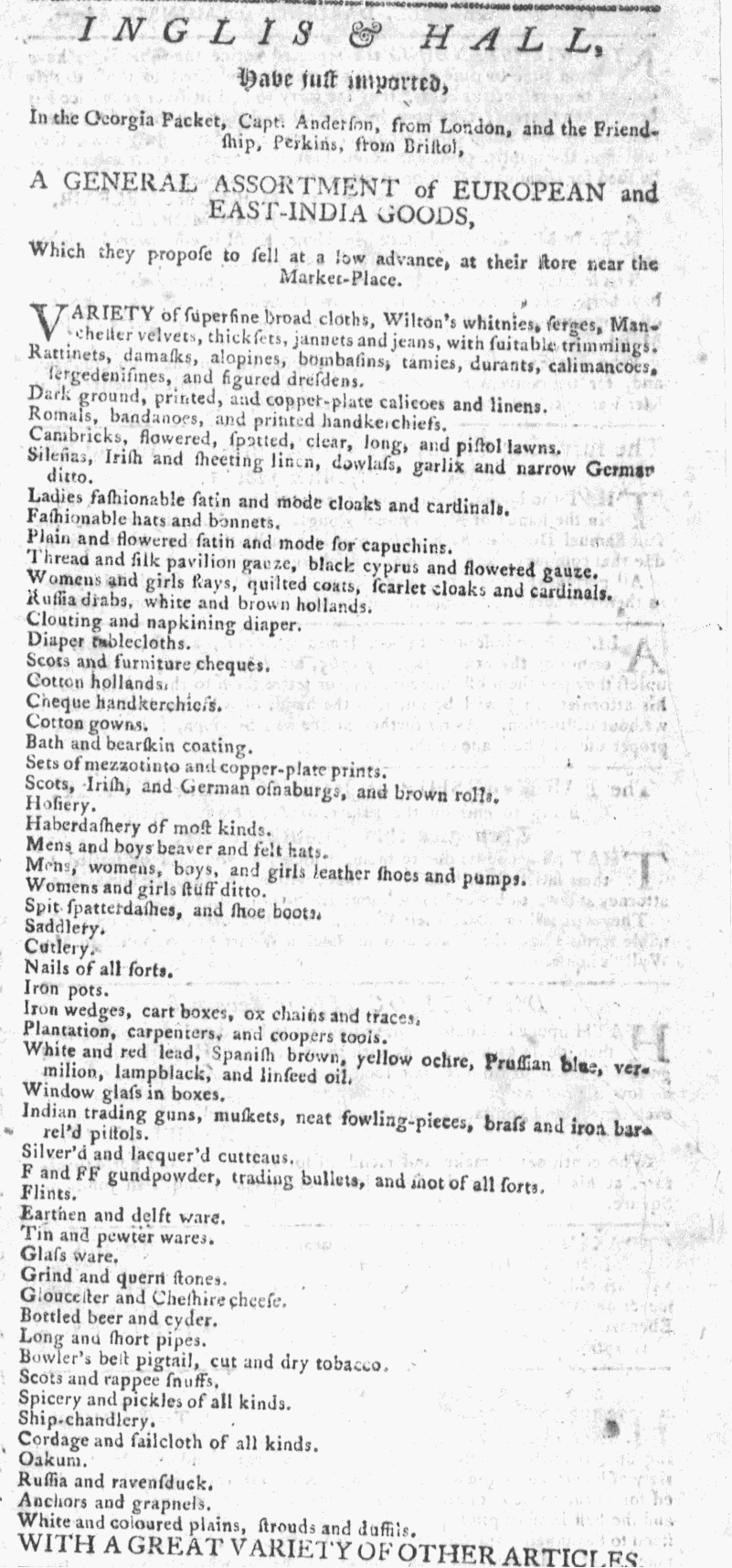
“Have just imported, In the Georgia Packet, Capt. Anderson, from London, and the Friendship, Perkins, from Bristol.”

Inglis and Hall regularly advertised in the Georgia Gazette. In May 1766 they placed an advertisement announcing that they “have just imported, In the GEORGIA PACKET, Capt. ANDERSON, from LONDON, A NEAT ASSORTMENT” of dry goods and housewares. In addition, they promised “a FURTHER ASSORTMENT daily expected from LONDON and BRISTOL.”

When additional cargoes arrived in port, Inglis and Hall updated their advertisement to add the name of another vessel that carried the textiles and hardware they stocked: “the Friendship, Perkins, from Bristol.” The new advertisement included many of the items listed in the previous one, but also integrated new merchandise to entice potential customers with the variety of choices available.

In both instances Inglis and Hall presented a list style advertisement, an extensive catalog of goods they stocked. The format, however, shifted from one advertisement to the next. The first one tallied everything together in a single paragraph, while the second one indicated only one item or group of related items per line. Both drew attention to the “NEAT ASSORTMENT” and “GREAT VARIETY” of merchandise, but many potential customers likely found the second one easier to read and identify specific items of interest.

Was that the purpose for the new format? Was it an innovation intended to make the advertisement more accessible to consumers? If so, who was responsible for it, the advertiser or the printer? It is also possible that the printer needed to fill space and choose a new format to extend the advertisement to the desired length. In the absence of additional records some questions about the reasons eighteenth-century advertisements took their form cannot be answered definitively.

May 21

What was advertised in a colonial newspaper 250 years ago today?

May 21 - 5:21:1766 Georgia Gazette
Georgia Gazette (May 21, 1766).

INGLIS and HALL, have just imported … A NEAT ASSORTMENT of India and English chintzes.”

This is the first time the Adverts 250 Project has featured an advertisement from the Georgia Gazette. Although I make every effort to select advertisements from as many different newspapers, cities, colonies, and regions as possible, but the Georgia Gazette, which commenced publication in 1763, was not previously available for inclusion in this project due to political considerations from the period.  It had been suspended in November 1765 in response to the Stamp Act and did not resume publication until May 21, 1766.

Examining newspapers from more than one region sometimes demonstrates striking differences, such as the sheer number of advertisements for runaway slaves that appeared in the Virginia Gazette compared to publications from New England and the Middle Atlantic colonies.

Today’s advertisement, however, demonstrates an important similarity among advertisements throughout the colonies. At a glance, this advertisement resembles others placed by shopkeepers in other regions. It could have appeared anywhere in the colonies and it would have looked familiar to readers. They would have recognized the variety of merchandise offered for sale.

T.H. Breen has previously described this as the standardization of consumer culture in colonial America. Even as consumers encountered greater amount of choice in the marketplace, the goods that were available in Georgia were largely the same goods available in Boston. Merchants and shopkeepers throughout New England, the Middle Atlantic, the Chesapeake, and the Lower South imported and sold the same items. As a result, this gave residents throughout the colonies a shared experience and a shared language of consumer culture. It helped to tie them together as a community, Breen argues, that facilitated conversations about political rights, especially concerning commerce and taxation within the British Empire. Colonists used consumer culture as one starting point for understanding their position in the empire.

This advertisement, almost indistinguishable from advertisement that appeared in newspapers in colonies far away, testifies to those shared experienced and that common language of consumer culture.