December 14

What was advertised in a revolutionary American newspaper 250 years ago today?
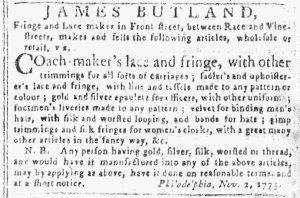
New-England Chronicle (December 14, 1775).

“Fringe and Lace maker in Front street, between Race and Vine-streets, … Philadelphia.”

James Butland, a “Fringe and Lace maker,” placed several newspaper advertisements in 1775.  In February, he inserted an advertisement in the Pennsylvania Journal, advising prospective customers that he “Continues to make and sell” all sorts of fringes and laces equal in quality to any imported from England.  He also assured the public that “no advantage shall be taken on account of the troubles between Britain and America,” signaling that he abided by the Continental Association and did not raise prices once that nonimportation agreement went into effect.  In July, he placed a new advertisement in the Pennsylvania Evening Post, once again promoting his fringes and laces made in Philadelphia.  He also requested “unfashionable” scraps “not fit for sale,” asserting that he could upcycle them into new pieces.

In December, he published another advertisement.  Like the others, it included a list of the types of fringes and laces he made, including “Coach-maker’s lace and fringe, with other trimmings for all sorts of carriages; sadler’s and upholsterer’s lace and fringe, with line and tassels made to any pattern or colour; gold and silver epaulets for officers, with other uniforms, [and] footmen’s liveries made to any pattern.”  In a nota bene, Butland invited “Any person having gold, silver, silk, worsted or thread” who would like it “manufactured into any of the above articles” to apply to his shop “between Race and Vine-streets” in Philadelphia.  It was much like the advertisements he previously published … except for the newspaper that carried it.  This notice appeared in the New-England Chronicle, printed in Cambridge as the siege of Boston continued.  Other advertisements in the December 14 edition came from towns in the vicinity, including Beverly, Braintree, Brookline, Cambridge, Concord, Danvers, Gloucester, Medford, Menotomy, Newton, Plymouth, Roxbury, Salem, Topsfield, Waltham, and Woburn.  One concerning a stray horse came from Epping, New Hampshire.  Like other newspapers, the New-England Chronicle served an entire region, yet advertisements for artisans (or shopkeepers or merchants) in cities and towns beyond that region rarely appeared in any colonial newspapers.  Printers and booksellers often distributed subscription proposals and other advertisements more widely in their efforts to incite enough demand and generate enough sales to make their projects viable.  Other advertisers, however, focused on cultivating local clienteles.  Even those who offered mail order goods and services lived and worked within the region served by the newspapers that carried their advertisements.  That made Butland’s advertisement for fringe and lace made in Philadelphia in the New-England Chronicle quite unusual, raising questions without easy answers.  Why did he choose to advertise in that newspaper?  How did that fit into his overall marketing strategy?  How effective did he anticipate his advertisement would be?
July 1

What was advertised in a revolutionary American newspaper 250 years ago today?

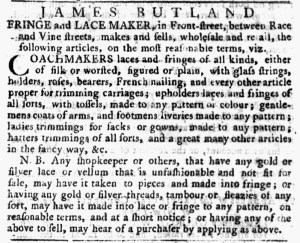
Pennsylvania Evening Post (July 1, 1775).

“Unfashionable [lace] … taken to pieces and made into fringe.”

In the summer of 1775, James Butland, a “FRINGE and LACE MAKER, in Front-street” in Philadelphia, placed a new advertisement in some of the city’s newspapers.  A few months earlier, he assured “the public, that no advantage shall be taken on account of the troubles between Britain and America” and “he retails his goods cheaper than ever they were in this country before.”  In other words, he did not raise his prices for the fringe and lace he made in Philadelphia once the Continental Association, a nonimportation agreement adopted in protest of the Coercive Acts, went into effect.  In his new advertisement, he reminded readers that he “makes and sells … COACHMAKERS laces and fringes of all kinds … and every other article proper for trimming carriages; upholders [upholsterer’s] laces and fringes of all sorts, with tossels, made to any pattern or colour; … hatters trimmings of all sorts, and a great many other articles in the fancy way.”

In a nota bene that constituted a significant portion of this advertisement, Butland sought other business by proposing an eighteenth-century version of upcycling, the transformation of unwanted or undesirable items into fashionable new ones. “Any shopkeeper or others, that have any gold or silver lace or vellum that is unfashionable and not fit for sale,” he suggested,” may have it taken to pieces and made into fringe.”  Furthermore, anyone “having gold or silver threads, tambour or sleazies of any sort, may have it made into lace or fringe to any pattern.”  Tambour, according to the Oxford English Dictionary, could have referred to either a kind of fine gold or silver thread or a kind of embroidery that Butland deconstructed for the materials.  Sleazies, a corruption of Silesia, referred to a kind of thin woven cloth originally from Silesia and used for making clothing in Britain and the colonies in the eighteenth century.  Butland did this work “on reasonable terms, and at a short notice,” promoting both price and efficiency.  Even if readers were not interested in incorporating upcycled fringe into their own wardrobes or décor, Butland still wanted any castoffs that they wished to sell to him.  With the Continental Association still in place and the uncertainty about when trade with Britain might resume following the outbreak of hostilities in Massachusetts in April, Butland may have needed materials to continue his business.

February 1

What was advertised in a colonial American newspaper 250 years ago today?

Pennsylvania Journal (February 1, 1775).

“No advantage shall be taken on account of the troubles between Britain and America.”

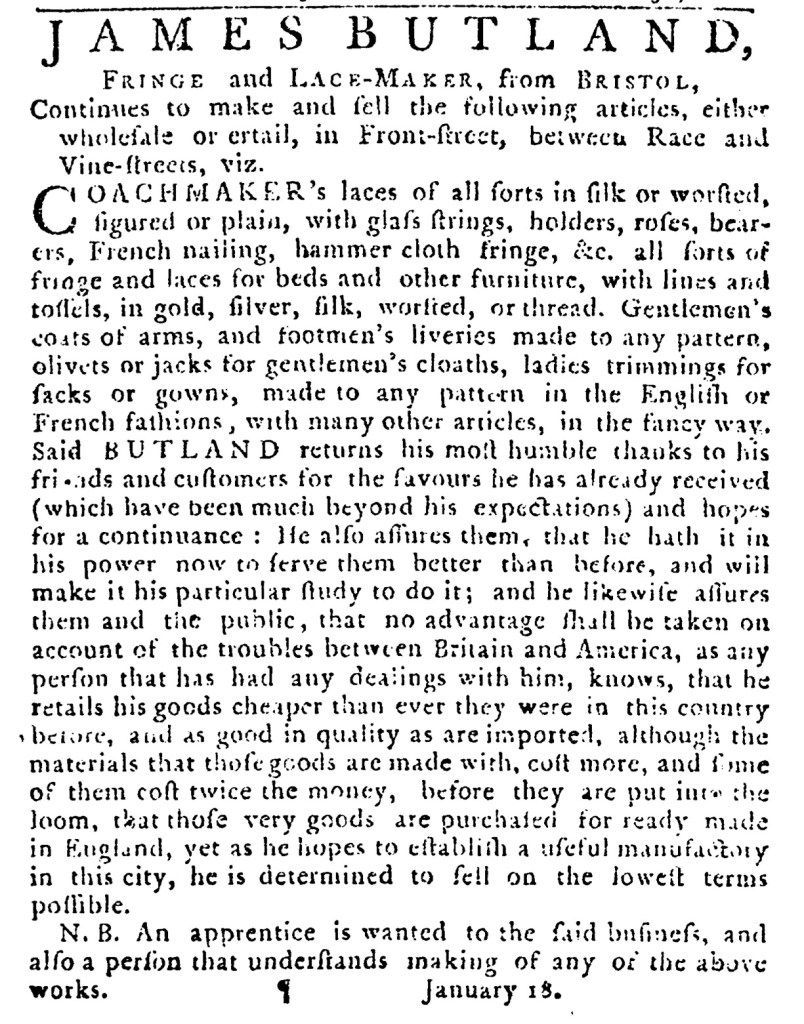
James Butland, a “FRINGE and LACE-MAKER, from BRISTOL,” set up shop in Philadelphia in the 1770s.  In an advertisement in the February 1, 1775, edition of the Pennsylvania Journal, he informed the public that he made and sold “COACHMAKER’s laces of all sorts in silk or worsted,” “all sorts of fringe and laces for beds and other furniture,” and other trimmings according to “any pattern in the English or French fashions.”

Colonizers observed the Continental Association, a nonimportation agreement enacted by the First Continental Congress in response to the Coercive Acts, at the time that Butland placed his advertisement.  Butland certainly had the Continental Association, in particular, and the imperial crisis, more generally, in mind when he made his pitch to prospective customers.  He made assurances to “the public, that no advantage shall be taken on account of the troubles between Britain and America.”  In other words, he would not raise prices on the fringe and lace he produced locally at a time that patriots refused to purchase imported goods.  Butland asserted that he had been in Philadelphia long enough that former customers knew his reputation on the matter: “any person that has had any dealings with him, knows, that he retails his goods cheaper than ever they were in this country before, and as good in quality as are imported.”  He did so even though “the materials that those goods are made with, cost more, and some of them twice the money, before they are put into the loom” compared to readymade alternatives from England.  That Butland offered such low prices under those circumstances suggested a significant markup on imported fringe and lace.

Butland did his part to satisfy consumers and to serve the American cause as the imperial crisis intensified.  Beyond his pledge not to gouge his customers with unreasonable prices during the boycott of imported goods, he sought to increase the inventory of locally produced fringes and laces available to them.  He planned “to establish a useful manufactory in this city,” vowing “to sell on the lowest terms possible.”  To that end, he sought an apprentice and an employee to assist him and aid in expanding his business.  As his advertisement made clear, Butland did his part as a producer to honor the Continental Association.  Readers now had a duty as consumers to do their part to support his endeavor.