GUEST CURATOR: Elizabeth Curley
What was advertised in a colonial American newspaper 250 years ago today?

“Just Published … The Examination of Doctor BENJAMIN FRANKLIN, before an AUGUST ASSEMBLY.”
In the eighteenth century and today, most people agree that Benjamin Franklin significantly influenced colonial American politics and commerce. Some count him as an honored founding father, but if you ask my seven-year-old nephew he’ll declare that Franklin was his favorite president (despite my repeated attempts to tell him that, no, Mr. (or Dr.) Franklin was in fact not a president). Franklin made many contributions to early America history and life.
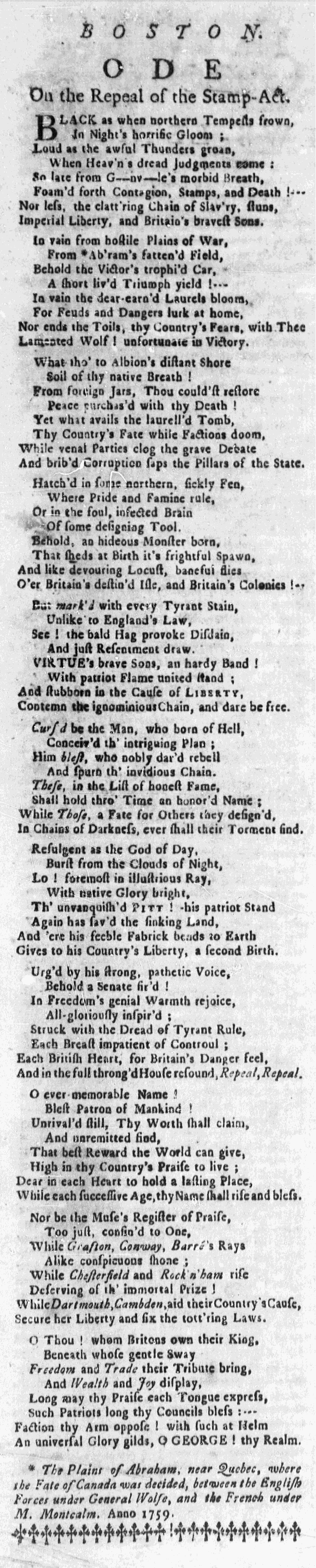
One of his most significant contributions was his delegation to England on behalf of Pennsylvania and other colonies. On February 13, 1766, he testified before Parliament about repealing the Stamp Act. On March 18, 1766, Parliament did in fact repeal the Stamp Act, although on that same day they voted in the Declaratory Act. News of the repeal reached the colonies around six weeks later, around the start of May.
As I was reading this advertisement I wondered, “Why would this be an August Assembly?” I found myself needing to know more, and went to J.L. Bell’s blog, Boston 1775. There I learned that Parliament’s proceedings were very secretive. Actions that Parliament took were made public, but the debates and arguments were private. Speaking about conversations held within either of the two houses was considered a breach of privilege and punishable by both houses.
To protect Franklin, his previous printing partner (and now owner of the Pennsylvania Gazette), David Hall changed the story. By saying that Franklin simply had spoken at an “August Assembly,” Franklin and Hall were attempting to get around the legality of publishing Franklin’s “Examination,” which discussed the flow of the questions and testimony and even recalled some speakers in Parliament by name. Publishing the testimony was a big deal, not only because many times colonists heard news months later, but also because this kept them better informed about Parliament, which met very far away from them.
**********
ADDITIONAL COMMENTARY: Carl Robert Keyes
Elizabeth introduces the curious history of “The Examination of Doctor BENJAMIN FRANKLIN, before an AUGUST ASSEMBLY, relating to the Repeal of the Stamp-Act.” The colonists were certainly hungry for information, which meant that advertisements for this pamphlet did not have to offer much in the way of marketing other than announcing that it was “Just Published … And Sold” by local printers and booksellers.
Indeed, members of the book trades in multiple cities produced, distributed, and sold pamphlets about Franklin’s testimony before “an AUGUST ASSEMBLY.” The American Antiquarian Society’s catalog indicates that at least five editions were printed in British mainland North America in 1766. As Elizabeth indicates, the original edition came off the presses of Hall and Sellers in Philadelphia, but that did not prevent other printers from producing their own editions. In each instance, politics and profit overlapped as printers and booksellers simultaneously sought to keep colonists informed about what was taking place in Parliament and generate revenues for themselves in the process.
Still, even with the subterfuge involved in allusions to “an AUGUST ASSEMBLY,” printers took on some risk when they decided to reprint their own copies of this pamphlet. The edition printed in New York did not list a printer, though bibliographers have associated James Parker with this imprint. An edition from New England listed neither printer nor city, but book historians believe Edes and Gill, printers of the Boston-Gazette, produced it. The title page of an edition from Virginia stated that it had been “Printed and sold by William Rind, opposite the Capitol” in Williamsburg. Back in Philadelphia, Heinrich Miller printed a German translation, which should come as little surprise considering the large population of German settlers in Pennsylvania. Timothy Green did not bother with printing another separate edition in Connecticut; instead, he reprinted the pamphlet in the New-London Gazette, beginning with the October 10, 1766, issue. In addition to being a treat for his readers and keeping them better informed, this stunt may have attracted new subscribers.
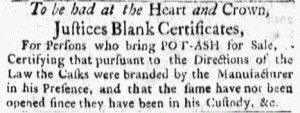
Today’s advertisement suggests that politics and a desire to keep colonists informed of Parliament’s machinations sometimes trumped competition among colonial printers. Note that the pamphlet was sold by “T. and J. Fleet, at the Heart & Crown in Cornhill,” yet the advertisement appeared in a newspaper “PUBLISHED by RICHARD DRAPERS, Printer to the Governor and Council, and by SAMUEL DRAPER, At their Printing Office in Newbury-Street.” In other words, the printers of Boston Evening-Post stocked and sold a pamphlet most likely produced by the printers of the Boston-Gazette and placed advertisements for it in the Massachusetts Gazette. This suggests cooperation and coordination rather than competition among the printers in Boston, all of whom faced a challenge to their livelihoods when the Stamp Act was in force.