October 4

What was advertised in a revolutionary American newspaper 250 years ago today?

Pennsylvania Journal (October 4, 1775).

“A NEAT MEZZOTINTO PRINT of the HON. JOHN HANCOKC, ESQ; PRESIDENT of the CONTINENTAL CONGRESS.”

On October 4, 1775, Nicholas Brooks took to the pages of the Pennsylvania Journal to announce that he “JUST PUBLISHED … An Exact VIEW of the Late BATTLE at CHARLESTOWN,” now known as the Battle of Bunker Hill.  Brooks had previously distributed subscription proposals for the project that he pursued in collaboration with Bernard Romans.  Brooks and Romans had recently worked together on a map of Boston that depicted the siege of the city following the battles at Lexington and Concord.  Brooks described the new print now ready for purchase as a “Large Elegant PIECE, beautifully Coloured, and much superior to any pirated copy now offered or offering to the public.” Apparently, Brooks had not worked with Robert Aitken in making a version to accompany the Pennsylvania Magazine.  It was not the first time that one colonizer pirated the work of another when producing items that commemorated the imperial crisis that eventually became a war for independence.  Paul Revere had done the same with Henry Pelham’s image of the Boston Massacre, advertising his copy in Boston’s newspapers before Pelham marketed the original.

Despite his frustration with the situation, Brooks must have considered prints commemorating the people and events related to the current crisis viable business ventures.  Immediately below his advertisement for “An Exact View of the Late BATTLE at CHARLESTOWN,” he inserted another advertisement, that one proclaiming, “It is PROPOSED to PRINT, in about ten days, A NEAT MEZZOTINTO PRINT of the HON. JOHN HANCOCK, ESQ; PRESIDENT of the CONTINENTAL CONGRESS.”  Brooks collected subscribers’ names and reserved copies of the print for them at his shop on Second Street in Philadelphia.  Interested parties could also visit the London Coffee House, a popular spot for socializing, conducting business, and talking politics.  Brooks’s advertisement did not give details about what to do at the London Coffee House.  Subscribers may have given their names to an employee who recorded them on a list or they may have signed their own names (and indicated the number of copies they wished to purchase) on a subscription proposal posted alongside other advertisements.  They very well may have perused the names of other patriots who ordered the print as they committed to acquiring their own copy.  Brooks hoped that they would also purchase “Frames and Glasses” to display the prints from his shop, just as he marketed a “Double Carv’d and Gilt Frame … with Crown Glass” for the print depicting the battle.  Brooks certainly wanted commemorative items to become fashionable items that consumers believed that they not only wanted but needed as the imperial crisis intensified.

April 5

What advertised in a colonial American newspaper 250 years ago today?

Essex Gazette (April 5, 1774).

To be sold by the Printers hereof, Mr. Hancock’s ORATION, On the Fifth of March.”

Immediately above the record of ships “Entered-In,” “Outward-Bound,” and “Cleared-Out” from the customs house in Boston in the April 5, 1774, edition of the Essex Gazette, Samuel Hall and Ebenezer Hall, the printers, inserted a brief notice, just three lines, alerting readers that they sold “Mr. Hancock’s ORATION, On the Fifth of March.”  The Halls did not need to provide further elaboration for readers to understand the announcement.  For colonizers in New England in the 1770s, the phrase “Fifth of March” conjured images like the phrase “Boston Massacre” evokes today.  They needed no explanation that the advertisement referred to John Hancock delivering the annual address to commemorate the event, to honor those killed when British soldiers from the 29th Regiment under the command of Captain Thomas Preston fired into a crowd of protesters, to condemn quartering troops in colonial cities during times of peace, and to advocate for American liberties.

As had become customary by the fourth anniversary of the Boston Massacre, the town voted to have the oration published and advertisements appeared in newspapers printed in Boston.  Yet they did not appear solely in newspapers in that town.  Other newspapers in New England sometimes carried them as well, none more often that the Essex Gazette, published in nearby Salem.  Samuel Hall had a long history of publishing news and opinion that favored sentiments expressed by Patriots.  On the first anniversary of the Boston Massacre, for instance, he included thick black mourning borders on the first page of his newspaper and published “a solemn and perpetual MEMORIAL Of the Tyranny of the British Administration of Government in the Years 1768, 1769, and 1770,” especially “THE FIFTH OF MARCH, … the Anniversary of Preston’s Massacre–in King-Street–Boston, N. England–1770.”  When Benjamin Edes and John Gill, among the most ardent of Patriots among the printers in Boston, published Hancock’s oration in 1774, the Halls acquired copies to disseminate in Salem and beyond.  In so doing, they participated in the commodification of the Boston Massacre while simultaneously commemorating it and encouraging others to side with the Patriots as relations with Parliament further deteriorated following the Boston Tea Party the previous December.

March 21

What was advertised in a colonial American newspaper 250 years ago today?

Boston-Gazette (March 21, 1774).

“THE ORATION DELIVER’D BY THE Hon. JOHN HANCOCK, Esq; Will be PUBLISHED.”

Many colonizers commemorated events that were part of the American Revolution before the Revolutionary War began.  For instance, residents of Boston acknowledged the anniversary of the “horrid Massacre on the 5th of March 1770” each year.  That description of the Boston Massacre came from coverage of the fourth anniversary commemorations in the March 7, 1774, edition of the Boston-Gazette.  Benjamin Edes and John Gill, the printers, reported that “the Freeholders and other Inhabitants of this Town met at Faneuil-Hall.”  They selected Samuel Adams as moderator for the meeting.  Adams, in turn, recognized John Hancock to deliver “an ORATION, on the dangerous Tendency of Standing Armies being placed in free and populous Cities” and sought to “perpetuate the Memory of the horrid Massacre … by a Party of Soldiers belonging to the 29th Regiment, commanded by Capt. Thomas Preston.”

According to the printers, a “prodigious Crowd of People attended to hear the Oration, which was received with universal applause.”  In turn, two committees were appointed, one to select a speaker to deliver the oration the following year and the other “to return the Orator the Thanks of the Town for his elegant and spirited Oration, and also to request a Copy of it for the Press.”  Already, the annual commemoration including publishing the oration for further dissemination throughout the city and beyond.  Edes and Gill further reported that the anniversary occurred on Saturday, “the Evening of which is considered by many Persons as the Commencement of the Sabbath,” so the display of the “Exhibition Portraits of the Murderers, and the slaughtered Citizens” was delayed until Monday evening, the same day the printers distributed that issue of the Boston-Gazette.

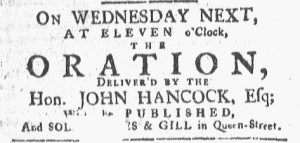
Two weeks later, on March 21, Edes and Gill ran a notice in their own newspaper to alert readers that “ON WEDNESDAY NEXT … THE ORATION DELIVER’D BY THE Hon. JOHN HANCOCK, Esq; Will be PUBLISHED” at their printing office.  They even specified the time, “ELEVEN o’Clock,” so prospective customers would know exactly when they could obtain their copies.  The printers staged an eighteenth-century precursor to a release party.  In hopes of inciting greater demand and gaining even more attention for Hancock’s arguments about the rights of colonizers, Edes and Gill also ran advertisements in the Boston Evening-Post and the Massachusetts Gazette and Boston Post-Boy on March 21.  The next issue of the Massachusetts Gazette and Boston Weekly News-Letter carried a notice that the oration had been published and was available from “EDES & GILL in Queen-Street.”  Each year, printers published the oration marking the anniversary of the Boston Massacre and advertised it widely.  Commodification of the event went hand in hand with commemoration.

December 23

What was advertised in a colonial American newspaper 250 years ago today?

New-York Journal (December 23, 1773).

“John Hancock, Esq; has neither directly, or indirectly, imported any tea from Great Britain.”

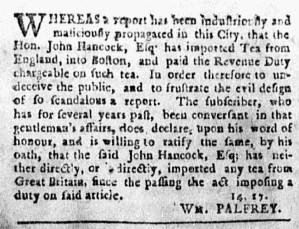
As news of the Boston Tea Party reached New York and appeared in the December 23, 1773, edition of the New-York Journal, an advertisement in that newspaper took on new significance.  Starting on December 9 and continuing for four weeks, William Palfrey inserted an advertisement that addressed a “report [that] has been industriously and maliciously propagated in this City, that the Hon. John Hancock, Esq. has imported Tea from England, into Boston, and paid the Revenue Duty chargeable on such tea.”  Such rumors had the potential to tarnish the reputation of one of the merchants who had been most vocal in opposition to the provisions of the Tea Act, decrying Parliament’s attempts to meddle in affairs that he believed rightly belonged to colonial legislatures.

Palfrey, one Hancock’s clerks, took to the public prints to “undeceive the public, and to frustrate the evil design of so scandalous a report.”  He noted that he had “been conversant in that gentleman’s affairs” for “several years past” and, as a result, could vouch for Hancock.  In late 1773, many readers of the New-York Journal may not have been as familiar with the merchant as residents of Boston, though Hancock regularly appeared in articles reprinted from newspapers published in Massachusetts.  Five months before Palfrey’s advertisement appeared, the New-York Journal printed one of Governor Thomas Hutchinson’s letters from June 1768 that described the seizure of the Liberty, “a sloop belonging to Mr. Hancock, a wealthy merchant, of great influence over the populace,” for “a very notorious breach of the acts of trade.”  (The July 8, 1773, edition of the New-York Journal carried the entire letter and other private correspondence by the governor.)  Contrary to abiding by Parliament’s attempts to regulate colonial commerce and tax imported goods, Hancock had a history of smuggling tea and other items to avoid paying duties.  According to Palfrey, neither Hancock’s public position nor his private actions had changed.  The clerk declared “upon his word of honour” (and expressed his willingness to “ratify the dame, by his oath”) that Hancock had “neither directly, or indirectly, imported any tea from Great Britain, since the passing the act imposing a duty on said article” and most certainly had not paid import duties on tea.  As Jordan E. Taylor has recently demonstrated in Misinformation Nation: Foreign News and the Politics of Truth in Revolutionary America (2022), Patriots and Loyalists vied to establish narratives that fit their politics and their purposes, whether in newspapers, other printed materials, letters, or conversation.  That contest over the truth extended to advertisements, including Palfrey’s notice in the New-York Journal.

September 16

What was advertised in a colonial American newspaper 250 years ago today?

Boston-Gazette (September 16, 1771).

“George Spriggs, Gardner to John Hancock, Esq.”

In the early 1770s, George Spriggs supplied colonists with fruit trees.  In September 1771, he placed advertisements in the Boston-Gazette to promote “ABOUT four or five Thousand Mulberry Trees of different Sizes,” “a large Assortment of English Fruit Trees,” and “an Assortment of flowering Shrubs.”  Those were not just any mulberry trees, Spriggs asserted.  They grew from seeds from “the first ripe Fruit of Mulberries, from a Tree of Mr. David Colson’s, which is the largest and finest Fruit that is in America.”  He expected consumers to be familiar with Colson and his trees or at least trust his expertise about the significance.  He carefully timed his marketing, advising prospective customers that “the best Time of transplanting” the fruit trees “is about the Middle of October.”  Anyone interested in purchasing trees or shrubs from Spriggs could plan accordingly.

In addition to establishing a connection to Colson, Spriggs leveraged his connection to a colonist so prominent that readers of the Boston-Gazette almost certainly knew who he was.  Before he even described the trees and shrubs he offered for sale, Spriggs described himself as “Gardner to John Hancock, Esq.”  It was not the first time he deployed that strategy, seeking to benefit from the celebrity of one of his clients.  In February 1770, for instance, he opened another advertisement in the same manner.  Nor was he the only advertiser who named a famous client as a means of establishing his credentials.  Elsewhere in the Boston-Gazette, Jacob Hemet introduced himself as “DENTIST to her Majesty, and the Princess Amelia.”  Doctors and dentists who migrated to the colonies frequently claimed they previously provided their services to nobles and the gentry in Europe, expecting prospective clients to take their word for it.  Spriggs, on the other hand, knew that customers could much more easily confirm whether he actually was a “Gardner to John Hancock, Esq.”  He did not publish a testimonial from the prominent merchant, but encouraged customers to believe that his association with Hancock was recommendation enough.

April 15

What was advertised in a colonial American newspaper 250 years ago today?

Boston-Gazette (April 15, 1771).

“The most strict Compliance with the Non-Importation Agreement.”

Colonial merchants and shopkeepers often included introductory remarks about the origins of their imported goods in their newspaper advertisements.  In the April 15, 1771, edition of the Boston-Gazette, for instance, William Jones advertised goods “JUST IMPORTED In the Ship LYDIA, JAMES SCOTT, Master, from LONDON.”  Similarly, Hugh Tarbett marketed goods “Imported in the Snow Jenny, Hector Orr, Master, from Glasgow.”  Both followed a format familiar to both advertisers and readers.  Samuel Eliot did so as well, announcing that he carried goods that he “has now IMPORTED in the Ships just arrived from LONDON.”  Eliot added an additional note that he sold those goods “after a long Suspension of Business by his strict Adherence to the late Non Importation Agreement.”  John Hancock did the same.  Like Jones and several others who advertised in that issue, Hancock received goods via the Lydia.  He proclaimed that he offered those items to customers “after the most strict Compliance with the Non-Importation Agreement during its Continuance.”

Eliot and Hancock both signaled their support of the patriot cause and suggested that consumers should purchase goods from them, now that trade with Britain commenced again, because they had faithfully obeyed the boycotts enacted in protest of duties imposed on certain imported goods by the Townshend Acts.  Hancock’s version of events, however, did not match coverage in the Boston Chronicle in the summer of 1769.  The committee of merchants who oversaw compliance with the nonimportation agreement singled out John Mein, loyalist printer of the Boston Chronicle, for continuing to import and sell British goods.  In turn, Mein published an exposé of prominent merchants who publicly claimed to support the nonimportation agreement yet continued to receive goods from Britain.  On August 21, 1769, he listed the cargoes of several ships, the owners of those vessels, and the merchants who ordered and received the goods.  That coverage included a “Manifest of the Cargo of the Brigantine Last Attempt, … Owner, JOHN HANCOCK,” a “Manifest of the Cargo of the Brigantine Lydia, … Owner, JOHN HANCOCK,” and a “Manifest of the Cargo of the Brigantine Paoli, … Owner JOHN HANCOCK.”  Mein called on the “PATRIOTIC GENTLEMAN” who owned those vessels to provide the public with more information.  Over the next two months, Mein continued his critique of Hancock and other patriot leaders.  In late October, he published character sketches that included one for “Johnny Dupe,” a jab at Hancock for duping the public by continuing to profit from importing goods despite claiming to support the boycott.  Not long after that, a mob attacked Mein.  He fled Boston, leaving the Boston Chronicle in the hands of his partner, John Fleeming.  The newspaper folded less than a year later.

Hancock’s claim that he sold an “Assortment of Goods” received from London only after “the most strict Compliance with the Non-Importation Agreement during its Continuance” was a polite fiction, at best.  He attempted to deploy patriotism as part of his marketing strategy, asking supporters of the American cause to endorse his version of events despite evidence to the contrary published in the Boston Chronicle two years earlier.  After all, that incident resulted in the disgrace and flight of a loyalist printer, not the prominent merchant and vocal supporter of the patriot cause.  When it came to marketing, image mattered, perhaps even more than reality.

**********

The Massachusetts Historical Society provides access to the August 21, 1769, edition of the Boston Chronicle via their online collections.

February 29

What was advertised in a colonial American newspaper 250 years ago this week?

Feb 29 - 2:26:1770 Boston-Gazette
Boston-Gazette (February 26, 1770)

“George Spriggs, Gardener to JOHN HANCOCK, Esq.”

As spring approached in 1770, the appropriately named George Spriggs took to the pages of the Boston-Gazette to advertise a “Large Assortment of English Fruit Trees” as well as “flowering Shrubs,” bushes, and other plants that he sold “at a reasonable price.”  Price and quality were not the only appeals that Spriggs incorporated into his advertisement.  He devised a headline to introduce himself to prospective customers as “Gardener to JOHN HANCOCK, Esq.”  In so doing, he attempted to leverage his relationship with an existing client to incite demand among other consumers.  Readers of the Boston-Gazette may not have known Spriggs, but they were certainly familiar with prominent merchant and patriot leader John Hancock.  The gardener hoped to capitalize on the cachet of being associated with such an eminent member of the community.  He invited prospective customers to imagine that they could possess something in common with Hancock, a marker of their own taste.

Spriggs deployed a strategy not often used in the late 1760s and early 1770s.  Doctors and artisans who recently arrived in the colonies sometimes listed notable patients or clients they previously served in Europe before migrating across the Atlantic.  Doing so helped newcomers establish their reputation, but advertisers rarely invoked the names of local customers.  They did make more general statements of appreciation to those who had previously employed them, simultaneously seeking to maintain their clientele while demonstrating to prospective new customers that others made purchases from them or hired their services.  Yet they did not tend to name specific clients.

Spriggs did not publish an endorsement nor a testimonial from Hancock, yet he did seek to benefit from his association with one of the most prominent men in Massachusetts.  Describing himself as “Gardener to JOHN HANCOCK, Esq.” suggested that the merchant was satisfied with his services, even if it fell short of an outright recommendation.  Spriggs pursued the eighteenth-century version of promoting his celebrity clientele as a means of attracting new customers for his business.