September 27

What was advertised in a revolutionary American newspaper 250 years ago today?
Pennsylvania Journal (September 27, 1775).

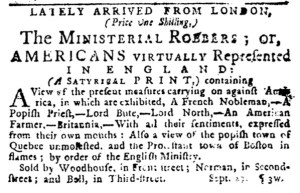
 “AMERICANS VIRTUALLY Represented IN ENGLAND: (A SATYRICAL PRINT.)”

As the imperial crisis intensified and hostilities commenced in Massachusetts in the spring of 1775, American colonizers had supporters in London.  In addition, some artists, engravers, and printers, whatever their own politics may have been, hoped to generate revenue by creating and publishing political cartoons that lambasted the British ministry for the abuses it perpetrated in the colonies.  Some of those prints found their way to eager audiences on the other side of the Atlantic.  In the fall of 1775, William Woodhouse, a bookseller and bookbinder, John Norman, an architect engraver building his reputation, and Robert Bell, the renowned bookseller and publisher, advertised a “SATYRICAL PRINT” that “LATELY ARRIVED FROM LONDON.”

The trio promoted “The MINISTERIAL ROBBERS; or, AMERICANS VIRTUALLY Represented IN ENGLAND,” echoing one of the complaints that colonizers made about being taxed by Parliament without having actual representatives serve in Parliament.  Based on the description of the print in the advertisement, Woodhouse, Norman, and Bell stocked “Virtual Representation, 1775” or a variation of it.  According to the newspaper notice, the image depicted a “View of the present measures carrying on against America, in which are exhibited, A French Nobleman,– A Popish Priest,– Lord Bute,– Lord North,– An American Farmer,– [and] Britannia.”  For each character, “their sentiments, expressed from their own mouths,” appeared as well.

Lord Bute, the former prime minister who inaugurated the plan of regulating American commerce to pay debts incurred during the Seven Years War, appeared at the center of the image, aiming a blunderbuss at two American farmers.  For his “sentiments,” he proclaimed, “Deliver your Property.”  Lord North, the current prime minister, stood next to Bute, pointing at one of the farmers and exclaiming, “I Give you that man’s money for my use.”  In turn, the first farmer stoutly declared, “I will not be Robbed.”  The second expressed solidarity: “I shall be wounded with you.”

The advertisement indicated that the print also showed a “view of the popish town of Quebec unmolested, and the Protestant town of Boston in flames; by order of the English ministry.”  Those parts of the political cartoon unfavorably compared the Quebec Act to the Coercive Acts (including the Boston Port Act and the Massachusetts Government Act), all passed by Parliament in 1774.  The Quebec Act angered colonizers because it extended certain rights to Catholics in territory gained from the French at the end of the Seven Years War.  In the print, the town of Quebec sat high atop its bluff, the flag of Great Britain prominently unfurled, in the upper left with the “French Nobleman” and “Popish Priest” in the foreground.  The legend labeled it as “The French Roman Catholick Town of Quebeck.”  The anti-Catholicism was palpable; the kneeling priest exclaiming “Te Deum” in Latin and holding a cross in one hand and a gallows in the other, playing on Protestant fears of the dangers they faced from their “Popish” enemies.

While Quebec appeared “unmolested” and even favored by Bute, North, and their allies in Parliament, the “English Protestant Town of Boston” appeared in the distance behind the American farmers in the upper right.  The town was indeed on fire, a reference to the battles fought in the vicinity as well as a metaphor for the way Parliament treated the town to punish residents for the Boston Tea Party.  As the advertisement indicated, Britannia, the personification of the empire, made an appearance in the print.  She wore a blindfold and exclaimed, “I am Blinded.”  She looked to be in motion, one foot at the edge of “The Pit Prepared for Others” and her next step surely causing her to fall into it.  There seemed to be no saving Britannia as Bute and North harassed the American farmers and their French and Catholic “Accomplices” watched with satisfaction.

The description of the “SATYRICAL PRINT” in the Pennsylvania Journal merely previewed the levels of meaning contained within the image, yet in likely piqued the curiosity of colonizers who supported the American cause and worried about their own liberties as events continued to unfold in Boston.  Such a powerful piece of propaganda supplemented newspaper reports, maps of the Battle of Bunker Hill, and political treatises circulating in the fall of 1775.

“Virtual Representation, 1775” (London, 1775). Courtesy Boston Public Library.

June 28

What was advertised in a revolutionary American newspaper 250 years ago today?

Pennsylvania Gazette (June 28, 1775).

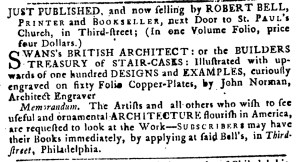
“JUST PUBLISHED … SWAN’s BRITISH ARCHITECT … Illustrated with upwards of ONE HUNDRED DESIGNS AND EXAMPLES.”

At the end of June 1775, Robert Bell, “Printer and Bookseller,” and John Norman, “Architect Engraver,” published an American edition of Abraham Swan’s British Architect: Or, the Builders Treasury of Staircases.  Norman had previously promoted the work with newspaper advertisements and proposals “with a specimen of the plates and letter press” that prospective subscribers could examine.  When the volume was ready for sale and for subscribers to collect the copies they reserved, Bell and Norman ran advertisements in the Pennsylvania Gazette and the Pennsylvania Journal on June 28.  The following day they placed the same advertisement in the Pennsylvania Evening Post.  On July 1, it appeared in the Pennsylvania Ledger and in Story and Humphreys’s Pennsylvania Mercury on July 7.  Of the newspapers printed in English in Philadelphia at the time, only Dunlap’s Pennsylvania Packet did not carry the advertisement.  Bell and Norman made a significant investment in marketing their edition of Swan’s British Architect.

Pennsylvania Journal (June 28, 1775).

To entice prospective customers, they specified that the book was “Illustrated with upwards of one hundred DESIGNS and EXAMPLES, curiously engraved on sixty Folio Copper-Plates” bound into the volume.  They also appended a “Memorandum” requesting that the “Artists and all others who wish to see useful and ornamental ARCHITECTURE flourish … look at the Work.”  If residents of the largest and most cosmopolitan urban port in the colonies wanted their city to maintain and enhance its level of sophistication, Bell and Norman implied, they needed to consider architecture and design important cultural pursuits.  To that end, they also marketed similar publications to those who purchased Swan’s British Architect.  Readers found to subscription proposals bound into the book.  The first one, advertising The Gentleman and Cabinet-Maker’s Assistant with drawings by John Folwell, a local cabinetmaker, and engravings by Norman (dated June 20), faced the title page.  The other, advertising an American edition of Swan’s Collection of Designs in Architecture, Containing New Plans and Elevations of Houses, for General Use (dated June 26), appeared immediately after the letterpress explanations of the engraved illustrations.  The dates on the subscription proposals suggest that they might have circulated separately, yet Bell and Norman made certain to place them before customers who already confirmed an interest in the subject matter.

June 26

What was advertised via subscription proposals in revolutionary American 250 years ago today?

Subscription proposals bound in Abraham Swan, The British Architect: Or, the Builders Treasury of Stair-Cases (Philadelphia: Robert Bell, Bookseller, for John Norman, Architect Engraver, 1775). Courtesy Library of Congress.

“A COLLECTION OF DESIGNS IN ARCHITECTURE … By ABRAHAM SWAN.”

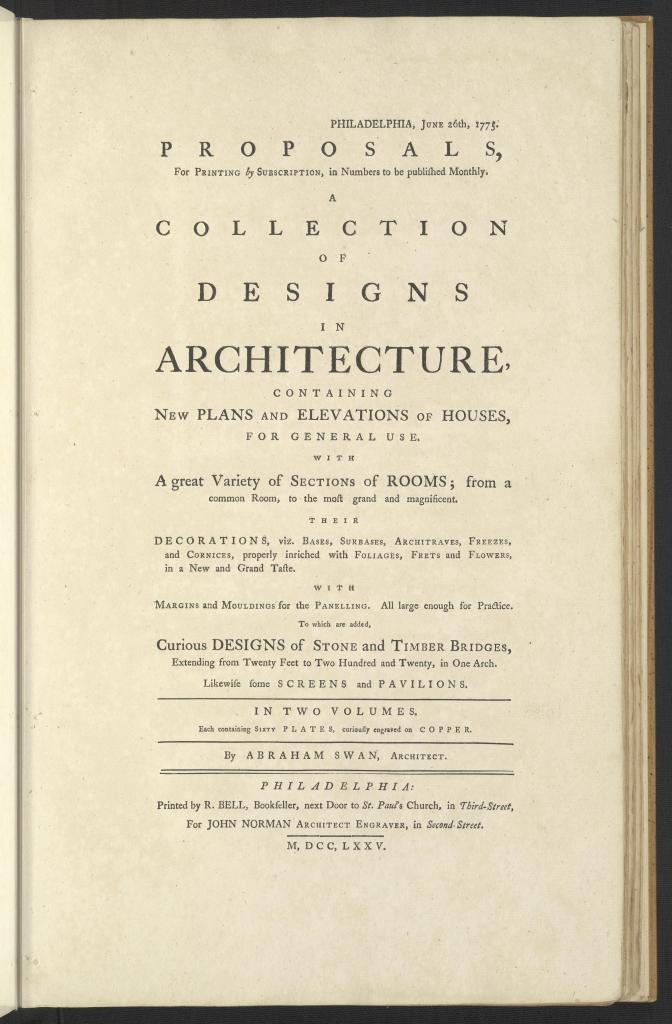
The Adverts 250 Project recently featured subscription proposals for The Gentleman and Cabinet-Maker’s Assistant with drawings by John Folwell and engravings by John Norman bound into the American edition of Abraham Swan’s British Architect published by Norman in collaboration with Robert Bell in the summer of 1775.  Those proposals, facing the title page, were not the only ones in that volume.  Other subscription proposals appeared after the text and before the engravings.  Norman and Bell once again attempted to entice subscribers and other readers of Swan’s British Architect to purchase a book undoubtedly of interest to them, Swan’s Collection of Designs in Architecture.

In contrast to the proposals for The Gentleman and Cabinet-Maker’s Assistant, the proposals for Designs in Architecture ran on two pages facing each other instead of on a single page.  The “CONDITIONS” appeared on the left and the full title, author, and publishers on the right.  Those “CONDITIONS” specified that the volume would be “printed on One Hundred and Twenty Folio Copper-Plates, with Explanations in Letter-Press, in Twelve Numbers, and published Monthly.”  A new “Number containing Ten Folio Copper-Plates, with Explanations” would be ready for subscribers on the first Monday of every month, amounting to “the Whole of the London Edition” over the course of a year.  Subscribers paid five shilling for each “Number” or three pounds altogether, a bargain compared to the four pounds and ten shilling charged for the London edition.  As with the British Architect and The Gentleman and Cabinet-Maker’s Assistant, “the Names of the Encouragers will be printed in the Book.”  The same local agents in Philadelphia, Annapolis, Baltimore, Charleston, and New York accepted subscriptions, except for John Folwell, the designer who supplied the drawings for The Gentleman and Cabinet-Maker’s Assistant but apparently did not have a stake in the American edition of Swan’s Designs in Architecture.

Subscription proposals bound in Abraham Swan, The British Architect: Or, the Builders Treasury of Stair-Cases (Philadelphia: Robert Bell, Bookseller, for John Norman, Architect Engraver, 1775). Courtesy Library of Congress.

The proposals for The Gentleman and Cabinet-Maker’s Assistant could be removed from the British Architect, but that was not the case for the proposals for Designs in Architecture.  The “CONDITIONS” for that proposed work appeared on the verso of the final page of the text, making it impossible for subscribers, bookbinders, or anyone else to remove that portions of the advertisement from the book.  That did not, however, eliminate the possibility of distributing the subscription proposals separately.  Norman and Bell could have issued a broadside that featured just the title, author, and publishers or a broadsheet with the title, author, and publishers on one side and the “CONDITIONS” on the other.  In his Supplement to Charles Evans’ American Bibliography, renowned bibliographer Roger P. Bristol identifies a broadside with the title, author, and publishers as a separate item, but the catalog maintained by the American Antiquarian Society indicates that he did so based solely on a copy in the collections of the Historical Society of Pennsylvania.  That broadside “may be excised” from a copy of the British Architect.  Extant copies do not yield a conclusive answer, but Bell, in particular, was such a savvy advertiser that he very well may have distributed the proposals for Designs in Architecture separately.

**********

I have worked with the copy of Swan’s British Architect in the collections of the American Antiquarian Society for this entry.  That copy has been digitized, yet it remains behind a subscription paywall.  Its features described here match those of copies in the collections of the Gerry Research Institute and the Library of Congress that have been digitized and are accessible to the public.

June 20

What was advertised via subscription proposals in revolutionary American 250 years ago today?

Subscription proposals bound in Abraham Swan, The British Architect: Or, the Builders Treasury of Stair-Cases (Philadelphia: Robert Bell, Bookseller, for John Norman, Architect Engraver, 1775). Courtesy Library of Congress.

“THE GENTLEMAN AND CABINET-MAKER’s ASSISTANT.”

As the summer of 1775 approached, Robert Bell, the prominent bookseller and auctioneer, partnered with John Norman, an architect engraver, in publishing an American edition of Abraham Swan’s British Architect: Or, the Builders Treasury of Stair-Cases.  Norman, who had arrived in Philadelphia just a year earlier, advertised the forthcoming volume in the Pennsylvania Journal in March and advised that prospective subscribers who considered supporting the project could examine printed proposals “with a specimen of the plates and letter press” at his house on Second Street.  He also pledged that the “names of the subscribers to this useful and ornamental work will be published.”  The book eventually included, according to its title page, “upwards of One Hundred DESIGNS and EXAMPLES, curiously engraved on Sixty FolioCopper-Plates,” some of them previously on view.  The “NAMES OF THE ENCOURAGERS,” as promised, appeared on four pages, clustered together by the first letter of their last names.  In the copy in the collections of the American Antiquarian Society, the list of nearly two hundred subscribers had a prominent place immediately after the title page and before the introduction, though binders may have placed the list at the end in other copies.

The copies at the American Antiquarian Society, the Getty Research Institute, and the Library of Congress also include subscription proposals for The Gentleman and Cabinet-Maker’s Assistant with the “DRAWINGS by the ingenious JOHN FOLWELL, Cabinet-Maker; and the ENGRAVINGS by JOHN NORMAN,” bound to face the title page.  While the proposals may have also circulated separately as a broadside, it seems that Bell and Norman seized an opportunity to market a similar book to subscribers and other readers of their edition of British Architecture, an audience that already demonstrated interest in the subject matter.  The proposals carried a date – June 20, 1775 – but could have been paired with British Architecture any time after that.  The proposed volume would feature even more illustrations, “Two Hundred Designs and Examples … with proper Explanations in Letter Press,” at a cost of fifty shillings.  Subscribers were expected to pay fifteen shillings in advance and the remainder “on the Delivery of the Book.”  Folwell and Norman intended to take it to press as soon as subscribers ordered three hundred copies.  As with the British Architect, “The Names of the SUBSCRIBERS to this useful WORK will be printed” as an acknowledgment of their support.  Folwell and Norman accepted subscriptions in Philadelphia, as did Bell and Thomas Nevell “at the Sign of the CARPENTERS-HALL,” but so did local agents in Annapolis, Baltimore, Charleston, and New York.  The list of associates in other towns further suggests that the subscription proposals did indeed circulate separately in an effort to enhance demand.

March 1

What was advertised in a colonial American newspaper 250 years ago today?

Pennsylvania Journal (March 1, 1775).

“THE American Edition of Swan’s British Architect.”

Less than a year after arriving in Philadelphia from London, John Norman, an engraver, embarked on producing an “American Edition of Swan’s British Architect” in the spring of 1775.  He unveiled the project with an advertisement in the March 1 edition of the Pennsylvania Journal, advising the public that he was “Now PUBLISHING” the volume “by SUBSCRIPTION” and seeking supporters to reserve their copies.  He asked those who did so to make a deposit and pay the remainder “at the delivery of the book,” noting that the total price “is Ten Shillings less than the London edition.”

The Continental Association, a nonimportation, nonconsumption, and nonexportation agreement devised by the First Continental Congress in response to the Coercive Acts, was in effect at the time that Norman advertised his American edition of Swan’s British Architect.  His project adhered to the eighth article, which called for “promot[ing] Agriculture, Arts, and the Manufacturers of this Country,” while the subject matter, all sorts of architectural elements in fashion in England, suggested that colonizers continued to value transatlantic cultural ties and their identity as members of the British empire.  The dispute with Parliament had intensified, but most still hoped for a redress of grievances and return to amiable relations.

In addition to the newspaper advertisement, Norman printed more extensive “proposals, with a specimen of the plates and letter press,” that interested parties could view at his house.  Prospective subscribers could learn more about the project and assess the quality of the engravings before placing their orders.  To further entice them, Norman declared that the “names of the subscribers to this useful and ornamental work will be published.”  Just as disseminating subscription proposals was a common marketing strategy in eighteenth-century America, so was publishing the list of subscribers.  In other circumstances, the “gentlemen” who subscribed wanted to see their names alongside those of other genteel members of their community.  That was still the case for this book, yet they likely also wished to see their names in print as they for supporting for an American edition.  Norman offered an opportunity to simultaneously demonstrate their commitment to both the arts and the Continental Association.

August 24

What was advertised in a colonial American newspaper 250 years ago today?

Pennsylvania Journal (August 24, 1774).

“They neatly engrave: Shop Bills; Bills of Exchange; Bills of Lading.”

When John Norman, “ARCHITECT and LANDSCAPE-ENGRAVER, from London,” arrived in Philadelphia in May 1774, he introduced himself to prospective clients via an advertisement in the Pennsylvania Journal.  A few months later, he once again took to the pages of that publication, this time to announce that the partnership of Norman and Ward, “ENGRAVERS and DRAWING-MASTERS,” had opened a shop where they engraved a variety of items and sold “an assortment of Pictures and Frames … much cheaper than imported.”  In addition, they established “an Evening Drawing School” for teaching “that most noble and polite Art in all its various and useful Branches.”  Still a newcomer in the city, Norman devised multiple ways to earn his livelihood.

The various kinds of engraving that Norman and Ward proposed testified to the prevalence of advertising in early America, especially in urban ports.  They indicated that they could produce all sorts of items but could not list them all because they were “too tedious to mention in an Advertisement.”  Yet they named more than a dozen kinds of engraved items, leading their list with “Shop Bills.”  They likely meant both trade cards with an engraved image that filled the entire sheet and billheads that featured an engraved image at the top and blank space for recording purchases.  On occasion, merchants, shopkeepers, and artisans wrote receipts on the reverse side of trade cards.  Norman and Ward next named “Bills of Exchange; Bills of Lading; [and] Bills of Parcels.”  Those could have been simple printed blanks, but that would have defeated the purpose of ordering them from an engraver rather than acquiring those common business forms from printers who produced them in volume.  In this instance, the bills of exchange, bills of lading, and bills of parcels likely included engraved images, not solely text, that served as advertisements for the merchants who ordered them.  Later in the list, Norman and Ward considered “Devices for News-Papers” important enough to include rather than “too tedious to mention.”  Presumably they produced woodcuts in additional to copperplate engravings.  In addition to newspaper printers seeking images to adorn their mastheads and stock images for use elsewhere, the engravers offered their services to advertisers who desired unique images that represented their businesses exclusively.  Trade cards, billheads, and other advertising ephemera have not survived in the numbers that they were likely produced and circulated in early America, yet Norman and Ward’s advertisement suggests that they were part of everyday life as colonizers engaged in commerce and participated in consumer culture.

May 11

What was advertised in a colonial American newspaper 250 years ago today?

Pennsylvania Journal (May 11, 1774).

“Booksellers, in any part of America, may be supplied with frontispieces of any kind.”

When John Norman, an “ARCHITECT and LANDSCAPE-ENGRAVER, from London,” arrived in Philadelphia in the spring of 1774, he introduced himself to the public with an advertisement in the May 11 edition of the Pennsylvania Journal.  He offered his services to “Any Gentlemen, who please to favour him their commands,” promising that they “may depend on having their work carefully and expeditiously executed on the lowest terms and in the best manner.”  The newcomer promised quality engravings at the best prices.  In addition to local customers, he also sought clients in other cities and towns.  In a nota bene, he addressed “Booksellers, in any part of America,” informing them that they “may be supplied with frontispieces of any kind.”  He produced such work “as reasonable as in England,” while also pledging to meet the schedules of his clients.  For those marketing books with frontispieces by subscription, Norman would invest “great care … to dispatch [the engravings] at the time they are wanted.”

Norman experienced success, first in Philadelphia and later in Boston.  He eventually became “one of the significant cartographic engravers and publishers of the early Republic.”  In 1775, he published an American edition of Abraham Swan’s The British Architect: or, the Builder’s Treasury of Staircases, printed by Robert Bell.  The copies in the collections of the American Antiquarian Society and the Library of Congress have two subscription proposals and a list of “ENCOURAGERS” (or subscribers) bound into them.  The engraver hoped that after recruiting nearly two hundred subscribers for The British Architect that the “generous ARTISTS, who encouraged this AMERICAN EDITION, and all others who wish to see useful and ornamental ARCHITECTURE flourish in AMERICA” would reserve one or more copies of “THE GENTLEMAN AND CABINET-MAKERS’S ASSISTANT” and “A COLLECTION OF DESIGNS IN ARCHITECTURE.”  For both volumes, “SUBSCRIPTIONS are gratefully received” by Norman and Bell in Philadelphia and local agents in Annapolis, Baltimore, Charleston, and New York.

The engraver relocated to Boston during the Revolutionary War.  In the final years of the war, he produced portraits of patriot leaders, including His Excellency George Washington, Esqr., General and Commander in Chief of the Allied Armies, Supporting the Independence of America; The Honorable Samuel Adams, Esqr., First Delegate to Congress from Massachusetts; and His Excellency Nathaniel Green, Esqr., Major General of the American Army.  In 1782, Norman engraved, published, and advertised Plan of the Town of Boston, with the ATTACK on BUNKERS-HILL, in the Peninsula of CHARLESTOWN, the 17th of June, 1775.  His engravings, both portraits and maps, contributed to the commodification of patriotism during the era of the American Revolution, a different sort of project than the “ARCHITECT and LANDSCAPE-ENGRAVER” first envisioned in his advertisement in the Pennsylvania Journal.