June 12

What was advertised in a colonial American newspaper 250 years ago today?

Jun 12 - 6:12:1767 New-Hampshire Gazette
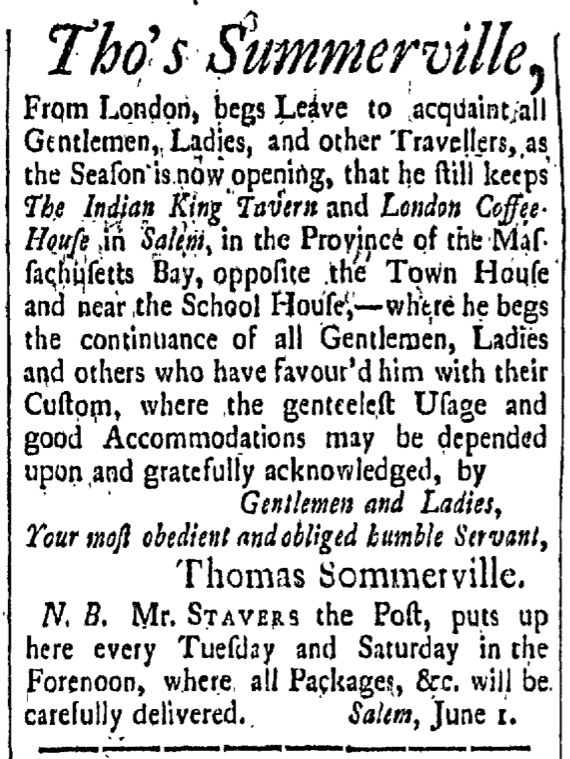
New-Hampshire Gazette (June 12, 1767).

“The Indian King Tavern and London Coffee House in Salem, in the Province of Massachusetts Bay.”

Thomas Sommerville was the proprietor of the Indian King Tavern and London Coffee House in Salem, Massachusetts. To entice visitors of all sorts, he provided a variety of amenities, from “good Accommodations” to exceptional customer service (“the genteelest Usage”) for “Gentlemen, Ladies, and other Travellers.” While Sommerville certainly welcomed local residents to partake in the food and beverages he served as they gathered to socialize or conduct business, he also wished to augment the number of patrons who came through his door, especially visitors from other towns who would pay for lodging in addition to food and drink.

To that end, Sommerville needed to attract customers from beyond his local market. Accordingly, he placed advertisements in the New-Hampshire Gazette to inform residents of Portsmouth and its hinterland about the services he offered. While the Indian King Tavern and London Coffee House might not have been the ultimate destination for most travelers, Sommerville sought to make it a destination that they planned to visit while en route to other places. Not unlike the modern hospitality and tourism industries, he marketed his services to potential customers from a distance.

In his announcement, Sommerville indicated that “the Season is now opening,” suggesting that as spring gave way to summer that greater numbers of people would travel beyond their local communities, either for business or leisure. In the advertisement printed immediately below Sommerville’s notice, Thomas Wood also addressed travelers and described the reception they could anticipate receiving at his tavern at Newbury Ferry in New Hampshire. Sommerville and Wood operated businesses with seasonal rhythms and placed advertisements accordingly, as did their counterparts in other parts of the colonies. Notices promoting houses of entertainment and scenic gardens within and beyond the major port cities increased in spring and the summer months as colonists embarked on their own version of what has become the summer vacation season.

January 19

What was advertised in a colonial American newspaper 250 years ago today?

jan-19-1191767-new-york-mercury
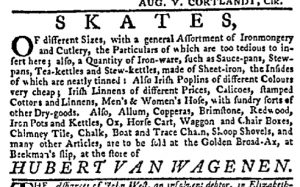
New-York Mercury (January 19, 1767).

“SKATES, OF different sizes.”

Hubert Van Wagenen sold a variety of goods – from “Ironmongery and Cutlery” to textiles and “sundry sorts of other Dry-goods” – at his store “at the Golden Broad-ax” in New York, but he highlighted one item in particular to attract the attention of potential customers: “SKATES, OF different sizes.” Van Wagenen enumerated his merchandise in a typical list advertisement, but he set apart “SKATES” as the only word on the first line, printed in a larger font so as to serve as a headline that invited readers to further explore his other wares.

By the late colonial period ice skating was a popular pastime in New England and the Middle Atlantic colonies, especially among the gentry. Along with dancing and fencing, skating allowed the better sorts to demonstrate grace, power, and agility. According to Nancy Struna, both men and women among the gentry and the middling sort aspiring to join the gentry “expected to play and display their prowess in such endeavors in the middle decades of the eighteenth century.”[1] To that end, they engaged in selected sports and other physical activities that simultaneously evoked pleasure and allowed them to demonstrate skill and discipline through their personal comportment. Physical improvement was as important an element of refinement as learning and manners.

Unlike some of his competitors, Van Wagenen did not make explicit appeals to gentility when describing any of the goods listed in his advertisement. He did not, for instance, use the word “fashionable” or underscore that he imported goods that reflected the latest tastes in London. He may not have considered any of that necessary. Realizing that readers likely considered skating a genteel leisure activity, the shopkeeper had an alternate means of associating gentility with his shop. By listing “SKATES” first and using them to headline his advertisement, he set the tone for how readers should imagine the housewares, textiles, and accessories he also sold.

**********

[1] Nancy L. Struna, People of Prowess: Sport, Leisure, and Labor in Early Anglo-America (Urbana: University of Illinois Press, 1996) 121.

September 20

What was advertised in a colonial American newspaper 250 years ago today?

sept-20-9201766-providence-gazette
Providence Gazette (September 20, 1766).

“To be RUN … by any Horse, Mare, or Gelding.”

Yesterday’s advertisement promoted a lottery for “SUNDRY Millinery Goods” at Joseph Calvert’s vendue house in Williamsburg. After weighing the risks and taking a chance, participants acquired an assortment of goods that they could keep for their own use or resell to others, further extending networks of commerce and distribution of goods in the colonies.

Today’s advertisement also invited readers to take a chance and perhaps win a prize, “a good pinchbeck WATCH, valued at Sixteen Dollars” awarded to the owner of “any Horse, Mare, or Gelding, in the County of Providence” that won a race to be held a little over a week later. Unlike the advertisement for Calvert’s lottery sale, this notice did not – and could not – indicate participants’ odds of winning the prize. It all depended on which horses (and how) many entered. The sponsors required that each entrant “pay one Dollar, upon entering his Horse,” presumably hoping to attract more than enough to balance the value of the watch to be given as the prize.

During the second half of the eighteenth century advertisements for goods and services increasingly placed consumption within a culture of entertainment, especially for those with sufficient wealth and leisure. Although this advertisement did not sell any particular merchandise or services, it did inform colonists of opportunities to be entertained. Those who owned fast horses could participate, but many others could also gather in Cranston to watch the run. The race and anticipation of which horse would win the prize for its owner offered the most excitement, but the entire event offered an entertaining experience, an opportunity to socialize with others and to see and be seen before and after the horses and riders competed. Anyone hoping to win the pinchbeck watch was most likely attired in the sorts of fashionable clothing and accouterments advertised elsewhere in the same issue of the newspaper. Gathering for this event allowed for consumption to become even more conspicuous.

September 18

What was advertised in a colonial American newspaper 250 years ago today?

sep-18-9181766-pennsylvania-gazette
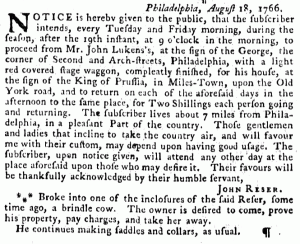
Pennsylvania Gazette (September 18, 1766).

“Those gentlemen and ladies that incline to take the country air … may depend upon having good usage.”

Residents of Philadelphia and other urban centers engaged in an increasing number of leisure activities during the eighteenth century. Just as consumer culture dramatically expanded during the period, so did the sorts of activities that those with time and money could pursue. Dancing and fencing masters tutored students of all ages. Men and women met for meals or tea at houses of entertainment, establishments that often tried to draw in patrons with musicians or fireworks. Some proprietors cultivated gardens for visitors to explore. Others promoted their own hospitality and the conversations they facilitated as hosts and hostesses.

John Reser, who earned part of his living “making saddles and collars,” offered another option to “gentlemen and ladies” who had leisure time and looked to be entertained in new and novel ways. On Tuesdays and Fridays he sponsored an excursion along the “Old York road” from Philadelphia to his house “at the sign of the King of Prussia, in Miles-Town.” Reser promoted several aspects of this excursion, including traveling through “a pleasant Part of the country” that looked much different from the point of departure at “the corner of Second and Arch-streets” in Philadelphia. He promised to serve them well as they “take the country air.” Even the means of travel was intended to be part of the experience: “a light red covered stage wagon, completely finished.” It appears that Reser may have been attempting to make sure residents in and around Philadelphia would be sure to recognize this conveyance, giving his enterprise more visibility and prestige.

Joining this excursion meant committing some time for the fourteen-mile round trip, restricting the number of potential patrons. Although Reser does not explicitly state that he served food and drink at “his house, at the sign of the King of Prussia,” other sources indicate that he was issued a license to operate a tavern in Bristol Township on August 10, 1765. Sponsoring excursions for residents of Philadelphia “to take the country air” twice a week may have been a means of augmenting the business at his tavern.

John Reser’s excursions from Philadelphia into the countryside were part of a growing selection of leisure activities that gained popularity in the second half of the eighteenth century, heralding the rise of the tourism industry.

March 19

What was advertised in a colonial newspaper 250 years ago this week?

Mar 19 - 3:17:1766 New-York Mercury
New-York Mercury (March 17, 1766).

“Baggammon tables, … flutes and fifes, … fishing reels.”

Peter Goelet presented many choices to potential customers in an advertisement that listed dozens and dozens of items that he stocked in his shop “At the Golden Key, in Hanover-Square, New-York.” What else possibly could have been included among the “great variety of other articles” listed at the end of the advertisement?!

This assortment of goods could be used to glimpse many different aspects of daily life in colonial America, from the types of tools that many artisans would have used to housewares and cooking equipment to supplies for writing letters, accounts, and other documents, to name a few.

This advertisement also suggests leisure activities pursued by some early Americans. Goelet sold “baggammon tables” on which colonists would have played the game now commonly known as backgammon. He also carried musical instruments, including violins and “German and common flutes and fifes,” and supplies, such as “hautboy [oboe] reeds, violin strings, bridges, and pins, [and] brass and steel harpsichord wire.” Although the advertisement does not list other sorts of books or pamphlets, “newest tunes, &c.” may have referred to music. Goelet concluded his advertisement with a list of fishing rods, reels, hooks, and flies.

Games, music, and fishing: advertisements offered colonial Americans the goods they needed to pursue a variety of leisure activities that in turn helped them to express their own status and gentility.