June 16

What was advertised in a colonial American newspaper 250 years ago today?

Pennsylvania Journal (June 16, 1773).

“The CONVENIENT BATH [and] The MINERAL SPRING (similar to the German Spaw).”

Newspaper advertisements promoted a nascent leisure and tourism industry in the late eighteenth century.  For instance, an advertisement for the “CONVENIENT BATH” at Perth Amboy, New Jersey, intended to run for two months during the summer of 1773 made its first appearance in the Pennsylvania Gazette and the Pennsylvania Journal on June 16.  The proprietors informed prospective guests that their facilities were “put in very good order for the reception of such as incline to BATH in SEA WATER.”  In addition, they also opened the “MINERAL SPRING (similar to the German Spaw).”  Visitors to the bath and mineral spring could arrange for “Genteel Lodgings” with “private families” in the town.

To entice colonizers in Philadelphia to travel to Perth Amboy, the proprietors confided that “several persons last year received great benefit” from bathing in sea water.  In addition, a combination of bath and spa “proved efficatious to scorbutic, and other disorders.”  They expected that prospective clients might remember advertisements published the previous summer, notices that went into greater detail about the health benefits associated with partaking in the services offered at their facilities.  In an advertisement in the New York Journal, for instance, the proprietors explained that their “Bath will be more beneficial, as at about two Miles Distance is a Mineral Water” and “its proper Distance procuring moderate Exercise after bathing, has proved in many Instances very assistant to the Medicinal Quality of the Waters.” They also asserted that the regimen had been “well examined by several Physicians of Ability, and frequently recommended by them” after observing “great Success” among those who visited the bath and “spaw.”

The proprietors did not provide as many details in the advertisement they ran in the summer of 1773 compared to the one that announced their inaugural season in 1772.  Perhaps they believed that word-of-mouth recommendations helped to enhance the reputation of the facility among the cohort of consumers with the leisure time and resources that would allow them to visit the shore during the summer, making it unnecessary to go into more specifics in their latest advertisement.  They may have considered the weekly repetition of the shorter advertisement over two months sufficient to create a buzz among the better sorts most likely to avail themselves of the bath and spa services in Perth Amboy.

July 12

What was advertised in a colonial American newspaper 250 years ago this week?

New-York Journal (July 9, 1772).

“A NEW and CONVENIENT BATH.”

Readers of the New-York Journal encountered an advertisement for “DOCTOR HILL’s GENUINE AMERICAN BALSAM” in the June 9, 1772, edition.  Michael Hoffman informed them that he received a “fresh Supply” of the “truly excellent medicine” responsible for “great numbers of cures” of all sorts of maladies.  In another advertisement, however, readers learned of an alternative to the patent medicines hawked by so many apothecaries, merchants, and shopkeepers.  That notice announced that a “NEW and CONVENIENT BATH” had been “LATELY ERECTED, And now opened” in nearby Perth Amboy, New Jersey.

The advertisement described what visitors could expect to experience if they visited the bath.  They had access to a “Room properly constructed to undress and dress in, with a Stair-Case leading into the Bathing Room, where Persons of wither Sex may bathe in Salt-Water, in the Salt-Water, in the greatest Privacy.”  In addition, “a Door is so placed in the Bath” that “those that choose to swim off into deeper Water … can conveniently go out and return.”  The notice suggested that visitors also take advantage of a “Mineral Water, similar to the German Spaw” about two miles from the bath, declaring that “its proper Distance procuring moderate Exercise after bathing, has proved in many Instances very assistant to the Medicinal Quality of the Waters.”  Furthermore, “bathing in Sea Water” enhanced the efficacy of the mineral waters at the spa.  In case that description did not entice prospective visitors, the advertisement also reported that “several Physicians of Ability” examined the “Qualities of this Spaw” and “frequently recommended” partaking in the experience.  A nota bene indicated that visitors from New York and other places could procure “Genteel Lodgings” from any of “several private Families” in Perth Amboy.”

A nascent tourism industry emerged in the second half of the eighteenth century, sometimes connected to the medicinal benefits of visiting baths and spas.  In the decade before the American Revolution, the proprietors of “JACKSON’S Mineral-Well in Boston,”  the “Bath and House” at Chalybeat Springs in Bristol, Pennsylvania, and the “BATH” near the “Mineral Water, similar to the German Spaw” in Perth Amboy all placed newspapers advertisements to encourage colonizers to visit their facilities and partake in the amenities they provided.

September 18

What was advertised in a colonial American newspaper 250 years ago today?

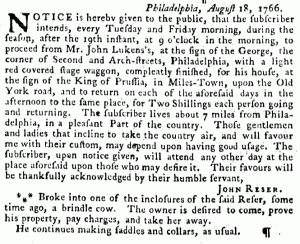
sep-18-9181766-pennsylvania-gazette
Pennsylvania Gazette (September 18, 1766).

“Those gentlemen and ladies that incline to take the country air … may depend upon having good usage.”

Residents of Philadelphia and other urban centers engaged in an increasing number of leisure activities during the eighteenth century. Just as consumer culture dramatically expanded during the period, so did the sorts of activities that those with time and money could pursue. Dancing and fencing masters tutored students of all ages. Men and women met for meals or tea at houses of entertainment, establishments that often tried to draw in patrons with musicians or fireworks. Some proprietors cultivated gardens for visitors to explore. Others promoted their own hospitality and the conversations they facilitated as hosts and hostesses.

John Reser, who earned part of his living “making saddles and collars,” offered another option to “gentlemen and ladies” who had leisure time and looked to be entertained in new and novel ways. On Tuesdays and Fridays he sponsored an excursion along the “Old York road” from Philadelphia to his house “at the sign of the King of Prussia, in Miles-Town.” Reser promoted several aspects of this excursion, including traveling through “a pleasant Part of the country” that looked much different from the point of departure at “the corner of Second and Arch-streets” in Philadelphia. He promised to serve them well as they “take the country air.” Even the means of travel was intended to be part of the experience: “a light red covered stage wagon, completely finished.” It appears that Reser may have been attempting to make sure residents in and around Philadelphia would be sure to recognize this conveyance, giving his enterprise more visibility and prestige.

Joining this excursion meant committing some time for the fourteen-mile round trip, restricting the number of potential patrons. Although Reser does not explicitly state that he served food and drink at “his house, at the sign of the King of Prussia,” other sources indicate that he was issued a license to operate a tavern in Bristol Township on August 10, 1765. Sponsoring excursions for residents of Philadelphia “to take the country air” twice a week may have been a means of augmenting the business at his tavern.

John Reser’s excursions from Philadelphia into the countryside were part of a growing selection of leisure activities that gained popularity in the second half of the eighteenth century, heralding the rise of the tourism industry.