May 19

Who was the subject of an advertisement in a revolutionary American newspaper 250 years ago today?
South-Carolina Gazette and Country Journal Extraordinary (May 19, 1775).

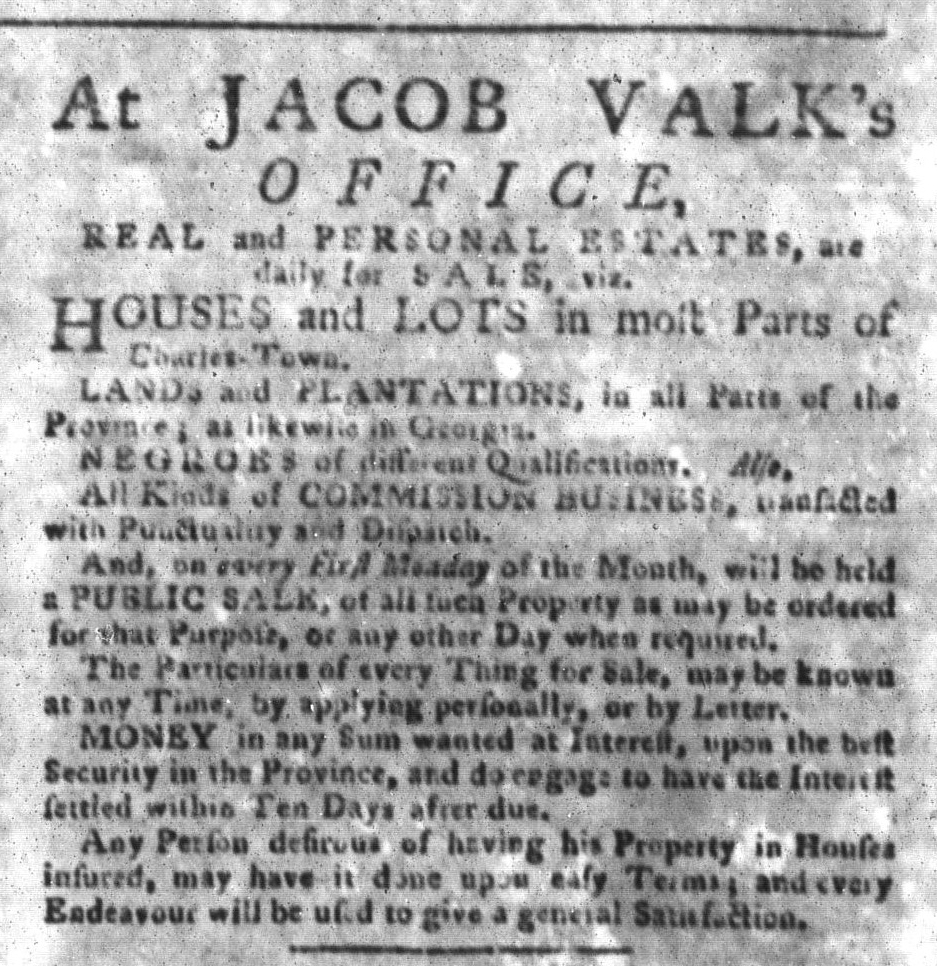
“NEGROES of different Qualifications.”

Charles Crouch usually published the South-Carolina Gazette and Country Journal on Tuesdays in 1775, distributing new issues on a different day than his competitors in Charleston.  Peter Timothy delivered the South-Carolina Gazette on Mondays and Robert Wells and Son presented the South-Carolina and American General Gazette on Fridays.  Yet as information about the battles at Lexington and Concord arrived in Charleston, Crouch published a two-page extraordinary issue on Friday, May 19.  He had first broken the news in the May 9 edition, printing “alarming Intelligence” received via “the Brigantine, Industry, Captain Allen, who sailed the 25th [of April] from Salem.”  Subsequent issues of both the South-Carolina Gazette and Country Journal and the South-Carolina and American Gazette carried news about Lexington and Concord.  (A gap in extant issues between April 10 and May 29 prevents determining when the South-Carolina Gazette reported on those events.)

Many, perhaps most, readers likely heard that British regulars had engaged colonial militia outside of Boston before they read anything in newspapers.  News and rumors spread via word of mouth more quickly than printers could set type, yet readers still clamored for coverage.  After all, the public prints carried more details about what happened, though not all of them were always correct.  Wells and Son printed the South-Carolina and American General Gazette as usual on Friday, May 19, carrying additional news about Lexington and Concord and the aftermath.  Refusing to be scooped, Crouch published his extraordinary issue on the same day.  He specified that the “particulars respecting the Engagement at Lexington, are copied from the Newport Mercury.”

Even as Crouch provided more news for subscribers and the public, he disseminated even more advertisements.  News accounted for only one-quarter of the contents of the May 19 extraordinary issue, with advertisements filling three-quarters of the space.  Those notices included three from Jacob Valk, a broker, looking to facilitate the sales of “ONE of the compleatest WAITING-MEN in the Province,” “Some valuable PLANTATION NEGROES,” and “NEGROES of different Qualifications” at his office.  In another advertisement, William Stitt described Lydia and Phebe, enslaved women who liberated themselves by running away, and offered rewards for their capture and return to bondage.  In yet another, the warden of Charleston’s workhouse described nearly a dozen Black men and women, all of them fugitives seeking freedom, imprisoned there, alerting their enslavers to claim them, pay their expenses, and take them away.  As readers learned more about acts of tyranny and resistance underway in Massachusetts, they also encountered various sorts of advertisements designed to perpetuate the enslavement of Black men and women.  The early American press simultaneously served multiple purposes, regularly featuring a juxtaposition of liberty and slavery that readers conveniently compartmentalized.
April 28

What was advertised in a revolutionary American newspaper 250 years ago today?

New-Hampshire Gazette (April 28, 1775).

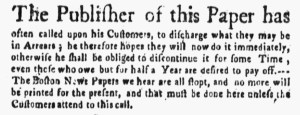
“The Boston News Papers we hear are all stopt.”

It was the sort of notice that printers throughout the colonies regularly inserted in their newspapers, though Daniel Fowle, the printer of the New-Hampshire Gazette in Portsmouth, may have done so with greater frequency than some of his counterparts in other towns.  “The Publisher of this Paper,” he declared on April 28, 1775, “has often called upon his Customers, to discharge what they may be in Arrears.”  This time, however, he did not threaten to stop sending copies to delinquent subscribers who did not pay their bills.  Instead, he suggested that the entire enterprise was at stake, that if he did not receive those payments “immediately” then “he shall be obliged to discontinue [the newspaper] for some Time.”  In other instances, printers addressed subscribers who had not paid in several years, but, again, this time was different.  Fowle proclaimed that “even those who owe but for half a Year are desired to pay off.”

To demonstrate the gravity of the situation, he reported that the “Boston News Papers we hear are all stopt, and no more will be printed for the present.”  Indeed, Fowle had heard correctly.  Five newspapers were published in Boston at the beginning of the month, but none continued uninterrupted by the end of April.  Isaiah Thomas removed the Massachusetts Spy to Worcester before the battles at Lexington and Concord on April 19.  Other printers suspended publication of their newspapers, believing that they would do so only “till Matters are in a more settled State.”  Yet it was the end for the Boston Evening-Post and the Massachusetts Gazette and Boston Post-Boy.  The Boston-Gazette and the Massachusetts Gazette and Boston Weekly News-Letter did eventually resume publication, though only the Boston-Gazette survived the Revolutionary War.

At that moment, neither Fowle nor his subscribers knew the fate of Boston’s newspapers or the New-Hampshire Gazette.  The printer asserted that he would cease publication “unless the Customers attend to this call.”  He did so on the same page that carried more extensive coverage of the events at Lexington and Concord than he had been able to publish in the previous issue because of the “different and contrary Accounts of the late Bloody Scene” received in the printing office in the hours immediately after something momentous happened.  When news about those engagements appeared in the April 28 edition, Fowle used thick black borders, usually associated with mourning, to draw attention.  He also inserted a note at the bottom of the first page: “See the other Side of the Paper an Account of the late Battle.”  In addition, instead of the usual four pages, that issue consisted of only two, an indication to readers that Fowle had limited resources.  If they wanted to continue receiving coverage in print to supplement what they heard by word of mouth, subscribers needed to “discharge what they may be in Arrears” and “do it immediately.”

April 21

What was advertised in a revolutionary American newspaper 250 years ago today?

New-Hampshire Gazette (April 21, 1775).

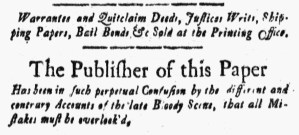
Warrantee and Quitclaim Deeds, Justices Writs … Sold at the Printing Office.”

Daniel Fowle, the printer of the New-Hampshire Gazette, used one of his own advertisements to fill the space near the bottom of the last column on the final page of the April 21, 1775, edition.  He devoted two lines to announcing, “Warrantee and Quitclaim Deeds, Justices Writs, Shipping Papers, Bail Bonds &c Sold at the Printing Office.”  Many printers adopted a similar strategy, promoting goods they sold and services they provided when they had extra space in their newspapers.

Yet that advertisement was not the last word from the printer in that issue of the New-Hampshire Gazette.  Fowle followed it with a notice that stated, “The Publisher of this Paper Has been in such perpetual Confusion by the different and contrary Accounts of the late Bloody Scene, that all Mistakes must be overlook’d.”  He referred to the skirmishes at Lexington and Concord that occurred two days earlier on April 19.  As the masthead proclaimed, Fowle published the “Freshest ADVICES,” but that meant going to press with the information that he received even if some reports contradicted others.  Fowle anticipated that he would offer a clear account of events over time.  For the moment, however, he did his best with the “different and contrary” stories to keep readers informed of what he recognized as momentous events even if all the details were not yet clear.

New-Hampshire Gazette (April 21, 1775).

To that end, the first column on the first page not only began with a rare headline but one that demanded attention: “BLOODY NEWS.”  In an introductory note, the printer explained that “Early this Morning,” on April 20, “we were alarmed with an Express from Newbury-Port, with the following Letter, to the Chairman of the Committee of Correspondence in this Town.”  That letter relayed “Reports of the TROOPS having marched out of Boston to make some Attack in the Country.”  Those reports “in general concur, in part, in [British troops] having been at Lexington.—And it is very generally said they have been at Concord.”  The rider who brought that letter supplement it with his own version of what he had heard.  Fowle also published updated information from two other express riders who arrived in Portsmouth on April 20, one in the afternoon and the other in the evening.  He devoted an entire column to breaking news from Lexington and Concord.

Many of the readers that Fowle hoped would purchase the various printed blanks that he advertised had no doubt heard that something had happened at Lexington and Concord before they saw the April 21 edition of the New-Hampshire Gazette, yet they would have looked to it for confirmation and additional details.  Fowle gave them more details, but stopped short of confirming the accuracy of all of them.  In the coming weeks, he would sift through even more accounts as events continued to unfold, chronicling the Revolutionary War as it happened.

April 20

What was advertised in colonial American newspaper 250 years ago today?

Norwich Packet (April 20, 1775).

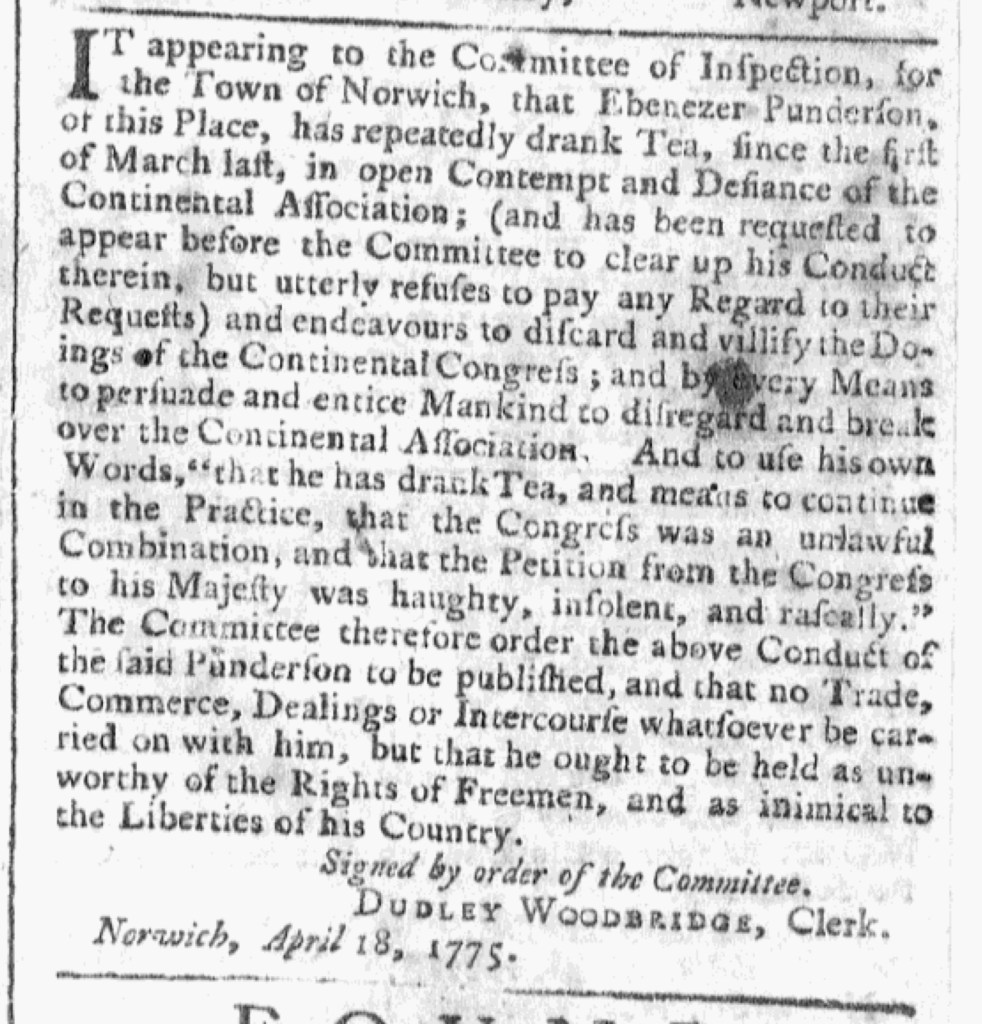
“Ebenezer Punderson … has repeatedly drank Tea … in open Contempt and Defiance of the Continental Association.”

Ebenezer Punderson went too far and now it was time for consequences.  He brazenly and repeatedly violated the Continental Association, the nonimportation and nonconsumption agreement enacted by the Continental Congress in response to the Coercive Acts.  As a result of his actions, the Committee of Inspection in Norwich, Connecticut, placed an advertisement in the April 20, 1775, edition of the Norwich Packet to document his behavior and advise the community to shun Punderson.

The committee reported that Punderson “has repeatedly drank Tea … in open Contempt and Defiance of the Continental Association.”  When the committee sought to investigate the matter, he “utterly refuse[d] to pay any Regard to their Requests” to appear before it.  Even worse, he “endeavours to discard and vilify the Doings of the Continental Congress; and by every Means to persuade and entice Mankind to disregard and break over the Continental Association.”  His refusal to abide by the Continental Association damaged the movement and had the potential to do even more harm by inspiring others to ignore it as well.  In addition, he stridently declared that he had no intention of adhering to the agreement, insulting the Continental Congress in the process:  “to use his own words, ‘that he has drank Tea, and means to continue in that Practice, that the Congress was an unlawful Combination, and that the Petition from the Congress to his Majesty was haughty, insolent, and rascally.’”

The Committee of Inspection, in turn, determined that it was Punderson who was haughty, insolent, and rascally.  It ordered that the “Conduct of the said Punderson be published, and that no Trade, Commerce, Dealings or Intercourse whatsoever be carried on with him.”  Furthermore, the committee declared that “he ought to be held as unworthy of the Rights of Freemen, and as inimical to the Liberties of his Country.”  Punderson acted in opposition to the patriot cause.  The Committee of Inspection intended to see him pay for his transgressions.

Norwich Packet (April 20, 1775).

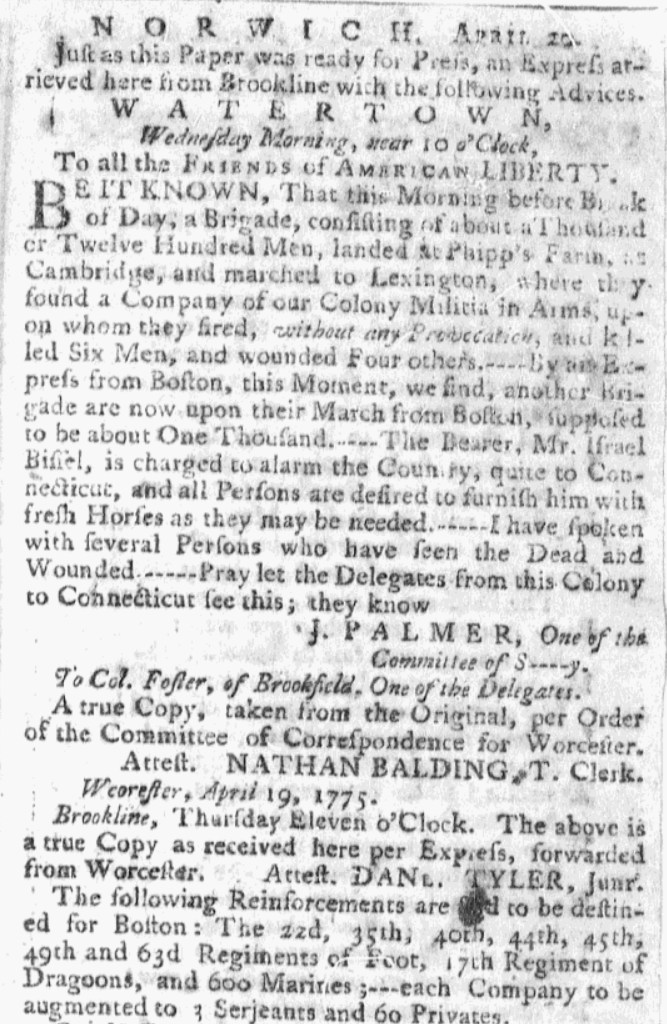
Punderson chose the wrong time to draw attention to himself.  Some of the first coverage of the battle at Lexington to appear in American newspapers ran at the top of the column that featured the advertisement about his offenses.  “Just as this Paper was ready for Press,” the printers declared, “an Express arrived here from Brookline with the following Advices” from J. Palmer, “One of the Committee of S[afet]y,” and dispatched to “Col. Foster, of Brookfield.”  The missive reported that before dawn on the morning of April 19 “a Brigade [of British troops] … marched to Lexington, where they found a Company of our Colony Militia in Arms, upon whom they fired, without any Provocation, and killed Six Men, and wounded Four others.”  Palmer stated that he had “spoken with several Persons who have seen the Dead and Wounded.”  He also relayed news that another Brigade “are now on their March from Boston.”  Israel Bissell carried the message, “charged to alarm the Country” in western Massachusetts all the way to Connecticut.  The printers published this account from a “true Copy, taken from the Original, per Order of the Committee of Correspondence for Worcester.”  The details were sparse, yet the “FRIENDS of AMERICAN LIBERTY” reading the Norwich Packet now knew that fighting had commenced near Boston.  That news quite likely had an impact on their attitude when they read about Punderson’s offenses further down the column.