December 11

What was advertised in a revolutionary American newspaper 250 years ago today?
South-Carolina Gazette (December 11, 1775).

“The Times make it uncertain how long he will be able to keep his Store open in Town.”

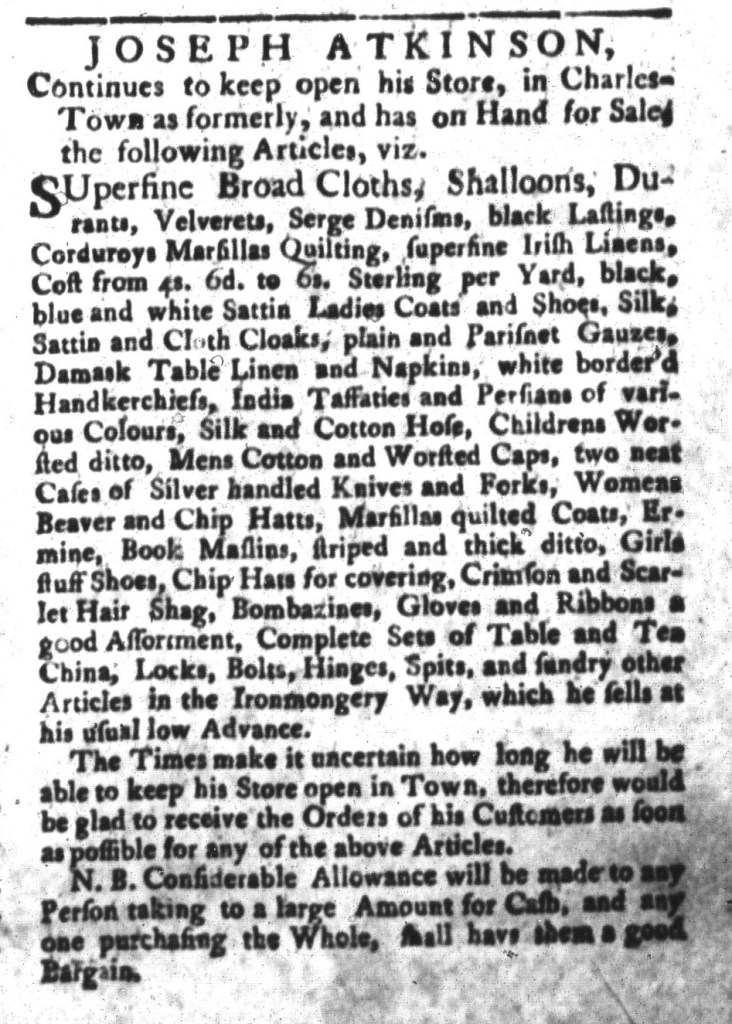
Joseph Atkinson placed an advertisement in the December 11, 1775, edition of the South-Carolina Gazette to advise prospective customers that he “Continues to keep open his Store, in Charles-Town as formerly.”  He listed an array of merchandise, including a variety of textiles, “Mens Cotton and Worsted Caps, two Cases of Silver handled Knives and Forks, Womens Beaver and Chip Hats, … Gloves and Ribbons a good Assortment, Complete Sets of Table and Tea China, … and sundry other Articles in the Ironmongery Way.”  Atkinson sought to liquidate his stock, declaring that “Considerable Allowance will be made to any Person taking to a large Amount for Cash.”  Furthermore, “any one purchasing the Whole, shall have them at a good Bargain.”

The shopkeeper also confessed that the “Times make it uncertain how long he will be able to keep his Store open in Town.”  He declared that he “therefore would be glad to receive the Orders of his Customers as soon as possible.”  To underscore the point about uncertain times, the items on the first page of that issue featured updates from the Second Continental Congress in Philadelphia and the colony’s own congress, including a call for provisions “to supply the REGIMENT of ARTILLERY in the Service of this Colony.”  What Atkinson and readers of the South-Carolina Gazette did not know was that the newspaper would soon cease publication.  The December 11 edition became the last known issue, though Clarence S. Brigham reports it “was followed by one other number, probably Dec[ember] 18.”[1]  Peter Timothy, the printer, revived the newspapers as the Gazette of the State of South-Carolina sixteen months later, on April 9, 1777.  As the title indicates, the colonies declared independence by the time Timothy resumed publishing his newspaper.

The demise of the South-Carolina Gazette meant less news and advertising circulating in that colony and the region.  Four months earlier, the South-Carolina Gazette and Country Journal folded.  Now only the South-Carolina and American General Gazette remained.  For nearly a decade, three competing newspapers served Charleston and the rest of the colony, many issues devoting more space to advertising than news.  Although the South-Carolina and American General Gazette continued publication, with occasional suspensions, until February 28, 1781, issues published after 1775 have not been preserved and digitized for wider access.  That means that advertisements from South Carolina, including the urban port of Charleston, will no longer be part of the Adverts 250 Project and the Slavery Adverts 250 Project.  As the projects continue to tell stories about the era of the American Revolution, they will focus on New England, New York, Pennsylvania, and the Chesapeake, drawing on those newspapers that continued publication (or commenced publication during the Revolutionary War) and that have been preserved and digitized.  So many stories remain to be told, but, for a time, South Carolina will be largely absent from this project’s featured advertisements.

**********

[1] Clarence S. Brigham, History and Bibliography of American Newspapers, 1690-1820 (Worcester: American Antiquarian Society, 1947), 1038.
September 22

What was advertised in a revolutionary American newspaper 250 years ago today?

Story and Humphreys’s Pennsylvania Mercury (September 22, 1775).

“Determined to SELL OFF his large Assortment of GOODS remarkably Cheap.”

The pages of American newspapers had a different appearance after the Continental Association went into effect on December 1, 1774.  While adherence to prior nonimportation agreements had been scattered, this one attracted much greater compliance.  As a result, the advertisements that featured lengthy lists of imported merchandise to be sold by local merchants and shopkeepers appeared in the public prints less often, but they did not disappear completely.  Notices that listed a few dozen items continued to appear in some newspapers.

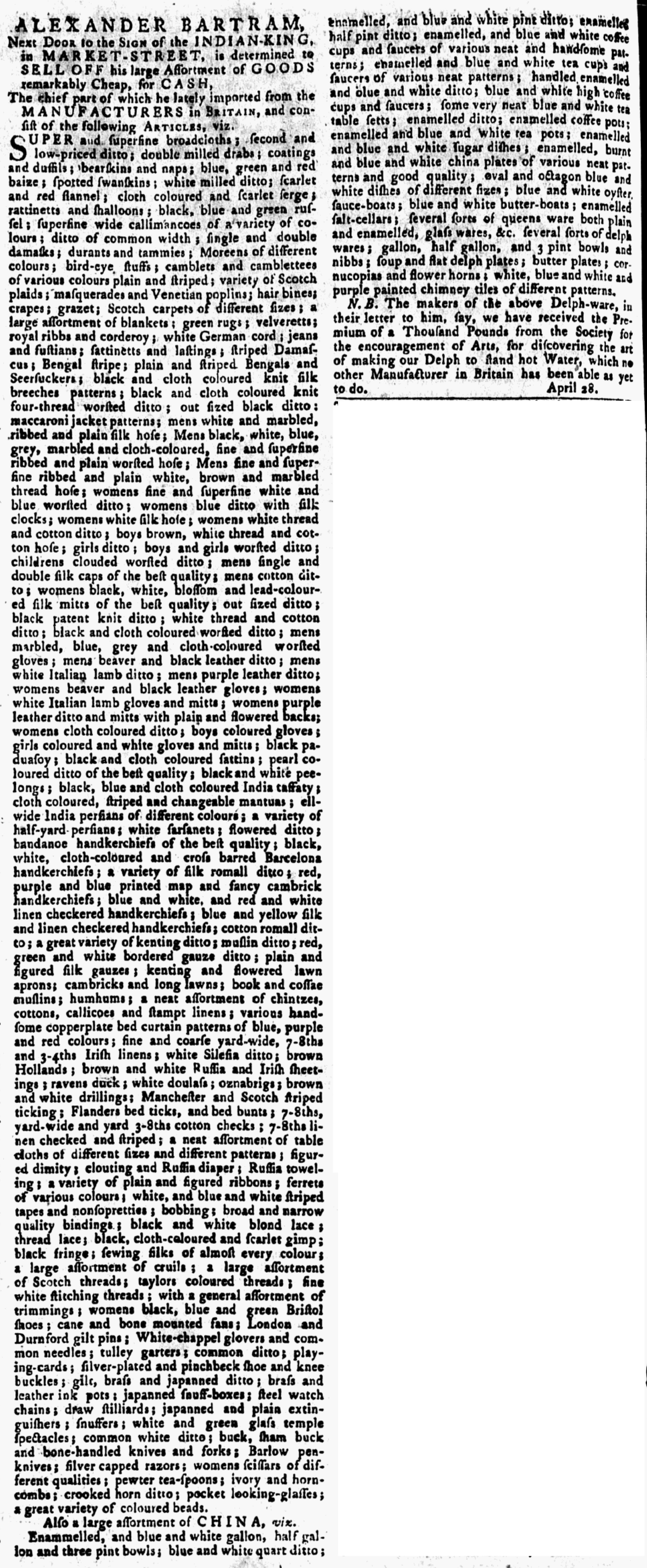
Even so, Alexander Bartram’s advertisement for goods “lately imported from the MANUFACTURERS in BRITAIN” seemed extraordinary because of its length.  It did not fill only a portion of a column in Story and Humphreys’s Pennsylvania Mercury; instead, it extended an entire column and overflowed into another column.  It cataloged dozens of items available at his shop “Next Door to the SIGN of the INDIAN-KING, in MARKET-STREET” in Philadelphia.  Dated April 28, Bartram’s advertisement first appeared in the newspaper on that day in 1775 and then again in the supplement the following week.  The shopkeeper declared his intention to “SELL OFF his large Assortment of GOODS remarkably Cheap.”  He apparently acquired his wares prior to December 1, though he did not make a point of asserting that was the case.  The boycott presented an opportunity to clear his shelves of older merchandise since he would not have to compete with new arrivals.

Five months later, his advertisement ran in Story and Humphreys’s Pennsylvania Mercury once again.  The compositor had not broken down the type in that time.  With the Continental Association still in effect, Bartram saw another opportunity to clear the shelves in his shop … but how many of the items listed in his advertisement remained after his prior attempts to sell them “remarkably Cheap” over the summer?  That likely mattered little to Bartram, especially if he believed that such an extensive list would get customers looking for bargains through the doors.  A month later, he took to the Pennsylvania Journal with a much shorter advertisement that promoted a “General assortment of MERCHANDIZE, suitable for the season.”  Dated October 25 and scheduled to run for six weeks, that notice advised that Bartram “proposes to leave the city in a short time.”  If he already planned to depart Philadelphia at the time he republished his lengthy advertisement in late September, he may have considered it worth the expense of taking up so much column space if it might result in significant sales to liquidate his merchandise.

November 30

What was advertised in a colonial American newspaper 250 years ago today?

Pennsylvania Journal (November 30, 1774).

“The Sign of the SPINNING-WHEEL.”

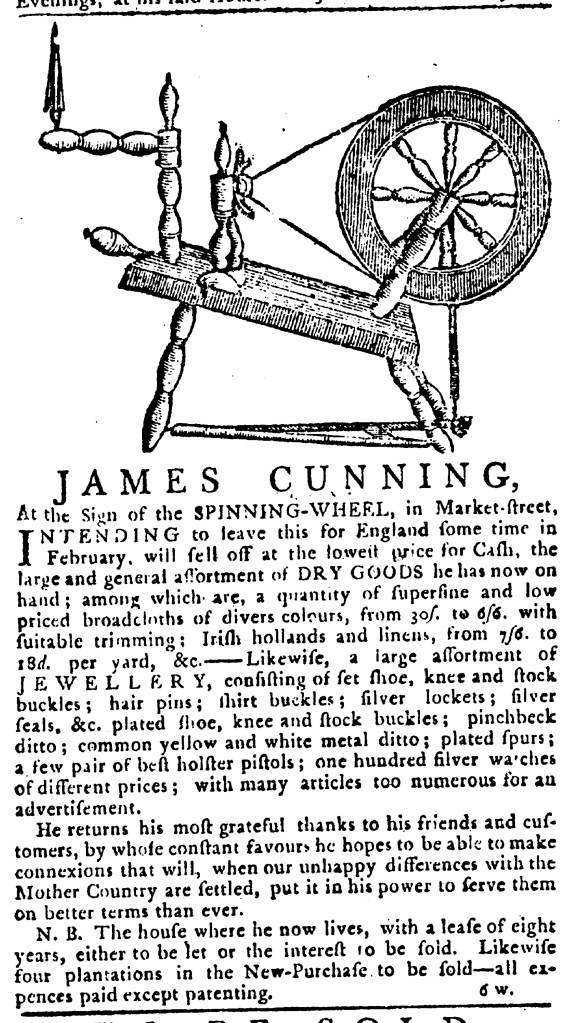
James Cunning ran a shop “At the Sign of the SPINNING-WHEEL” in Philadelphia in the early 1770s, occasionally advertising in the local newspapers.  In the fall of 1774, he made plans to depart for England the following February.  His preparations included running a new notice and selling his remaining merchandise “at the lowest price for Cash.”  He did not indicate why he planned to leave Philadelphia or how long he would be away, but he did state that during his time on the other side of the Atlantic that he “hopes to be able to make connexions that will, when our unhappy differences with the Mother Country are settled, put it in his power to serve [his customers] on better terms than ever.”  Neither Cunning nor readers knew that armed conflict between the colonies and Britain would erupt in Massachusetts in April 1775 or that the “unhappy differences” would be settled with a war for independence that would last eight years.

They did know, however, that the imperial crisis had intensified to the point that delegates from twelve colonies convened the First Continental Congress in Philadelphia in September and October 1774.  They also knew that meeting resulted in the Continental Association, a nonimportation agreement intended to unify the colonies.  That pact was scheduled to go into effect on December 1, the day after Cunning’s advertisement made its first appearance in the Pennsylvania Journal. Envisioning the difficulty ahead, the shopkeeper may have decided to make the best of the situation by liquidating his inventory and making plans for what he hoped would be a better future.

Given the stakes, Cunning sought to increase the chances that readers would take note of his advertisement.  To that end, he included a woodcut that depicted a spinning wheel, the same device that marked the location of his shop.  He had incorporated that image into advertisements he placed in October 1771 and December 1772.  More recently, including in an advertisement in the December 6, 1773, edition of Dunlap’s Pennsylvania Packet, he did not feature a visual image.  When he decided to visit England, Cunning either remembered where he had stored the woodcut or managed to find it after some searching, determined to use it to his advantage during difficult times.  A nick in the spindle reveals that it was the same woodcut from his earlier advertisements, collected from the printing office where John Dunlap published the Pennsylvania Packet and later delivered to the printing office where William Bradford and Thomas Bradford published the Pennsylvania Journal.  The shopkeeper intended, at least one more time, to get a return on the investment he made when he commissioned the woodcut.

June 7

What was advertised in a colonial American newspaper 250 years ago today?

Essex Gazette (June 7, 1774).

“He is winding up his Affairs as fast as possible, and is determined to drop Trade.”

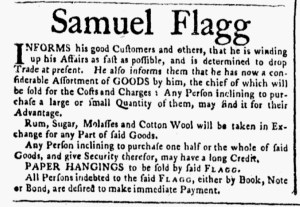
It was a going out of business sale by another name.  As summer approached in 1774, Samuel Flagg took to the pages of the Essex Gazette to inform residents of Salem and nearby towns that “he is winding up his Affairs as fast as possible, and is determined to drop Trade at present.”  That meant that he needed to get rid of his existing inventory, “a considerable Assortment of GOODS.”  For bargain hunters or any consumers looking for good deals, this was quite an opportunity since Flagg pledged to sell his wares “for the Costs and Charges” without significant retail markup.  He attempted to entice customers with promises that they “may find it for their Advantage” to purchase “a large or small Quantity” of his remaining goods.  Flagg also presented his decision to “drop Trade” as favorable to other retailers, suggesting that they might be interested in acquiring “one half or the whole of said Goods.”  Provided that they “give Security,” Flagg was willing to allow “a long Credit” for payment.

Flagg had a history of publishing colorful advertisements in the Essex Gazette, commenting on the marketing strategies deployed by some of his competitors, and it was not the first time that he announced plans to liquidate his merchandise.  A year earlier, he asserted “his present Determination is to go home to London in the Fall; he is therefore determined to sell off the whole of his Goods.”  The entrepreneur made bold claims that he would part with his goods “as low as they can be bought at any Store on the Continent, without any Exception.”  His “Determination” did not result in returning to London in the fall of 1773, but it may have resulted in some good deals for consumers who took advantage of his intentions.  Those who benefited from that sale might have been especially eager to examine Flagg’s goods this time, though others who did not consider the savings all that significant likely would have been wary of renewed promises.  Today, consumers become skeptical of retailers who repeatedly hold going out of business sales yet do not close their doors, realizing that liquidation prices are just their everyday prices.  Flagg risked the same response if he resorted to this marketing strategy too many times.

August 31

What was advertised in a colonial American newspaper 250 years ago today?

South-Carolina Gazette and Country Journal (August 31, 1773).

“The most minute and trifling article, INDISPUTABLY CHEAPER than they could possibly do in London.”

Working on behalf of the beneficiary of George Thomson’s estate at the end of August 1773, Benjamin Villepontoux attempted to liquidate the remaining inventory in the store “lately occupied” by Thomson on Tradd Street in Charleston.  The merchandise included a “Large and valuable assortment of DRY GOODS,” most of them imported by Thomson “in the month of October last.”  Although nearly a year had passed, Villepontoux insisted that the goods were still in style, reiterating the word “fashionable” in the list of goods in the advertisement: “SUPERFINE fashionable broad cloths, with trimming,” Fashionable beaver hats, with gold and silver bands,” “fashionable cloaks,” and “the most fashionable ribbons.”  Similarly, he promoted a “variety of genteel articles in the millinary branch” and “very elegant embroidered brocade for waistcoats.”

Villepontoux hoped that such descriptions would attract both consumers and, especially, retailers.  To encourage prospective buyers to take a significant portion of the inventory, he allowed credit until January 1774 to anyone who made a purchase “of 50l. sterling, at one time.”  Otherwise, “immediate payment will be expected” for smaller sales.  This was an opportunity for “planters, shopkeepers, and others” to acquire even “the most minute and trifling article, INDISPUTABLY CHEAPER than they could possibly do in London.”  How could Villepontoux make such a promise about these fashionable wares?  How could the prices in Charleston beat the prices in London?  He asserted that the goods “were purchased, in large parcels, of the original manufacturers, with the utmost care and pains.”  He rehearsed a narrative often delivered by merchants who sought to convince shopkeepers and consumers that they offered the best deals.  Rather than dealing with English merchants, middlemen responsible for inflating prices, Thomson contracted with the producers directly.  That lowered his costs, as did purchasing in volume.  That meant that Thomson (and now Villepontoux) could give bargains to colonizers in South Carolina by passing along the discounts.

In his effort to clear out the merchandise at Thomson’s store, Villepontoux combined a variety of popular marketing appeals.  He invoked choice, fashion, price, and connections to the most cosmopolitan city in the empire.  To persuade prospective buyers that they did not want to pass on the deals now available, he presented an explanation about how he managed to set low prices.  Those circumstances suggested the possibility of negotiating favorable transactions with an already motivated seller.

June 15

What was advertised in a colonial American newspaper 250 years ago today?

Essex Gazette (June 15, 1773).

“His present determination is to go home to London in the Fall; he is therefore determined to sell off the whole of his Goods … at the very lowest Rate.”

In the summer of 1773, Samuel Flagg took to the pages of the Essex Gazette to promote the “general Assortment of English and India GOODS” that he recently received via “the last Shops from London and Bristol.”  He directed prospective customers interested in “Hosery of all sorts,” “men’s and boys felt Hats of all sizes,” “a good assortment of Paper Hangings,” “an assortment of Ship-Chandlery,” and “almost every other Article usually enquired for” to visit his shop “two Doors below the Town-House” in Salem.

To entice consumers, Flagg declared that he parted with his imported goods “as low as they can be bought at any Store on the Continent, without any Exception.”  It was a bold claim.  The merchant not only compared his prices to prices set by competitors in Salem and nearby Boston but also to prices found anywhere in Britain’s mainland colonies.  To back up this claim, Flagg explained that “his present Determination is to go home to London in the Fall.”  Accordingly, “he is therefore determined to sell off the whole of his Goods … at the very lowest Rate, by Wholesale and Retail.”  Flagg sought to demonstrate that he did not make idle promises about his prices.  Instead, his plans to return to London motivated him to liquidate his merchandise over the course of the next several months.

Although he did not deploy the same phrases that marketers would come to use in the twentieth and twenty-first centuries, Flagg experimented with a strategy eventually known as a liquidation sale, selling his inventory at a significant discount in order to generate cash in advance of closing his business.  At the same time, he encouraged former customers and other associates indebted to him to settle accounts “for the above Reason,” departing for London, so he would be ready to travel in the fall.

Other advertisers offered their wares “very cheap for Cash or short Credit” or “at the very lowest Rate,” but did not provide assurances or explanations.  Nathaniel Sparhawk declared that he sold his imported goods “as cheap for Cash or short Credit as at any Store in this Town (without Exception),” but did not offer any comments about why prospective customers should trust that proclamation.  In the June 15 edition of the Essex Gazette, only James Grant took an approach that resembled Flagg’s strategy, declaring that he “will sell for the sterling Cost and Charges,— as he intends going into some other Business.”  In colonial Salem, some entrepreneurs experimented with marketing strategies, such as liquidation sales, that became much more common more than a century later.