May 21

What was advertised in a colonial newspaper 250 years ago today?

May 21 - 5:21:1766 Georgia Gazette
Georgia Gazette (May 21, 1766).

INGLIS and HALL, have just imported … A NEAT ASSORTMENT of India and English chintzes.”

This is the first time the Adverts 250 Project has featured an advertisement from the Georgia Gazette. Although I make every effort to select advertisements from as many different newspapers, cities, colonies, and regions as possible, but the Georgia Gazette, which commenced publication in 1763, was not previously available for inclusion in this project due to political considerations from the period.  It had been suspended in November 1765 in response to the Stamp Act and did not resume publication until May 21, 1766.

Examining newspapers from more than one region sometimes demonstrates striking differences, such as the sheer number of advertisements for runaway slaves that appeared in the Virginia Gazette compared to publications from New England and the Middle Atlantic colonies.

Today’s advertisement, however, demonstrates an important similarity among advertisements throughout the colonies. At a glance, this advertisement resembles others placed by shopkeepers in other regions. It could have appeared anywhere in the colonies and it would have looked familiar to readers. They would have recognized the variety of merchandise offered for sale.

T.H. Breen has previously described this as the standardization of consumer culture in colonial America. Even as consumers encountered greater amount of choice in the marketplace, the goods that were available in Georgia were largely the same goods available in Boston. Merchants and shopkeepers throughout New England, the Middle Atlantic, the Chesapeake, and the Lower South imported and sold the same items. As a result, this gave residents throughout the colonies a shared experience and a shared language of consumer culture. It helped to tie them together as a community, Breen argues, that facilitated conversations about political rights, especially concerning commerce and taxation within the British Empire. Colonists used consumer culture as one starting point for understanding their position in the empire.

This advertisement, almost indistinguishable from advertisement that appeared in newspapers in colonies far away, testifies to those shared experienced and that common language of consumer culture.

March 19

What was advertised in a colonial newspaper 250 years ago this week?

Mar 19 - 3:17:1766 New-York Mercury
New-York Mercury (March 17, 1766).

“Baggammon tables, … flutes and fifes, … fishing reels.”

Peter Goelet presented many choices to potential customers in an advertisement that listed dozens and dozens of items that he stocked in his shop “At the Golden Key, in Hanover-Square, New-York.” What else possibly could have been included among the “great variety of other articles” listed at the end of the advertisement?!

This assortment of goods could be used to glimpse many different aspects of daily life in colonial America, from the types of tools that many artisans would have used to housewares and cooking equipment to supplies for writing letters, accounts, and other documents, to name a few.

This advertisement also suggests leisure activities pursued by some early Americans. Goelet sold “baggammon tables” on which colonists would have played the game now commonly known as backgammon. He also carried musical instruments, including violins and “German and common flutes and fifes,” and supplies, such as “hautboy [oboe] reeds, violin strings, bridges, and pins, [and] brass and steel harpsichord wire.” Although the advertisement does not list other sorts of books or pamphlets, “newest tunes, &c.” may have referred to music. Goelet concluded his advertisement with a list of fishing rods, reels, hooks, and flies.

Games, music, and fishing: advertisements offered colonial Americans the goods they needed to pursue a variety of leisure activities that in turn helped them to express their own status and gentility.

February 4

GUEST CURATOR:  Maia Campbell

What was advertised in a colonial newspaper 250 years ago this week?

Feb 4 - 2:3:1766 Newport Mercury
Newport Mercury (February 3, 1766)

“A Large Assortment of Medicines, chymical and galenical.”

This advertisement brings a variety of goods to the table, but what caught my eye was the presence of medicine at the top of the list. Prior to this period in colonial America, the Scientific Revolution was set into motion after the medieval period, which on some levels lacked innovation. In medicine, there seemed to be a regressing, especially with the presence of the Black Plague. However, scientists in the 1600s and 1700s were ever experimenting to find new solutions to problems, including diseases. Not only were there artificial remedies created, but there were natural remedies used as well, distinguished in the advertisement as “chymical and galenical.” As the Europeans composed the bulk of innovators and inventors, their ideas and products were passed on to their colonies. Although the colonial era continued to have sicknesses, including the Yellow Fever, colonists had a knowledge of medicine that would continue to grow and eventually lessen the effects of epidemics.

The American Colonies were able to benefit from improved Western medicine and they continued to see medicine develop in their time.

**********

ADDITIONAL COMMENTARY:  Carl Robert Keyes

I suspect that much of Maia’s analysis of this advertisement was inspired by the two-semester History of Western Civilization sequence taught by my colleagues, Lance Lazar in the fall and Winston Black this spring. I encourage students to look for connections among their courses, especially history courses, rather than treat different places and different eras as if they existed completely independently of each other. It’s certainly gratifying when students take content and ideas from one course and effectively apply them to the periods and places they are studying in other courses.

That being said, this advertisement offers another opportunity to challenge students to think about other perspectives, to continue to integrate new knowledge into their interpretation of the past. While Europeans were certainly influential in the development of Western medicine, this advertisement leaves out the possible contributions of indigenous peoples (just as the advertisement for Jamaican sugar earlier this week belied the labor of enslaved Africans). Consider, for instance, the work of Kathleen S. Murphy (History, California Polytechnic State University), including “Translating the Vernacular: Indigenous and African Knowledge in the Eighteenth-Century British Atlantic.”[1] Murphy demonstrates that Europeans were often assisted by non-Europeans in their quest for scientific and medical knowledge. In some cases, these so-called “others” acted as teachers to Europeans, instructing them in healing techniques and the qualities of previously unknown flora and fauna in the wake of the Columbian Exchange.

Medical knowledge did make significant advances in the eighteenth century, partly as a result of interactions and cooperation among Europeans, Africans, and indigenous Americans.  In turn, colonists could purchase “A Large Assortment of Medicines, chymical and galenical.”

**********

[1] Kathleen S. Murphy, “Translating the Vernacular: Indigenous and African Knowledge in the Eighteenth-Century British Atlantic,” Atlantic Studies 8, no. 1 (2011): 29-48.

February 3

GUEST CURATOR:  Maia Campbell

What was advertised in a colonial newspaper 250 years ago today?

Feb 3 - 2:3:1766 Boston Post-Boy
Boston Post-Boy (February 3, 1766)

“A Silver Sugar Chest and Quart Can, Gold and Silver Lace …”

A variety of the items to be sold in this new public auction room seem like the type of items that wealthier families during the eighteenth century would purchase. Goods such as horse whips and saddles would appeal more to wealthier classes because they were more likely to own many horses, as they were a symbol of wealth in the eighteenth century (and in some cases they remain a symbol of wealth to this day). Also, fancier fabrics like gold and silver lace would appeal to upper classes because they tended to dress in a more stylized manner than more common people.

Likewise, a variety of items appeal to the general public. Items such as buttons, blankets, hinges, and household furniture were things that that everybody needed to have. The advertisement demonstrates the flexibility of the vendor and his desire to reach a wide audience of customers. This colonial vendor had a vast number of clients and the knowledge of their necessities and desires.

**********

ADDITIONAL COMMENTARY:  Carl Robert Keyes

What an assortment of goods up for sale at “PUBLIC VENDUE” on Tuesday, Wednesday, and Friday evenings! I agree with Maia’s assessment that this advertisement includes merchandise intended to appeal to many different kinds of potential customers. A consumer revolution was taking place in the eighteenth-century British Atlantic world, a transformation in consumption habits experienced not only by the elite but, as the century progressed, increasingly by the middling sort and, to the alarm of some critics, the lower sorts as well, though some colonists were able to participate to greater extents than others.

Some of the goods on offer here would have permitted the better sort to demonstrate their affluence by engaging in conspicuous consumption that others would easily recognize as markers of their social and economic stature. Yet, as Maia suggests, many of the other items likely ended up in the possession of colonists from more humble backgrounds. Some may have even purchased unexpected items in hopes doing so might contribute to their social mobility.

This advertisement also hints at a much larger assortment of merchandise for consumers and retailers to purchase. Note that “&c.” (the eighteenth-century method of writing “etc.”) was included twice, suggesting too much inventory to include in the small space available.

January 28

What was advertised in a colonial newspaper 250 years ago today?

Jan 28 - 1:28:1766 Newport Mercury
Newport Mercury (January 28, 1766)

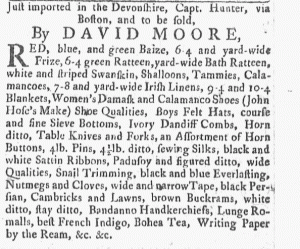
“To be sold, By DAVID MOORE … Women’s Damask and Calamanco Shoes … Boys Felt Hats … &c. &c.”

I recently featured an advertisement noteworthy in that it explicitly addressed female consumers.  I pointed out that this was not a standard practice in colonial America, that most advertisers did not narrow the realm of possible customers by specifying that they expected to sell their wares to patrons of one sex or the other.  I also noted some occasional exceptions, such as milliners who specialized in women’s hats or tailors who made men’s garments.  Still, most shopkeepers, like David Moore, did not place advertisements that singled out one sex or the other.

That being said, many shopkeepers did indicate that they stocked goods, almost always clothing items, intended for men or women, boys or girls, such as the “Women’s Damask and Calamanco Shoes” and Boys Felt Hats” in this advertisement.  They were not, however, parceled out in distinct sections of advertisements.  Instead, they appeared mixed in with the multitude of other goods included in the list advertisements so common during the period.  Rather than categorize their merchandise to make it easier for consumers to find men’s, women’s, and children’s garments, advertisers allowed them to discover these items in the midst of others that may or may not have been related.

January 25

What was advertised in a colonial newspaper 250 years ago this week?

Jan 25 - 1:24:1766 New-Hampshire Gazette
New-Hampshire Gazette (January 24, 1766)

“Crim-¶son Chiney; green & blue ¶ print; cartridge paper; ¶ paste board; Starch by the ¶ cask; Brimstone by the ¶ hundred, or smaller quan ¶ tity; powder and Shot.”

It appears that Joseph Bass liked to advertise.  I’ve previously featured a different advertisement from Bass (on December 6, when Adverts 250 was confined to Twitter exclusively).  Either he or the printer of the New-Hampshire Gazette liked to experiment with breaking his list of merchandise into columns.  Bass may have requested a particular format, but the printer was ultimately responsible for the execution.  From a graphic design perspective, some attempts appear more successful than others.

Dec 6 - 12:6:1765 New-Hampshire Gazette
New-Hampshire Gazette (December 6, 1765)

This particular advertisement drew my eye because the design seems particularly poor.  The pilcrows (¶¶¶) that form the dividing line are distracting and disruptive.  They do not make it easy to read the advertisement.  Many eighteenth-century printers created works of art using ornamental type.  Even in the hurry of setting type for newspapers, their efforts usually yielded better, more attractive results than this.

I am left wondering how eighteenth-century readers would have approached this advertisement.  It looks ugly to my twenty-first-century eyes and the possibilities presented by modern technologies, but would it have been so off-putting to potential customers in 1766?  To what extent would they have acknowledged the differences between today’s advertisement and the one from December?

On the other hand, the design elements of this advertisement got my attention.  I examined it more closely as a result.  In that regard, maybe it was successful.

January 20

What was advertised in a colonial newspaper 250 years ago today?

Jan 20 - 1:20:1766 Boston Post-Boy
Boston Post-Boy (January 20, 1766)

“At his STORE … Where LADIES may find as compleat an Assortment as at any Store in Town.”

Consumption is feminized in the twenty-first century.  After all, ladies love shopping, right?  At first glance, Samuel Fletcher’s advertisement might suggest that this is a natural conclusion, that consumption has always been a feminine pursuit because women more inherently possess a desire to shop than men do.

However, reaching such a conclusion based on Fletcher’s advertisement would be faulty.  This advertisement, listing so many of the different goods for sale in Boston and so many other colonial American port cities and villages, is rather unique among those published in the 1760s.  Very rarely did advertisers in this era identify potential customers by gender (though there were exceptions, such as seamstresses who made clothes for women and tailors who specialized in men’s garments).  In explicitly identifying “LADIES” with consumption, Fletcher engaged in a mode of marketing not yet widely practiced, but one that eventually became a largely unquestioned part of American consumer culture.

I choose many advertisements because they include common or standard aspects of eighteenth-century marketing, but this advertisement caught my attention precisely because the appeal to the “LADIES” was extraordinary, rather than ordinary, in the 1760s.