January 5

What was advertised in a colonial American newspaper 250 years ago today?
jan-5-151767-boston-evening-post
Boston Evening-Post (January 5, 1767).

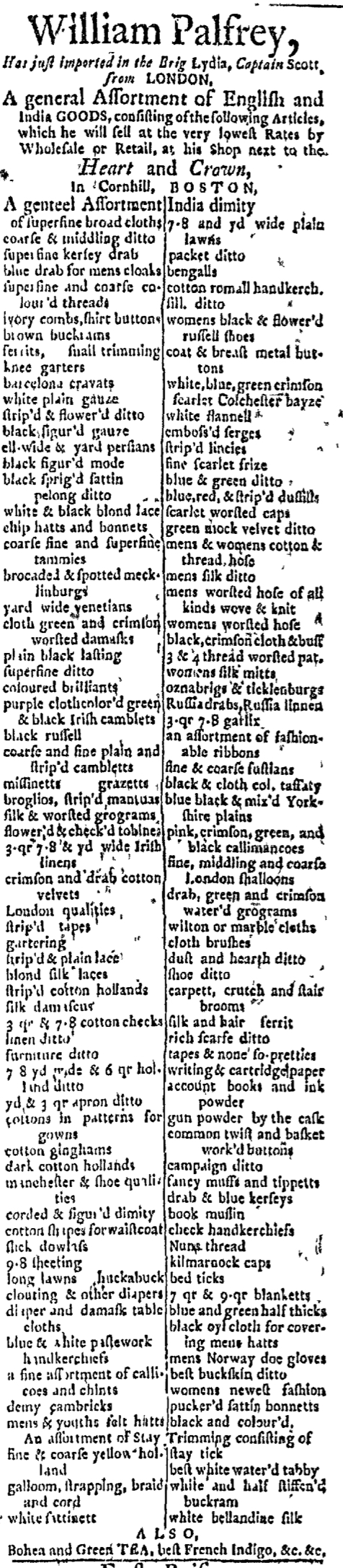
“A general Assortment of English and India GOODS, consisting of the following Articles.”

William Palfrey’s lengthy list advertisement, which comprised almost the entire third column of the January 5, 1767, issue of the Boston Evening-Post, fulfilled a promise made in a much shorter advertisement inserted in the previous issue. Confined to a single “square” of advertising space, the earlier advertisement announced that Palfrey had just imported “A general Assortment of English and India GOODS, consisting of many Articles.” The final line of the notice indicated that “[The particular Articles will be in our next].” A week later the same short announcement appeared, though this time as a header for a list of dozens of items divided into two columns. The phrase “consisting of many Articles” had been updated to “consisting of the following Articles,” a more appropriate introduction for the list that followed, but otherwise the content and format for the header remained the same.

It would be reasonable to conclude that the printers of the Boston Evening-Post made a decision to truncate Palfrey’s lengthy advertisement in the interest of space. After all, colonial newspapers often included some sort of notice that due to space restrictions some advertisements that had been omitted would appear in the next issue. That could have been the case in this instance, but another explanation places the decision in the hands of the advertiser rather than the printers.

Perhaps Palfrey decided to insert the first advertisement with its promise of a lengthier catalog of merchandise to appear later as a means of inciting interest and anticipation among prospective customers. The advertisement invited readers to consult the pages of the Boston Evening-Post once again, prompting them to look for Palfrey’s advertisement specifically amid all of those from his competitors. Palfrey may have calculated this as a strategy to overshadow other advertisements, especially if he did not have sufficient time to draw up a list of merchandise that had been “just imported in the Brig Lydia, Captain Scott, from LONDON.” The shipping news supplied by the Customs House in the December 29 issue indicated that the Lydia had arrived only two days earlier. Palfrey likely did not have time to compile a complete inventory of his newly arrived merchandise, but did not want to wait a week to inform potential customers about his “general Assortment of English and India GOODS.” The shorter advertisement simultaneously allowed him to spread the word to eager customers and to encourage anticipation among curious readers who might choose to visit his shop only after previewing the merchandise listed in a subsequent advertisement.

January 1

What was advertised in a colonial American newspaper 250 years ago today?

jan-1-111767-massachusetts-gazette
Massachusetts Gazette (January 1, 1767.)

“The VERY LOW Price at which he sells will not afford a lengthy Advertisement.”

Joshua Blanchard did not have much patience for the sort of list advertisement that frequently appeared in colonial American newspapers. Retailers commonly made appeals to consumer choice, inserting lengthy lists of merchandise to underscore the extent of the choices they offered prospective customers. Accordingly, such advertisements took up significant space in many newspapers. Blanchard’s advertisement, for instance, appeared to the left of an advertisement placed by competitor Frederick William Geyer, an advertisement that extended most of the column and listed more than one-hundred items. Samuel Eliot inserted a similar advertisement on the previous page. Both retailers used extensive lists of goods to entice potential customers into their shops.

Blanchard took a different approach. Although he stated that he carried “a large and general Assortment of Goods,” he specified very few of them. Instead, in a separate paragraph, headed by a manicule, he proclaimed that “The VERY LOW Price at which he sells will not afford a lengthy Advertisement enumerating every Particular, even to Pins and Needles.” Blanchard considered the advertisements published by his competitors preposterous. He mocked their marketing strategies, but also cleverly dismissed extensive lists of merchandise by claiming that more modest advertising allowed him to offer lower prices to his customers. Eliot and Geyer promised “the very lowest Rates” and “the very lowest Advance,” but Blanchard called those claims into question when he suggested that listing their entire inventory, down to the smallest “Pins and Needles,” incurred significant advertising costs to be passed along to consumers.

Lest potential customers suspect that Blanchard did not provide a list of his merchandise because he could not offer the same array of choices as his competitors, he stressed that “his Friends and the Publick may be assured, that his Assortment consists perhaps of as many Articles, that are as good Goods, and will be sold as cheap for CASH, as at any Shop or Store in TOWN.” He folded together appeals to choice, quality, and price in his argument that a longer advertisement did not necessarily mean more merchandise on hand.

Joshua Blanchard made a virtue out of his shorter, more modest advertisement when he implied that his competitors could not compete with his prices because they purchased significant amounts of advertising space in the local newspapers. He needed to publish an advertisement to make this claim, an advertisement designed to shape the attitudes and actions of potential customers even as it critiqued other marketing practices.

December 31

What was advertised in a colonial American newspaper 250 years ago today?

dec-31-12311766-georgia-gazette
Georgia Gazette (December 31, 1766).

“A LARGE and NEAT ASSORTMENT of superfine broad cloths.”

Inglis and Hall frequently advertised in the Georgia Gazette. Among Savannah’s shopkeepers, this partnership often placed the most extensive commercial notices in the local newspaper, making their marketing familiar to readers. Although they sometimes experimented with the format of their advertisements, most of the time Inglis and Hall took a fairly conservative approach to the strategies they deployed.

Today’s advertisements, for instance, included several of the most common appeals to consumers made throughout the eighteenth century. Inglis and Hall promoted “A LARGE and NEAT ASSORTMENT” of goods recently imported from England. Listing dozens of items potential customers could expect to find when visiting their shop. In addition, Inglis and Hall noted that these new arrivals supplement “their former assortment,” prompting readers to recollect previous list advertisements that enumerated their merchandise. In so doing, Inglis and Hall made an appeal to choice. Potential customers did not have to accept whatever goods the shopkeepers happened to have in stock. Instead, they could make their own selections to suit their tastes and budgets.

The retailers acknowledged both of those aspects of the shopping experience as well. They concluded their advertisement by promising to sell all of their merchandise “on the most reasonable terms.” Appeals to price were common in the eighteenth century, though they often received as little elaboration as in today’s advertisement. Such appeals became a standard part of boilerplate advertisements, yet shopkeepers dared not omit pledges to low and competitive prices. Potential customers came to expect such reassurances.

Appeals to fashion or taste could also be fleeting or expansive, depending on the advertisement. Today’s advertisement took the former approach when it listed some of the less utilitarian goods for sale: “fashionable Roman tea-urns, tea kettles, coffee pots, and waiters, pewter plates, water dishes, and measures.” Ultimately, customers had to decide for themselves whether Inglis and Hall actually carried “fashionable” housewares that testified to their taste and that they desired to show off to visitors, yet the advertisement helped to shape their expectations.

Today’s advertisement was not especially innovative in 1766, but that did not make it dull or lacking in marketing strategy. Inglis and Hall incorporated an array of standard advertising strategies to attract customers to their shop. They announced that they stocked new goods, noted the origins of their wares, and made appeals to choice, price, and fashion. Ingis and Hall depended on marketing techniques that advertisers throughout the colonies generally agreed were effective.

December 21

What was advertised in a colonial American newspaper 250 years ago today?

dec-21-12201766-agar-in-new-york-journal-supplement
Supplement to the New-York Journal (December 20, 1766).
dec-21-12201766-new-york-jorunal-supplement
Supplement to the New-York Journal (December 20, 1766).

“A fresh and general Assortment of Drugs and Medicines.”

Thomas Bridgen Attwood and Edward Agar both sold patent medicines recently imported from London, but the competitors advanced different strategies for attracting customers in their advertisements. Readers of the December 20, 1766, supplement to the New-York Journal encountered notices from both druggists in the center column on the second page, separated by only three other advertisements.

Like many shopkeepers, Agar provided a partial list of his merchandise, hoping to entice potential customers interested in particular products. Among “numberless other articles in the medicinal way,” Agar carried a dozen patent medicines that he mentioned by name: “DR. James’s fever powders, Hill’s pectoral balsam of honey, … Turlington’s balsam, Greenough’s tincture for the teeth, Lockyer’s pills, Anderson’s [pills]; Dr. Ward’s essence for the head-ach, Bateman’s drops, Stoughton’s bitters, Daffy’s elixir, Godfrey’s cordial; … [and] Dr. Ryan’s sugar plumbs for worms.” Colonists would have recognized each of these, just as modern consumers associate particular brands with specific symptoms and remedies.

Attwood depended on that familiarity, refraining from inserting any sort of list. Instead, in a separate paragraph (headed with a manicule to draw attention to it), he promised “The most approved patented Medicines, warranted genuine, from the Original Warehouses.” His advertisement appeared just below Agar’s, making any sort of list unnecessary since his competitor already named many of the most popular eighteenth-century patent medicines. However, even without such fortuitous placement of the two notices, Attwood could have depended on potential customers’ ability to identify a variety of medicines and makers on their own. He chose instead to focus on the services that he provided, including compounding new prescriptions and filling “Country Orders” from those who contacted him by letter rather than visiting his shop.

In general, Agar emphasized selection while Attwood accentuated service. The druggists found common ground when they each promised low prices, one of the most common appeals made to consumers in eighteenth-century advertising. Attwood, more economical in his use of words, pledged to “Sell at the very lowest prices, wholesale and retale.” Agar, the more verbose of the two, stoutly proclaimed that he sold imported patent medicines “on the lowest terms they can possibly be afforded by any one in America.” Which swayed potential customers? Agar’s extravagant assertions about his prices? Or Attwood’s variety of consumer-centered services?

November 20

GUEST CURATOR: Patrick Keane

What was advertised in a colonial newspaper 250 years ago today?

nov-20-11201766-massachusetts-gazette
Massachusetts Gazette (November 20, 1766).

“A general Assortment of Goods.”

I chose this advertisement because Bartholomew Kneeland ran a store that sold a wide variety of products that almost everyone during colonial times used. These products were “imported from London” to be sold at his store in Boston. Kneeland did not sell just one category of products; he sold items such as fabrics to make clothing, tea and spices, “Writing Paper,” “English and Poland Starch,” and “many other articles not mentioned.”

Many of these are everyday products were very much needed in colonial America; many continue to be important even today. I noticed a lot of materials that colonists used to make their own clothing and other necessities. According to Virginia Johnson, “Every colonial family except for the very rich had to be able to make their own soap, candles, furniture, cloth, baskets, toys, and musical instrument.” Families in colonial Boston needed the products Kneeland sold. This made me think of today and how most people do not need to make their own clothing and other household items.

**********

ADDITIONAL COMMENTARY: Carl Robert Keyes

When Patrick and I met to review his advertisements together, I asked him to explain why he selected this particular advertisement for his first day as guest curator of the Adverts 250 Project. Of all the possible advertisements he could have chosen, what was it about this advertisement that attracted his attention. Patrick indicated that he noticed this advertisement because of its length and the number of consumer goods listed separately in its two columns. We then had a discussion in which we compared Bartholomew Kneeland’s advertisement to others that appeared in the same issue of the Massachusetts Gazette.

Kneeland’s advertisement appeared at the top of the first column on the second page of that issue. It extended approximately three-quarters of the way down the column. Readers would have noticed it not only because it was the first advertisement in that issue but also because it occupied so much space on the page. Immediately below it, another advertisement announced “West-India Goods” for sale but did not list any specific items. To the right, similar list-style advertisements by Thomas Hickling and Samuel Eliot extended the entire second and third columns, respectively. Other lengthy list-style advertisements appeared on the third and fourth pages of the issue.

Many other advertisements, however, were markedly shorter. Richard Salter and Joshua Blanchard, for instance, each inserted short advertisements that announced goods imported for London available at low prices, but they did not deploy a list of merchandise as an appeal to attract customers to their shop. One advertisement briefly stated, “Nathaniel Appleton, At his Shop in CORNHILL, has just opened: A General Assortment of English and India Goods, which he will sell cheaper than ever for Cash only.”

nov-20-11201766-appleton-massachusetts-gazette
Massachusetts Gazette (November 20, 1766).

Each advertiser attempted to incite demand and encourage potential customers to visit their shops, but they used different strategies. Bartholomew Kneeland and some of his competitors invested in lengthy list-style advertisements to demonstrate the variety of their merchandise and to make it more likely that readers noticed their advertisements. A quarter of a millennium later this method continued to succeed: Kneeland’s advertisement caught Patrick’s attention and prompted him to read through it to see what the shopkeeper offered for sale.

July 15

What was advertised in a colonial newspaper 250 years ago this week?

Jul 15 - 7:14:1766 Boston-Gazette
Boston-Gazette (July 14, 1766).

“A large Assortment of English and India GOODS, consisting of the the following Articles.”

The July 14, 1766, issues of the Boston-Gazette overflowed with advertising, in part because several merchants and shopkeepers inserted extensive list advertisements. Several of them were of a moderate length, extending two or three times the number of column inches occupied by those that were the standard “squares” that served as the basic unit for selling advertising in many colonial newspapers. William Palfrey’s advertisement on the first page took up most the third and final column, running from just below the masthead almost to the bottom of the page. It left just enough room to squeeze in a four-line advertisement for loaf sugar available at “John and William Powell’s Warehouse.”

Samuel Eliot’s advertisement was by far the longest. It took up the entire first column on the third page. What could have been a dense and impenetrable block of text, however, had some visual variation thanks to the decision to divide the list of merchandise into two columns and list only one or two items per line. This created sufficient white space to make the advertisement a bit more navigable.

Only three of the list advertisements in this issue of the Boston-Gazette were divided into columns. They happened to be the three longest advertisements, which may not have been a coincidence. The printer may have decided that some means of dividing the page was necessary. In addition to the advertisements placed by Eliot and Palfrey, Jolley Allen’s advertisement (with its distinctive decorative border) was divided into columns. Recall that Allen placed the same advertisement, complete with a distinctive border, in all four of Boston’s newspapers, but the Boston-Gazette was the only one in which it was divided into two columns.

It seems quite possible that the printer experimented with the design of the longer advertisements in order to create a more visually appealing publication and to make the advertisements easier to navigate. This strategy replicated the “LIST of LETTERS remaining in the Post-Office” that covered the entire first column and half of the second on the first page of this issue of the Boston-Gazette. In general, this provides further evidence, though certainly not definitive, that printers took the lead in determining the format of newspaper advertisements while their clients supplied the copy.

July 1

What was advertised in a colonial newspaper 250 years ago this week?

Jul 1 - 6:30:1766 Newport Mercury
Newport Mercury (June 30, 1766).

“RIBBONS, … best English RIGGING, … neat silver WATCHES, … genuine red PORT WINE.”

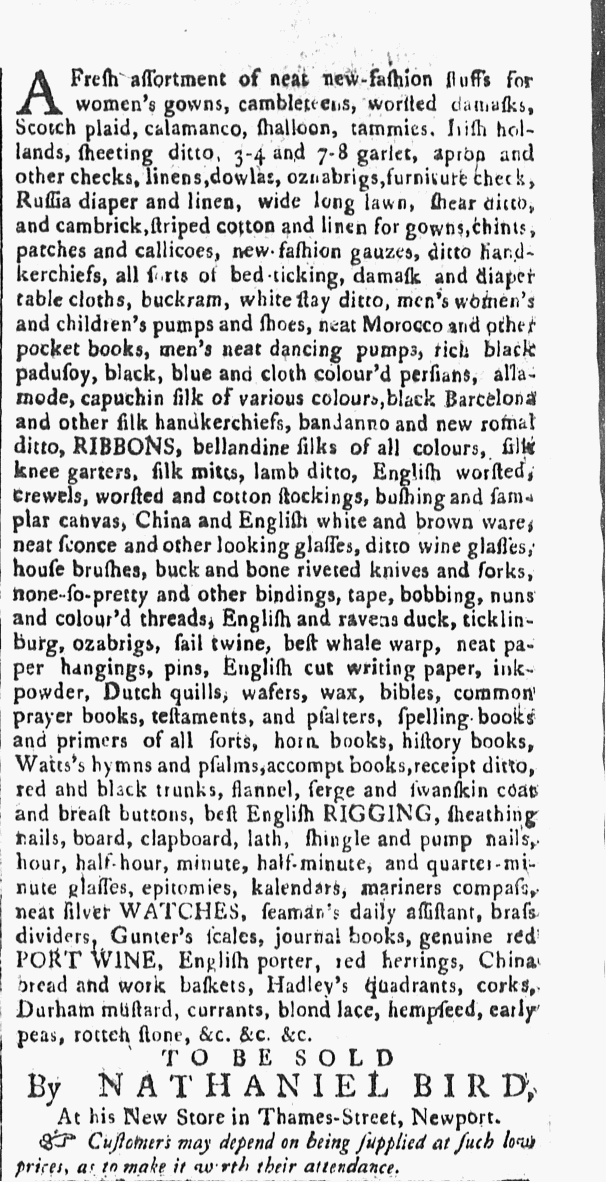
Shopkeeper Nathaniel Bird published a dense advertisement that listed dozens of items for sale, everything from textiles to dancing shoes to ink powder to hourglasses. He loosely organized the merchandise, but that did little to make it easier to navigate the extensive list of goods he stocked “At his New Store in Thames-Street.”

Four items do stand out from the rest: ribbons, rigging, watches, and port wine. Each of them, like Nathaniel Bird’s name, was set in capitals intended to draw attention. I have previously argued that in most cases advertisers wrote their own copy but printers took the responsibility for its appearance and format, though the advertisers likely gave special instructions on occasion. This would appear to be one of those instances. It seems unlikely that a printer (or an apprentice or anybody else working in the shop) would encounter a list of merchandise and on a whim decide to set a small number of items in capitals. More likely, the advertiser specified that certain items be capitalized.

Why those particular items? It is impossible to determine for certain. Perhaps Bird intended to highlight the diversity of goods he sold, the various departments in his shop a century before the concept of the department store was invoked. Many similar list advertisements include textiles exclusively. By listing other items in capitals, Bird drew attention to the portions of the advertisement that promoted other sorts of goods: a variety of adornments to accompany the textiles (RIBBONS), supplies for outfitting vessels (RIGGING), devices for keeping or measuring time (WATCHES), and imported groceries and spirits (PORT WINE). Bird may have been experimenting with a rudimentary method of cataloging his merchandise as a means of demonstrating the various needs and desires that could be fulfilled in his shop without having to visit other establishments.

June 18

What was advertised in a colonial newspaper 250 years ago today?

Jun 18 - 6:18:1766 Georgia Gazette
Georgia Gazette (June 18, 1766).

“Have just imported, In the Georgia Packet, Capt. Anderson, from London, and the Friendship, Perkins, from Bristol.”

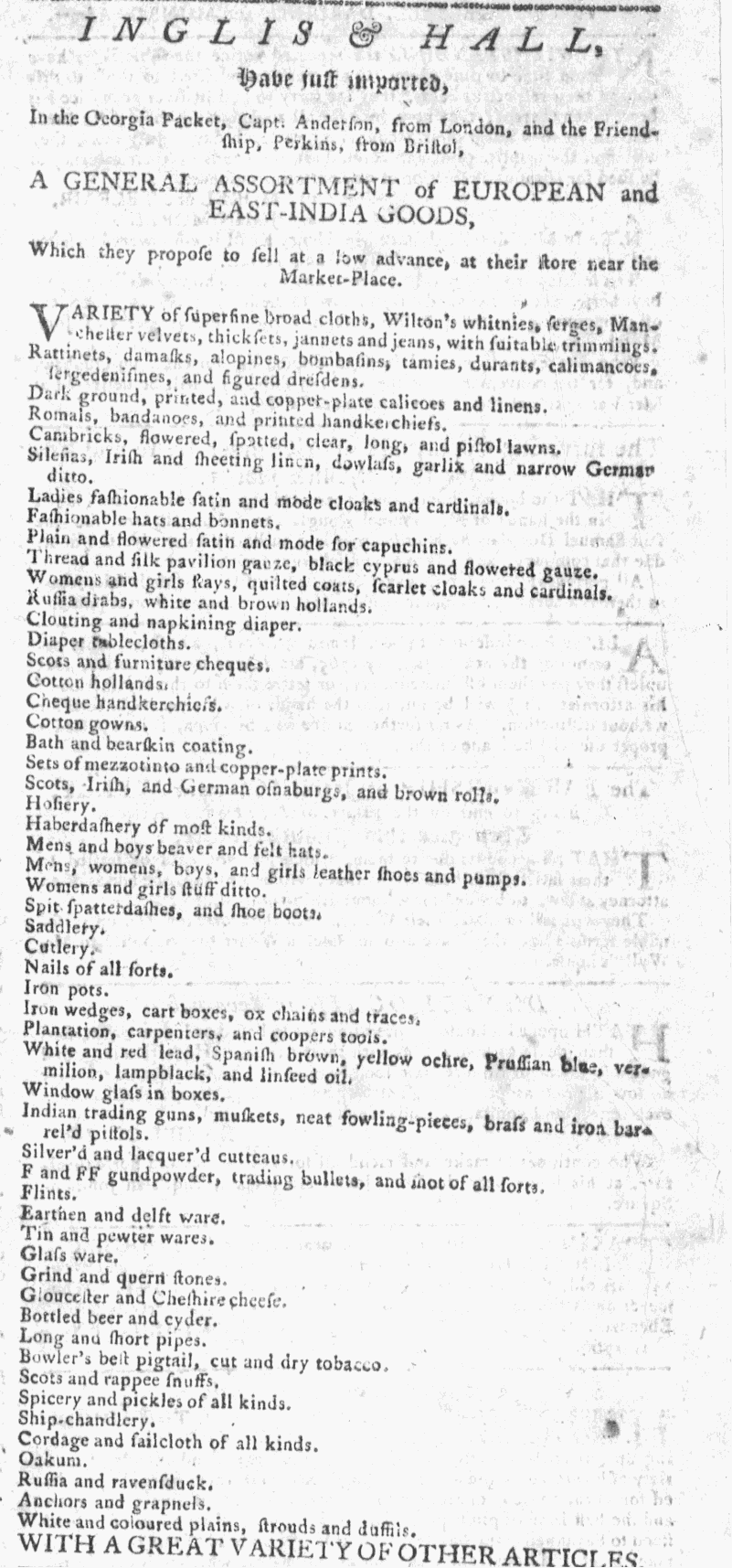
Inglis and Hall regularly advertised in the Georgia Gazette. In May 1766 they placed an advertisement announcing that they “have just imported, In the GEORGIA PACKET, Capt. ANDERSON, from LONDON, A NEAT ASSORTMENT” of dry goods and housewares. In addition, they promised “a FURTHER ASSORTMENT daily expected from LONDON and BRISTOL.”

When additional cargoes arrived in port, Inglis and Hall updated their advertisement to add the name of another vessel that carried the textiles and hardware they stocked: “the Friendship, Perkins, from Bristol.” The new advertisement included many of the items listed in the previous one, but also integrated new merchandise to entice potential customers with the variety of choices available.

In both instances Inglis and Hall presented a list style advertisement, an extensive catalog of goods they stocked. The format, however, shifted from one advertisement to the next. The first one tallied everything together in a single paragraph, while the second one indicated only one item or group of related items per line. Both drew attention to the “NEAT ASSORTMENT” and “GREAT VARIETY” of merchandise, but many potential customers likely found the second one easier to read and identify specific items of interest.

Was that the purpose for the new format? Was it an innovation intended to make the advertisement more accessible to consumers? If so, who was responsible for it, the advertiser or the printer? It is also possible that the printer needed to fill space and choose a new format to extend the advertisement to the desired length. In the absence of additional records some questions about the reasons eighteenth-century advertisements took their form cannot be answered definitively.

June 16

What was advertised in a colonial newspaper 250 years ago today?

Jun 16 - 6:16:1766 Supplement to the Boston-Gazette
Supplement to the Boston-Gazette (June 16, 1766).

“A Fresh and neat Assortment of English and India GOODS.”

Business was booming in Boston at the beginning of summer in 1766. The pages of the Boston-Gazette were filled with advertisements, most of them marketing consumer goods. Perhaps it was because a greater number of ships arrived in port with “English and India GOODS” now that winter was over and conditions for traveling had improved. Or perhaps it was because in the wake of the repeal of the hated Stamp Act a greater number of sellers felt comfortable announcing to the public that they sold imported goods.

Frederick William Geyer was just one of many advertisers in the June 16, 1766, issue of the Boston-Gazette. Indeed, the printer had received so many advertisements that a two-page supplement featuring nothing but advertisements was necessary, increasing the length of the newspaper for that week by half! Geyer’s advertisement appeared on the second page of that supplement. Many of the other advertisements were fairly short, at least in comparison to Geyer’s extensive list of textiles and other dry goods. His advertisement extended an entire column, catching the eye because it took up so much space on the page. Such a lengthy advertisement would have certainly been an investment for the merchant and shopkeeper (he sold the goods (“Wholesale or Retail”), one that he hoped would more than pay for itself by bringing customers into his shop. Given how many competitors were also advertising in the Boston-Gazette and the city’s other three newspapers, Geyer may have considered his own advertisement a necessity.

Jun 16 - 6:16:1766 Supplement to the Boston-Gazette fullpage
Supplement to the Boston-Gazette (June 16, 1766).

June 9

What was advertised in a colonial newspaper 250 years ago today?

Jun 9 - 6:9:1766 Boston Evening-Post
Boston Evening-Post (June 9, 1766).

“Sattin … Persians … Taffeties … Patches … Callicoes … Bengals … Ginghams … Cherederies.”

When Jane Gillam announced that she stocked “a Variety of English Goods” she was not exaggerating. The shopkeeper named approximately fifty textiles, but that may not have been an exhaustive list. Even if it was, she offered a dizzying assortment of fabrics, especially considering that some fabrics came in multiple colors or patterns.

To many modern readers, this advertisement may seem disorienting. What’s the difference between “Cherederies” and “Garlicks” or between “Callamancoes” and “Ozenbrigs”? Gillam expected eighteenth-century readers – her potential customers – recognized all the variations, but most of the distinctions are likely lost among modern Americans. Fortunately, historians of material culture have created a variety of resources documenting the different types of fabrics that made their way across oceans and into merchants’ warehouses and retailers’ shops.

Advertisements like those placed by Gillam have aided historians in determining which fabrics were available in early America. Consider the subtitle for one of the standard works in the field, Florence M. Montgomery’s Textiles in America, 1650-1870: A Dictionary Based on Original Documents, Prints and Paintings, Commercial Records, American Merchants’ Papers, Shopkeepers’ Advertisements, and Pattern Books with Original Swatches of Cloth (New York: W.W. Norton, 1984).

Initially I set about providing a short description of each fabric in Gillam’s advertisement as described in Montgomery’s dictionary, but I quickly discovered that the distinctions were too numerous and too complicated to do that here. Instead, how about a quick definition of the four textiles listed above, just to get a sense of what colonial Americans knew about textile that most Americans never learn.

Cherederies = Cherryderry (charadary, carridary): “Striped or checked woven cloth of mixed silk and cotton imported from India from the late seventeenth century.” (199)

Garlicks = Garlick (garlits, garlix, gulick, gulix): “A linen cloth first imported from Goerlitz, Silesia. It could be fully or partially bleached.” (245)

Callamancoes = Calimanco (calamande, calamandre): “A worsted ‘stuff … [with] a fine gloss upon it. There are calamancoes of all colours, and diversly wrought; some ate quite plain; others have broad stripes, adorned with flowers; some with plain broad stripes; some with narrow stripes; and others watered.’” (185)

Ozenbrigs = Osnaburg (oznabrig): “Coarse, unbleached linen or hempen cloth first made in Osnabrück, Germany. It was commonly used for trousers, sacking, and bagging.” (312)

As we can see from the descriptions of just four of the fabrics listed in Gillam’s advertisement, colonial consumers imagined different uses for different kinds of cloth. At a glance, they would have made assumptions about which they desired and which they could afford.