February 20

What was advertised in a colonial American newspaper 250 years ago this week?

Massachusetts Spy (February 17, 1774).

“Pointing out the names of several persons concerned in destroying the Tea.”

Two months after what has become known as the Boston Tea Party, tea continued to occupy the minds of colonizers in that port city and beyond.  In the February 17, 1774, edition of the Massachusetts Spy, Joseph P. Palmer once again ran his advertisement for “GRANADA RUM” with a nota bene that emphatically proclaimed, “NO TEA.”  Immediately above it, Jeremiah Cronin placed a notice in which he attempted to disassociate himself from any sort of political position concerning the recent dumping of tea into the harbor, hoping to reduce unwanted and, he claimed, unwarranted attention.

Cronin reported that on a morning early in February he discovered that “an Advertisement appeared posted up at the North-End of this town, signifying that I the subscriber, have been active in taking minutes, and pointing out the names of several persons concerned in destroying the Tea, and tarring and feathering.”  He likely feared the ire of patriots who believed that he undermined their cause and planned to inform on them to the authorities.  Yet, Cronin declared, he had no such intentions!  “I hereby beg leave to inform the Public,” he pleaded, “that so far from being active and busy on any such occasions, I have neither directly or indirectly concerned myself with public affairs.”  Instead, he promised, “I have always kept myself within doors when any disturbance happened in the town.”  Just as he did not want patriots looking too closely at him, Cronin aimed to avoid trouble with the authorities and the loyalists who supported them.  He ran his advertisement to declare his neutrality.  To buttress his effort to convince the public that was the case, he appended a declaration by a justice of the peace, Joseph Gardner, who affirmed that Cronin “made solemn oath to the whole of the above declaration.”

Massachusetts Spy (February 17, 1774).

The politics of tea also received attention in the upper left corner of the page that carried Cronin’s notice and Palmer’s advertisement.  The “POETS CORNER” for that issue featured “A Lady’s Adieu to her TEA-TABLE.”  Perhaps written by a woman, perhaps not, the poem said “FArewel [to] the tea board and its equipage” and the “many a joyous moment” of “Hearing the girls tattle” and “the old maids talk scandal” while drinking “hyson, congo, and best double fine” tea.  “No more shall I dish out the once lov’d liquor,” the lady asserted, considering tea “now detestable.”  Consuming tea was no longer a diversion or a treat, but instead a vice: “Its use will fasten slavish chains upon my country, / And Liberty’s the goddess I would choose / To reign triumphant in AMERICA.”  The lady’s “Adieu to her TEA-TABLE” suggested, even more forcefully than Palmer’s proclamation of “NO TEA,” that Cronin might not much longer have the luxury of taking a neutral position in “public affairs.”  When it came down to tea or liberty, when decisions about consumption had political meaning, when neighbors and acquaintances observed decisions that fellow colonizers made in the marketplace, Cronin would find it increasingly difficult to avoid taking a side in the trouble that was brewing.

February 17

What was advertised in a colonial American newspaper 250 years ago today?
Massachusetts Spy (February 17, 1774).

“GARDEN SEEDS.”

It was a sign of the changing seasons for colonizers in Boston.  Each year several female entrepreneurs who sold seeds took to the pages of the several newspapers published in the urban port.  Among them, Lydia Dyar, Elizabeth Greenleaf, and Susanna Renken usually began running notices by the end of February, alerting readers that they sold a variety of seeds.  Renken had been the first to do so in 1768, 1770, and 1773.  On occasion, men joined the women, including John Adams and Ebenezer Oliver, who took up the trade following the death of his mother, Bethiah Oliver.

Renken was not the first to advertise seeds and announce that spring was on its way in 1774.  Instead, that distinction went to John White, “Gardner, and Seeds-Man, in SEVEN-STAR LANE.”  White first advertised in the Massachusetts Spy on February 3 and then again on February 10 and 17.  No other seed sellers, male or female, joined the chorus in the Massachusetts Spy or any of the other newspapers in Boston in that time, not even Renken.  For a few weeks, White was alone in hawking a “large assortment of GARDEN SEEDS” imported from London and an “assortment of AMERICAN SEEDS.”

His female competitors tended to run their advertisements in multiple newspapers, but White confined his initial efforts to the Massachusetts Spy.  He did, however, experiment with a format that differed from the dense paragraphs that listed all sorts of seeds that Renken and her sorority of seed sellers usually inserted in the public prints.  White organized his advertisement as a catalog, dividing it into two columns.  In each column, he included only one type of seed per line and the price for either a bushel or a pound.  That likely made it easier for prospective customers to peruse his notice and spot items of interest.  In addition, Renken and others did not usually include their prices.  White’s method allowed readers to spot bargains without needing to visit his shop.

White was the first to herald the arrival of spring in 1774, making his notices memorable with a format that differed from what Dyar, Greenleaf, Renken, and others published in previous years.  He may have hoped that a head start and providing prices in his advertisement would give him an edge in what would become a very competitive market in the coming months.

February 10

What was advertised in a colonial American newspaper 250 years ago today?

Massachusetts Spy (February 10, 1774).

Those who do not chuse to be disappointed of the first number, are requested to be speedy in subscribing.”

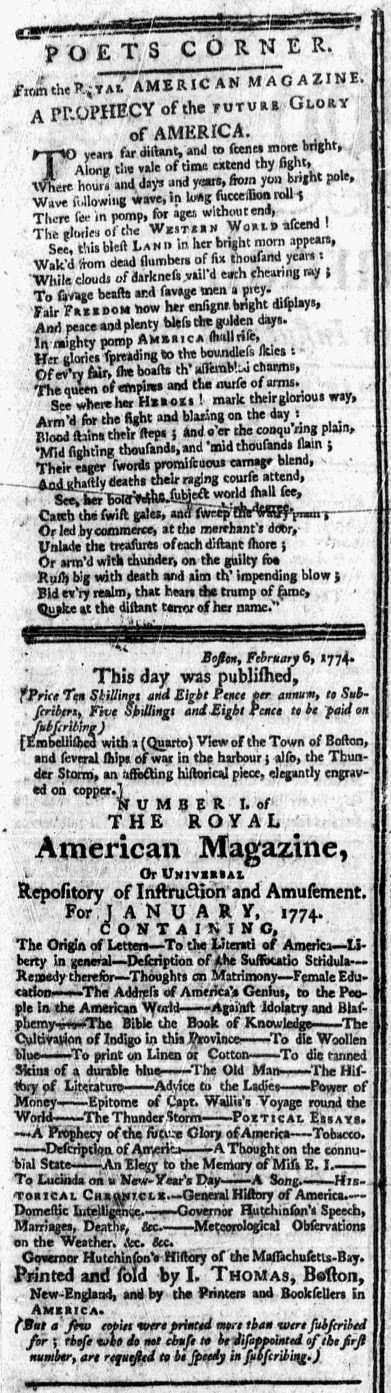
After months of distributing subscription proposals, advertising in newspapers from New Hampshire to Maryland, seeking submissions, and providing updates, Isaiah Thomas finally published the first issue of the Royal American Magazine on February 7, 1774.  He ran advertisements to that effect in the Boston-Gazette and the Massachusetts Gazette and Boston Post-Boy on the day the magazine became available to current and prospective subscribers.  Three days later, when he published the next edition of his own weekly newspaper, the Massachusetts Spy, Thomas inserted an even more elaborate advertisement.  He ran a similar notice, a slightly shorter variation, in the Massachusetts Gazette and Boston Weekly News-Letter on the same day.

Thomas began the version in the Massachusetts Spy with the pronouncement, “This day was published.”  Readers understood that meant that printed material, whether book, magazine, pamphlet, or almanac, was available to purchase, not necessarily that it was first printed that very day.  After all, newspaper advertisements proclaiming, “This day was published,” usually ran for weeks and sometimes even months without revision.  Thomas then reviewed the price, ten shillings and eight pence per year, with just over half, five shillings and eight pence, “to be paid on subscribing,” and promoted the copperplate engravings that “Embellished” the first issue of the magazine.  Only after providing that information did Thomas name the publication, “NUMBER I. of THE ROYAL American Magazine, Or UNIVERSAL Repository of Instruction and Amusement, For JANUARY, 1774.”  That Thomas published the January edition in early February likely did not seem odd to colonizers.  The few magazines published in eighteenth-century America tended to be printed and distributed at the end of the month rather than the beginning.

Massachusetts Gazette and Boston Weekly News-Letter (February 10, 1774).

Thomas devoted about half of the advertisement to a list of contents of the January issue of the Royal American Magazine, including essays on “Liberty in General,” “Thoughts on Matrimony,” and “Advice to the Ladies,” instructions “To die Woollen blue,” “To print on Linen or Cotton,” and “To die tanned Skins of a durable blue,” and several items under the headings “POETICAL ESSAYS” and “HISTORICAL CHRONICLE.”  Several authors apparently heeded his earlier calls for submissions, “requesting the Favour of their LUCUBRATIONS, which he promises to convey to the World with the greatest Care and Attention.”  Thomas also listed “Governor Hutchinson’s History of Massachusetts-Bay” at the end of the contents.  In the subscription proposals for the magazine, he offered Hutchinson’s History as a premium, pledging to include a portion with each issue of the magazine “in such a manner as to be bound up by itself.”  Subscribers could opt to have multiple issues of the magazine bound together into a single volume at the same time they had bookbinders collate and bind the pages of Hutchinson’s History.

Thomas concluded with a note to encourage prospective subscribers who had hesitated to submit their names soon or risk missing out.  “But a few copies were printed more than were subscribed for,” he declared, so “those who do not chuse to be disappointed of the first number, are requested to be speedy in subscribing.”  Customers could purchase the magazine from Thomas and “Printers and Booksellers in AMERICA.”  With all the fanfare around the first issue of the magazine, Thomas hoped to entice even more subscribers for his latest venture.  An advertising campaign that began months earlier continued with the publication of “NUMBER I” of the Royal American Magazine.

January 27

What was advertised in a colonial American newspaper 250 years ago today?

Massachusetts Spy (January 27, 1774).

“NO TEA.”

More than a month after colonizers disguised as Indians dumped tea into Boston Harbor to protest the duties imposed by Parliament in the Tea Act, the subject of purchasing and consuming tea continued to animate conversations around town and in the public prints.  On January 27, 1774, the Massachusetts Spy published a letter from “DEBORAH DOUBTFUL,” who may have been a concerned woman or, in the spirit of Benjamin Franklin’s Silence Dogood, may have been a man masquerading as a woman.  The message mattered more than the messenger.  In this case, Deborah Doubtful issued a warning to anyone who sold or purchased tea.

The writer claimed that colonizers in Boston “hear and read so much of indulging the sale of undutied teas through comparatively a small number of the citizens countenance the use of any tea.”  That disparity prompted “a number of the female friends to liberty” to “agree to enquire into the number of those who still continue the use of that detestable drug.”  Terminology for tea had shifted.  Rather than a pleasure to imbibe, it became something worse than any of the patent medicines so widely advertised in early American newspapers.  Deborah Doubtful warned that unless those who still consumed tea “very speedily reform,” her committee would “resolve to take such measures with them, as will perhaps cause them to repent their love to their country runs so low in so trying a season.”  Those measure could include public shaming, but both men and women sometimes resorted to other forms of protest.

Deborah Doubtful made it clear that colonizers needed to be very careful about what they chose to sell or drink.  “Dealers in Dutch tea are informed form the same society,” she cautioned, “that a strict watch will be kept over them, and the smugglers exposed as they deserve.”  Her committee extended their purview beyond just those teas imported from Britain and subject to the Tea Act, refusing to accept smuggled tea as an alternative.  “The only sure way to avoid being imposed upon by dutied tea,” Deborah Doubtful proclaimed, “being to oppose the trade in all tea.”  That the author so obviously used a pseudonym put readers on notice that anyone, both men and women, could participate in surveillance of their friends and neighbors, report them to a committee composed of “friends of liberty,” and cause problems for them as result of the choices they made in the marketplace.

Joseph P. Palmer did not need to read Deborah Doubtful’s letter to reach that conclusion.  He already arrived there when he submitted his advertisement for “GRENADA RUM” and various groceries to the printing office.  It concluded with a list of “Cheese, Coffee, Chocolate, &c. as usual,” but something was missing.  In a nota bene, centered and in a larger font to make it all the more visible, Palmer declared “NO TEA.”  Merchants, shopkeepers, grocers, and other who carried coffee and chocolate usually stocked tea as well, but given the climate in Boston at the time, including Deborah Doubtful’s letter and other items about tea in that issue of the Massachusetts Spy, Palmer stayed away from the problematic commodity.  He may have done so as a matter of his own political principles, but that might not have been his only motivation.  At that moment, conducting business and remaining in the good graces of the community meant going along with prohibitions on selling and drinking tea.

Happy Birthday, Isaiah Thomas!

Isaiah Thomas, patriot printer and founder of the American Antiquarian Society, was born on January 19 (New Style) in 1749 (or January 8, 1748/49, Old Style).  It’s quite an historical coincidence that the three most significant printers in eighteenth-century America — Benjamin Franklin, Isaiah Thomas, and Mathew Carey — were all born in January.

isaiah_thomas1818
Isaiah Thomas (January 30, 1739 – April 4, 1831). American Antiquarian Society.

The Adverts 250 Project is possible in large part due to Thomas’s efforts to collect as much early American printed material as he could, originally to write his monumental History of Printing in America.  The newspapers, broadsides, books, almanacs, pamphlets, and other items he gathered in the process eventually became the initial collections of the American Antiquarian Society.  That institution’s ongoing mission to acquire at least one copy of every American imprint through 1876 has yielded an impressive collection of eighteenth-century advertising materials, including newspapers, magazine wrappers, trade cards, billheads, watch papers, book catalogs, subscription notices, broadsides, and a variety of other items.  Exploring the history of advertising in early America — indeed, exploring any topic related to the history, culture, and literature of early America at all — has been facilitated for more than two centuries by the vision of Isaiah Thomas and the dedication of the curators and other specialists at the American Antiquarian Society over the years.

Thomas’s connections to early American advertising were not limited to collecting and preserving the items created on American presses during the colonial, Revolutionary, and early national periods.  Like Mathew Carey, he was at the hub of a network he cultivated for distributing newspapers, books, and other printed goods — including advertising to stimulate demand for those items.  Sometimes this advertising was intended for dissemination to the general public (such as book catalogs and subscription notices), but other times it amounted to trade advertising (such as circular letters and exchange catalogs intended only for fellow printers, publishers, and booksellers).

Thomas also experimented with advertising on wrappers that accompanied his Worcester Magazine, though he acknowledged to subscribers that these wrappers were ancillary to the publication:  “The two outer leaves of each number are only a cover to the others, and when the volume is bound may be thrown aside, as not being a part of the Work.”[1]

jan-30-worcerster-magazine-april-1786
Detail of Advertising Wrapper, Worcester Magazine (Second Week of April, 1786).

Thomas’s patriotic commitment to freedom of the press played a significant role in his decision to develop advertising wrappers.  As Thomas relays in his History of Printing in America, he discontinued printing his newspaper, the Massachusetts Spy, after the state legislature passed a law that “laid a duty of two-thirds of a penny on newspapers, and a penny on almanacs, which were to be stamped.”  Such a move met with strong protest since it was too reminiscent of the Stamp Act imposed by the British two decades earlier, prompting the legislature to repeal it before it went into effect.  On its heels, however, “another act was passed, which imposed a duty on all advertisements inserted in the newspapers” printed in Massachusetts.  Thomas vehemently rejected this law as “an improper restraint on the press. He, therefore, discontinued the Spy during the period that this act was in force, which was two years. But he published as a substitute a periodical work, entitled ‘The Worcester Weekly Magazine,’ in octavo.”[2] This weekly magazine lasted for two years; Thomas discontinued it and once again began printing the Spy after the legislature repealed the objectionable act.

jan-30-advertising-wrapper-worcester-magazine-4th-week-may-1786
Third Page of Advertising Wrapper, Worcester Magazine (Fourth Week of May, 1786).

Isaiah Thomas was not interested in advertising for its own sake to the same extent as Mathew Carey, but his political concerns did help to shape the landscape of early American advertising.  Furthermore, his vision for collecting American printed material preserved a variety of advertising media for later generations to admire, analyze, ponder, and enjoy.  Happy 275th birthday, Isaiah Thomas!

**********

[1] Isaiah Thomas, “To the CUSTOMERS for the WORCESTER MAGAZINE,” Worcester Magazine, wrapper, second week of April, 1786.

[2] Isaiah Thomas, The History of Printing in America: With a Biography of Printers, and an Account of Newspapers, vol. 2 (Worcester, MA: Isaac Sturtevant, 1810), 267-268.

December 30

What was advertised in a colonial American newspaper 250 years ago today?

Massachusetts Spy (December 30, 1773).

“THE Editor of the ROYAL AMERICAN MAGAZINE, presents his most respectful Compliments.”

After advertising the Royal American Magazine more widely than in any previous month in November 1773, Isaiah Thomas placed fewer advertisements in December.  In total, he ran twenty advertisements in seven newspapers in six towns in five colonies, compared to the forty-three advertisements he published in November.  The success of his marketing efforts in June, July, August, September, October, and November likely explains the decline in the number of advertisements for December.  Thomas distributed subscription proposals to determine whether or not he could entice enough subscribers to make the magazine a viable venture and, if so, how many copies he needed to print.  Once he determined that sufficient interest existed to merit moving forward with the project, he did not need to disseminate the subscription proposals or notices about submitting them to his printing office as widely.  He could instead devote more attention to launching a newspaper, the Essex Journal, in Newburyport in partnership with Henry-Walter Tinges.

Thomas also shifted his attention to the production of the magazine, including gathering contents.  His advertisement addressed to the “generous Patrons and Promoters of useful KNOWLEDGE throughout AMERICA” solicited “the Favour of their LUCUBRATIONS” or essays to publish in the magazine.  In November, that notice appeared only in Boston, but in December it ran in newspapers published in Boston and Newburyport, Massachusetts; Portsmouth, New Hampshire; and Newport, Rhode Island.  Still, Thomas’s own publications carried the notice six of the twelve times it ran in December, five times in the Massachusetts Spy, where it originated, and once in the free inaugural issue of the Essex Journal.  That advertisement included a request for “PRINTERS of all the Public Papers in America” to insert it “as soon as may be,” but fewer took note of it than a notice asserting that “subscription papers will be returned to the intended publisher in a few days.”  That advertisement appeared five times in October, thirty-two times in November, and eight more times in December.  Only two newspapers, the Maryland Gazette and the Norwich Packet, carried it in December.  Having commenced publication the previous month, the Norwich Packet may have been eager for both the content and, especially, advertising revenue.

Thomas continued to advertise the Royal American Magazine in 1774.  He regularly announced the publication of new issues each month.  He did not, however, place such advertisements as widely as the subscription proposals and other notices calling on subscribers to submit their names as soon as possible or risk missing out on the magazine.  His marketing campaign concentrated on establishing the magazine rather than promoting it once it began publication.

**********

“Subscription Papers will be returned” Update

  • December 2 – Maryland Gazette (fifth appearance)
  • December 2 – Norwich Packet (third appearance)
  • December 9 – Maryland Gazette (sixth appearance)
  • December 9 – Norwich Packet (fourth appearance)
  • December 16 – Maryland Gazette (seventh appearance)
  • December 16 – Norwich Packet (fifth appearance)
  • December 23 – Maryland Gazette (eighth appearance)
  • December 30 – Maryland Gazette (ninth appearance)

“generous Patrons” Update

  • December 2 – Massachusetts Spy (second appearance)
  • December 3 – New-Hampshire Gazette (first appearance)
  • December 4 – Essex Journal (first appearance)
  • December 6 – Newport Mercury (first appearance)
  • December 9 – Massachusetts Spy (third appearance)
  • December 13 – Boston-Gazette (third appearance)
  • December 13 – Newport Mercury (second appearance)
  • December 16 – Massachusetts Spy (fourth appearance)
  • December 20 – Newport Mercury (third appearance)
  • December 23 – Massachusetts Spy (fifth appearance)
  • December 24 – New-Hampshire Gazette (second appearance)
  • December 30 – Massachusetts Spy (sixth appearance)

December 26

What was advertised in a colonial American newspaper 250 years ago this week?

Massachusetts Spy (December 23, 1773).

“The above teas were imported before the East India Company’s teas arrived, or it was known that they would send any here on their own account.”

A week after colonizers in Boston dumped tea into the harbor in an event now known as the Boston Tea Party, Cyrus Baldwin continued to advertise “CHOICE Bohea and Souchong Teas, best Hyson ditto.”  His advertisement on the December 23, 1773, edition of the Massachusetts Spy, like his advertisement that ran in the Boston Evening-Post three days earlier, concluded with a nota bene declaring that the “teas were imported before the East India Company’s teas arrived, or it was known that they would send any here on their own account.”  That previous advertisement ran below a “NOTIFICATION” that called on “all the Dealers in, and Venders of Teas” to attend a meeting on December 21 for the purpose of “determining on suitable Measures to be adopted, and to cooperate with a great number of respectable Inhabitants of this Province, express’d by a Vote of their late Assembly to suppress the Use of that detested Article.”  Those who attended did not reach any final decisions.  Instead, a notice dated December appeared in the Massachusetts Spy, advising the “Traders in TEA … that their meeting stands Adjourned to THIS Evening at 5 o’clock, at the Royal-Exchange Tavern.”

In addition to that brief notice, the December 23 edition of the Massachusetts Spy, the first published since the Boston Tea Party, included several articles and editorials about tea.  Among the local news in the first column on the first page, readers learned that East India Company’s tea commissioners remained at Castle William on an island in the harbor.  Mixing news and editorial, this update stated, “Their obstinacy has rendered them infinitely more obnoxious to their countrymen than even the Stamp-Masters were.”

Elsewhere on the first page, a letter to the printer, Isaiah Thomas, signed by “A WOMAN,” objected to the recitation “a great number of arguments used to persuade the ladies to leave off the use of [tea].”  The correspondent inquired, “If Tea has been really known to be a baneful weed, a poisonous draught, &c. why were not these arguments used against the use of it in former times, before it was thought a political evil?”  She also noted that “gentlemen as well as ladies” enjoyed drinking tea and derived benefits to their health from doing so.  However, she did not make these arguments to justify continuing to consume the beverage.  Instead, she wished to be presented with a rationale for boycotting tea “such as will convince persons who are capable of using their reason,” whether male or female.  To that end, she recommended that “the gentlemen who are fully acquainted with all the political reasons for discarding the use of Tea … to publish a full and plain narrative of fact, so that we might see how it comes to pass that the use of Tea is a political evil in this country.”  If men were to instruct women “in all they know” about the political implications of drinking tea “it would be a much more probable method to make us leave off the use of it than the calling it hard names, and telling us scare-crow stories about it.”  Women participated in politics through their decisions in the marketplace.  When treated as capable of understanding rational arguments, the correspondent suggested, women would join with men in more effective and powerful resistance to Parliament’s abuses.

Three other letters to the printer expressed outrage over tea, while a news article offered an overview of the town meetings that occurred in the days before colonizers disguised as Indians boarded three ships and destroyed the tea they carried.  Another article described that event: “A number of brave and resolute men, determined to do all in their power to save their country from the ruin which their enemies had plotted, emptied every chest of tea on board the three ships … without the least damage done to the ships or any other property.”  According to this article, “The masters and owners are well pleased that their ships are thus cleared; and the people are almost universally congratulating each other on this happy event.”

Among the advertisements, Baldwin was not the only shopkeeper who promoted tea in the December 23 edition of the Massachusetts Spy, though he alone inserted an explanation about when he acquired the tea in hopes of convincing the community that he could sell it in good conscious and prospective customers that they could purchase and drink it in good conscious.  Even as many colonizers in Boston and other towns called for a boycott of tea, many retailers and consumers did not immediately cease buying and selling the popular beverage.

November 21

What was advertised in a colonial American newspaper 250 years ago this week?

Massachusetts Spy (November 18, 1773).

“Humbly requesting the Favour of their LUCUBRATIONS, which he promises to convey to the World with the greatest Care and Attention.”

Isaiah Thomas, printer of the Massachusetts Spy, advertised widely in his efforts to launch the Royal American Magazine.  On November 18, 1773, he once again published a notice calling on “gentlemen, in this and the other provinces, who have subscription papers in their hands … to return them as soon as possible.”  As readers very well knew, taking the magazine to press depended on generating a sufficient number of subscribers in advance to make it a viable endeavor.  Fortunately for both the printer and the “generous Patrons and Promoters of useful KNOWLEDGE, throughout AMERICA” who supported the project, that critical number of subscribers did present themselves by the middle of November.

Thomas inserted an update to inform subscribers and the public “that the first Number will undoubtedly appear on the first of January next.”  Now he needed another sort of assistance, “the Favour of their LUCUBRATIONS” or essays to publish in the magazine.  An American magazine needed content contributed by Americans.  In the proposals, Thomas acknowledged that he would select some pieces “from the labours of our European brethren,” but “shall not fail of making the strictest searches after curious anecdotes, and interesting events in British America.”  He requested “the assistance of the learned, the witty, the curious, and the candid, of both sexes, throughout this extensive continent” in sending their correspondence “for the public benefit.”  In his latest update, Thomas solicited those “LUCUBRATIONS” and “promises to convey [them] to the World with the greatest Care and Attention” after submitting them to a “Society of Gentlemen, for their Inspection and Approbation.”  In other words, Thomas would not publish every essay he received, but did intend to print those that earned the approval of an informal editorial board.

The printer also took the opportunity to make another appeal to “Gentlemen and Ladies who incline to encourage theRoyal American Magazine” who had not yet subscribed to submit their names as soon as possible.  If they did not do so, they ran the risk of “be[ing] disappointed of the first Number” when Thomas distributed the inaugural issue to subscribers.  He also inserted a note to “PRINTERS of all the Public Papers in America,” knowing that they perused newspapers for material to reprint and that many already served as local agents for the magazine so updates that appeared in the Massachusetts Spy would catch their attention.  Thomas requested that printers of other newspapers “insert this Advertisement as soon as may be, for which they shall be fully satisfied by their humble servant.”  Rather than expecting fellow printers to run his advertisement as an in-kind favor, Thomas indicated that he would send payment.  From recruiting subscribers to soliciting essays to publish to coordinating a marketing campaign, Thomas’s advertisements revealed several aspects of establishing the Royal American Magazine.

October 21

What was advertised in a colonial American newspaper 250 years ago today?

Massachusetts Spy (October 21, 1773).

“He has improved on the late patent Windlass.”

William Smith, a shipwright, advertised windlasses, mechanisms for moving heavy weights, in the October 21, 1773, edition of the Massachusetts Spy.  In his efforts to convince “Merchants or Captains” to purchase his windlasses, Smith emphasized innovations that made them superior to “the late patent Windlass.”  According to the shipwright, he “has contrived a new plan by which two men will have a strain equal to seven in less time.”  That significantly reduced the effort necessary to raise an anchor.  In addition, Smith noted that he “fixed the palls” or pawls “to catch twenty-four times in once going round.”  The “Merchants or Captains” that the shipwright addressed knew that pawls used on anchor windlasses prevented free-spooling chains by grabbing and securing individual links.

Innovation did not result in higher prices for Smith’s windlasses.  To the contrary, he asserted that his windlass “will not cost as much money as the late patent windlass, by at least one fourth.”  Those “Merchants or Captains” could acquire a superior piece of equipment at lower prices.  Furthermore, Smith advised that “the improvement may be fixed to any common windlass, with a power far greater then the late patent windlass.”  The shipwright encouraged prospective customers to consult with him about making the modifications.

When advertisers promoted new technologies, they sometimes included testimonials to demonstrate the accuracy of the claims they made.  Even more commonly, they reported that others examined and endorsed their products, neglecting to provide any names or commentary.  Still, they aimed to convince prospective customers that they did not have to rely on an advertiser’s word alone.  For his part, Smith confided that his “model has been surveyed by several gentlemen, who unanimously agree that it is the greatest improvement yet made.”  That suggested to “Merchants or Captains” that they would be satisfied with the performance of Smith’s windlass once they gave it a chance.  Today, many advertisers emphasize innovation and new technologies in their marketing campaigns.  When they do so, they draw on a long history.  Such advertising strategies had precursors in the eighteenth century.

October 14

What was advertised in a colonial American newspaper 250 years ago today?

Massachusetts Spy (October 14, 1773).

“The encouragement they have had … renders a pompous advertisement unnecessary.”

Although they had operated a shop in Boston for quite some time, Thomas Courtney and Son continued to describe themselves as “TAYLORS, from LONDON,” when they advertised in the October 14, 1773, edition of the Massachusetts Spy.  Like many tailors, milliners, and other artisans, they believed that associating themselves with the cosmopolitan center of the empire conferred a certain amount of cachet in the eyes of prospective customers.  The tailors placed the notice to alert the public that they moved to a new location but continued to “carry on the different branches of the Taylor and Habit making business, in the truest and most elegant manner.”

Despite trumpeting their London origins in the headline of their advertisement, Courtney and Son asserted that they did not need to publish an extensive description of the quality of their work, the exceptional customer service they provided, or any of the other appeals that often appeared in notices placed by members of the garment trades.  Their work spoke for itself, as demonstrated by the longevity of their business and the clientele they cultivated during their time in Boston.  “The encouragement they have had for six years past in the town and province,” Courtney and Sons proclaimed, “is a flattering proof of the public approbation of their integrity and abilities.”

That being the case, the tailors considered “a pompous advertisement unnecessary.”  On occasion, eighteenth-century advertisers promoted their goods and services by critiquing the kinds of marketing that appeared in the public prints.  They suggested something unsavory in the manner that many of their competitors boasted of their abilities or told elaborate stories about their merchandise.  Courtney and Son cast suspicion on the extravagant prose presented in many advertisements, implying that those advertisers oversold what they could deliver to customers.  In the process, they attempted to enlist savvy consumers in expressing the same skepticism … and demonstrating that they could not be fooled with clever marketing by giving their business to Courtney and Son.  After all, the tailors insisted, their reputation spoke for itself.  Rather than publishing overzealous appeals to prospective customers, Courtney and Sons “sincerely thank[ed] their Friends and customers for past favours” and pledged to “continue to deserve their recommendation.”  They considered their reputation essential in marketing their business.