July 7

What was advertised in a colonial American newspaper 250 years ago today?

Massachusetts Spy (July 7, 1774).

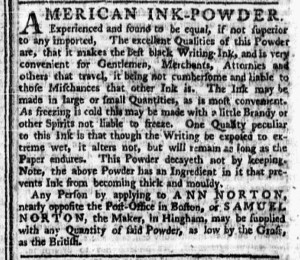
“AMERICAN INK-POWDER.”

In an advertisement in the July 7, 1774, edition of the Massachusetts Gazette, Ann Norton of Boston and Samuel Norton of Hingham heralded “AMERICAN INK-POWDER” made by Samuel.  They encouraged “Gentlemen, Merchants, Attornies and others that travel” to purchase this product “found to be equal, if not superior to any imported.”  Most of the advertisement described the various qualities of the ink powder that made it better than imported alternatives.  As colonizers in Boston and other towns considered enacting nonimportation agreements to protest the Boston Port Act, entrepreneurs like the Nortons seized the opportunity to present “domestic manufactures” or goods produced in the colonies as patriotic choices for consumers.  On the same page as the Nortons’ advertisement for “AMERICAN INK-POWDER,” Philip Freeman once again ran his notice asserting that “we can manufacture enough [gloves] here, to supply the whole Continent” and recommending that “the importation of this article at least will be totally stopped” during such “threatning” times.

Both advertisements ran in a newspaper that featured a new addition to its masthead: a snake in several segments facing a dragon.  The words “JOIN OR DIE” appeared above the snake and abbreviations for New England and other colonies accompanied each segment.  Readers understood that the snake represented the colonies and the dragon represented Great Britain.  As Isiah Thomas, the printer of the Massachusetts Spy, explained in his History of Printing in America(1810), “The head and tail of the snake were supplied with stings, for defence against the dragon, which appeared furious, and as bent on attacking the snake.”[1]  It was a more elaborate version of the “JOIN, OR DIE” emblem that ran in Benjamin Franklin’s Pennsylvania Gazette twenty years earlier and the “UNITE OR DIE” emblem added to the masthead of the New-York Journal just two weeks earlier.  With this image, Thomas made the threat to American liberty explicit with the addition of the dragon.  That “political device,” as Thomas called it, joined a quotation from Joseph Addison’s Cato that had been part of the masthead for many months: “DO THOU Great LIBERTY inspire our Souls – And make our Lives in THY Possession happy – Or, our Deaths glorious in THY just Defence.”  An assertion that the Massachusetts Spy was “Open to ALL Parties, but Influenced by None” disappeared from the masthead.  The combination of the quotation from Cato and the “political device” made the editorial perspective of the newspaper clear.  Thomas ceased publishing the Massachusetts Spy in Boston and left the city in April 1775 and soon after established the Massachusetts Spy; or, American Oracle of Liberty in Worcester.  Throughout the remainder of the newspaper’s publication in Boston, the snake defending itself against the dragon was part of the masthead, setting the tone for all the news, editorials, and advertisements that appeared below.

Massachusetts Spy (July 7, 1774).

**********

[1] Isaiah Thomas, The History of Printing in America: With a Biography of Printers and an Account of Newspapers (1810; New York: Weathervane Books, 1970), 273.

June 16

What was advertised in a colonial American newspaper 250 years ago today?

Massachusetts Spy (June 16, 1774).

“It is hoped therefore, that the importation of this article at least will be totally stopped.”

Current events informed Philip Freeman’s marketing strategy as he attempted to sell gloves in the summer of 1774.  As colonizers from New England to Georgia discussed how to respond to Parliament closing Boston Harbor and other legislation passed following the Boston Tea Party, many proposed a new round of nonimportation agreements.  American merchants previously participated in boycotts to protest the Stamp Act and duties on several commodities imposed in the Townshend Acts, believing that disruptions to commerce served as an effective political tool.  Parliament relented, repealing the Stamp Act and duties on glass, lead, paint, and paper (but doubled down on tea with a new Tea Act in 1773).  A variety of other factors, including petitions and popular protests, played a role, so nonimportation agreements may not have had as much of an influence as intended.  Still, colonizers believed that boycotting goods imported from Britain effectively achieved their political goals.

Freeman believed that was the case and encouraged prospective customers of its veracity.  “As times are threatning,” he declared, “it behoves one and all to go into the most frugal methods to encourage our own Manufactures.”  He recognized “a great consumption of Gloves in this large Country,” yet proposed that “we can manufacture enough here, to supply the whole Continent.”  Such industry would have multiple benefits: it “will employ our own people, and keep a large sum of Money here, which is annually sent to England for Gloves.”  Furthermore, Freeman asserted that the gloves he made “are better and cheaper than can be imported from England.”  Not willing to wait for any sort of official nonimportation agreement enacted in Boston or throughout the colony or in cooperation with other colonies, Freeman implored that “the importation of this article at least will be totally stopped.”  In common cause, Freeman and his competitors in the colonies could meet demand without having to resort to imported gloves.  He did not direct his advertisement to consumers but rather the “Merchants and Shop-keepers” that he could supply with several different kinds of gloves “on the most reasonable terms.”  Working in concert, Freeman envisioned that glovemakers, retailers, and consumers could participate in politics via the decisions they made about production, consumption, and importing goods, starting immediately and informally with gloves and perhaps extending to other items through formal agreements as colonizers continued to organize in opposition to the Boston Port Act.

June 9

What was advertised in a colonial American newspaper 250 years ago today?

Massachusetts Spy (June 9, 1774).

Contains as much news, as many Political Essays, as any in America.”

Printers and other entrepreneurs often published notices calling on customers and associates to settle accounts.  Isaiah Thomas, the printer of the Massachusetts Spy, did so in June 1774, though he confessed that he “is loath to trouble them with a dunning advertisement.”  Still, “his affairs make it necessary.”  Many printers threatened legal action against those who did not submit payment, but Thomas opted for a different strategy.  His “‘dunningadvertisement” focused primarily on the service to the public he provided in publishing the Massachusetts Spy, especially considering the “gloomy prospect of public affairs, at present.”  Readers knew, of course, that he referred to the Boston Port Act that initiated a blockade of the harbor and halted trade at the beginning of the month as well as a series of troubling events over the past decade.

Zechariah Fowle and Thomas commended publishing the Massachusetts Spy in July 1770, four months after the Boston Massacre.  At the age of twenty-one, Thomas became the sole proprietor just a few months later.  In the four years that the newspaper had been published, the young printer sought to establish its reputation in Boston and beyond.  When he asked subscribers to pay what they owed, he underscored that “the MASSACHUSETTS SPY is a third larger than any News-Paper published in this province.”  That distinguished it from the Boston Evening-Post, the Boston-Gazette, the Massachusetts Gazette and Boston Post-Boy, and the Massachusetts Gazette and Boston Weekly News-Letter as well as the Essex Gazette, published in Salem, and the Essex Journal, published in Newburyport.  At the time, no other city or colony had as many newspapers, which meant that Thomas faced significant competition for subscribers and advertisers. Furthermore, Thomas’s newspaper “contains as much News, [and] as many Political Essays, as any in America,” making it a valuable resource for readers far and wide.  Thomas also asserted that the Massachusetts Spyis the cheapest on the globe,” making it a good value that merited support (and payment) from readers.

In return for “the honour of being an hand-servant to the public,” Thomas requested the “kind assistance” of his customers.  He asked that they “take proper notice” of his appeal, warning that “there is no possibility … in carrying on business without regular payments.”  The June 9 edition of his newspaper featured extensive coverage of the “PROCEEDINGS in the HOUSE of COMMONS” from April, including an “Authentic account of Tuesday’s Debate on the Motion for repealing the Tea-Duty in America,” and editorials “To the FREE and BRAVE AMERICANS” from “AN AMERICAN” and “To the ADRESSERS of the late Governor HUTCHINSON” from “A MODERATE MAN.”  Thomas compiled and circulated such news and opinion as a service, but could not afford to continue that endeavor without receiving subscription fees from his customers.  Rather than an explicit threat to take them to court to force them to pay what they owed, Thomas made a much more subtle insinuation about what they would lose if they did not settle accounts.  By his accounting, no other newspaper compared to the Massachusetts Spy.

May 15

What was advertised in a colonial American newspaper 250 years ago this week?

Massachusetts Spy (May 12, 1774).

“All sorts of Groceries as usual – except TEA.”

By the time that Thomas Walley’s advertisement ran in the May 12, 1774, edition of the Massachusetts Spy, it would have been a familiar sight to regular readers of that newspaper.  It previously appeared on six occasions in March, April, and May, advising the public that Walley stocked a variety of items that he sold wholesale or retail at his “Store on Dock-Square” in Boston.  He had “Dutch looking-glasses of various sizes,” “quart and pint Mugs and Chamber Pots,” and “choice junk” (or old rope) “to make into cordage of any size.”

Walley also sold “Oatmeal per bushel,” “all sorts of Spices,” “choice Rice,” “new Raisins,” and “all sorts of Groceries as usual – except TEA.”  That last entry, listing what he did not sell rather than what he wanted to put into the hands of consumers, may have the primary reason that Walley inserted his advertisement in the Massachusetts Spy so many times.  As one of the owners of the Fortune, the vessel that transported the tea involved in the second Boston Tea Party, Walley had been under suspicion, though he and his partners asserted that they did not have “any share, interest or property, directly or indirectly in any part of the Tea that came from London in said vessel.”  They made that declaration, affirmed by a justice of the peace, in an advertisement that ran in the March 10 edition of the Massachusetts Spy, just days after colonizers disguised as Indians once again dumped tea into Boston Harbor.

A week later, Walley’s advertisement listing a variety of goods “except TEA” appeared in the Massachusetts Spy for the first time.  Given the political orientation of that publication, printed by ardent patriot Isaiah Thomas, it made sense for Walley to take to the pages of that newspaper in his effort to convince the public that he was not trucking in tea.  His advertisement ran again the following week and then on April 7, 15, and 22 and May 5 and 12, missing from only the March 31 and April 28 editions.  Merchants and shopkeepers often ran notices for several months, but in this instance a desire to sell his inventory probably was not Walley’s sole consideration.  He continuously reminded the public that he wanted nothing to do with peddling tea, probably even more so on May 12 when Thomas published a two-page Postscript to the Massachusetts Spy that featured the text of the Boston Port Act that closed the harbor until the colonizers made restitution of the tea they destroyed.  As the crisis intensified, Walley sought to distance himself from tea.

May 1

What was advertised in a colonial American newspaper 250 years ago this week?

Massachusetts Spy (May 28, 1774).

“Medicine Boxes … are put up in the neatest Manner.”

The woodcut that adorned John Joy’s advertisement in the April 28, 1774, edition of the Massachusetts Spy alerted readers to the type of merchandise that the apothecary sold before they even read the copy.  It depicted a lion wearing a crown and working a mortar and pestle atop a column.  The woodcut ran the entire length of the advertisement, as if Joy or the compositor or perhaps the two working together intentionally designed the image and copy to fit together that way.  A sign with a similar image may or may not have marked Joy’s location at “the North-Corner of William’s Court, BOSTON,” but he did not make specific mention of a sign.  Other advertisers who commissioned woodcuts for their newspaper notices often did so when the image matched the device customers saw at their shop.  Whatever the case, the image made Joy’s advertisement much more visible to prospective customers than M.B. Goldthwait’s notice about a “fresh supply of DRUGS and MEDICINES” and “SURGEONS INSTRUMENTS, Of all Kinds.”

Massachusetts Spy (April 28, 1774).

The copy declared that Joy “Has just received from LONDON, A large and compleat Assortment of Drugs and Medicines, Of the best Quality.”  The lion with the crown asserted both those imperial connections and the quality of the remedies that Joy sold.  In addition, he stocked “Surgeons Instruments, of every Kind, finished in the neatest Manner” as well as “a full Assortment of Groceries and Dye Stuffs.”  Not unlike modern retail pharmacies, Joy diversified his enterprise to cultivate multiple revenue streams, including medicines, medical equipment, home health care supplies, and groceries.  To that end, he also prepared “Medicine Boxes of various Prices, for Ships or private Families,” pledging that they “are put up in the neatest Manner.”  Goldthwait also prepared “Doctor’s Boxes … for Masters of Vessels and private Families” and included “every necessary direction” for using the contents.  These first aid kits included both medicine and supplies.  Selling them allowed apothecaries to enhance their revenues since buyers acquired a variety of items that they did not yet need and might never use but purchased against the chance of injury or illness.  After all, it was better to have them on hand than not at all.  Joy also operated a precursor to the mail order pharmacy, alerting “Prac[ti]tioners and others” that they may be supplied with large or small Quantities, by Letter or otherwise [such as sending a servant enslaved messenger], as well as though they were present.”  Joy and other apothecaries frequently promoted such convenience as part of their marketing efforts.  Like the image of the crowned lion working a mortar and pestle, that appeal distinguished Joy’s advertisement from the notice placed by his competitor.

April 22

What was advertised in a colonial American newspaper 250 years ago today?

Massachusetts Spy (April 22, 1774).

“GARDEN SEEDS.”

“GARDEN SEEDS.”

“GARDEN SEEDS.”

“GARDEN SEEDS.”

“GARDEN SEEDS.”

Susanna Renken advertised “GARDEN SEEDS” in several newspapers published in Boston throughout the spring of 1774, just as she had been doing for many years.  Many of her competitors, including Lydia Dyar, Elizabeth Greenleaf, and Anna Johnson, did the same.  Each of them deployed the same headline, “GARDEN SEEDS,” and listed the many options they stocked in their shops.  Dyar’s advertisement in the Massachusetts Spy included a final notation, “4 m,” intended for those who worked in the printing office, not for readers.  It indicated that her advertisement should run for four months before the compositor removed it.  All the advertisements placed by Boston’s female seed sellers became familiar sights in the public prints, an annual ritual that marked the changing of the seasons.

Their notices often appeared together.  In the April 22 edition of the Massachusetts Spy, for instance, four of their advertisements filled most of a column, running one after another with Greenleaf’s first, followed by Dyar’s and Renken’s, and finally Johnson’s.  That merits notice because printers did not tend to arrange advertisements by purpose or genre in eighteenth-century newspapers.  Paid notices were not classified advertisements because they were not clustered together according to classification or category.  Instead, they appeared in whatever order the compositor made them fit on the page.  The eight advertisements immediately to the right of those placed by the female seed sellers included one for a pamphlet for sale, two for imported textiles and “all sorts of Groceries … except TEA,” one for imported silks and “Hard-Ware and Cutlery GOODS,” one for a lottery to benefit Harvard College, one for “CHOICE MADDER,” a plant used in dyeing, one for “ENGLISH, India, and Scotch Goods, suitable for the season, one for a school for girls, and one for millinery goods “of the newest fashion,” in that order.  No guiding principle seemed to dictate which one followed which.  Yet the compositor made a choice to place the advertisements for “GARDEN SEEDS” together, even opting to put Sarah Dawson’s notice first.  The “Widow of the late Joseph Dawson, Gardner,” marketed a “collection of grafted and inoculated English FRUIT TREES,” but also happened to mention an “assortment of GARDEN SEEDS.”  That apparently convinced the compositor to position her advertisement with those from Dyar, Greenleaf, Johnson, and Renken.

This practice made the notices placed by female seed sellers in Boston during the era of the American Revolution precursors to classified advertisements that would eventually run in American newspapers in later periods.  For the most part, however, advertising in early American newspapers did not have that level of organization when it came to the order in which they appeared.

March 31

What was advertised in a colonial American newspaper 250 years ago today?

Norwich Packet (March 31, 1774).

“Set off from the Printing-Office in Norwich every Thursday, immediately after the Publication of the NORWICH PACKET.”

When Moses Cleveland set about establishing a “Post to ride weekly between Norwich and Boston,” he simultaneously advertised in newspapers in both towns.  His advertisements, dated March 23, 1774, first appeared in the March 24 edition of the Norwich Packet and ran a week later in the Massachusetts Spy.  Cleveland covered a route that incorporated stops in both Connecticut and Massachusetts, including Windham, Pomfret, and Mendon.  He advised prospective customers that he would “set out from the Printing-Office in Norwich every Thursday, immediately after the Publication of the NORWICH PACKET.”  Customers in Connecticut received that newspaper hot off the presses, while those in Boston only waited a couple of days.  He arrived there on Saturdays, delivering news from the west that the Boston Evening-Post, Boston-Gazette, and Massachusetts Gazette and Boston Post-Boy might publish the following Monday.  Cleveland remained there until Monday morning before returning to Norwich via the same route.

Massachusetts Spy (March 31, 1774).

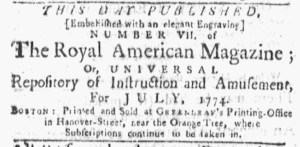
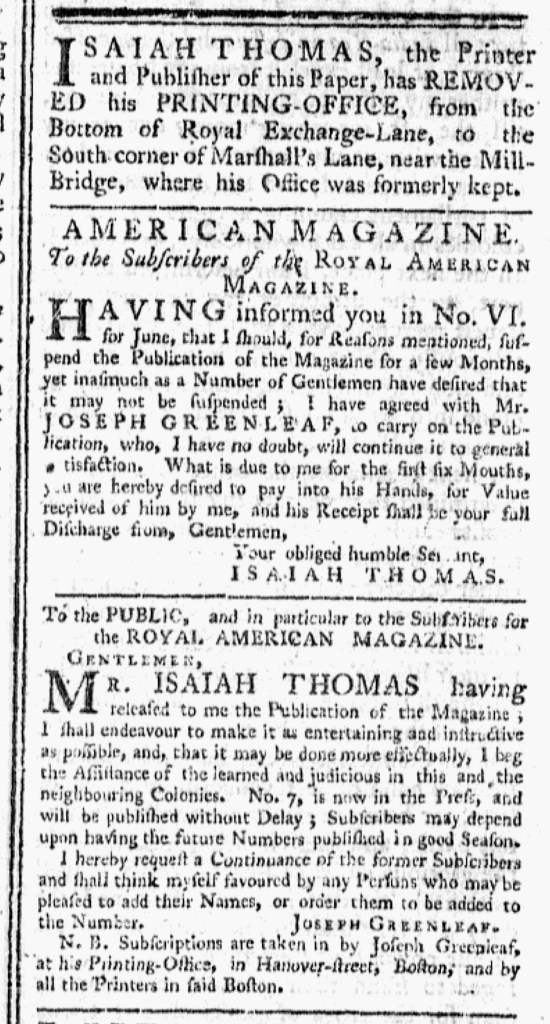
His advertisement in the Massachusetts Spy featured almost identical copy, though either the postrider or the printer, Isaiah Thomas, made some updates.  In the Norwich Packet, Cleveland declared that he “will carry this Paper,” while in the Massachusetts Spy he stated that he “will carry this and other papers, and the Royal American MAGAZINE,” the publication that Thomas launched earlier in the year and had been promoting in the public prints from New Hampshire to Maryland for months.  Perhaps Cleveland instructed Thomas to mention the magazine in his advertisement, but a revision to the nota bene that concluded the notice suggests that Thomas did so on his own.  In the Norwich Packet, that postscript indicated that Cleveland “has employed a Post to ride every Week from Norwich to Hartford, [and] serve the Customers with this Paper.”  In the Massachusetts Spy, on the other hand, the nota bene advised that Cleveland “has employed a post to ride every week from NORWICH to HARTFORD, [and] serve the customers with News-Papers [and] Magazines.”  Had delivering the Royal American Magazine, the only magazine published in the colonies at the time, or any other magazines been among the services that Cleveland thought most likely to garner attention from prospective customers, he probably would have mentioned magazines in his advertisement that originated in the Norwich Packet.  More likely, the savvy Thomas seized an opportunity to promote his magazine and assure subscribers beyond Boston that they would receive it in a timely manner.

March 10

What was advertised in a colonial American newspaper 250 years ago today?

Massachusetts Spy (March 10, 1774).

“We neither jointly nor separately had any share, interest or property, directly or indirectly in any part of the Tea that came from London in said vessel.”

Thomas Walley, Peter Boyer, and William Thompson needed to do some damage control and salvage their reputations in the wake the second Boston Tea Party.  That trio owned the Fortune, a brig that recently arrived from London. Among its cargo, the ship carried twenty-eight chests of tea “destined for some independent merchants,” according to the Massachusetts Historical Society’s overview of events.  The brig arrived in port on March 6, 1774.  J.L. Bell explains that Walley, Boyer, and Thompson worked with those merchants to request that the tea be returned, but customs officers refused.  Bostonians did not spend weeks debating what to do like they had a few months earlier.

A news item in the March 10, 1774, edition of the Massachusetts Spy reported that “His Majesty Oknookortunkogog King of the Narragansett tribe of Indians, on receiving information of the arrival of another cargo of the cursed weed Tea, immediately summoned his Council.”  Colonizers once again played Indian in their acts of resistance against imperial authority.  The imaginary leader of the Narragansetts “did advise and consent to the immediate destruction” of the tea, “after resolving that the IMPORTATION of this Herb, by ANY persons whatever, was attended with pernicious and dangerous consequences to the lives and properties of all his subjects throughout America.”  The king and council dispatched “the seizor and destroyer-general, and their deputies … to the place where this noxious herb was.”  They made their way to the Fortune on the evening of March 7, where they “emptied every chest … and effectually destroyed the whole” before they “returned to Narrangasett to make report of their doings to his Majesty.”  The Sons of Liberty and their allies maintained the ruse deployed the previous December.

Walley, Boyer, and Thompson’s advertisement appeared immediately below that description of the destruction of another cargo of tea.  They opened by rehearsing the story of “a certain WILLAIM BOWES, Brazier, on Dock-square” who “industriously propagated … a false and scandalous report, that the owners of the brig … have imported a quantity of Tea in that vessel upon their own account.”  Walley, Boyer, and Thompson suspected that Bowes might have even “invented” the story himself rather than repeating gossip he heard elsewhere.  The merchants did not trust his motives at all, claiming that Bowes “impudently asserted” that he knew all about the tea they supposedly imported from London and told the story “with a malignant design … to injure their reputation, and expose them to public resentment.”  As a result, they found it necessary to run an advertisement “in vindication of themselves from the vile and groundless aspersion of that impertinent medler in other men’s matters.”  Although they had tried to defuse the situation by assisting merchants who shipped cargo on their vessel in receiving permission to return the tea to London, they had not been aware in advance that the Fortune carried tea.  They wished to make that clear.

To that end they published a “deposition” which explicitly stated, “WE the subscribers, owners of the brig Fortune, do solemnly declare that we neither jointly nor separately had any share, interest or property, directly or indirectly in any part of the Tea that came from London in said vessel.”  Just as Jeremiah Cronin had done when facing allegations that he acted against the interests of the patriots, Walley, Boyer, and Thompson enlisted the aid of a justice of the peace to lend credibility to their explanation of what occurred.  Edmund Quincy asserted that the merchants “personally appeared and made oath to the truth of the above declaration.”  As was often the case in early American newspapers, the section devoted to news did not contain all the information about current events.  Instead, readers garnered valuable information from an advertisement as well.

February 27

What was advertised in a colonial American newspaper 250 years ago this week?

Massachusetts Spy (February 27, 1774).

“GARDEN SEEDS … SOLD by SUSANNA RENKEN.”

Susanna Renken was not the first entrepreneur to advertise seeds in Boston’s newspapers as the spring of 1774 approached, though she had been on several occasions in the past decade.  That distinction went to John White, “Gardner, and Seeds-Man, in SEVEN-STAR LANE,” with his advertisement in the February 17 edition of the Massachusetts Spy, yet within a week Renken she activated her advertising campaign.  Fittingly, Renken placed an advertisement for “GARDEN SEEDS” in the next issue, serving as a counterpoint to White’s repeated notice.

Unlike the approach White had taken so far, Renken did not confine her marketing efforts to a single newspaper.  When she ran her first advertisement on February 24, she placed it in both the Massachusetts Gazette and Boston Weekly News-Letter and the Massachusetts Spy.  That made her among the first of the sorority of female seed sellers to advertise in 1774.  Her competitors Elizabeth Clark and Elizabeth Nowell also ran a notice in the Massachusetts Gazette and Boston Weekly News-Letter.  It appeared immediately to the left of Renken’s advertisement.

So began the annual contest to woo customers to purchase seeds.  As had been her practice in the past, Renken continued expanding her advertising campaign, seeking to reach more prospective customers by inserting her notice in multiple newspapers.  On February 28, she ran it in the Boston Evening-Post, immediately above Elizabeth Greenleaf’s advertisement for “GARDEN-SEEDS.”  The appropriately named Greenleaf was part of the sisterhood of seed sellers who advertised extensively each spring.  On the same day, her advertisement appeared immediately above Renken’s advertisement in the Boston-Gazette.  Perhaps having noticed that Renken and Clark and Nowell commenced their advertising Greenleaf determined that it was time to invest in her own marketing efforts for 1774.

For whatever reason, none of them or their competitors placed advertisements in the Massachusetts Gazette and Boston Post-Boy on February 28, but the March 3 edition of the Massachusetts Gazette and Boston Weekly News-Letter once again featured advertisements from Renken and Clark and Nowell, joined by Greenleaf.  As had been common in previous years, the compositor arranged them one after the other in a single column.  Printers did not usually arrange advertisements by purpose or category, but they often made an exception for women who sold seeds in Boston.  Renken and White once again placed their notices in the Massachusetts Spy on March 3.

For newspaper readers in and near Boston, this flurry of advertising was an annual ritual.  It signaled that spring was on its way.  Perhaps for modern readers who regularly visit the Adverts 250 Project, these advertisements serve a similar purpose, a sign of the changing seasons as days become longer even if not necessarily warmer.

February 24

What was advertised in a colonial American newspaper 250 years ago today?

Massachusetts Spy (February 24, 1774).

“POETS CORNER.  From the ROYAL AMERICAN MAGAZINE.”

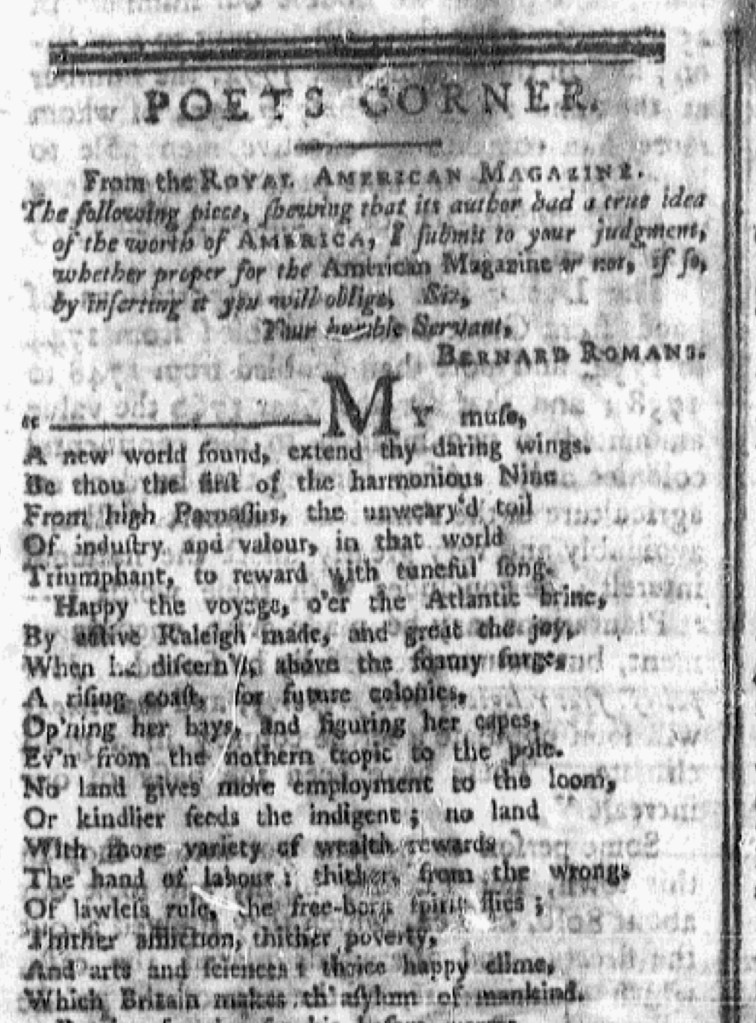
Isaiah Thomas, printer of the Massachusetts Spy, continued promoting a new venture, the Royal American Magazine, in the February 24, 1774, edition of his newspaper.  He once again ran an advertisement announcing that “This day was published … NUMBER I. of THE ROYAL American Magazine,” noting the price, promoting the two copperplate engravings that accompanied the inaugural issue, listing the contents, and encouraging “those who do not chuse to be disappointed of the first number … to be speedy in subscribing.”  That was not the extent of Thomas’s efforts to market the Royal American Magazine in that issue of the Massachusetts Spy.  The “POETS CORNER,” a regular feature in the upper left corner of the final page, featured a poem entitled, “A PROPHECY of the FUTURE GLORY of AMERICA.”  A note of introduction indicated that the verses came “From the ROYAL AMERICAN MAGAZINE.”  Thomas conveniently placed the advertisement for the magazine immediately below the poem, guiding readers toward subscribing.

That was not the only instance of the industrious printer publishing an excerpt from the magazine in his efforts to increase its visibility and gain new subscribers.  On February 23, the Essex Journal, a newspaper that Thomas recently launched in Newburyport in partnership with Henry-Walter Tinges, carried the advertisement on the final page and an excerpt “From the Royal American Magazine” on the first page.  In this instance, the excerpt was a short essay “Against IDOLATRY and BLASPHEMY” that critiqued the practice of using “epithets” including “Most gracious Sovereign” and “Most excellent Majesty” because they “can justly be applied to none but GOD; and therefore, applying them to men, is idolatry.”  The author, identified only as “A CHRISTIAN,” took the opportunity to take a swipe at “Roman catholics … paying divine honours to a vain empty Pope.”  Yet they were not much better than “protestants and Englishmen” who were “in some degree partakers of the same guilt.”  Americans, on the other hand, could avoid “this sin” by “pay[ing] honour to whom honour is due, among men” and “pay[ing] supreme honour to none by the SUPREME.”  In selecting that piece to excerpt, Thomas played to the prejudices of Protestants in New England, many of them descended from Puritans who first colonized the region.  The excerpt on the first page and the advertisement on the last page bookended the contents of that issue of the Essex Journal, the reiterating reminding readers to subscribe and read the new magazine.

In both newspapers, Thomas inserted excerpts to create a buzz around the Royal American Magazine.  He offered previews to prospective subscribers, both in the list of contents and the excerpts themselves, in hopes of inciting curiosity and demand for the new publication.