December 15

What was advertised in a colonial American newspaper 250 years ago today?
New-York Journal (December 15, 1774).

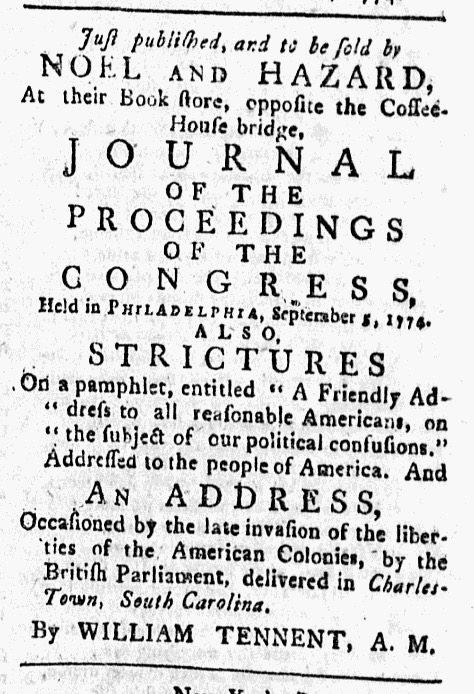
“JOURNAL OF THE PROCEEDINGS OF THE CONGRESS.”

According to their advertisement in the December 15, 1775, edition of the New-York Journal, Garrat Noel and Ebenezer Hazard stocked the “JOURNAL OF THE PROCEEDINGS OF THE CONGRESS, Held in PHILADELPHIA” at their bookstore.  They also marketed “STRICTURES On a pamphlet, entitled ‘A Friendly Address to all reasonable Americans, on the subject of our political confusions’” by Charles Lee and “AN ADDRESS, Occasioned by the late invasion of the liberties of the American Colonies, by the British Parliament, delivered in Charles-Town, South Carolina” by William Tennent.  The booksellers provided the public access to news and commentary about current events beyond what appeared in the public prints, though they privileged perspectives expressed by Patriots rather than Loyalists.

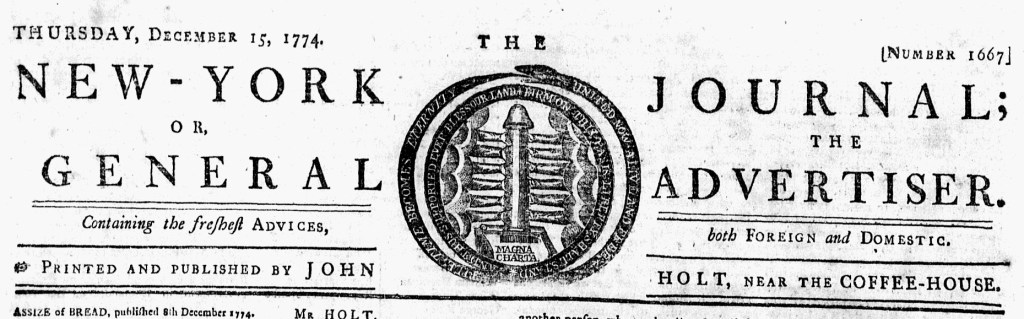
Noel and Hazard may have sold Hugh Gaine’s New York edition of the Proceedings of the First Continental Congress, though the other titles in their advertisement suggest that they could have sold the Philadelphia edition printed by William Bradford and Thomas Bradford.  The Bradfords also published Lee’s Strictures and Tennent’s Address, possibly sending copies of all three titles to Noel and Hazard.  Either  way, the masthead of the newspaper that featured the booksellers’ advertisement suggested that the Bradfords’ edition of the Proceedings made their way to New York.  Six months earlier, John Holt, the printer of the New-York Journal, incorporated a political cartoon depicting a severed snake, each segment representing one of the colonies, with the motto “UNITE OR DIE” into the masthead.  On December 15, he replaced it with a woodcut depicting twelve hands, one for each colony represented at the First Continental Congress, grasping a liberty pole with a liberty cap perched atop it on a pedestal inscribed “MAGNA CHARTA.”  A similar image appeared on the title page of the Bradfords’ edition of the Proceedings, described in Princeton University Library’s online catalog as “the first wood-cut device of the 12 colonies intended to symbolize the need for the true political unity of the colonies.”  Holt enhanced that image, having an ouroboros twice encircle the hands and pillar.  A message on the ouroboros proclaimed, “UNITED NOW – ALIVE AND FREE – AND THUS SUPPORTED EVER – BLESS OUR LAND – FIRM ON THIS BASIS LIBERTY SHALL STAND – TILL TIME BECOMES ETERNITY.”  This addition to his newspaper set the tone for readers to peruse Noel and Hazard’s advertisement, other paid notices, and the news and editorials selected by Holt.
New-York Journal (December 15, 1774).

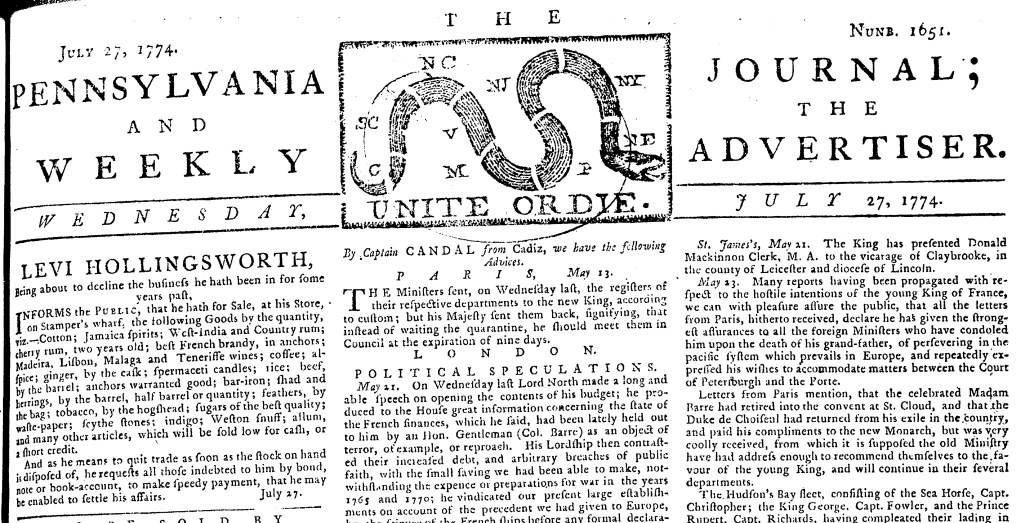
July 27

What was advertised in a colonial American newspaper 250 years ago today?

Pennsylvania Journal (July 27, 1774).

“Many other articles, which will be sold low for cash, or a short credit.”

Levi Hollingsworth’s advertisement for a variety of goods available “at his Store, on Stamper’s wharf,” in Philadelphia in the July 27, 1774, edition of the Pennsylvania Journal appeared immediately below a masthead that featured a new image.  Previously, the device had four components.  In the center, a newspaper bearing the title “JOURNAL” sat on a pedestal above a cartouche that showed a ship at sea, those items testifying to information that the newspaper disseminated and the commerce that it facilitated.  An indigenous American on the left and an angel representing Fame on the right flanked the newspaper and ship.  The new device depicted a divided snake, each segment assigned to a colony, with the motto, “UNITE OR DIE.”

In recent weeks, at least two other American newspapers incorporated similar images into their mastheads.  The New-York Journal, printed by John Holt, had done so on June 23.  The images were so similar that William Bradford and Thomas Bradford, printers of the Pennsylvania Journal, likely copied directly from Holt’s newspaper after they received it via exchange networks that linked printers throughout the colonies.  On July 7, Isaiah Thomas adopted an even more elaborate image in the masthead of the Massachusetts Spy, one that showed a divided snake with a pointed tongue and a pointed tail facing off against a dragon that represented Great Britain.  Its admonition demanded that readers “JOIN OR DIE.”  Once the Bradfords updated their masthead, a newspaper published in three of the four largest American port cities circulated the divided snake political cartoon to subscribers and other readers every week.  The Pennsylvania Journalcontinued doing so for fifteen months, returning to its previous device at the end of October 1775.  By that time, the Revolutionary War had started.

In his History of Printing in America (1810), Isaiah Thomas stated that the Pennsylvania Journal “was devoted to the cause of the country.”[1]  Each time that Hollingsworth or other advertisers placed notices in that newspaper they aided in underwriting a partisan press that advocated for the rights of colonizers as British subjects and, eventually, independence from Great Britain.  Each time a reader perused those advertisements, they likely saw the political cartoon in the masthead, forced to engage with its message even if they did not read the news and editorials closely.

**********

[1] Isaiah Thomas, The History of Printing in America: With a Biography of Printers and an Account of Newspapers (1810; New York: Weathervane Books, 1970), 437.

June 23

What was advertised in a colonial American newspaper 250 years ago today?

New-York Journal (June 23, 1774).

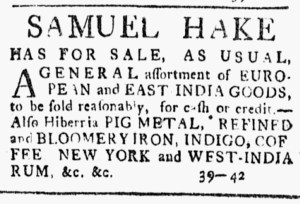
“AS USUAL, A GENERAL assortment of EUROPEAN and EAST INDIA GOODS.”

As readers perused the June 23, 1774, edition of the New-York Journal, they once again encountered Samuel Hake’s advertisements for a “GENERAL assortment of EUROPEAN and EAST INDIA GOODS, to be sold reasonably, for cash or credit.”  It was the fourth consecutive week that it appeared in that newspaper, having originated in the June 2 edition.  It was the first time, however, that the advertisement ran under a new image in the masthead.  The New-York Journal previously included the coat of arms of the United Kingdom, a lion and a unicorn flanking a shield with the words “DIEU ET MON DROIT” (“God and My Right”) on a banner beneath it.  After receiving word of the Boston Port Act that closed and blockaded the harbor until residents of that city paid for the tea destroyed during the Boston Tea Party, John Holt, the printer of the New-York Journal, selected a new image for the masthead, a snake severed into pieces with the words “UNITE OR DIE” beneath it.  Short abbreviations indicated each part of the snake represented New England or one of the other colonies.

Pennsylvania Gazette (May 9, 1754). Courtesy Library of Congress.

Holt drew inspiration from the “JOIN, or DIE” woodcut that appeared in Benjamin Franklin’s Pennsylvania Gazette twenty years earlier on May 9, 1754.  At that time, the American colonies faced a threat from the French and their Indigenous allies on the eve of the Seven Years War.  In an editorial, Franklin encouraged colonizers to support the Albany Plan of Union and recognize their shared identity as Americans.  The “JOIN, or DIE” political cartoon that accompanied that call to a common cause is the earliest known visual representation of such unity, a symbol repurposed during the imperial crisis.  According to public historians at the National Constitution Center, the “emblem appeared in colonial newspapers during the Stamp Act crisis” and again “during the American Revolutionary War, sometimes as part of a masthead.”  Holt was the first printer to deploy it in 1774, though in the coming months variations appeared in the mastheads of other newspapers.  Those newspapers carried editorials and coverage of the Boston Port Act and the rest of the Coercive Acts and the colonial response, including proposals to cease trade with Britain and stop purchasing imported goods.  Over the next several months, the “GENERAL assortment of EUROPEAN and EAST INDIA GOODS” advertised by Hake would take on new political meanings for colonial consumers.

New-York Journal (June 23, 1774).

August 1

What was advertised in a colonial American newspaper 250 years ago this week?

Pennsylvania Packet (July 26, 1773).

“MAKES and sells soap and candles … for exportation.”

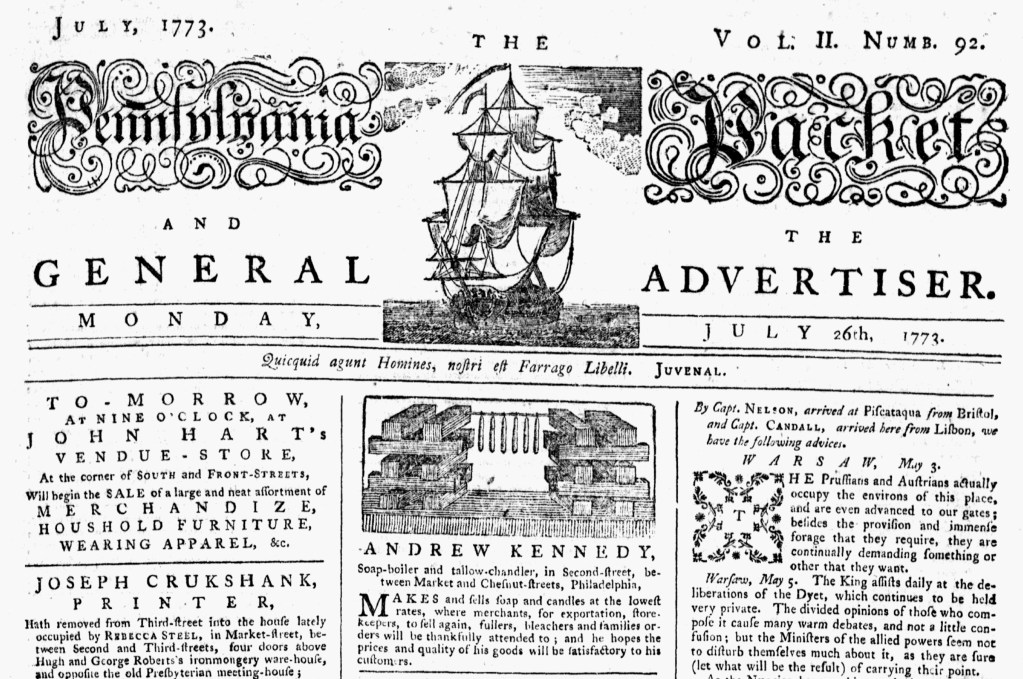
The front page of the July 26, 1773, edition of the Pennsylvania Packet and General Advertiser featured two images.  As usual, a woodcut depicting a ship at sea appeared in the masthead.  The newspaper took its name from the packet ships that crisscrossed the Atlantic, transporting passengers and freight.  Significantly, packet ships also carried information, whether written in letters, printed in newspapers, or shared by captains, other officers, and crew.  The Pennsylvania Packet, like a packet ship, disseminated news to every destination it reached.  Whether accounts of current events, rosters of vessels arriving and departing from customs houses, prices current for commodities, or advertisements, the contents of the Pennsylvania Packet facilitated commerce in Philadelphia, its figurative home port, and readers wherever they happened to peruse the newspaper.

Andrew Kennedy certainly hoped that the Pennsylvania Packet and General Advertiser would facilitate his own commercial interests.  The “soap-boiler and tallow-chandler” ran a shop in Philadelphia, though he aimed to serve consumers far beyond that bustling port.  Like packet ships and newspapers, he envisioned the soap and candles that he made and sold “at the lowest rates” reaching faraway places.  He offered them to “merchants, for exportation,” and to “storekeepers, to sell again,” presenting those options for buying by volume first before mentioning “families orders.”  Like many other artisans and shopkeepers who advertised in colonial newspapers, he promoted the “prices and quality of his goods” and concluded with overtures about customer satisfaction.  Kennedy commenced his advertisement with an image that readers immediately recognized, stacks of blocks on the right and left to support a string dangling six freshly-dipped candles.  Without even skimming the rest of the advertisement, readers knew that Kennedy sold candles.

Only two other images appeared in that issue of the Pennsylvania Packet, both of them woodcuts of indentured servants who ran away from their masters.  John Dunlap, the printer, provided those stock images to the advertisers, but Kennedy commissioned a woodcut for his own exclusive use.  That image likely helped attract attention to the appeals to price and quality that he intended to resonate with merchants, shopkeepers, and other prospective customers.