September 30

What was advertised in a revolutionary American newspaper 250 years ago today?
Pennsylvania Ledger (September 30, 1775).

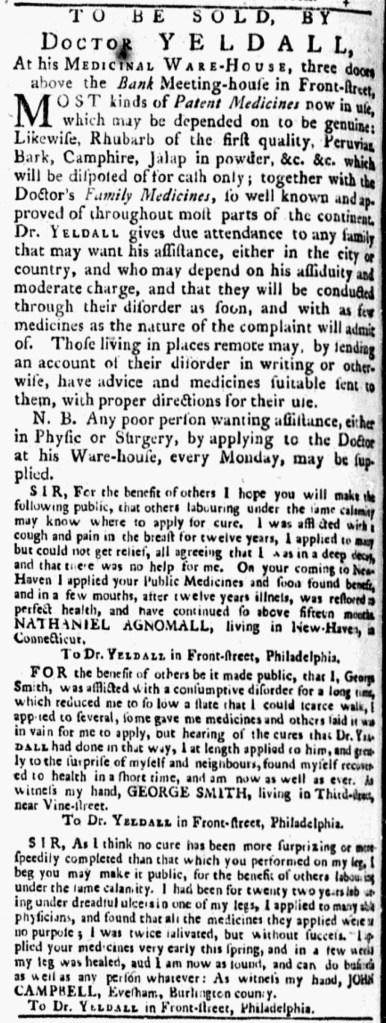
“To the surprise of myself and neighbours, found myself recovered to health.”

Doctor Yeldall apparently believed that testimonials worked.  In June 1775, he published an advertisement that included several testimonials from his patients.  Three months later, he once again promoted his “MEDICINAL WARE-HOUSE’ in Philadelphia with an advertisement that featured three new testimonials.  The notice gave the impression that the doctor had not solicited them, but instead merely published letters addressed “To Dr. YELDALL in Front-Street, Philadelphia” at the request of those who sent them.  “For the benefit of others I hope you will make the following public,” Nathan Agnomall’s testimonial began.  Similarly, John Campbell, who had suffered “dreadful ulcers in one of my leges,” implored the doctor: “I beg you may make it public, for the benefit of others labouring under the same calamity” that Yeldall’s medicines healed leg.

In his preamble to the testimonials, Yeldall described his “Doctor’s Family Medicines” as “so well known and approved of throughout most parts of the continent.”  Two of the testimonials did indeed come from beyond Philadelphia.  Campell listed his address as “Eversham, Burlington county,” in New Jersey, while Agnomall stated that he was “living in New-Haven, in Connecticut.”  The third testimonial, however, came from a resident of Philadelphia, George Smith, “living in Third-street, near Vine-street.”  Skeptics in that city could question the veracity of letters that supposedly arrived from other colonies, but they might know Smith or could seek him out to confirm what they saw printed in the newspaper advertisement.  Smith’s letter even revealed that he had been cured of a “consumptive disorder” and “to the surprise of myself and neighbours, found myself recovered to health.”  Many residents of Philadelphia living in Smith’s neighborhood could also testify to the efficacy of the Yeldall’s medicines, at least that was the inference in Smith’s letter.  Unlikely to attempt to track down Smith or interview any of his neighbors, prospective patients who had not found relief through any other means may have found this testimonial convincing enough to give Yeldall’s medicines a chance.  Even if they had doubts, the details in Smith’s letter gave them hope by encouraging them to believe something that was likely too good to be true.
June 17

What was advertised in a revolutionary American newspaper 250 years ago today?

Pennsylvania Ledger (June 17, 1775).

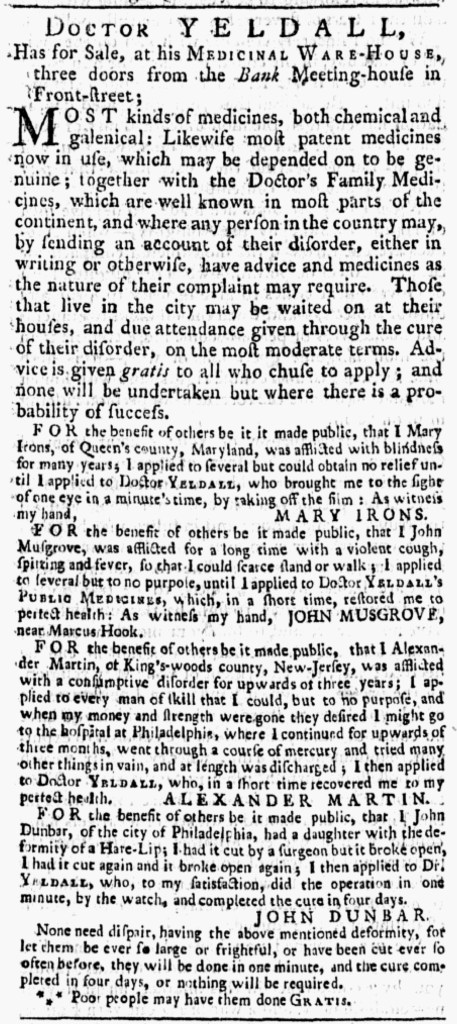
“I applied to Doctor YELDALL’S PUBLIC MEDICINES, which, in a short time, restored me to perfect health.”

An advertisement placed by “DOCTOR YELDALL” in the June 17, 1775, edition of the Pennsylvania Ledger advised the public that he sold “MOST kinds of medicines” at his “MEDICINAL WARE-HOUSE” on Front Street in Philadelphia.  He carried “most patent medicines now in use” as well as his own line of “the Doctor’s Family Medicines,” which, he claimed, “are well known in most parts of the continent.”  Customers residing in the country could send orders for Yeldall to fill, while those in the city could arrange to “be waited on at their houses, and due attendance given through the cure of their disorder.”  The doctor did not charge for consultations, nor did he commence treatment except “where there is a probability of success.”  He attempted to build trust with prospective patients in his advertisement.

To that end, he also published a series of testimonials, hoping that former patients would prove even more convincing than his own description of his services.  Each started with the same phrase, “FOR the benefit of other be it made public,” suggesting that Yeldall solicited the testimonials and assisted in drafting them (or perhaps even wrote them himself).  In one, John Musgrove, who lived near Marcus Hook, Pennsylvania, reported that he “was afflicted for a long time with a violent cough, spitting and fever” to the point that he “could scarce stand or walk.”  He sought assistance “but to no purpose, until [he] applied to Doctor YELDALL’S PUBLIC MEDICINES.”  They quickly restored him to “perfect health.”  Alexander Martin “of Kings-woods county, New-Jersey” similarly declared that he “was afflicted with a consumptive disorder for upwards of three years,” during which time he “applied to every man of skill that [he] could, but to no purpose.”  He even entered the “hospital at Philadelphia” and stayed for three months, enduring “a course of mercury” and “tried many other things in vain.”  Only after his discharge from the hospital did Martin seek aid from Yeldall, who “in a short time recovered me to my perfect health.”  According to Martin and Musgrove, the doctor’s methods were both fast and effective.

In addition to prescribing the right medicines to treat his patients’ maladies, Yeldall also performed medical procedures.  In one testimonial, Mary Irons of Queen’s County, Maryland, declared that she “was afflicted with blindness for many years.”  She “applied to several, but could obtain no relief until I applied to Doctor YELDALL, who brought me to the sight of one eye in a minute’s time, by taking off the film.”  John Dunbar “of the city of Philadelphia” told of a surgeon who unsuccessfully treated his daughter.  She had “the deformity of a Hare-Lip” that “broke open” after the surgeon “cut” it.  Dunbar then took his daughter to Yeldall, “who, to my satisfaction, did the operation in one minute, by the watch, and completed the cure in four days.”  Yeldall added a note that others with “the above mentioned deformity” did not need to “dispair,” no matter how “large or frightful, or hav[ing] been cut so often before,” because his procedure “will be done in one minute, and the cure completed in four days” or else he did not charge for his services.  Perhaps the focus on how quickly the doctor performed these operations was meant to reassure prospective patients that they would not experience prolonged discomfort during a procedure.

Yeldall’s promises seemed too good to be true … and they almost certainly were.  Yet the “DOCTOR” realized that some prospective patients were likely desperate for any sort of treatment that they could hope for a different outcome.  As they searched for hope, he expected that his own promises and, especially, testimonials supposedly composed by his former patients would convince the afflicted to give him a chance to restore them to health.

May 23

What was advertised in a colonial American newspaper 250 years ago today?

Dunlap’s Maryland Gazette (May 23, 1775).

Proper medicines in all stages of the Venereal disease put up with the most faithful attention to the symptoms.”

Patrick Kennedy, a surgeon and apothecary, advertised an “assortment of genuine Patent Medicines” available at his “Drug-Store” in Baltimore in the May 23, 1775, edition of Dunlap’s Maryland Gazette.  He carried many familiar items, including Bateman’s Drops and Stoughton’s Bitters, as well as “a few boxes of Patent dentifrice powder, for cleaning and beautifying the teeth.”  He also “compounded [prescriptions] with care and fidelity.”

Beyond those medicines and services, Kennedy devoted a significant portion of his advertisement to addressing readers who contracted syphilis and other venereal diseases.  “Proper medicines in all stages of the Venereal disease,” the apothecary advised, “put up with the most faithful attention to the symptoms.”  In other words, Kennedy devised prescriptions baes on the specific symptoms that patients reported to him.  When doing so, he observed “the most profound secrecy” to protect the privacy of his clients.  Prospective patients could trust Kennedy’s discretion concerning such delicate matters.  In addition to residents of Baltimore who visited his shop, he offered these services to “Persons afflicted with this disorder in the country.”  He instructed them to send “a line descriptive of their case” and then he would supply “remedies of the most approved kind, with ample directions.”  Providing written directions substituted for in-person consultations, allowing patients to use the medicines responsibly and effectively.  Although some may have been anxious about submitting their requests in writing, they may have found doing so less embarrassing than discussing their symptoms with the apothecary in his shop.  Ordering medicines from a distance made the patients nearly anonymous compared to face-to-face interactions at Kennedy’s shop.  His promise of “profound secrecy” also applied to those orders.

For those who had avoided misfortune and wished to keep it that way, the apothecary promoted the “Antivenereal preventive Wash.”  He explained that “repeated experiments” demonstrated its “assured efficacy in destroying the recent venereal infection; as it never fails to search after and cleanse away the acting cause of the malady.”  Kennedy hoped that readers would consider this preventative regimen worth the investment since it “preserv[ed] the constitution from the long course of medicines” that they would otherwise take after contracting venereal diseases.  As Benjamin Franklin had advised a few decades earlier, an ounce of prevention was worth a pound of cure!  Kennedy hoped that sentiment would resonate with prospective clients who sought to avoid venereal diseases.

July 2

What was advertised in a colonial American newspaper 250 years ago today?

Maryland Journal (July 2, 1774).

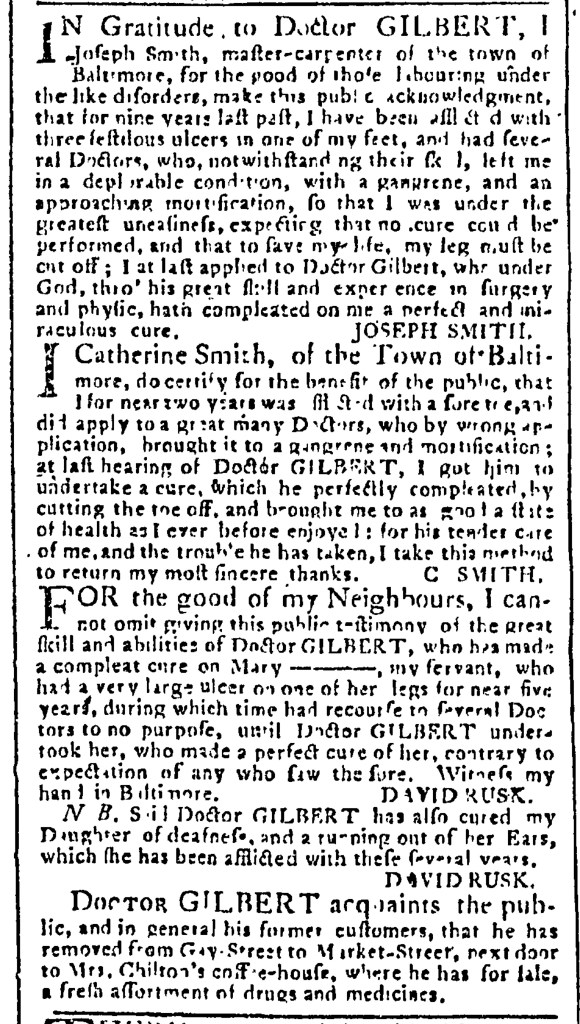
“IN Gratitude to Doctor GILBERT, I … make this public acknowledgment.”

When Doctor Gilbert moved to a new location on Market Street from Gay Street in Baltimore in 1774, he alerted “the public, and in general his former customers” in an advertisement in the Maryland Journal.  Yet that information appeared at the end of a lengthy advertisement devoted primarily to testimonials from some of the patients he served.  The advertisement began with Joseph Smith, “master-carpenter of the town of Baltimore,” expressing his gratitude to the doctor and doing so in the public prints “for the good of those labouring under the like disorders.”  He then explained that for nine years he had suffered from ulcers that would not heal on one of his feet, despite the skill of other doctors he consulted.  His condition reached such a “deplorable condition” that he feared that his leg would need to be amputated “to save my life.”  Fortunately, he “applied to Doctor Gilbert” who “thro’ his great skill and experience in surgery and physic, hath completed on me a perfect and miraculous cure.”

Similarly, Catherine Smith offered an account of her experience with a “sore toe” that would not heal.  She saw several doctors, but they unsuccessfully treated her and instead “brought it to a gangrene and mortification.”  She turned to Gilbert.  Although he could not save her toe, after he amputated it he “brought me to as good a state of health as I ever before enjoyed.”  Smith offered her “most sincere thanks” for “his tender care of me,” making a statement in an advertisement “for the benefit of the public.”  David Rusk felt a similar duty to report on how Gilbert aided members of his household.  “FOR the good of my Neighbours,” he explained, “I cannot omit giving this public testimony of Doctor GILBERT.”  His servant, Mary, had “a very large ulcer on one of her legs for near five years.”  She had also seen many doctors “to no purpose,” but then Gilbert “made a perfect cure of her, contrary to expectation of any who saw the sore.”  In addition, Gilbert cured Rusk’s daughter of deafness through treating “a running out of her Ears, which she has been afflicted with these several years.”

For his part, Gilbert did not describe his services or his training.  He merely informed readers of his new location and mentioned that he sold “a fresh assortment of drugs and medicines.”  He apparently believed that he did not need to expound on his credentials or his experience like others who provided medical services often did in their advertisements, figuring that testimonials from his former patients told a more compelling and more convincing story than anything he could say about himself.  Those stories of successful treatments offered hope to prospective patients, a powerful motivation to seek Gilbert’s services.

November 20

What was advertised in a colonial American newspaper 250 years ago today?

Maryland Journal (November 20, 1773).

“Such unworthy motives as these are far from Dr. Gilbert’s intention.”

When Dr. H. Gilbert relocated from Philadelphia to Baltimore, he inserted an advertisement in the Maryland Journal to introduce himself to the community and solicit patients who wished to consult him about “all the disorders to which the human body is incident.”  His lively notice included commentary about the kinds of advertisements that others who provided medical services often placed. “It is now become almost customary,” the doctor observed, “at least many have of late thought proper to begin their address to the public with liberal encomiums on their own knowledge, practice, and abilities.”  When they arrived in new places, doctors could not rely on their reputations to encourage patients to see them; in the absence of such familiarity, many emphasized their training and experience to assure prospective patients that they would be in good hands.

Gilbert found a certain aspect of such introductions particularly unsavory and disingenuous.  Some doctors, he charged, “at once declare there is no disorder, however accute or malignant in its nature, that they cannot immediately not only give relief in, but effectually eradicate, without the least inconvenience or danger to the patient.”  Those claims appeared in too many newspaper advertisements and handbills, leading “persons who are unacquainted with the human frame” to believe that “many disorders exist altogether in the imagination, by the easy manner in which they are said to be expelled.”  Such marketing had two outcomes: “imposing on the ignorant” and “the emolument of the authors of such preposterous assertions.”  Unfortunately, patients often had a “fatal experience” under those circumstances.  Gilbert suggested that grandiose promises from doctors “must … appear in a very ridiculous light to every person of the smallest degree of penetration.”  In a backhanded fashion, he discouraged readers from seeking treatment from quacks and charlatans who seemed to promise too much.

Gilbert pledged that he would give patients false hopes by telling them merely what they wanted to hear and taking their money for cures that did not work.  He would not make “preposterous assertions” and swindle them: “such unworthy motives as these are far from Dr. Gilbert’s intention.”  He did relay his own credentials, “being regularly bred to his profession, as well as his having had several years experience and practice by land and sea, and in Germany, Holland, and America,” but did not make the kinds of unfounded assertions that he critiqued.  Instead, he stated that he would “exert his utmost abilities to serve” patients and “by good attendance and a particular attention to their respective cases, endeavour to merit the patronage of the public.”  In other words, Gilbert stressed the individualized care that he bestowed on each patient.  He assessed their particular symptoms and recommended care specific to their needs.  Rather than making self-promotion and dubious promises the centerpieces of his marketing efforts, he emphasized honesty and respect in his interactions with the public and his patients.

November 11

What was advertised in a colonial American newspaper 250 years ago today?

Rivington’s New-York Gazetteer (November 11, 1773).

“Dr. OGDEN’S very successful Method of Cure, which the Printer inserted in the Almanack at the particular request of some of the Inhabitants.”

As the new year approached and printers throughout the colonies advertised almanacs for 1774, James Rivington of New York took to the pages of his own newspaper to advise prospective customers that the “very great Demand for Rivington’s Almanack … HAS occasioned him to print a new Edition.”  Like many other printers who marketed the almanacs they published, Rivington provided an extensive list of the contents as a means of generating interest.  He enumerated twenty items.  They included helpful reference information, such as “Courts in this and the neighbouring Provinces,” “Fairs,” “FRIENDS Meetings,” and “Roads.”  They also included six “Cures for Disorders in Horses” and five “Receipts [or cures] from some of the most eminent Physicians” for a variety of symptoms.  For entertainment, the almanac contained “Pleasant Jests.”  For the edification of readers, it included “A very important Lesson.”  Rivington emphasized that the contents of his almanac “vary in many particulars from others” sold by competitors.  The items he selected for inclusion “have been so well received by the Public, as to occasion a very large Quantity to be sold in a few Days.”  Existing demand served as a recommendation for the new edition.

Before commenting on the reception that the almanac already enjoyed or listing the contents, Rivington opened his advertisement with a note intended to resonate with prospective customers in nearby Connecticut.  “The following Almanack is particularly recommended to the Inhabitants of the Colony of Connecticut,” the printer asserted, “where the ulcerous and malignant Sore Throat, at this Time rages in a very high Degree.”  Rivington reported that he inserted “Dr, OGDEN’S very successful Method of Cure … at the particular Request of some of the Inhabitants.”  Among the contents enumerated in the advertisement, “Dr. JACOB OGDEN’S Method of treating the Malignant Sore Throat Distemper” appeared first.  That item alone, Rivington suggested, justified purchasing this particular almanac.  He implied that he provided an important service, though his altruism had limits.  After all, he could have published the “Method of Cure” in Rivington’s New-York Gazetteer; or the Connecticut, New-Jersey, Hudson’s-River, and Quebec Weekly Advertiser for the benefit of readers throughout the region he distributed his newspaper.  Still, Rivington framed his choice of contents for his almanac as an act of benevolence that took current events in account.  His awareness of the particular needs of prospective customers in Connecticut led him to respond in a manner that he intended would simultaneously contribute to public health and further his own commercial interests.

January 20

GUEST CURATOR:  Kelly Blecker

What was advertised in a colonial American newspaper 250 years ago today?

Supplement to the Boston-Gazette (January 20, 1772).

“Snake Root Waters.”

This advertisement features a wide variety of items for sale by Joseph Hall, including “Snake Root Waters,” an item I found particularly interesting. I had never heard of this before, so I was curious to see what it was and how colonists used it. The snakeroot plant is native to North America. According to George E. Gifford, Jr., in “Botanic Remedies in Colonial Massachusetts, 1620-1820,” snakeroot “had long been used by the Seneca … as a specific in cases of poisoning by the bite of a rattlesnake.” They boiled the plant in water and made a paste, or poultice, which they used to heal rattlesnake bite. “They had inferred this from a supposed resemblance between the root of the plant and the rattle of the snake.” Other uses for snakeroot included treating headache, stomachache, and respiratory problems such as pneumonia and bronchitis. English physicians found using the plant to treat their patients to be highly effective.

The increase in the use of snakeroot waters and other natural remedies showcases how the colonists did not trust European medicine exclusively. Gifford states, “The settlers benefited from the skill of native healers who understood the medicinal value of many indigenous animal and vegetable products.”  As a result, they “establish[ed] an independent tradition of prescribing a specific remedy for a specific ailment. It also caused them to gradually shift from relying on the European schoolmen to depending on the simples and specifics of the old wives, Indians, and ministers.” Colonists adopted knowledge and guidance from Native Americans to create remedies right in North America instead of relying only on patent medicines imported from England.

**********

ADDITIONAL COMMENTARY:  Carl Robert Keyes

Readers of the Boston-Gazette and other newspapers published throughout the colonies regularly encountered advertisements for a vast array of patent medicines produced in England and exported to America.  Apothecaries stocked patent medicines (as we will see in some of the advertisements selected by Kelly’s classmates), but so did merchants and shopkeepers … and even printers!  Patent medicines were the over-the-counter drugs of the eighteenth century, the brands and their uses so familiar that they did not require specialized expertise on the part of purveyors who provided them to colonial consumers.  The producers of many of those patent medicines claimed that their elixirs cured all sorts of maladies rather than targeting specific symptoms and illnesses.

Yet medical knowledge and remedies did not flow in just one direction across the Atlantic, as Kelly demonstrates in her examination of snakeroot.  On both sides of the Atlantic, Europeans embraced knowledge and products derived from the experiences of indigenous peoples.  As Gifford explains, “simple remedies,” like snakeroot, “were quite unlike the complicated nostrums and electuaries of Europe,” those patent medicines, “which sometimes contained up to eighty ingredients.”  Identifying a specific purpose for snakeroot and other flora contributed to a “tradition of prescribing a specific remedy for a specific ailment” instead of relying as extensively on patent medicines that supposedly cured just about any disorder or disease.

Gifford indicates that the “collection, cultivation, and exportation of plant drugs such as ipecac, Virginia snakeroot, and ginseng were of considerable economic significance in the colonies.”  In 1770, for instance, England imported seventy-seven tons of sassafras, used for treating syphilis.  Gifford describes this as part of a “favorable exchange” of ideas as European practitioners incorporated indigenous knowledge into their treatment of patients.  That does not mean that doctors and apothecaries recognized indigenous healers as equal partners in the enterprise, but Europeans on both sides of the Atlantic did benefit from knowledge, experience, and guidance from indigenous Americans.

January 30

What was advertised in a colonial American newspaper 250 years ago this week?

Supplement to the Boston-Gazette (January 28, 1771).

“I think it my Duty to acquaint the Publick, that I met with a Doctor … [who] made a sound Cure of me.”

One brief advertisement in the supplement that accompanied the January 21, 1771, edition of the Boston-Gazetteconsisted entirely of a testimonial by Eleanor Cooley about the medical services provided by Charles Stephen Letester of Braintree.  Physicians and purveyors of patent medicines sometimes published testimonials as portions of their newspaper advertisements in the eighteenth century, but rarely did they confine their advertising solely to testimonials.  Assuming that Letester and Cooley collaborated on the advertisement and Letester paid to insert it in the newspaper, he must have believed that Cooley’s testimonial was sufficient recommendation to convince prospective clients to avail themselves of his services.

WHEREAS I Eleanor Cooley,” the grateful patient declared, “have had a Burst in the Side of my Belly for Twelve Years, with a Dropsey and several other Disorders:  I think it my Duty to acquaint the Publick, that I met with a Doctor in the Town of Braintree, that with the Help of God, has made a sound Cure of me:  His Name is CHARLES STEPHEN LETESTER.”  This testimonial put Letester in competition with others who provided medical care of various sorts, including Oliver Smith.  In an advertisement almost immediately to the left of Cooley’s testimonial, Smith informed readers that he carried a “compleat Assortment of DRUGGS & MEDICINES, Imported in the last Ships from London, and warranted genuine.”  Especially for colonists who had attempted to find relief via various remedies sold by apothecaries, Cooley’s testimonial about Letester may have provided new hope sufficient to incite them to consult with the doctor.

In this instance, Letester did not recite his credentials, his training, his extensive experience, or his prominent clients, strategies often deployed by other doctors in their newspaper advertisements.  Instead, he relied on a firsthand account of his care for a single patient, one who was not famous but perhaps more relatable to prospective clients as a result.

January 29

What was advertised in a colonial American newspaper 250 years ago today?

Essex Gazette (January 29, 1771).

“Choice Labradore Tea.”

Two advertisements in the January 29, 1771, edition of the Essex Gazette promoted tea to colonial consumers.  William Vans advertised “CHOICE Bohea Tea by the Hundred, Dozen or single Pound,” acknowledging the demand for imported tea.  Robert Bartlett, on the other hand, sold “Choice Labradore Tea,” an alternative produced in the colonies.  As Lisa L. Petrocich explains, “Colonists brewed Labrador, or Labradore, tea from the Ledum groenlandicum evergreen plant that grows in New England, and the Middle Atlantic, and the Midwest.”[1]

Bartlett emphasized the medicinal qualities of Labradore tea in his advertisement, advising prospective customers that the product was “esteemed as very wholesome, & good for the Rheumatism, Spleen, and many other Disorders and Pains.”  He also hawked a medicine that he described as “an infallible Cure for the Tooth-Ach.”  Bartlett focused on providing remedies for ailments rather than rehearsing the recent history of tea consumption in the colonies, but he almost certainly depended on consumers possessing some familiarity with the politics of Labradore tea.  The import duties on glass, paper, lead, and paint imposed in the Townshend Acts had been repealed the previous year, prompting colonists to call an end to the nonimportation agreements adopted in protest, but the tax on tea remained.  Some stalwarts argued that was reason enough to continue the boycotts until Parliament met all of their demands by repealing the duty on tea as well, but both merchants and consumers eager to resume trade and gain access to imported goods once again overruled them.  Before that debate, however, newspapers, especially newspapers published in New England, ran news items, editorials, puff pieces, and advertisements that educated the public about Labradore tea and promoted it as an alternative to Bohea and other imported teas.

Bartlett eschewed politics in his advertisement, perhaps not wanting to alienate prospective customers who advocated for resuming trade with Britain, but the political meaning of choosing Labradore tea likely still resonated with many readers of the Essex Gazette.  That Bartlett advertised Labradore tea at all indicated that he believed he believed a market for it still existed and that he could incite greater demand by presenting it as a remedy for various ailments.

**********

[1] Lisa L. Petrovich, “More than the Boston Tea Party: Tea in American Culture, 1760s-1840s” (master’s thesis, University of Colorado, 2013), 24.

June 17

What was advertised in a colonial American newspaper 250 years ago today?

Jun 17 - 6:17:1769 Providence Gazette
Providence Gazette (June 17, 1769).

“The Art of curing, with God’s Assistance, all curable Disorders.”

Isaac Calcott, a healer, inserted an advertisement in the June 17, 1769, edition of the Providence Gazette to announce his presence in the city as soon as he arrived from London, even though he was not yet ready to see patients. He aimed to stoke anticipation among residents, especially prospective patients who might benefit from the “Art of curing” that he had obtained during “several Years travelling abroad.” Calcott did not indicate where he had traveled, leaving it to others to imagine the faraway places where this “SEVENTH SON of a SEVENTH SON” had learned secrets for healing a variety of maladies, from “Rheumatism” to “Pleurisy,” “Venereal Disorder” to “Scurvy,” and “Dropsy” to “Consumption.” Calcott informed colonists who suffered from any of these that they could soon consult with him at Elizabeth Thurston’s house starting on the following Tuesday.

Many medical practitioners from London and other places in Europe tended to assert their credentials when they advertised upon their arrival in the colonies. They detailed their professional training at universities and the hospitals where they had worked alongside prominent physicians. Many reported that they had served members of the aristocracy, suggesting that having earned the trust of prominent clients demonstrated their competency. Calcott, however, was a different sort of healer. He did not trumpet his prior successes. Instead, he implied that those who adopted that strategy often reported on “Cures never performed.”

Calcott expected his work to provide sufficient testimonial over time: “let my Medicines and Practice merit your Applause.” This strategy did depend on attracting patients who could then speak favorably of the care they received. Prospective clients had little to lose, except for the shilling they paid for the consultation. Calcott promised that even “if he can do no Good” at least “he will do no Hurt.” Perhaps more significantly, Calcott repeatedly invoked the role that faith played in the care he provided to patients. His ability to cure all sorts of disorders flowed from “God’s assistance.” For colonists who had exhausted other options or could not afford to visit physicians who proclaimed their specialized training, this may have been an attractive alternative.