January 5

Who was the subject of an advertisement in a colonial American newspaper 250 years ago today?

Supplement to the South-Carolina Gazette and Country Journal (January 5, 1775).

“Several valuable NEGROES.”

The first week of 1775 was a busy one in Charles Crouch’s printing office “on the Bay, the Corner of Elliott-street” in Charleston.  Crouch published the South-Carolina Gazette and Country Journal on Tuesday, January 3, distributing it to subscribers on the usual day.  The standard four-page issue, however, could not contain all the content that Crouch received for that edition.  Accordingly, he released a two-page supplement, composed entirely of advertisements, on the same day.  Yet Crouch’s press was not finished with the “freshest Advices, both Foreign and Domestic,” for the week.  Two days later, a two-page Supplement to the South-Carolina Gazette and Country Journal carried both news and advertising.  It featured updates from Boston, New York, and Philadelphia, as well as local news.  Advertising appeared on both sides of the broadsheet, accounting for just under half of the content.  Many of those advertisements ran in the standard edition or its supplement just two days earlier.  Thanks to the news that Crouch determined to publish immediately rather than wait nearly a week for the next issue, all the advertisements in the January 5 supplement circulated sooner than anticipated.

Initially, I did not notice that Crouch published the second supplement on January 5 rather than January 3.  Both supplements have been cataloged with the standard edition for that week in the database of digitized eighteenth-century newspapers I consult for this project.  It seemed strange to have two two-page supplements rather than one four-page supplement on a single day.  Although uncommon, that arrangement was not unknown, especially when a printer received breaking news after the supplement went to press.  When I downloaded the standard issue and the supplements, I was in enough of a hurry to move on to other tasks that I did not look closely enough at the mastheads to spot “THURSDAY, JANUARY 5” instead of “TUESDAY, JANUARY 3” on the second supplement.  I noticed only later when I worked more intensively with the advertisements, questioning why John Grafton’s advertisement ran twice on the same day.  On closer inspection, I discovered that it made its second appearance in the January 5 supplement.  I could have been frustrated that the database did not include a separate entry for the January 5 supplement, but I recognized that I had overlooked the date in the masthead more than once when working with the file I downloaded.  My own lack of attention to detail had almost led me into attributing incorrect dates to notices compiled for the Slavery Adverts 250 Project (including the advertisement featured above).  This incident served as a good reminder to work carefully with primary sources, including digitized primary sources, because minor errors do happen no matter how carefully and conscientiously catalogers, archivists, librarians, historians, and others go about the work of making documents more widely accessible.
December 17

What was advertised in a colonial American newspaper 250 years ago today?

Providence Gazette (December 17, 1774).

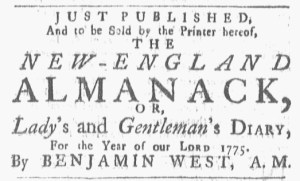
“The NEW-ENGLAND ALMANACK … By BENJAMIN WEST.”

The December 17, 1774, edition of the Providence Gazette carried nearly two dozen advertisements, including one by the printer, John Carter, for “THE NEW-ENGLAND ALMANACK, OR, Lady’s and Gentleman’s DIARY, For the Year of our LORD 1775. By BENJAMIN WEST.”  For a decade, West and the printers of the Providence Gazette had been collaborating on that annual publication, even as proprietorship of the newspaper and the printing office changed hands.  The Adverts 250 Project has documented that partnership, covering West’s almanac perhaps more extensively than any other almanac advertised in early American newspapers.

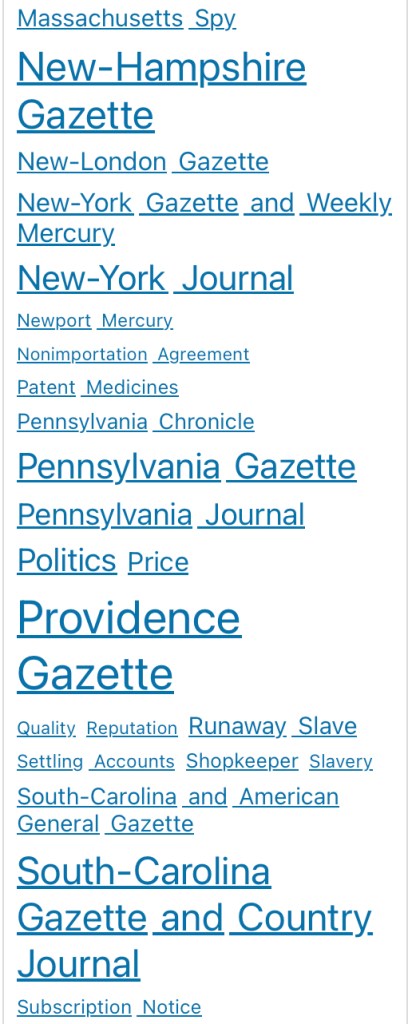
Some of the “most used” tags for the Adverts 250 Project.

That is a result, in part, of the project’s methodology that calls for examining an advertisement published 250 years ago that day.  Accordingly, I select advertisements from approximately two dozen newspapers that have been digitized and made more widely accessible, yet publication of those newspapers did not occur evenly throughout the week.  Throughout most of the nine years that I have produced the Adverts 250 Project, the Providence Gazette was the only newspaper published in Saturdays.  As a result, that newspaper has been disproportionately featured in the project … and the methodology has encouraged me to have a closer look at the annual publication of West’s New-England Almanack than most other almanacs.

The word cloud generated for the “most used tags” by WordPress reflects this.  “Providence Gazette” appears in a larger font and thicker bold than any other newspaper or other tag, even though it was not the most significant newspaper published in the colonies, neither for news coverage nor for advertising innovation.  Similarly, advertisements from the New-Hampshire Gazette have also been featured regularly due to the methodology because for quite some time that was only newspaper published on Fridays that had been digitized.  While the Providence Gazetteand the New-Hampshire Gazette might not be considered as significant as certain other newspapers published during the era of the American Revolution, this project’s methodology has caused me to approach the contents of those newspapers with greater attention and creativity.

These are the newspapers published 250 years ago this week that have been digitized for greater access:

Monday

  • Boston Evening-Post
  • Boston-Gazette
  • Connecticut Courant (Hartford)
  • Dunlap’s Pennsylvania Packet (Philadelphia)
  • Maryland Journal (Baltimore)
  • Massachusetts Gazette and Boston Post-Boy
  • Newport Mercury
  • New-York Gazette and Weekly Mercury
  • South-Carolina Gazette

Tuesday

  • Essex Gazette (Salem)
  • South-Carolina Gazette and Country Journal (Charleston)

Wednesday

  • Essex Journal (Newburyport)
  • Pennsylvania Gazette (Philadelphia)
  • Pennsylvania Journal (Philadelphia)

Thursday

  • Maryland Gazette (Annapolis)
  • Massachusetts Gazette and Boston Weekly News-Letter
  • Massachusetts Spy
  • New-York Journal
  • Norwich Packet
  • Rivington’s New-York Gazetteer
  • Virginia Gazette [Pinkney] (Williamsburg)
  • Virginia Gazette [Purdie and Dixon] (Williamsburg)

Friday

  • Connecticut Gazette (New London)
  • Connecticut Journal (New Haven)
  • New-Hampshire Gazette (Portsmouth)
  • South-Carolina and American General Gazette (Charleston)

Saturday

  • Providence Gazette

September 25

What was advertised in a colonial American newspaper 250 years ago today?

Postscript to the Maryland Journal (September 25, 1773).

“At the Sign of the CUP and CROWN … in BALTIMORE.”

William Goddard quickly gained advertisers for the Maryland Journal and Baltimore Advertiser, the city’s first newspaper, when he commenced publication in August 1773.  So many advertisers submitted notices to the printing office that a two-page supplement accompanied the sixth issue.  That Postscript contained advertising exclusively.  In addition, paid notices filled the entire final page of the standard four-page edition, along with a couple advertisements below the prices current on the third page.  A lengthy list of winning tickets and prizes from the Frederick Street Lottery, likely also a paid advertisement, occupied the first page.  Christopher Hughes and Company, “GOLDSMITHS and JEWELLERS, At the Sign of the CUP and CROWN,” joined many others in using the new publication to market goods and services or disseminate information that did not appear among the articles and editorials selected by the editor.

The publication of the Maryland Journal, published on Saturdays, shifts the contours of the Adverts 250 Project.  The project currently incorporates approximately two dozen newspapers published in 1773 and subsequently digitized to make them more accessible.  Of those many newspapers, however, only the Providence Gazette was published on Saturdays.  Once a week, that made the Providence Gazette the only option for selecting an advertisement to feature on the Adverts 250 Project.  That allowed for examining that newspaper, as well as the city and the region it served, in greater depth, but it also resulted in disproportionate representation of the Providence Gazette, one out of seven entries on the Adverts 250 Project, relative to the total number of digitized newspapers currently available.  On occasion, this also significantly narrowed the choices in issues with few advertisements or with many advertisements previously featured on the Adverts 250 Project as a result of running for several weeks.

Goddard published the Maryland Journal on Saturdays for less than a year.  That means that my opportunity to consult both the Maryland Journal and the Providence Gazette when selecting which advertisement to feature will be temporary, but I plan to make good use of that opportunity while it lasts.  In addition, America’s Historical Newspapers provides access to the Maryland Journal into the 1790s, which means that the newspaper will continue to be part of the Adverts 250 Project and the Slavery Adverts 250 Project long “after” publication shifts to other days of the week.

January 1

What was advertised in a colonial American newspaper 250 years ago this week?

Pennsylvania Packet (December 30, 1771).

“JOHN CARNAN … AT THE GOLDEN LION.”

In its exploration of advertising and daily life in colonial America, the Adverts 250 Project features an advertisement originally published in an American newspaper 250 years ago that day … on most days.  It is not always possible, however, to select an advertisement from the exact date.  Two factors play significant roles.  First, no printers produced newspapers on Sundays, which means that once a week the Adverts 250 Project instead features an advertisement published sometime during the previous week 250 years ago.

Second, most newspapers were weekly publications.  Even though printers staggered the dates they distributed new issues (with clusters on Mondays and Thursdays), at least one newspaper appeared somewhere in the colonies every day of the week (Sundays excepted) throughout most of the late 1760s and early 1770s, the period covered by the Adverts 250 Project.  (I say most of the late 1760s and early 1770s because several newspapers ceased publication while the Stamp Act was in effect in late 1765 and early 1766.  As a result, fewer newspapers appeared on fewer days of the week for several months.)  Even though printers published and disseminated newspapers every day except Sundays, copies of those newspapers have not necessarily survived in research libraries, historical societies, and other collections.  Those still extant have not all been digitized, making them difficult to access for inclusion in the Adverts 250 Project.

January 1, 1772, is one of those days without any digitized newspapers to consider.  The first day of 1772 fell on a Wednesday, a day that printers did indeed publish newspapers.  Yet no newspapers for January 1, 1772, are available in any of the several databases that I consult in producing the Adverts 250 Project.  James Johnston printed the Georgia Gazette on Wednesdays, but that newspaper has not been part of the Adverts 250 Project since May 23, 2020, because the May 23, 1770, edition was the last one digitized.  According to Edward Connery Lathem’s Chronological Tables of American Newspapers, 1690-1820, no copies of the Georgia Gazette are extant from 1771 and very few have survived from 1772 and 1773.  Complete or extensive coverage exists for 1774 and 1775, but no copies published after 1770 have been digitized.

Johnston likely published a new edition of the Georgia Gazette on January 1, 1772.  It likely included at least a page of advertisements, including multiple notices about enslaved people for sale and others offering rewards for the capture and return of those who liberated themselves from their enslavers.  Yet no copy is available for examination and inclusion in the Adverts 250 Project, a reminder of one of the many factors that makes the curation of this project incomplete despite efforts to be as extensive as possible.  In addition, the Slavery Adverts 250 Project does not include every advertisement about enslaved people originally published in American newspapers 250 years ago, only those in newspapers that have been digitized.  Such advertisements were even more ubiquitous than the Slavery Adverts 250 Project demonstrates.

All of this means that the Adverts 250 Project does not begin 2022 with an advertisement from 1772.  Instead, I have selected an advertisement that ran in the Pennsylvania Packet on December 30, 1771.  Regular visitors to the Adverts 250 Project will recognize John Carnan’s notice with its distinctive woodcut depicting a golden lion, an image that has appeared on the project’s homepage since its inception.  I previously examined another advertisement placed by Carnan, that one in the Pennsylvania Gazette on August 1, 1771, the first time he included the image in one of his notices.  Tomorrow the Adverts 250 Project will feature its first advertisement from 1772, one selected by a student in my Revolutionary America class in Fall 2021.  We’ll get 1772 and 2022 started with an advertisement seeking a “Journeyman COMPOSITER” that Isaiah Thomas inserted in his own newspaper, the Massachusetts Spy.

September 29

What was advertised in a colonial American newspaper 250 years ago today?

Massachusetts Spy (September 29, 1770).

“LISBON LEMONS … to be sold at the Sign of the Basket of Lemons.”

The selection of advertisements for the Adverts 250 Project is contingent on which newspapers were published on a particular day 250 years ago.  On some days that means far more advertisements to choose among than others.  Consider the publication schedule of most newspapers in the fall of 1770.  Most newspapers were weeklies; printers distributed a new issue once a week.  For instance, John Carter published the Providence Gazette on Saturdays in 1770.  (The corresponding dates fall on Tuesdays in 2020.)  Isaiah Thomas’s Massachusetts Spy, published three times a week on Tuesdays, Thursdays, and Saturdays, was the one exception.

Some days were more popular than others.  Most printers chose Mondays or Thursdays to distribute new issues, though at least one newspaper was published somewhere in the colonies on every day of the week except Sundays.  Mondays saw the publication and distribution of the Boston Evening-Post, the Boston-Gazette, the Massachusetts Gazette and Boston Post-Boy, the Newport Mercury, the New-York Gazette and Weekly Mercury, and the New-York Gazette or Weekly Post-Boy.  A similar number of newspapers were published in Annapolis, Boston, New York, Philadelphia, and Williamsburg on Thursdays.  An array of advertising appeared in those newspapers, sometimes overflowing the standard issues into supplements distributed simultaneously.

In contrast, the Massachusetts Spy and the Providence Gazette were the only newspapers printed on Tuesdays.  The Providence Gazette featured a moderate amount of advertising in 1770, but the Massachusetts Spy was a new publication, founded a few months earlier, and Thomas had not yet cultivated a clientele of advertisers for his new enterprise.  An advertisement for “LISBON LEMONS … to be sold at the Sign of the Basket of Lemons” in the September 29 edition was the first paid notice to appear in the Massachusetts Spy over the course of many issues.

In combination with the uneven distribution of newspaper publication throughout the week in 1770, that scarcity of advertisements in some newspapers and abundance in others shapes the Adverts 250 Project.  Some newspapers and towns perhaps receive too much attention and others not enough.  Recall, however, that printers did not published newspapers on Sundays.  This allows for a correction.  On days in 2020 that with no “new” newspapers from the corresponding days in 1770, the Adverts 250 Project features advertisements from any time during the previous week.  Strictly adhering to an “On This Day” format has consequences for which advertisements become part of the project, but a slight revision to the methodology in recognition of printing practices in the 1770s allows for a more representative sampling of advertisements, newspapers, and places of publication.

June 27

What was advertised in a colonial American newspaper 250 years ago this week?

Jun 27 - 6:26:1770 South-Carolina Gazette and Country Journal
South-Carolina Gazette and Country Journal (June 26, 1770).

“RUN AWAY … a NEGRO fellow, named July.”

No newspaper advertisements concerning enslaved people appear via the Slavery Adverts 250 Project today, but that does not mean that no such advertisements were published in the American colonies on June 27, 1770.  The absence of these advertisements is a consequence of the Georgia Gazette no longer being part of the Slavery Adverts 250 Project as of May 23.  James Johnston continued publishing the Georgia Gazette into 1776, but many editions have been lost over time.  Any surviving copies published after May 23, 1770, have not been digitized, making them less accessible to scholars and others who wish to consult them.  Of the newspapers published in 1770 that have been digitized, the Georgia Gazette was the only publication regularly distributed on Wednesdays (with dates that correspond to Saturdays in 2020), though printers in Charleston occasionally published newspapers on Wednesdays.  As a result, the Slavery Adverts 250 Projectnow inadvertently gives the impression that no advertisements concerning enslaved people circulated in colonial America on Wednesdays in 1770 even though the Georgia Gazette usually included at least half a dozen such advertisements and often significantly more.

Unfortunately, the absence of these advertisements further obscures the stories that they tell about the experiences of enslaved people in the era of the imperial crisis that resulted in the American Revolution.  Today’s featured advertisement about an enslaved man who liberated himself, a man known to his enslavers as July, comes from the June 26, 1770, edition of the South-Carolina Gazette and Country Journal.  Filtered through the perspective of July’s enslaver, the advertisement tells a truncated story of Black agency and resistance similar to the stories told in advertisements that likely appeared in the Georgia Gazette on the following day.  Other advertisements in that missing issue likely told other kinds of stories, some of enslaved people for sale as individuals or in groups or “parcels” and others of enslaved people who attempted to liberate themselves but were captured and imprisoned until those who asserted mastery over them claimed them.  Advertisements that ran in other newspapers tell similar stories as those from the missing issues of the Georgia Gazette.

Relying on those proxies, however, does not as effectively reveal the number and frequency of advertisements concerning enslaved people that circulated in early American newspapers.  The Slavery Adverts 250 Project seeks not only to tell representative stories of enslaved people but also to demonstrate the magnitude of newspaper advertising as a means of perpetuating slavery in early America by identifying and republishing as many advertisements as possible, making the evidence impossible to ignore.  Like any examination of the past, work on the Slavery Adverts 250 Project is sometimes constrained by which sources have survived and are accessible and which have not survived or are not accessible. Despite its endeavor toward comprehensiveness, the Slavery Adverts 250 Project is not presenting newspaper advertisements originally published on June 27, 1770; that does not mean that advertisements concerning enslaved people did not circulate in the American colonies on that day, only that the sources are not known to exist at this time.

April 29

What was advertised in a colonial American newspaper 250 years ago this week?

Apr 29 - 4:26:1770 Virginia Gazette Rind Supplement
Supplement to the Virginia Gazette [Rind] (April 26, 1770).
“MAKES and SELLS the best mould CANDLES.”

“WILL repair all sorts of CLOCKS and WATCHES.”

Once a week the Adverts 250 Project examines an advertisement originally published 250 years ago that week rather than 250 years ago that day.  This is the result of the publication schedule of newspapers in colonial America.  Printers published newspapers every day of the week except for Sunday, quite a difference from practices that developed in the twentieth century and still continue.  Nowadays the Sunday edition is in many ways the most significant and usually the largest.  It contains items and sections not issued throughout the rest of the week.  It is a commodity associated with leisure, an edition that consumers take the time to savor.  Readers luxuriate in its very size and variety of contents.

That differs so greatly from colonial newspapers.  In 1770, the year currently under examination by the Adverts 250 Project, most were published only once a week.  The Boston Chronicle was one of only a few that experimented with twice weekly publication by that time.  Each issue usually consisted of only four pages, inclusive of all new items, editorials, advertisements, and other contents.  A single broadsheet comprised the standard four-page edition, two pages printed on each side and then folded in half.  Printers sometimes issued supplements, additions, and extraordinaries when the contents overflowed the standard issue, bringing the total length to six or eight pages, but rarely more than that.  Often the supplements consisted entirely of advertising.

Most printers published their newspapers on Mondays or Thursdays.  Smaller cohorts published on Tuesdays, Wednesdays, and Fridays.  Only the Providence Gazette distributed new issues on Saturdays, such timing likely chosen to allow the printer to receive newspapers printed in Boston earlier in the week in time to extract items for republication.

These practices allowed for advertisements to come off colonial presses and appear in the public prints every day of the week except Sundays.  Although this prevents the Adverts 250 Project from examining advertisements published 250 years ago to the day once a week, it presents an opportunity to feature advertisements that otherwise would not have been included in the project by revisiting newspapers published on Mondays and Thursdays.  Those newspapers included publications from the largest port cities, publications that tended to distribute the greatest number of advertisements.  Due to the volume of advertising disseminated in those newspapers, they merit a second look.  The absence of newspapers published on Sundays in the colonial era differs greatly from modern practices and disrupts the methodology of the Adverts 250 Project, but it also allows a second chance for examining advertisements that the methodology otherwise would have excluded.

January 11

What was advertised in a colonial American newspaper 250 years ago today?

Jan 11 1770 - 1:11:1770 Maryland Gazette
Maryland Gazette (January 11, 1770).

“THE MARYLAND ALMANACK, FOR THE YEAR 1770.”

The Adverts 250 Project and the Slavery Adverts 250 Project draw their contents from several databases of eighteenth-century newspapers that have been digitized to make them more accessible to the scholars and the general public. Readex has made most of the newspapers included in the projects available through its America’s Historical Newspapers collection. Although extensive, that collection is not comprehensive. For the period investigated in the projects so far, 1766-1770, America’s Historical Newspapers provides broad coverage of New England, the Middle Atlantic, and Georgia. That collection has complete or nearly complete runs of newspapers printed in those places. However, it includes only occasional issues of newspapers from the Chesapeake and the Lower South.

Fortunately, digitized copies of eighteenth-century newspapers from those regions are available via other databases. Accessible Archives has two collections relevant to the Adverts 250 Project and the Slavery Adverts 250 Project: South Carolina Newspapers and The Virginia Gazette. The projects regularly draw from issues of the South-Carolina Gazette, the South-Carolina Gazette and Country Journal, and the South-Carolina and American General Gazette, all published in Charleston during the late 1760s and early 1770s. Rather than consult the various publications all known as the Virginia Gazette, including Alexander Purdie and John Dixon’s Virginia Gazette and William Rind’s Virginia Gazette, via Accessible Archives, the projects instead rely on the digitized copies made available by Colonial Williamsburg via its Digital Library. Scholars and the general public can both access Colonial Williamsburg’s Digital Library free of charge, compared to the individual or institutional subscriptions required to examine the newspapers digitized by Readex and Accessible Archives. This means that the Adverts 250 Project and the Slavery Adverts 250 Project can provide links to the source material so readers can view advertisements in the larger context of an entire page or an entire issue.

Today’s featured advertisement comes for “THE MARYLAND ALMANACK, FOR THE YEAR 1770” comes from the Maryland Gazette, drawn from the Archives of Maryland Online series created and maintained by the Maryland State Archives. That series “currently provides access to over 471,00 historical documents that form the constitutional, legal, legislative, judicial, and administrative basis of Maryland’s government.” Those documents include the Maryland Gazette Collection, incorporating several newspapers of that name published between 1728 and 1839. Like Colonial Williamsburg’s Digital Library, scholars and the general public can access Archives of Maryland Online for free. The Maryland Gazette Collection is new to the Adverts 250 Project and the Slavery Adverts 250 Project, expanding the coverage of both of the projects and providing a more complete portrait of the role of the press, especially advertising, in promoting consumer culture and perpetuating slavery in eighteenth-century America.

I am excited to add the Maryland Gazette to the Adverts 250 Project and the Slavery Adverts 250 Project. This will benefit readers and followers, but it will also benefit the undergraduates at Assumption College who work on these projects as part of the requirements for my upper-level History courses. Each database of digitized eighteenth-century newspapers has a different interface. As students learn how to navigate each of them, they enhance their information literacy skills … and sometimes their problem solving skills as well. Sometimes errors get introduced when creating online repositories. Other times the databases replicate errors made in classifying and cataloging at a library or archive. These minor issues are usually easily resolved, but they allow undergraduates working with digitized primary sources for the first time important opportunities to play detective and, in the process, achieve a better understanding of both historical sources and research methods.

In short, adding the Maryland Gazette Collection to the Adverts 250 Project and the Slavery Adverts 250 Project will enhance both my research and my teaching by adding newspapers from another colony and resources from another database of digitized primary sources.

January 2

What was advertised in a colonial American newspaper 250 years ago today?

Jan 2 1770 - 1:2:1770 South-Carolina Gazette and Country Journal
South-Carolina Gazette and Country Journal (January 2, 1770).

“NEW ADVERTISEMENTS.”

It has been more than a year since any “NEW ADVERTISEMENTS” from Charles Crouch’s South-Carolina Gazette and Country Journal have been featured on the Adverts 250 Project. Why? The project relies on eighteenth-century newspapers that have been digitized and made available via Accessible Archives’s collection of South Carolina Newspapers, Colonial Williamsburg’s Digital Library, and Readex’s America’s Historical Newspapers. These sources provide extensive access to newspapers published in the colonies in the late 1760s and early 1770s, but they are not comprehensive and complete.

Consider the newspapers printed in Charleston, South Carolina, on the eve of the American Revolution. For nearly a decade before the outbreak of military hostilities, three newspapers circulated in that busy urban port. In addition to Crouch’s South-Carolina Gazette and Country Journal, Peter Timothy published the South-Carolina Gazette and Robert Wells published the South-Carolina and American General Gazette.

Today, all three are available, to varying degrees, via Accessible Archives. That database includes transcriptions of those newspapers as well as digitized images of most issues. However, it does not include such images of issues of the South-Carolina Gazette and Country Journal published in 1769. The transcriptions for that year are certainly valuable, giving scholars and others greater access to the past, but that form of remediation and the methods for navigating that kind of database do not lend themselves well to the Adverts 250 Project. As a result, the South-Carolina Gazette and Country Journal temporarily dropped from both the Adverts 250 Project and, even more significantly, the Slavery Adverts 250 Project. The projects both had good coverage, but not complete coverage, of South Carolina, incorporating two of the three newspapers published in the colony in 1769.

In 2020, the South-Carolina Gazette and Country Journal returns to those projects. The Slavery Adverts 250 Project identifies fourteen advertisements concerning enslaved men, women, and children published in the January 2, 1770, edition of the South-Carolina Gazette and Country Journal. The Adverts 250 Project will examine advertisements for consumer goods and services as well as other kinds of paid notices in the coming months. For the past year, the project has relied on the Essex Gazette, the only newspaper published on Tuesdays in 1769 (with dates that correspond to Thursdays in 2019) available via these databases. As a result, that newspaper has been disproportionately featured in the project.

Having access once again to digitized images of the South-Carolina Gazette and Country Journal will shift the scope of the Adverts 250 Project and the Slavery Adverts 250 Project. This will clearly benefit the Slavery Adverts 250 Project by generating a more complete archive that demonstrates the ubiquity of advertisements concerning enslaved men, women, and children in early America. This also has the potential to benefit the Adverts 250 Project by reducing coverage of the Essex Gazette. On the other hand, having no choice but to feature advertisements from that newspaper guaranteed that a less prominent publication from a smaller town regularly found its ways into the Adverts 250 Project. That is a goal that must continue to be observed, even while featuring the Essex Gazette less often thanks to restored access to the South-Carolina Gazette and Country Journal.

July 7

What was advertised in a colonial American newspaper 250 years ago today?

Jul 7 - 7:7:1769 Connecticut Journal
Connecticut Journal (July 7, 1769).

“Hugh Glassford … now carries on his Business, at Glen and Gregory’s.”

Moving to a new location prompted Hugh Glassford, a leather breeches and glove maker in New Haven, to place an advertisement in the Connecticut Journal in the summer of 1769. Glassford stated that he resided with Mr. Beers for the past year, but he “now carries on his Business, at Glen and Gregory’s.” He reported that he served customers “much to their Satisfaction” at his former location, suggesting that he would offer the same quality of service at his new location. It does not appear that Glassford inserted an advertisement in the local newspaper when he first arrived in New Haven. He likely engaged customers via word of mouth. After building a clientele for his leather breeches and gloves and cultivating a reputation in the town and beyond, however, he likely considered an advertisement worth the investment. Advising the public of his new location would help Glassford retain current customers as well as encourage new ones to seek out his services.

To quickly discover if Glassford had previously advertised, I did a keyword for his last name in all 2752 issues of the Connecticut Journal, spanning dates from October 23, 1767 to December 26, 1820, available in America’s Historical Newspapers database. That search yielded zero results, but that did not surprise me since I had searched for the breeches and glove maker’s name as I read it – Glassford – rather than as optical character recognition software would interpret it – Glafsford. As a person with experience working with eighteenth-century newspapers, I possess knowledge and creativity that the software lacks. I easily recognize the long s commonly used in the eighteenth century and effortlessly translate “Glafsford” into “Glassford.” The database’s OCR does not.

Armed with that knowledge, I did a second keyword search, this time for “Glafsford.” It yielded five results, all of them for the advertisement Glassford ran in the summer of 1769. According to the keyword search, his notice appeared five times: June 30, July 7, 14, and 28, and August 25. In order to produce these results, I had to adopt a methodology that tricked the software into doing what I needed. This is a valuable lesson that I pass along to students when we work with primary sources. Beyond our usual manner of thinking, we also have to think like people from the era we are investigating and think like the tools we deploy in doing our work. For the latter, sometimes that means thinking about how a cataloger might have organized a collection of documents, but other times it means thinking about the shortcomings of optical character recognition.