May 27

What was advertised in a revolutionary American newspaper 250 years ago today?
A New Hampshire Gazette (May 27, 1776).

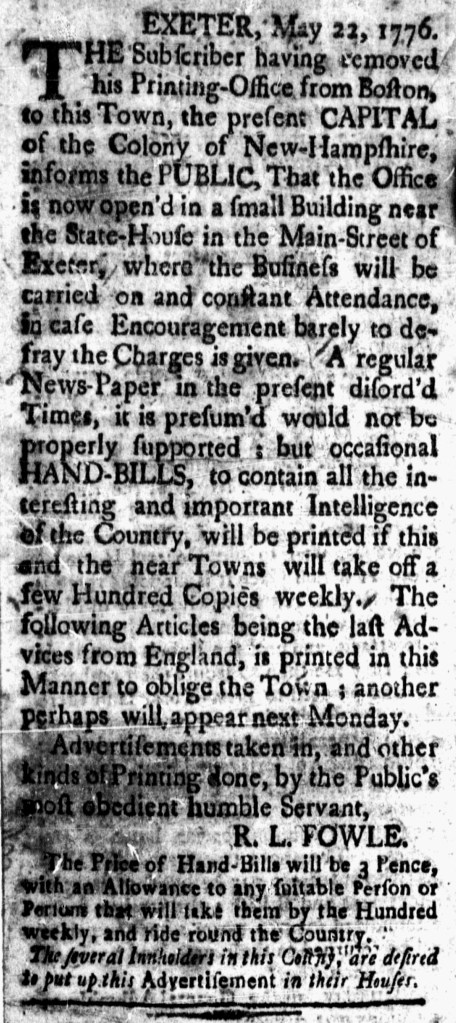
“Occasional HAND-BILLS, to contain all the interesting and important Intelligence of the Country.”

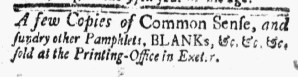
A broadsheet bearing the title A New-Hampshire Gazette carried only two advertisements.  A notice from Robert L. Fowle, the printer filled half of the first column on the first page.  A brief advertisement, only three lines, completed the final column on the other side of the sheet.  It announced, “A few Copies of Common Sense, and sundry other Pamphlets, BLANKS, &c. &.c &c. sold at the Printing-Office in Exeter.”
A New Hampshire Gazette (May 27, 1776).

The notice, dated at “Exeter, May 22, 1776,” informed the public that Fowle “removed his Printing-Office from Boston, to this Town, the present CAPITAL of the Colony of New-Hampshire.”  He solicited job printing and advertisements, though he may have meant broadsides and handbills rather than newspaper notices since he had concerns about the prospects of establishing a “regular News-Paper in the present disord’d Times” because “it is presum’d [it] would not be properly supported.”  Instead, he proposed printing and distributing “occasional HAND-BILLS, to contain all the interesting and important Intelligence of the Country” if “this and the near Towns will take off a few Hundred Copies weekly.”  Fowle planned to charge three pence for each handbill-newspaper “with an Allowance” or appropriate discount for “any suitable Person or Persons that will take them by the Hundred weekly, and ride round the Country.”  In addition, he requested that the “Innholders in this Colony … put up this Advertisement in their Houses” to help publicize the proposed handbill-newspapers.

Fowle indicated that the “following Articles [were] the last Advices from England” and another of the “occasional HAND-BILLS” “perhaps will appear next Monday.”  In his monumental History and Bibliography of American Newspapers, 1690-1820, Clarence S. Brigham states that Fowle established his New-Hampshire Gazette with a prospectus in the form of a handbill on May 22, 1776, with another handbill “promised for May 27, although no copy has been located.”  The first regular issue of the New-Hampshire Gazette, or, the Exeter Morning Chronicle, Brigham continues, appeared on June 1, “was numbered vol. 1, no. 3, and referred to the two ‘Hand-Bills’ previously published.”  That issue and most subsequent ones were “single sheets and without the name of the publisher in the imprint.”[1]

I believe that Brigham misidentifies the handbill-newspaper in the collections of the collections of the American Antiquarian Society as the first of the handbills rather than the second.  The date on Fowle’s notice, May 22, appeared immediately below the masthead, but that entire notice likely had been reprinted without revision from the first handbill-newspaper.  The “Fresh Advices” that followed on the first page relayed news from Philadelphia, New York, and Boston, not “the last Advices from England.”  The news on the other side of the sheet had “EXETER, May 27th, 1776,” for the dateline, though some of that content relayed “Advices by Friday’s Post from Boston.”  With news dated May 27, this handbill could not have been printed on May 22.  In addition, May 27 was a Monday, the day that Fowle indicated “another [handbill-newspaper] perhaps will appear.”  All this evidence suggests that no copy of the first handbill-newspaper has been located.  The known copy should be properly dated as May 27, 1776.

**********

[1] Clarence S. Brigham, History and Bibliography of American Newspapers, 1690-1820 (Worcester: American Antiquarian Society, 1947), 454.

January 5

Who was the subject of an advertisement in a colonial American newspaper 250 years ago today?

Supplement to the South-Carolina Gazette and Country Journal (January 5, 1775).

“Several valuable NEGROES.”

The first week of 1775 was a busy one in Charles Crouch’s printing office “on the Bay, the Corner of Elliott-street” in Charleston.  Crouch published the South-Carolina Gazette and Country Journal on Tuesday, January 3, distributing it to subscribers on the usual day.  The standard four-page issue, however, could not contain all the content that Crouch received for that edition.  Accordingly, he released a two-page supplement, composed entirely of advertisements, on the same day.  Yet Crouch’s press was not finished with the “freshest Advices, both Foreign and Domestic,” for the week.  Two days later, a two-page Supplement to the South-Carolina Gazette and Country Journal carried both news and advertising.  It featured updates from Boston, New York, and Philadelphia, as well as local news.  Advertising appeared on both sides of the broadsheet, accounting for just under half of the content.  Many of those advertisements ran in the standard edition or its supplement just two days earlier.  Thanks to the news that Crouch determined to publish immediately rather than wait nearly a week for the next issue, all the advertisements in the January 5 supplement circulated sooner than anticipated.

Initially, I did not notice that Crouch published the second supplement on January 5 rather than January 3.  Both supplements have been cataloged with the standard edition for that week in the database of digitized eighteenth-century newspapers I consult for this project.  It seemed strange to have two two-page supplements rather than one four-page supplement on a single day.  Although uncommon, that arrangement was not unknown, especially when a printer received breaking news after the supplement went to press.  When I downloaded the standard issue and the supplements, I was in enough of a hurry to move on to other tasks that I did not look closely enough at the mastheads to spot “THURSDAY, JANUARY 5” instead of “TUESDAY, JANUARY 3” on the second supplement.  I noticed only later when I worked more intensively with the advertisements, questioning why John Grafton’s advertisement ran twice on the same day.  On closer inspection, I discovered that it made its second appearance in the January 5 supplement.  I could have been frustrated that the database did not include a separate entry for the January 5 supplement, but I recognized that I had overlooked the date in the masthead more than once when working with the file I downloaded.  My own lack of attention to detail had almost led me into attributing incorrect dates to notices compiled for the Slavery Adverts 250 Project (including the advertisement featured above).  This incident served as a good reminder to work carefully with primary sources, including digitized primary sources, because minor errors do happen no matter how carefully and conscientiously catalogers, archivists, librarians, historians, and others go about the work of making documents more widely accessible.

October 16

What was advertised in a colonial American newspaper 250 years ago today?

Oct 16 - 10:16:1768 South-Carolina Gazette
South-Carolina Gazette (October 17, 1768, but misdated October 16, 1768).

“A FRESH ASSORTMENT of GOODS, proper for the present and approaching season.”

At a glance, Paul Townsend’s advertisement for a “FRESH ASSORTMENT of GOODS, proper for the present and approaching season” would seem to have been published on October 16, 1768. After all, it appeared on the front page of the October 16, 1768, edition of the South-Carolina Gazette. Most modern readers would not think twice about that date when examining a single issue of the South-Carolina Gazette, but anyone perusing several consecutive issues would notice a discrepancy.

Like other newspapers of the colonial era, the South-Carolina Gazette was published only once a week, with the exception of occasional supplements and extraordinaries. According to the dates embedded in the masthead of the issues from October 1768, Peter Timothy distributed new editions on October 3, 10, 16, 24, and 31. The issue from October 16 deviates from the seven-day interval that usually fell between issues, suggesting something out of the ordinary with that issue.

It was possible that Timothy could have released an issue a day early. Others printers did so on rare occasions. However, the South-Carolina Gazette was regularly published on Mondays. Colonial printers did not circulate new issues on Sundays. Indeed, Sunday was the only day of the week that did not see the publication of at least one newspaper somewhere in colonial America. Most printers published their newspapers on Mondays and Thursdays, but a few also published on Tuesdays, Wednesdays, Fridays, and Saturdays. It would have been extremely exceptional for Timothy to publish the South-Carolina Gazette on a Sunday. Nothing in the issue under consideration merited doing so.

Indeed, the masthead reads “MONDAY, OCTOBER 16, 1768.” A summary of local news from “CHARLES-TOWN” on the third page, however, bears that date “October 17.” All of this evidence makes it clear that the compositor made a mistake when updating the issue number and date of what should have been the October 17 edition of the South-Carolina Gazette.

This minor discrepancy may not seem to matter much in telling the story of the American experience during the period of the imperial crisis that ultimately became the American Revolution. It does, however, provide a stark example for demonstrating to students the importance of noticing the details and identifying patterns among the sources they examine. If the date on the issue had been accurate, if it had been published on October 16, the contents would have demanded even greater scrutiny to determine what the printer considered so momentous to deem publication on a Sunday imperative. The details led to a false alarm in this instance, but in other cases noticing such deviations from the printing practices of the era can lead readers to coverage of significant events. For instance, the New-Hampshire Gazette, usually published on Fridays, appeared a day early on Thursday, May 22, 1766. Colonial newspapers rarely incorporated headlines. This one, however, announced “Total Repeal of the STAMP-ACT.” The printers rushed to press a day early to spread the breaking news about such a significant story.