January 14

What was advertised in a revolutionary American newspaper 250 years ago this week?
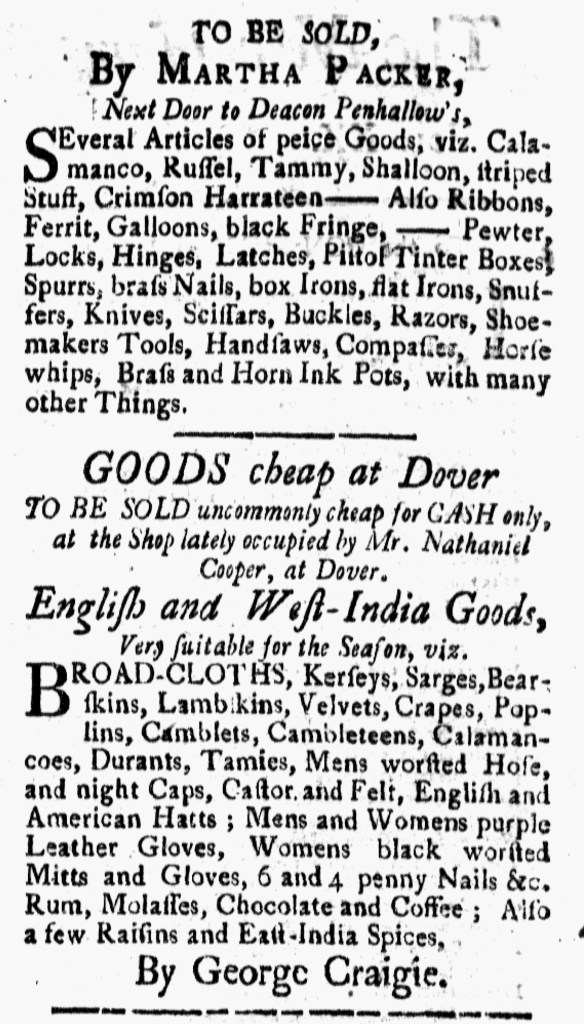
New-Hampshire Gazette (January 9, 1776).

English and West-India Goods, Very suitable for the Season.”

In January 1776, Martha Packer ran a shop “Next Door to Deacon Penhallow’s” in Portsmouth.  According to her advertisement in the January 9 edition of the New-Hampshire Gazette, she stocked several kinds of textiles, ribbons, hardware, horse whips, ink pots, and “many other things.”  Immediately below her notice, George Craigie promoted “GOODS cheap at Dover TO BE SOLD uncommonly cheap.”  His inventory of “English and West-India Goods” included textiles, hats, gloves, rum, molasses, chocolate, and coffee.  Both advertisements looked much like those that ran in the New-Hampshire Gazette and other colonial newspapers before the Revolutionary War began.

Although those advertisements looked like business as usual, that was far from the case for the New-Hampshire Gazette.  Daniel Fowle, the printer, experienced disruptions in his supply of paper and, for a brief period in the fall of 1775, moved the press to Greenland when rumors circulated about a possible British attack on Portsmouth.  The issue that carried Packer’s and Craigie’s advertisements was the last one published for more than two years.  Edward Connery Lathem gives a brief overview in his Chronological Tables of American Newspapers, 1690-1820, noting that the New-Hampshire Gazette was suspended on January 9, 1776, and resumed on June 16, 1778.[1]  In his History and Bibliography of American Newspapers, 1690-1820, Clarence S. Brigham offers a more complete overview.[2]  He states that the January 9, 1776, issue featured “a communication strongly attacking independency.”  In turn, on January 17, “the New Hampshire House of Representatives ‘Voted that Daniel Fowle Esqr the Supposed Printer of said Paper be forthwith Sent for and ordered to Appear before this house and give an account of the Author of said Piece, and further to answer for his Printing said piece.’”  Brigham does not, however, indicate that displeasure with that editorial caused the suspension.  For his part, Isaiah Thomas, a Patriot printer and contemporary of Fowle, thought that the New-Hampshire Gazette “was not remarkable in its political features; but its general complexion was favorable to the cause of the country” when he discussed the newspaper in his History of Printing in America in 1810.[3]  Neither Thomas nor Brigham reported why Fowle suspended the New-Hampshire Gazette.  It may have simply been the difficulty of continuing the newspaper during the war.  Whatever the reason, the New-Hampshire Gazette, which has sometimes been disproportionately represented in this project, will disappear from the Adverts 250 Project for a while, but it will not be long before the project features advertisements from other newspapers established in New-Hampshire during the war.  For instance, Benjamin Dearborn commenced publishing the Freeman’s Journal, or New-Hampshire Gazette in Portsmouth on May 25, 1776.

**********

[1] Edward Connery Lathem, Chronological Tables of American Newspapers, 1690-1802 (American Antiquarian Society and Barre Publishers, 1972), 11.

[2] Clarence S. Brigham, History and Bibliography of American Newspapers, 1690-1820 (American Antiquarian Society, 1947), 471-473.

[3] Isaiah Thomas, The History of Printing in America: With a Biography of Printers and an Account of Newspapers (1810; Weathervane Books, 1970), 335.

December 5

What was advertised in a revolutionary American newspaper 250 years ago today?

New-Hampshire Gazette (December 5, 1775).

“Shopkeepers are cautioned, not to advance on their Goods, which is contrary to the Resolves of the Continental Congress.”

The December 5, 1775, edition of the New-Hampshire Gazette consisted of only two pages rather than the usual four.  That limited the amount of news and advertising that the printer, Daniel Fowle, could disseminate to readers, yet that issue carried good news that the “Printing Press is now again removed from Greenland to Portsmouth.”  Fowle had moved his press to Greenland, about six miles from Portsmouth, to protect it from an anticipated British attack on New Hampshire’s most important port.  In early December, he moved his press back to Portsmouth, “into an old Building adjoining the late Printing-Office … where it is hop’d the Types will remain undisturb’d, as this Harbour is so well fortified that any Enemy must pass thro’ a Hell of Fire, intermix’d with Brimstone, Pitch Tar, Turpentine, and almost every Sort of Combustible Matter to make the Passage dreadful.”

Yet enemies to the American cause did not approach Portsmouth solely by sea.  Some enemies resided in the port and nearby towns, undermining efforts to resist British tyranny through their actions in the marketplace rather than on the battlefield.  At the bottom of the last column on the last page, Fowle concluded that issue of the New-Hampshire Gazettewith a warning published “By desire” of a correspondent that “Shopkeepers are cautioned, not to advance on their Goods, which is contrary to the Resolves of the Continental Congress.”  The correspondent invoked the ninth article of the Continental Association, a nonimportant agreement devised by the First Continental Congress that went into effect on December 1, 1774.  That article stated that “such as are Venders of Goods or Merchandise will not take Advantage of the Scarcity of Goods that may be occasioned by this Association, but will sell the same at the Rates we have been respectively accustomed to do for twelve months past.”  Some shopkeepers in and near Portsmouth apparently considered charging an “Advance” (or markup) on their wares, prompting the patriotic correspondent to remind them of the Continental Association and the consequences they faced.  That would be their only warning because “if they do [raise prices], their Names will be return’d to the Congress ad publish’d, without further Notice.”  Once that happened, the ninth article specified that “if any Venders of Goods or Merchandise shall sell any such Goods on higher Terms … no Person ought, nor will any of us deal with any such Person … at any Time thereafter, for any Commodity whatever.”  That issue carried only two advertisements from local retailers, yet the address applied to all the shopkeepers in the vicinity.

November 21

What was advertised in a revolutionary American newspaper 250 years ago today?

New-Hampshire Gazette (November 21, 1775).

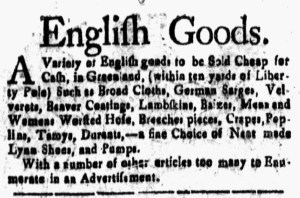
“English Goods … within ten yards of Liberty Pole.”

An anonymous advertiser hawked “A Variety of English goods” in the November 21, 1775, edition of the New-Hampshire Gazette.  The notice included a short list of imported items, mostly textiles, such as “Broad Cloths, … Velverets, … Poplins, Tamys, [and] Durants,” as well as “Mens and Womens Worsted Hose [and] Breeches pieces.”  That list apparently did not cover everything available for sale; the advertisement concluded with a note about “a number of other articles too many to Enumerate in an Advertisement.”

That may have been the advertiser’s choice since some merchants and shopkeepers did occasionally resort to similar language, though it may have been a decision influenced by the printer, Daniel Fowle.  That issue of the New-Hampshire Gazette consisted of only two pages instead of the usual four.  It was the first issue of the New-Hampshire Gazette since November 8.  The printer did not produce and circulate an issue the previous week.  The Adverts 250 Project has tracked apparent disruptions in the supply of paper that had an impact on the New-Hampshire Gazette, yet that was not the only difficulty the printer faced.  In the monumental History and Bibliography of American Newspapers, 1690-1820, Clarence S. Brigham notes that Fowle announced that he printed the November 2 edition “‘with great difficulty’ because of the threatened British attack on Portsmouth” and that the printer “stated that the press ‘is removed to Greenland, about six miles from Portsmouth.”[1]  Those circumstances may have played a role in the decision to publish an abbreviated advertisement that promised a greater selection of goods than appeared in print.

The advertisement presents other questions about consumer culture during the era of the American Revolution.  The Continental Association, a nonimportation and nonconsumption agreement devised by the First Continental Congress, was in effect, yet the unnamed advertiser boldly marketed imported goods.  The headline, “English Goods,” appeared in a larger font than anything else in that issue except for the title of the newspaper in the masthead.  The advertiser conveniently did not mention when the goods had arrived in the colonies, whether they had been transported and delivered before the boycott went into effect.  Yet the advertiser did acknowledge current events when giving the location to purchase the imported goods: “within ten yards of [the] Liberty Pole” in Greenland.  In his recent book on the consumption and politics of tea during the era of the American Revolution, James R. Fichter argues that many tea retailers did not face repercussions while tea importers certainly did.  He further contends that advertisements revealed the reality of local commerce compared to the propaganda that appeared in news articles and editorials about tea.[2]  Perhaps something similar occurred with these “English Goods” in Greenland in the late fall of 1775.

**********

[1] Clarence S. Brigham, History and Bibliography of American Newspapers, 1690-1820 (American Antiquarian Society, 1947), 471.

[2] James Fichter, “Truth in Advertising,” in Tea: Consumption, Politics, and Revolution, 1773-1776 (Cornell University Press, 2023), 132-157.

November 2

Who was the subject of an advertisement in a revolutionary American newspaper 250 years ago today?

New-Hampshire Gazette (November 2, 1775).

“’Tis likely he will change his Name, perhaps call himself Elisha Bartlet, as he has said that was … his right Name.”

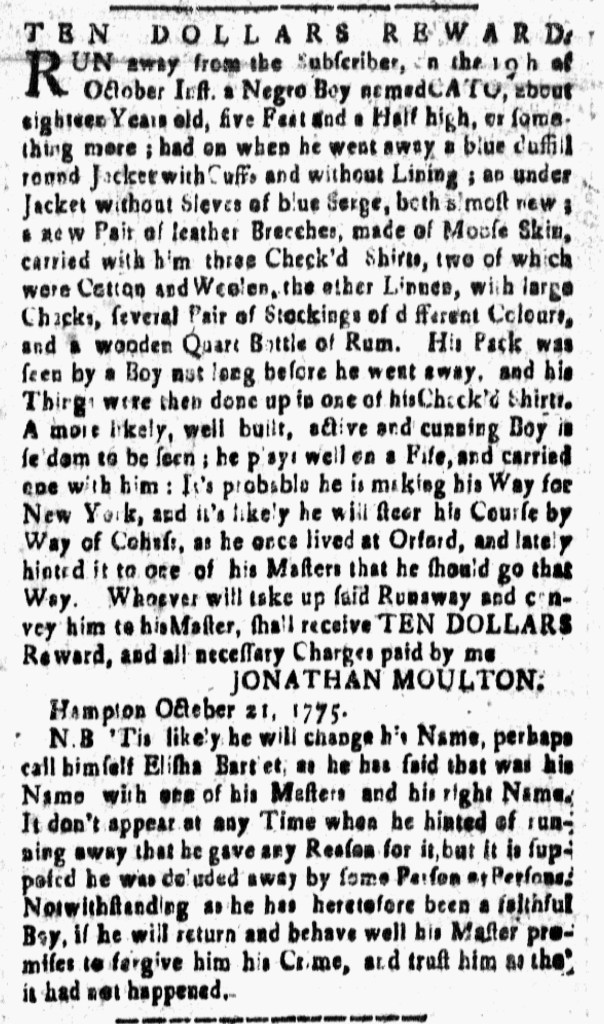
Even though the disruption in the paper supply once again meant that the New-Hampshire Gazette consisted of only two pages instead of the usual four, Daniel Fowle, the printer, found space to publish three advertisements about enslaved men who liberated themselves by running away from their enslavers in the November 2, 1775, edition.  They appeared one after the other in the final column on the first page.  All three men – Cato (also known as Elisha Bartlet), Peter Long, and Oliver – made their escape in October, perhaps taking advantage of the turmoil caused by the outbreak of hostilities at Lexington and Concord the previous spring and the ongoing siege of Boston.

Jonathan Moulton’s advertisement describing Bartlet was about three times the length of Marifield Berry’s advertisement about Peter Long and Gould French’s advertisement about Oliver.  Moulton reported on the clothes that Bartlet wore when he departed, noting that he “carried with him three Check’d Shirts [and] several Pair of Stockings of different Colours.”  Apparently, Bartlet had been spotted by a boy who observed that “his Things were then done up in one of Check’d Shirts” as a pack that he carried.  Moulton suspected that the man he called Cato would “change his Name, perhaps call himself Elisha Bartlet, as he has said that was his Name with one of his Masters and his right Name.” Although not his intention in placing the advertisement, Moulton revealed Bartlet’s commitment to self-determination in naming himself.  It did not matter to Bartlet what Moulton or any other enslaver called him at their own whim.  He considered Elisha Bartlet his true name, though Moulton did not share enough of the enslaved man’s story to explain why that was the case.

The enslaver did indicate that Bartlet had suggested on more than one occasion that he planned to escape.  He thought it “probable [Bartlet] is making his Way for New York,” having “lately hinted it to one of his Masters.”  In addition, Moulton stated, “It don’t appear at any Time when he hinted of running away that he gave any Reason for it.”  Given the circumstances, Moulton conjectured that Bartlet had been “deluded away by some Person or Persons.”  The enslaver seemingly did not entertain the notion that the man he insisted on calling Cato had the same aspirations for freedom that animated so much of the news and editorials about current events that ran alongside his advertisement in the New-Hampshire Gazette.  Instead, Moulton asserted that since Bartlet “has heretofore been a faithful Boy, if he will return and behave well his Master promises to forgive him his Crime, and trust him as tho’ it had not happened.”  Considering that Bartlet planned his escape from slavery for some time and chose an opportune moment to flee, he likely had little interest in any promises that his enslaver published in the public prints.

October 17

Who was the subject of an advertisement in a revolutionary American newspaper 250 years ago today?

New-Hampshire Gazette (October 17, 1775).

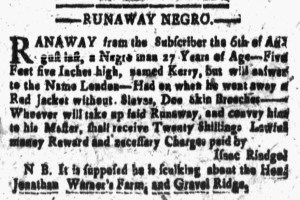
“RUNAWAY NEGRO … named Kerry, but will answer to the Name London.”

During the first year of the Revolutionary War, Daniel Fowle, the printer of the New-Hampshire Gazette, sometimes experienced disruptions to his paper supply that forced him to resort to broadsheets of alternate sizes.  His newspaper carried less content, both news and advertising, on such occasions.  That was the case on October 3, 1775, when he inserted an “Apology” that stated that “he could not procure any other” paper.  Compared to the usual three columns on each of four pages, that issue had only two columns on each of two pages.  Fowle did not include any advertisements.

The following week, Fowle managed to acquire broadsheets of the usual size, but apparently not enough of them for a four-page issue.  Instead, he published a half sheet edition that had three columns on each of two pages.  He found room for advertisements and even a poem, “On LIBERTY.”  On October 17, however, the New-Hampshire Gazette returned to the smaller sheet from two weeks earlier, but he had enough to publish four pages instead of two.  With twice as much space compared to the October 3 edition, he had room for five advertisements, including one by Mrs. Hooper, a milliner, and another for John Williams’s “House of Entertainment … at the Sign of the SALUTATION.”

Another advertisement featured a headline that proclaimed, “RUNAWAY NEGRO.”  Isaac Rindgel described a “Negro man 27 Years of Age … named Kerry, [who] will answer to the Name London.”  Kerry liberated himself by escaping from his enslaver on August 6.  For two and a half months he managed to elude capture, though Rindgel suspected that Kerry “is sculking about Hon. Jonathan Warner’s Farm, and Gravel Ridge.”  He did not indicate why he thought Kerry might be in that area.  Perhaps Kerry had a wife, a parent, a sibling, or a friend at Warner’s farm.  The advertisement, composed by an enslaver seeking to recover his human property, did not include the details about Kerry’s life and experiences that mattered most to the fugitive seeking freedom.  In addition to not explaining why Kerry may have been in the proximity of Warner’s farm, Rindgel did not speculate on why the enslaved man departed when he did.  Kerry was likely aware of the disruptions caused by the battles at Lexington and Concord in April, the ensuing siege of Boston, and the Battle of Bunker Hill in June.  The same events that affected Fowle’s access to paper created an opportunity for Kerry to liberate himself by running away.  It is impossible to know for certain that was the case since the newspaper advertisement reflected his enslaver’s perspective and included only the details Rindgel chose.  Kerry certainly would have told a different and more complete story had he been given the opportunity.

October 3

What was advertised in a revolutionary American newspaper 250 years ago today?

New-Hampshire Gazette (October 3, 1775).

“Brown Bread with Liberty, will please more, than white with Slavery.”

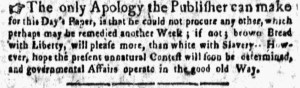
No advertisements appeared in the October 3, 1775, edition of the New-Hampshire Gazette, though the printer, Daniel Fowle, inserted a notice addressing why that was the case.  “The only Apology the Publisher can make for this Day’s Paper,” he stated, is that he could not procure any other.”  He referred to the size of the broadsheet.  The newspaper usually consisted of four pages with three columns on each page, but since hostilities commenced at Lexington and Concord Fowle’s paper supply had been disrupted.  Many issues consisted of only two pages, including the one from the previous week.  Despite having fewer pages, the masthead for the September 26 edition featured an additional note that proudly exclaimed, “This Paper compleats the 19th Year of the New-Hampshire GAZETTE, AND HISTORICAL CHRONICLE.”  The newspaper began its twentieth year with a two-page edition that had only two columns on each page.  Given the limited space, Fowle published news and excluded advertisements.

Fowle hoped that the problem “may be remedied another Week,” but “if not; brown Bread with Liberty, will please more, than white with Slavery.”  Like many other printers, he had been a consistent supporter of the American cause.  Even so, he added his “hope [that] the present unnatural Contest will soon be determine, and governmental Affairs operate in the good old Way.”  In the fall of 1775, most colonizers still sought a redress of grievances from Parliament.  Within a year, however, the Continental Congress would declare independence and the war that started at Lexington and Concord would not end until 1783.  Those “governmental Affairs” would never again “operate in the good old Way.”  Fowle did, however, manage to acquire paper for the next issue of the New-Hampshire Gazette.  The October 10 edition once again had advertisements, including one from Mrs. Hooper, a milliner, and another insertion of John Williams’s invitation to his “House of Entertainment … at the Sign of the SALUTATION.”  It was not the last time, however, that Fowle would experience a disruption in his paper supply during the war.

September 26

What was advertised in a revolutionary American newspaper 250 years ago today?

New-Hampshire Gazette (September 26, 1775).

“Gentlemen Travellers inclining to have their Hair or Wigs dressed before they go to Town.”

As the siege of Boston continued to the south in the fall of 1775, John Williams took to the pages of the New-Hampshire Gazette to inform the public that he “has opened a House of Entertainment in Greenland,” just outside Portsmouth, “at the Sign of the SALUTATION.”  The image that marked the location of his tavern and inn may have depicted two or more colonizers greeting each other or perhaps a generous host welcoming patrons to his establishment.  Few signs for shops, taverns, and other businesses survive from the era of the American Revolution.  Instead, references to them in newspaper advertisements remain the only vestiges of most of them.

Whatever scene the “Sign of the SALUTATION” may have shown, Williams wanted prospective customers to know that he “will do his utmost to wait on such Gentlemen and Ladies as will oblige him with their Favours and Custom.”  To that end, he “Has provided himself with the best of Liquors and every other Necessary for the Accommodation of Travellers & their Horses.”  When it came to hospitality, Williams would not be outdone by tavernkeepers, coffeehouse proprietors, and innkeepers in other cities and towns.  He planned to see to his guests’ every need and “promises the best Attendance & Care of them.”

That included a service that most men and women who ran similar establishments did not offer.  In a nota bene, Williams noted that “Any Gentlemen Travellers inclining to have their Hair or Wigs dressed before they go to Town, may have it done by said WILLIAMS in the genteelest and most fashionable Manner.”  After enduring the trials of the road, his patrons did not have to worry about entering Portsmouth looking disheveled or out of sorts.  They certainly did not need to seek out the services of William Stanwood, a “PERUKE [or Wig] MAKER and HAIR DRESSER” in Portsmouth who advertised in the same issue of the New-Hampshire Gazette.  Their host at the “Sign of the SALUTATION” would help them look presentable for conducting business and making social calls.

July 25

What was advertised in a revolutionary American newspaper 250 years ago today?

New-Hampshire Gazette (July 25, 1775).

“John Greenleaf, TAYLOR from BOSTON.”

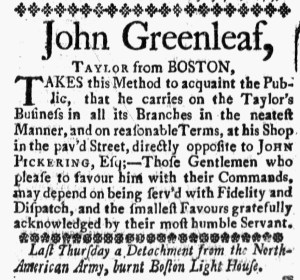
Even though Daniel Fowle sometimes had to reduce the size of the New-Hampshire Gazette to two pages instead of four in the months following the battles at Lexington and Concord, he found space to include advertisements alongside the news of the momentous events taking place in Massachusetts where the siege of Boston continued and General George Washington took command of the Continental Army, in Philadelphia where the Second Continental Congress met to address the crisis, and throughout the colonies as everyone took stock of what occurred and made preparations for what they believed might come next.  The July 25, 1775, edition of the New-Hampshire Gazette, for instance, consisted of six columns spread over two pages.  Several advertisements filled just over half of the final column.

Those advertisements included one from John Greenleaf, “TAYLOR from BOSTON,” who wished “to acquaint the Public, that he carries on the Taylor’s Business in all its Branches in the neatest Manner, and on reasonable Terms, at his Shop” in Portsmouth.  After rehearsing common appeals about his skill and the quality of his work (“neatest Manner”) and the price (“reasonable Terms”), Greenleaf emphasized the sort of service that customers expected from tailors: “Those Gentlemen who please to favour him with their Commands, may depend on being serv’d with Fidelity and Dispatch, and the smallest Favours gratefully acknowledged.”  The tailor’s advertisement followed a familiar formula, one used by members of his trade from New England to Georgia.

Even listing his occupation and the place he formerly lived and worked (“TAYLOR from BOSTON”) as a secondary headline was part of that formula, yet in this instance doing so had new significance.  Greenleaf did not merely communicate that he brought his experience from one of the largest urban ports in the colonies to the smaller town of Portsmouth.  He also made a statement about how his life had been disrupted when hostilities commenced in April 1775.  He took advantage of negotiations between General Thomas Gage, the governor and king’s representative, and the Massachusetts Provincial Congress that allowed Loyalists to enter Boston and Patriots and others to depart.  In describing himself as a “TAYLOR from BOSTON,” Greenleaf declared that he was a refugee, one of many who placed advertisements when they settled in new towns.  He likely hoped that would influence prospective customers to avail themselves of his services.  The scrap of news that Fowle, the printer, inserted immediately below the tailor’s advertisement underscored Greenleaf’s status as a refugee.  “Last Thursday,” Fowle reported, “a Detachment from the North-American Army, burnt Boston Light House.”  Greenleaf did not need to elaborate on the dangers he escaped and the challenges he faced in establishing his business in a new town.  Readers already knew all about it.

June 27

What was advertised in a revolutionary American newspaper 250 years ago today?

New-Hampshire Gazette (June 27, 1775).

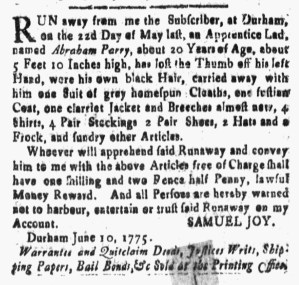
Warrantee and Quitclaim Deeds, Justices Writs, Shipping Papers, Bail Bonds, &c Sold at the Printing Office.”

Daniel Fowle, the printer of the New-Hampshire Gazette, managed to keep publishing his newspaper after the battles of Lexington and Concord, though he warned readers that they could not depend on him doing so.  On April 28, 1775, just over a week after the battles, he asked for those who owed money to settle accounts.  “The Boston News Papers we hear are all stopt, and no more will be printed for the present,” Fowle noted, “and that must be done here unless the Customers attend to this call.”  Two weeks later, he stated, “The publisher of this Paper Designs, if possible, to continue it a while longer, provided the Customers who are in Arrear pay off Immediately, to enable him to purchase Paper.”  Fowle asserted that he had to price paper “at a great Distance and Charge.”  Disruptions in his paper supply and “the disorder’d State of the Continent” (as Fowle described the aftermath of the battles at Lexington and Concord) led him to reduce the size of many issues to two pages instead of the usual four.

The June 27 edition was one of those, the third consecutive one.  Fowle squeezed in as much news as he could, including updates from the Continental Congress meeting in Philadelphia, the Massachusetts Provincial Congress in Watertown, and the New Hampshire Provincial Congress in Exeter.  He also published an account of the Battle of Bunker Hill that occurred ten days earlier.  The printer found one space for a couple of advertisements, including one that described Abraham Parry, an apprentice who ran away from Samuel Joy of Durham on May 22.  The young man took advantage of the “disorder’d State” to get away from his master, though Joy offered a reward to “Whoever will apprehend said Runaway and convey him to me.”  As the very last item on the second (and final) page, Fowle inserted an advertisement, just two lines, for printed blanks: “Warrantee and Quitclaim Deeds, Justices Writs, Shipping Papers, Bail Bonds, &c Sold at the Printing Office.”  Such notices often appeared in newspapers during the era of the American Revolution, perhaps more frequently in the New-Hampshire Gazette than most others, because printers sought to diversity their revenue streams.  Many of them printed and sold “blanks,” blank forms used for common legal and commercial transactions.  In this instance, Fowle did not have enough space to insert a line to separate his notice from the advertisement above it, though he did use italics to distinguish it from Joy’s notice.  More than ever, the printer needed whatever revenue he could get.  He made sure to remind readers that he stocked and sold blanks.

May 26

What was advertised in a revolutionary American newspaper 250 years ago today?

New-Hampshire Gazette (May 26, 1775).

“HAIR-DRESSERS … The Business is still carried on in the same Shop.”

William Knight, a “PERUKE MAKER and HAIR DRESSER,” placed advertisements for the wigs he made and the services he provided on several occasions.  In the January 22, 1773, edition of the New-Hampshire Gazette, for instance, he announced that he “open’d SHOP near LIBERTY BRIDGE” in Portsmouth, where he will be ready to serve any Persons on reasonable Terms.”  Six months later, he established a partnership with Peter Man.  On July 30, they published an advertisement to advise prospective clients that they “carry on their Business in all its Branches, at their Shop on the Parade in Portsmouth.”  They continued together for nearly two years, but as the Revolutionary War began Man and Knight decided to part ways.

That prompted another newspaper advertisement, one that deployed standard language for such circumstances.  Upon “having agreed to dissolve the Partnership which was between them,” they called on “all Persons with whom they have Accounts open to close them as soon as possible.”  They did not indicate why they ended their partnership, though perhaps Knight retired or moved to another town.  He did not place any more advertisements in the New-Hampshire Gazette.  Man, on the other hand, used the notice about the partnership ending for a second purpose.  With a manicule to draw attention, he proclaimed, “The Business is still carried on in the same Shop, on the Parade and constant Attendance given.”  Even as one iteration of the business closed, Man hoped to maintain the clientele that he and Knight had established over the past two years as well as attract new customers for wigs and styling.

He was not the only one to advertise such services.  In an advertisement for the inn that he operated in nearby Greenland, John Williams added a nota bene to inform “Amy Gentlemen Travellers inclining to have their Hair or Wigs dressed before they go to Town, may have it done by said WILLIAMS in the genteelest and most fashionable Manner.”  Even as the New-Hampshire Gazette carried the “Freshest ADVICES FOREIGN AND DOMESTIC” about the imperial crisis, advertisers catered to ladies and gentlemen who wanted their hair or wigs presentable for appearing in public.