August 15

What was advertised in a colonial American newspaper 250 years ago today?

Aug 15 - 8:15:1768 New-York Gazette Weekly Mercury
New-York Gazette and Weekly Mercury (August 15, 1768).

“I am Master of the new Mode, lately invented in London, of making Wigs.”

In the advertisements they placed in American newspapers in late colonial period, entrepreneurs in occupations tied to fashion often underscored their connections to London, the cosmopolitan center of the Britain’s empire. Tailors, milliners, and others who made apparel often proclaimed that they were “from London.” Hairdressers and wigmakers advanced similar appeals. Even shopkeepers did so when they thought that it might help them to sell imported garments, textiles, and assorted adornments.

John Lewis, a native of New York, could not claim to be “from London,” but his origins mattered less than the time he had spent in that city. The “HAIR-DRESSER, and PERUKE-MAKER” opened his advertisement in the New-York Gazette and Weekly Mercury by informing prospective clients that “after considerable Residence in London” he had returned to New York and set up shop. During the time that he had resided in London Lewis had worked with “the most eminent Masters in the above mentioned Branches of Business” and, as a result, had “acquired Abilities equal to any of my Brethren, in the Professions of Hair-Dressing and Wig-Making.” This made him particularly qualified to serve customers in New York and its environs.

Lewis highlighted his familiarity with current fashions and the most advanced methods of his trade, both acquired during his time in London. To that end, his advertisement served as a primer to newspaper readers about some of styles currently popular on the other side of the Atlantic. “I am Master of the new Mode, lately invented in London,” he proclaimed, “of making Wigs that shall not need dressing for six Months, preserving their Shape and first Appearance during that Time.” For those who were unaware, he firther explained that “This fashion is much esteem’d at present in England [for] its Usefulness and Convenience.” Since such wigs were new to the American marketplace, Lewis proposed another means of helping prospective clients become more familiar with them. In addition to describing the wigs in advertisements, he made several “Specimens” or samples that “Gentlemen” could examine before engaging his services.

Lewis leveraged his connections to London in his advertisement. He not only claimed familiarity with the current styles but also asserted that he was in a position to educate potential customers about new tastes and methods that they had not yet encountered in the colonies. He provided extensive detail in hopes that these factors would distinguish him from local competitors who either had never traveled to London or had not done so recently.

August 1

What was advertised in a colonial American newspaper 250 years ago today?

Aug 1 - 8:1:1768 New-York Gazette Weekly Mercury
New-York Gazette and Weekly Mercury (August 1, 1768).

“One of the most beautiful Animals, call’d, The LEOPARD.”

In addition to an array of consumer goods and services, newspaper advertisements also promoted a variety of entertainments and leisure activities, from concerts and plays to fireworks and exotic animals. Readers of the August 1, 1768, edition of the New-York Gazette and Weekly Mercury could not have missed Abraham Van Dyck’s advertisement that invited them to view a leopard that had just arrived in the city. The relatively large woodcut that accompanied the advertisement crudely depicted the large cat, inciting even greater interest than Van Dyck’s description of the animal.

Van Dyck introduced New Yorkers to a spectacle previously unknown to them, “one of the most beautiful Animals.” He could not assume that prospective viewers were already familiar with leopards, prompting him to publish a short description to supplement the woodcut. Van Dyck explained that the leopard was “adorned all over with very neat and different spots, black and white.” It had “large sparkling Eyes, and long Whiskers on both Sides of his Jaws.” In comparison to an animal that may have been more familiar to many colonists, “This Leopard is much in Shape, Nature, and Colour, like unto a Panther.” To augment the excitement of viewing this exotic beast, Van Dyck noted that the leopard was “greedy in catching his Prey by leaping at it,” but those tantalized by this description did not need to worry about their safety when they went to see this exotic creature. “Gentlemen and Ladies may have a full View of the Leopard,” Van Dyck promised, as he is well secured with a Chain.”

The leopard was not Van Dyck’s only attraction. He informed readers that he had “several other Animals, which will be seen at the same Time,” though he did not indicate which other animals comprised the rest of the show. The leopard was the star, the exotic beast that Van Dyck expected would draw viewers willing to pay a shilling to glimpse a creature so out of the ordinary compared to the sights they encountered on most days. The woodcut underscored that the leopard was a true curiosity that readers did not want to miss.

June 27

What was advertised in a colonial American newspaper 250 years ago today?

Jun 27 - New-York Gazette Weekly Mercury
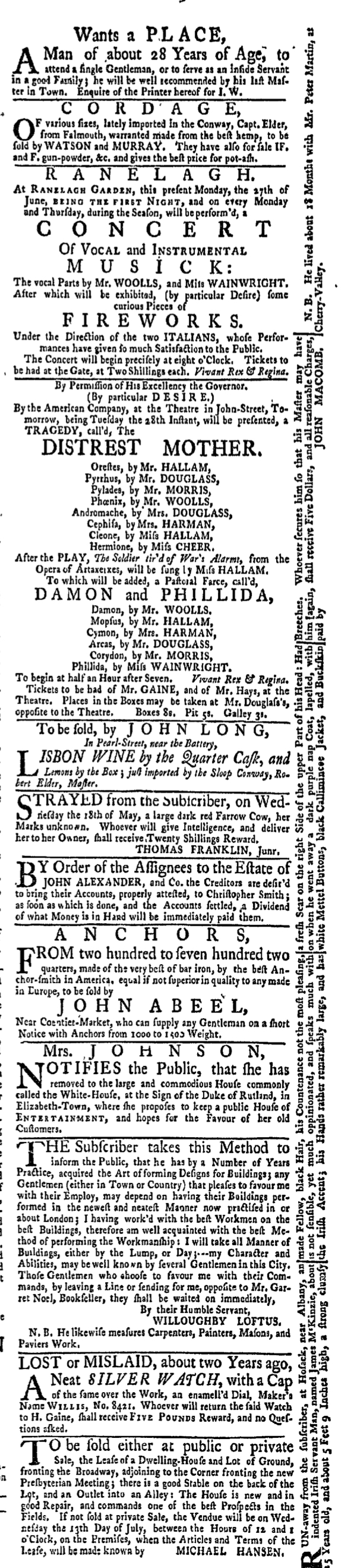
New-York Gazette and Weekly Mercury (June 27, 1768).

“RUN-away from the subscriber at Hosack, near Albany, an indented Irish servant Man.”

The second and third pages (or the two center pages of a broadsheet folded in half to create the standard four-page issue) of the June 27, 1768, edition of the New-York Gazette and Weekly Mercury included more than just the usual three columns. The compositor created a very thin fourth column by rotating the type ninety degrees; this allowed for the insertion of three additional advertisements in the outside margins that otherwise would not have fit on the page. Two of those advertisements appeared on the second page. John Duncan and Thomas Peeles placed a notice calling on those indebted “to the estate of John Knox, of the town of Schenectady, and county of Albany” to settle accounts. Collin McDonald “of the manor of Livingston, and county of Albany” inserted a notice warning others against trusting his wife, Catherine. She had “eloped from his bed,” causing him to “forewarn all persons not to trust or harbour her on my account, as I will pay no debts contracted by her.” A single advertisement occupied the additional column on the third page. In it, John Macomb, “at Hosack, near Albany,” described James McKinzie, a runaway indentured servant. Given that all three of these advertisements came from Albany and none of them previously appeared in the New-York Gazette and Weekly Mercury, they likely all arrived at the same time via the same post carrier or messenger, after the type for the rest of the issue had been set but not before it went to press. The printer and compositor may have had a brief window of opportunity to work these advertisements into the June 27 issue rather than wait a week to publish them.

The placement of these advertisements was certainly out of the ordinary for the New-York Gazette and Weekly Mercury, but it was not altogether uncommon in newspapers published in the American colonies during the eighteenth century. Printers and compositors sometimes made space for short advertisements in the side margins or across the bottom of the page, but usually only when special circumstances required. This aspect of American newspaper production and format differs significantly from standard practices in Dutch newspapers in the 1760s, as I learned from during a panel on “Newspapers and Information Management in the Atlantic World” at the 24th annual conference sponsored by the Omohundro Institute of Early American History and Culture held earlier this month. In her paper on “Dutch Newspaper Coverage of the Berbice Slave Revolit, 1763,” Esther Baakman (Leiden University) presented images of the newspapers she consulted. In terms of graphic design, they featured two columns for news and a third column for advertising. The column for advertising was slightly narrower than the other two and rotated ninety degrees. What amounted to an occasional strategy for inserting additional advertisements in American newspapers was a design feature intended to aid readers in distinguishing among content in Dutch newspapers in the middle of the eighteenth century.

May 9

What was advertised in a colonial American newspaper 250 years ago today?

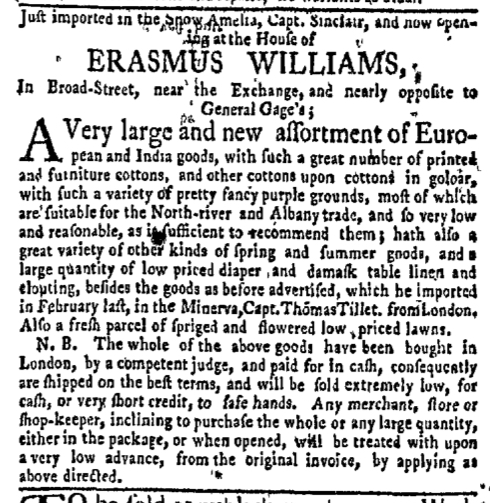
May 9 - 5:9:1768 New-York Gazette Weekly Mercury
New-York Gazette and Weekly Mercury (May 9, 1768).

“Most of which are suitable for the North-river and Albany trade.”

Although Erasmus William’s advertisement in the May 9, 1768, edition of the New-York Gazette and Weekly Mercury did not discourage or exclude retail sales, it did focus primarily on further distributing imported goods by offering to sell to merchants and shopkeepers wholesale. Williams reported that he had just received “A very large and new assortment of European and India goods” via “the Snow Amelia, Capt. Sinclair.” The merchant proposed specific customers for many of the textiles, especially the “great number of printed and furniture cottons.” He stressed that they were “suitable for the North-river and Albany trade.” Since the newspapers published in New York served the entire colony, he had a reasonable expectation that potential buyers from far beyond the city would see his advertisement and possibly contact him to refresh their inventories.

Williams also directly addressed prospective customers who might wish to buy in bulk, pledging that “Any merchant, store or shop-keeper, inclining to purchase the whole or any large quantity” would get a real bargain. He explained that an associate in London, a “competent judge” of the merchandise, had negotiated a deal and paid for the goods in cash. In turn, this allowed Williams to pass along the savings to his own customers, especially those interested in relieving him of significant quantities all at once.

Most merchants who placed advertisements for consumer goods in eighteenth-century newspapers did not explicitly specify that they intended to sell their wares wholesale. Some likely assumed that readers already knew which advertisers were wholesalers and which were retailers. Williams, on the other hand, made it clear that he intended to sell “the whole” or a large quantity in a single transaction. He also imagined the further distribution of the assortment of goods he had just imported, envisioning that they would be transported beyond New York, a busy port city. The consumer revolution of the eighteenth century was not confined to the urban centers on the Atlantic coast. Instead, merchants like Williams and the shopkeepers and other traders that did business with him in other parts of the colony helped facilitated the expansion of consumer culture to towns and villages and beyond.