December 4

What was advertised in a revolutionary American newspaper 250 years ago today?
Connecticut Courant (December 4, 1775).

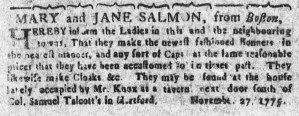
“Newest fashioned Bonnets … at the same reasonable prices that they have been accustomed to in times past.”

When they relocated to Hartford, milliners Mary Salmon and Jane Salmon placed an advertisement in the December 4, 1775, edition of the Connecticut Courant to introduce themselves to their new neighbors and, especially, to prospective customers.  They informed “the Ladies in this and the neighbouring towns, That they make the newest fashioned Bonnets in the neatest manner, and any sort of Caps.”  They also noted that they “make Cloaks” and other garments.  The milliners hoped to establish a clientele and earn their livelihood in a town new to them.  In the headline for their advertisement, they described themselves as “from Boston.”  The Salmons were not the only newcomers from Boston who ran an advertisement in that issue of the Connecticut Courant.  James Lamb and Son, tailors “From Boston” who had previously inserted a notice in that newspaper in September, ran a new advertisement that appeared in the same column as the Salmons’ notice.  Like the Lambs, the Salmons may have been refugees who left Boston following the outbreak of hostilities at Lexington and Concord in the spring.

In marketing their wares, the Salmons did not allow the difficulties of the war to overshadow prospective customers’ desire for hats that followed the latest styles.  They intentionally declared that they made “the newest fashioned Bonnets” and did so “in the neatest manner.”  They combined appeals to taste with a pledge about the quality of their hats and their skill as milliners.  The Salmons also incorporated promises regarding price into their brief advertisement, asserting that they charged “the same reasonable prices that [prospective customers] have been accustomed to in times past.”  The disruptions caused by the war did not cause them to raise prices.  In addition, they made a nod to the ninth article of the Continental Association: “That such as are Venders of Goods or Merchandise will not take Advantage of the Scarcity of Goods that may be occasioned by this Association, but will sell the same at the Rates we have been respectively accustomed to do so for twelve Months last past.”  The Salmons could not rely on their reputation among an existing clientele to generate business as they had done in Boston.  Instead, they devised an advertisement that said a lot in just a few lines, deploying appeals to fashion, quality, skill, and price.  They may have also expected that current events would resonate with their notice, anticipating that prospective customers would realize why they moved from Boston and their commitment to abiding by the Continental Association.

May 28

What was advertised in a revolutionary American newspaper 250 years ago this week?

New-York Journal (May 25, 1775).

He has settled a Correspondence in London, whereby he acquires the first fashions of the Court.”

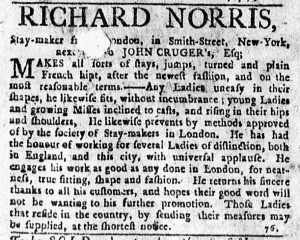
Richard Norris, a “STAY MAKER, from LONDON,” regularly placed advertisements in New York’s newspapers during the era of the American Revolution.  Even as the imperial crisis heated up following the battles at Lexington and Concord in the spring of 1775, he emphasized his connections to London and knowledge of the current fashions there as he marketed the corsets he made.  After all, most colonizers still looked to the largest and most cosmopolitan city in the empire for the latest trends even if they happened to have concerns with how the Coercive Acts and other abuses perpetrated by Parliament.

In an advertisement in the May 25, 1775, edition of the New-York Journal, for instance, Norris declared that he fitted his clients “by methods approved by the Society of Stay Makers in London” and noted that he “has had the honour of working for several ladies of distinction, both in England and this City, with universal applause.”  By that time, he had been in New York for nearly a decade.  He placed an advertisement in the New-York Mercury on March 3, 1776.  The Adverts 250 Project first featured Norris with his advertisement that ran in the New-York Journal on June 23, 1768.  Even though he continued to describe himself as a “STAY MAKER, from LONDON” in 1775, it had been quite some time since he practiced his trade there.  Yet his clients did not need to worry about that because Norris “has settled a Correspondence in London, whereby he acquires the first fashions of the Court.”  That being the case, he proclaimed with confidence that he delivered the “newest fashions from London.”  In addition, he asserted “his work to be as good as any done in these parts, for neatness [and] true fitting.”

Norris also resorted to a familiar marketing strategy, encouraging women to feel anxious about their appearance, especially the shape of their bodies, to convince them to seek out his services.  He addressed “Ladies who are uneasy in their shapes” and emphasized that wearing his stays “prevents the casts and risings in the hips and shoulders of young Ladies and growing Misses, to which they are often subject.”  Norris considered this copy so effective that he recycled it several times over the years, honing a strategy that eventually became a staple of marketing in the modern beauty industry.

May 22

What was advertised in a revolutionary American newspaper 250 years ago today?

New-York Gazette and Weekly Mercury (May 22, 1775).

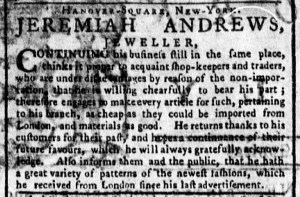
“Shop-keepers and traders, who are under disadvantages by reason of the non-importation.”

The Continental Association, a nonimportation agreement devised by the First Continental Congress in response to the Coercive Acts, created an opportunity for Jeremiah Andrews, a jeweler in New York, to market his services in the spring of 1775.  In the May 22 edition of the New-York Gazette and Weekly Mercury, he announced that he “CONTINU[ED] his business still in the same place” and “thinks it proper to acquaint shop-keepers and traders, who are under disadvantages by reason of the non-importation, that he is willing chearfully to bear his part.”  How would Andrews help them with that burden?  By supplying retailers with items that they could not import while the Continental Association remained in effect!

He explained that he could “make every article … pertaining to his branch,” jewelry, “as cheap as they could be imported from London, and materials as good.”  Andrews expected that he offered an attractive alternative.  After all, he used quality materials in crafting his jewelry and set prices comparable to those previously charged for imported items.  His appeals resonated with various articles of the Continental Association, including the eighth article that called for “promot[ing] Agriculture, Arts, and the Manufactures of this Country” and the ninth article that prohibited “tak[ing] Advantage of the Scarcity of Goods” by increasing prices for those “Goods or Merchandise” available for sale.

Andrews also informed both retailers and the public that “he hath a great variety of patterns of the newest fashions, which he received from London since his last advertisement.”  Assessing the situation, he realized that consumers still valued connections to the largest and most cosmopolitan city in the empire.  The Continental Association made importing textiles, accessories (including jewelry), housewares, and other goods from there off limits, but it did not proscribe replicating the styles currently in fashion.  Andrews presented retailers and consumers with a means of keeping up with the latest trends for jewelry without sacrificing support for the American cause.  After all, most colonizers still valued being part of the British Empire, despite the imperial crisis and the battles between regulars and colonial militia in Massachusetts in April and the ongoing siege of Boston.  They thought of themselves as British and hoped for a redress of grievances.  Andrews provided a means for minimizing the disruptions that consumers experienced, his way “chearfully to bear his part” while expanding his business.

August 22

What was advertised in a colonial American newspaper 250 years ago this week?

Maryland Journal (August 20, 1773).

“He will be always ready to convey to his partner any new fashions.”

Just a few days before William Goddard distributed the inaugural issue of the Maryland Journal, the first newspaper published in Baltimore, Grant and Garritson, “TAYLORS from PHILADELPHIA,” submitted an advertisement to the printing office on Market Street.  Their advertisement was one of twenty that ran in the first issue of the newspaper.  About half of the notices promoted consumer goods and services.  Others included legal notices, real estate opportunities, an account of a lost bundle of papers, and a description of an indentured servant who ran away from his master.  Two advertisements concerned enslaved people, one seeking a young girl to purchase and the other offering a reward for the capture and return of Prince, an enslaved man who liberated himself and managed to elude his enslaver.  All in all, the advertisements in the Maryland Journal resembled those that ran in other newspapers throughout the colonies.

Grant and Garrison’s advertisement also looked similar to notices by tailors in other newspapers.  They stated that they “will be greatly obliged to all Gentlemen who will be pleased to favour them with their commands” and they pledged that their customers “may depend on having their work done in the neatest and most fashionable manner, with care and dispatch.”  With an economy of prose, Grant and Garritson made appeals to quality, fashion, customer service, and their own skill.  As many artisans did in their notices, the tailors also emphasized their previous experience working in another location, one known for its cosmopolitanism.  Tailors and others often described themselves as “from London” or “from Paris.”  In this instance, Grant and Garritson purposefully presented themselves as “TAYLORS from PHILADELPHIA,” the largest and most cosmopolitan city in the colonies.  Yet they did not merely possess a prior connection to that major urban port.  The tailors explained in a note at the end of their advertisement that Grant “resides and carries on the business in Philadelphia.”  That being the case, “he will be always ready to convey to his partner any new fashions, either in making or trimmings.”  Tailors, seamstresses, milliners, and others in the garment trades in Philadelphia and other port cities eagerly awaited news about new fashions from Europe.  Grant and Garritson provided a direct pipeline for disseminating that information to their clients in Baltimore, making sure that they kept pace with all the latest developments and perhaps even ahead of the curve compared to others colonizers who did not have tailors with such beneficial networks.  As Baltimore gained in prominence as a port and a center of commerce, Grant and Garrison offered their services in keeping their clients advised of the latest fashions so they could demonstrate their own influence.

April 4

What was advertised in a colonial American newspaper 250 years ago this week?

New-York Journal (April 1, 1773).

“Any Ladies uneasy in their shapes, he likewise fits, without incumbrance.”

Richard Norris billed himself as a “Stay-maker from London” even though he had resided and worked in New York for several years by the time he published his advertisement in the April 1, 1773, edition of the New-York Journal.  He considered his connection to the largest and most cosmopolitan city in the empire a selling point.  Norris informed readers that he previously served the best sorts of clients on both sides of the Atlantic, declaring that he “has had the honour of working for several Ladies of distinction, both in England, and this city.”  The quality of his stays (or corsets) and his skill in producing them yielded “universal applause” from his clients.

Although Norris had been in New York for some time, he also suggested that he maintained his connection to London.  For instance, he made stays “after the newest fashion” in that city.  In another advertisement, he described how he “acquires the first fashions of the court of London by a correspondent he has settled there.”  Furthermore, he adhered to “methods approved of by the society of Stay-makers in London” in designing and making his stays, especially those for “young Ladies and growing Misses inclined to casts, and rising in their hips and shoulders.”

Norris frequently coupled appeals to the latest fashions from London with attempts to make women feel anxious about their bodies.  “Any Ladies uneasy in their shapes, he likewise fits, without incumbrance,” the staymaker asserted in 1768 and reiterated in 1770 and 1773.  In return for helping them address purported physical shortcomings that he helped them to overcome (or at least disguise) with his stays, Norris asked his clients to recommend him to others.  He extended “his sincere thanks to all his customers, and hopes their good word will not be wanting to his further promotion.  Not unlike modern marketing for clothing and beauty products, Norris encouraged “young Ladies and growing Misses” to feel uncomfortable with their bodies, purchase his product to ease their anxieties, and reward him for his part in addressing a supposed shortcoming that he highlighted and did not allow them to overlook.

November 22

What was advertised in a colonial American newspaper 250 years ago this week?

Maryland Gazette (November 19, 1772).

“They are well acquainted with the newest Fashions.”

When they settled in Annapolis, Jane Nelson and Anne Nelson took out an advertisement in the Maryland Gazette to introduce themselves to the community and encourage “Ladies … to favour them with their Commands” or orders for “all Kind of Milliners and Mantua-makers Work.”  As newcomers to the colony, they could not rely on their reputations to market their services.  Instead, they emphasized their connections to London, the cosmopolitan center of the empire, and their knowledge of current styles there.

In the deadline for their advertisement, the Nelsons proclaimed that they “Just arrived from LONDON.”  Artisans, tailors, milliners, and others often trumpeted that they were “from London” in their advertisements, sometimes long after they crossed the Atlantic.  The Nelsons made it clear that they only recently made that journey.  Accordingly, prospective clients could trust that they were indeed “well acquainted with the newest Fashions” and capable of making hats, cloaks, and other garments “in the most elegant and fashionable manner.”  Having recently come from London, the Nelsons could also provide guidance about “Ladies fashionable dress and undress Caps” and other items.

The Nelsons also aimed to convince prospective clients that they offered exemplary customer service.  They asserted that “Ladies … may depend on having their Work neatly done, and with the utmost Dispatch.”  If given a chance, the Nelsons assured those ladies that “they will not be disappointed in their Endeavours to please, as it shall be their constant Study and greatest Ambition.”  In addition to serving clients who visited them in Annapolis, the Nelsons also took “Orders from the Country,” pledging to punctually complete them.

These “Milliners and Mantua-makers” deployed a two-pronged approach to marketing their services upon arriving in Annapolis.  They promoted their connections to London, underscoring their familiarity with the latest tastes there, while simultaneously vowing to meet and exceed the expectations of their clients in terms of customer service.  The Nelsons hoped that combination of appeals would entice the ladies of Annapolis to engage their services.

January 26

What was advertised in a colonial American newspaper 250 years ago this week?

New-York Journal (January 23, 1772).

“The newest and neatest manner, either in the French or English taste.”

When John Burcket, a “Stay and Riding Habit-maker,” arrived in New York, he placed an advertisement in the New-York Journal to offer his services to the “ladies of this city.”  Like many other artisans who migrated across the Atlantic, he informed prospective clients where he had previously lived and worked, hoping to bolster his reputation among those who had not yet had an opportunity to examine the garments that he made.

In Burcket’s case, he proclaimed that he “lately arrived from London and Paris,” but did not mention where he had been most recently or how long he spent in either city.  What mattered more to him (and what he hoped mattered more to the ladies that he hoped to entice to his shop) was that his connections to two such cosmopolitan cities gave him greater knowledge of the current tastes and styles in both of them.  Burcket proclaimed that made stays (or corsets) and riding habits “in the newest and neatest manner, either in the French or English taste.”  This signaled that he did more than merely produce the garments; he also served as a guide for his clients, keeping them up to date on the latest trends and giving them advice.

Burcket buttressed such appeals with other promises intended to draw prospective clients into his shop.  He pledged that they “may depend on being punctually served.”  In addition to such customer service, Burcket aimed to achieve “utmost satisfaction” among his clients, hoping that “meriting their esteem” would lead to word-of-mouth recommendations.  He was also conscious of the prices he set, stating that he made and sold stays and riding habits “as cheap as can be imported.”  His clients did not have to pay a premium for consultations with an artisan “lately arrived from London and Paris.”  Even as he incorporated several marketing strategies into his notice, he made his connections to those cities the centerpiece of his introduction to the ladies of New York.

February 25

What was advertised in a colonial American newspaper 250 years ago today?

New-York Gazette and Weekly Mercury (February 25, 1771).

“Just received advice from London of the fashions advanced for the court ladies this year.”

Thomas Hartley made stays or corsets for “the LADIES” of New York in the early 1770s.  In his efforts to cultivate a clientele, he placed an advertisement in the February 25, 1771, edition of the New-York Gazette and Weekly Mercury, advising prospective customers that “he makes STAYS OF ALL SORTS, in the newest and best fashion.”  Staymakers as well as tailors, milliners, and others who made garments frequently emphasized that they followed the latest fashions, assuring clients that they did not need to worry about appearing behind the times and out of style after visiting their shops and hiring their services.

Hartley enhanced such appeals with additional commentary in his advertisement, first describing himself as “LATE FROM LONDON” in a portion of his advertisement that served as a headline.  Colonists looked to London, the cosmopolitan center of the empire, for the latest fashions.  The gentry in New York and other colonies sought to demonstrate their own sophistication by keeping up with styles popular in London.  In proclaiming that he was “LATE FROM LONDON,” Hartley established a connection that suggested he had special insight into the current trends in the metropolis.  Later in the advertisement, he extended “humble thanks to all ladies that have favoured me with their commands,” calling into question just how recently he had arrived in New York.

The staymaker, however, suggested that something else mattered more.  After migrating across the Atlantic, he maintained contact with correspondents who kept him informed about the newest styles.  He trumpeted that he had “just received advice from London of the fashions advanced for the court ladies this year.”  As a result, Hartley felt confident that he could “give universal satisfaction” to his clients.  In making a pitch to “the LADIES” of New York, he claimed to have access to information about the garments the most elite women in London would be wearing in the coming months.  Prospective clients in New York could not expect anything more cutting edge than that!

Fashion often played a role in the appeals made by staymakers, tailors, milliners, and others.  In some instances, advertisers included generic statements using formulaic words and phrases, a shorthand intended to reassure prospective clients that they understood their trade and provided satisfactory services.  Hartley, on the other hand, elaborated on his appeal to “the very newest and best fashion,” seeking to convince customers that he did indeed possess special insights into current trends in the most cosmopolitan city in the empire.

December 17

What was advertised in a colonial American newspaper 250 years ago today?

New-York Gazette and Weekly Mercury (December 17, 1770).

“Beds and window curtains in the newest taste, as practised in London.”

An array of merchants and shopkeepers placed advertisements for imported goods in the December 17, 1770, edition of the New-York Gazette and Weekly Mercury.  For instance, John Schuyler, Jr., announced that he “just imported in the last vessels from London and Bristol, a neat assortment of goods.”  Many of them asserted that their new inventory reflected current fashions in England.  Artisans who offered their services to colonial consumers made similar appeals in their advertisements.

George Richey, who described himself as an “UPHOLSTERER and TENT-MAKER,” did so.  He informed “ladies and gentlemen that will favour him with their custom” that he “MAKES all sorts of upholstery work in the newest fashions” for beds, chairs, couches, and other furniture.  He also made curtains for both windows and beds, stressing that his wares followed “the newest taste, as practised in London.”

Richey and others who advertised consumer goods and services in the 1760s and 1770s frequently assured prospective customers that they provided products that matched current fashions in London, the cosmopolitan center of the empire.  Such appeals tapered off when nonimportation agreements went into effect, but they were quite common at other times.  Even as colonists sparred with Parliament over increased regulation of commerce, collecting duties on certain imported goods, quartering soldiers in port cities, and other matters, they continued to look to London for the latest fashions.

Newspaper advertisements published throughout the colonies made overtures concerning current trends and tastes in London, but such appeals most often appeared in advertisements placed by merchants, shopkeepers, and artisans in the largest port cities.  Residents of Boston, Charleston, New York, and Philadelphia experienced urban life, though on a much smaller scale than their counterparts in London.  Still, advertisers sought to assure potential clients and customers that they could acquire the same goods and, in the process, embody the same sophistication even though they lived on the other side of the Atlantic.  Richey the upholsterer joined a chorus of advertisers who invoked “newest fashions” and “newest taste, as practised in London.”

December 12

What was advertised in a colonial American newspaper 250 years ago this week?

Supplement to the New-York Gazette and Weekly Mercury (December 10, 1770).

“Goods of the best qualities, and newest patterns.”

George Fenner stocked a variety of textiles and clothing at his store on Broad Street in New York.  In an advertisement that he inserted several times in both the New-York Gazette and Weekly Mercury and the New-York Journal in November and December 1770, he listed “PRINTED cottons and lines of the finest colours,” “handkerchiefs of all sorts,” “linen and cotton checks,” “men and boys ready made clothes,” “womens scarlet cardinals,” and “felt and castor hats” along with an array of other merchandise.  Yet that was not an exhaustive catalog of his inventory.  Fenner advised prospective customers that he also carried “many other articles in the linen and woollen draper, too tedious to insert.”  If readers wanted to know what other items the merchant made available then they would have to visit his store.  He whetted their appetites by mentioning only some of his wares.

Fenner directed his advertisement to shopkeepers and others who wished to purchase by volume.  He noted that he sold his goods wholesale “at a very small profit.”  In other words, his markup was low enough that his buyers could still charge competitive retail prices at their retail shops.  He also attempted to incite interest in his merchandise by declaring that his customers “may depend upon having goods of the best qualities, and newest patterns.”  He realized that retailers would reiterate such appeals to their own customers when they marketed clothing and textiles.  To convince prospective buyers that he did indeed provide the “newest patterns,” Fenner opened his advertisement with a proclamation that he had “Just arrived from LONDON,” the largest and most cosmopolitan city in the empire.  Accordingly, he had been on the scene to assess for himself which patterns were currently in fashion.  Retailers who dealt with him could assure their own customers that they could choose from among the latest trends.

Fenner had several goals in constructing his advertisement.  He sought to convince retailers that he had an impressive inventory that warranted a visit to his store to select among the clothing and textiles he offered at wholesale prices.  At the same time, he needed to convince prospective buyers that these wares had good prospects for retail sales.  In so doing, he made appeals to price, quality, and fashion to reassure retailers that they would be able to sell these items to consumers.