November 19

What was advertised in a revolutionary American newspaper 250 years ago today?
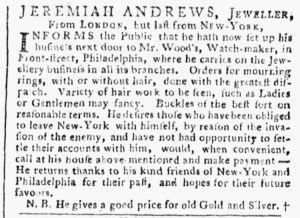
Dunlap’s Pennsylvania Packet (November 19, 1776).

“JEREMIAH ANDREWS, JEWELLER, From LONDON, but last from NEW-YORK.”

A day after the New-York Gazette and Weekly Mercury ran advertisements by tailors “from BOSTON” and a watchmaker “from London, (late from Boston,)” Dunlap’s Pennsylvania Packet carried an advertisement by Jeremiah Andrews, a jeweler “From LONDON, but last from NEW-YORK.”  He informed the public that he “hath now set up his business next door to Mr. Wood’s, Watch-maker, in Front-street, Philadelphia.”  The tailor and the watchmaker in New York and the jeweler in Philadelphia all experienced disruptions during the war that caused them to relocate to other cities.  Their political principles may have also provided a strong motivation to move.  When the siege of Boston ended, the tailor and the watchmaker might have followed the British to Halifax and then to New York.  The jeweler plainly stated that the British occupation of New York caused him to relocate.

In addition to promoting “the Jewellery business in all its branches,” especially mourning rings, and inviting “Ladies and Gentlemen” to view items they “may fancy” at his new shop, Andrews called on his former customers “who have been obliged to leave New-York with himself, by reason of the invasion of the enemy, and have not had opportunity to settle their accounts with him, would, when convenient, call at his house above mentioned and make payment.”  He was not so unfortunate as John H. Holt in Virginia, who had lost his “Account Books, with his other Effects” to Lord Dunmore’s forces, but he did hope that his clients would pay their bills to make his life easier as he established himself in a new city.  He simultaneously expressed gratitude to “his kind friends of New-York and Philadelphia” for their past business and hoped for their “future favours.”  That Andrews relocated from New York to Philadelphia “by reason of the invasion of the enemy” made him a refugee displaced by the war.  Amid all the disruptions, he tried for a new start in a new city, hoping that an advertisement in the public prints would help in that process.
May 22

What was advertised in a revolutionary American newspaper 250 years ago today?

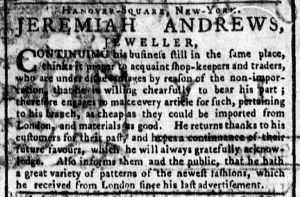
New-York Gazette and Weekly Mercury (May 22, 1775).

“Shop-keepers and traders, who are under disadvantages by reason of the non-importation.”

The Continental Association, a nonimportation agreement devised by the First Continental Congress in response to the Coercive Acts, created an opportunity for Jeremiah Andrews, a jeweler in New York, to market his services in the spring of 1775.  In the May 22 edition of the New-York Gazette and Weekly Mercury, he announced that he “CONTINU[ED] his business still in the same place” and “thinks it proper to acquaint shop-keepers and traders, who are under disadvantages by reason of the non-importation, that he is willing chearfully to bear his part.”  How would Andrews help them with that burden?  By supplying retailers with items that they could not import while the Continental Association remained in effect!

He explained that he could “make every article … pertaining to his branch,” jewelry, “as cheap as they could be imported from London, and materials as good.”  Andrews expected that he offered an attractive alternative.  After all, he used quality materials in crafting his jewelry and set prices comparable to those previously charged for imported items.  His appeals resonated with various articles of the Continental Association, including the eighth article that called for “promot[ing] Agriculture, Arts, and the Manufactures of this Country” and the ninth article that prohibited “tak[ing] Advantage of the Scarcity of Goods” by increasing prices for those “Goods or Merchandise” available for sale.

Andrews also informed both retailers and the public that “he hath a great variety of patterns of the newest fashions, which he received from London since his last advertisement.”  Assessing the situation, he realized that consumers still valued connections to the largest and most cosmopolitan city in the empire.  The Continental Association made importing textiles, accessories (including jewelry), housewares, and other goods from there off limits, but it did not proscribe replicating the styles currently in fashion.  Andrews presented retailers and consumers with a means of keeping up with the latest trends for jewelry without sacrificing support for the American cause.  After all, most colonizers still valued being part of the British Empire, despite the imperial crisis and the battles between regulars and colonial militia in Massachusetts in April and the ongoing siege of Boston.  They thought of themselves as British and hoped for a redress of grievances.  Andrews provided a means for minimizing the disruptions that consumers experienced, his way “chearfully to bear his part” while expanding his business.