November 30

What was advertised in a colonial American newspaper 250 years ago today?

Essex Gazette (November 30, 1773).

“He will sell by Wholesale and Retail … at so cheap a Rate as he doubts not will give Satisfaction to every Purchaser.”

George Deblois inserted a lengthy advertisement in the November 30, 1773, edition of the Essex Gazette, the sort of advertisement that regularly appeared in newspapers from New England to Georgia.  The merchant announced that he recently imported a “fine Assortment of ENGLISH and HARD-WARE GOODS” and provided a list of some of that merchandise to demonstrate the range of choices customers would encounter at his shop in Salem.  Deblois carried everything from “check’d and stampt linen Handkerchiefs” and “men’s, women’s and boys worsted Gloves” to “a very large assortment of horn and metal coat and breast Buttons” and “brass and iron Candlesticks” to “steel and iron plate Saws of all sorts and sizes” and “Locks, Hinges, Latches, [and] Bolts.”  Even those extensive lists did not exhaust Deblois’s inventory.  He finished one paragraph with “&c. &c.”  Repeating an abbreviation for et cetera suggested that he stocked much more.  A nota bene at the end of the advertisement concluded with “&c. &c. &c.”

Drawing another paragraph to a close, Deblois promoted “a great Variety of other Articles, too tedious to mention in an Advertisement.”  He also appended a note that “he assures his Customers and others, he will sell by Wholesale and Retail … at so cheap a Rate as he doubts not will give Satisfaction to every Purchaser.”  What are the chances that anyone actually noticed those final appeals among the preponderance of prose, most of it cataloging Deblois’s inventory?  Given eighteenth-century practices of intensive reading as well as consumers’ familiarity with standard advertising formats, many readers likely perused those final promises offered by Deblois, at least the first time they saw the advertisement.  Consider that the Essex Gazette, like most other colonial newspapers, was a weekly publication that consisted of four pages.  That limited the amount of content available to readers, increasing the likelihood that many would examine both news and advertisements carefully to glean information about what was happening in places far and near.  In addition, lengthy advertisements listing goods became so common that readers likely learned that even if they did not wish to read every item – all of those “iron Coffee-Mills” and “silk knee Garters” – they should skip to the end of each dense block of text to see if an advertiser inserted anything else, like the appeals Deblois made in this advertisement.  While such advertisements do not look especially attractive to modern eyes accustomed to other forms of marketing, eighteenth-century readers saw them so often that they learned to navigate them to identify the details they considered most important.

November 15

What was advertised in a colonial American newspaper 250 years ago today?

South-Carolina Gazette (November 15).

“New Advertisements.”

“Advertisements.”

The November 15, 1773, edition of the South-Carolina Gazette carried more advertising than news or other content.  Advertisements filled the entire first page, except for the masthead, most of the second and third pages, and all of the final page.  Peter Timothy, the printer, also published a four-page supplement devoted almost exclusively to advertising, though it did feature an essay raising “an ALARM” over the “INTRODUCTION of TEAS into AMERICA, immediately from the East-India Company’s Ware-houses, so that the Duties imposed thereon by the British Parliament, may be paid in America.”  Advertisements comprised twenty-one of the twenty-four columns in the standard issue and supplement.  From legal notices to calls to settle accounts to notices hawking consumer goods and services to descriptions of enslaved men and women who liberated themselves by running away from their enslavers, those advertisements delivered news in an alternate format.

Unlike content selected by the printer, most paid notices ran in multiple issues.  Readers likely encountered many of them more than once as they perused the latest edition of the South-Carolina Gazette each week.  To help readers navigate the advertisements, the compositor inserted headers in the standard issue (but not in the supplement).  Headers for “New Advertisements” appeared on the first, second, and third pages.  Another header for “Advertisements” also appeared on the third page, suggesting that anything that appeared below or after it (including in the supplement) had been published in at least one previous issue.  The same headers regularly appeared in the South-Carolina Gazette.  Although the headers usually provided reliable guidance, occasionally advertisements from previous issues found their way into the “New Advertisements,” as was the case with Edmund Egan’s notice promoting “CAROLINA BEER” on the first page of the November 15 edition.  Printers and compositors generally did not classify advertisements by placing those inserted for similar purposes together.  Headers like “New Advertisements” and “Advertisements,” along with “Timothy’s Marine List” introducing the shipping news,” accounted for the first efforts to organize some of the contents and aid readers in navigating the pages of the South-Carolina Gazette.

July 14

What was advertised in a colonial American newspaper 250 years ago today?

Jul 14 - 7:14:1767 South-Carolina Gazette and Country Journal
South-Carolina Gazette and Country Journal (July 14, 1767).

“JUST IMPORTED, By JAMES DRUMMOND … a large and compleat Assortment of Goods.”

James Drummond obtained a privileged place for his advertisement in the South-Carolina Gazette and Country Journal. Or did he? The answer depends on how readers engaged with the newspaper when it came into their possession. Drummond’s advertisement appeared in the third and final column on the first page, immediately under a headline that proclaimed “New Advertisement.” An ornamental device separated it from the news item that occupied most of the page, a lengthy “Extract of a Representation from the Board of Trade to his Majesty.” Drummond’s advertisement seemed to have a prime position on the page.

However, that may not necessarily have been the case. The vast majority of the advertising in the July 14 edition appeared on the third and fourth pages of the four-page issue. Although not arranged by any sort of classification on those two pages, dozens of advertisements were grouped together. Readers who perused any particular advertisement would have also noticed the others that surrounded it. From that perspective, Drummond’s notice was isolated from the others and may have received less attention as a result. Having his advertisement inserted in closer proximity to those placed by competitors may have worked to his benefit.

Where within the issue Drummond’s advertisement appeared probably depended on decisions made in the printing office. Given its length relative to the columns of news on the first page, the compositor likely saw an opportunity to fill most of the remaining space once the “Extract” had been set, adding one short real estate announcement to complete the page. For readers who approached this issue intensively – reading straight through from start to finish – Drummond’s advertisement would have been the first commercial notice (and one of the first items of any sort) encountered, making its placement a boon to the shopkeeper. On the other hand, some readers, especially those who did not examine every column of every page, may have overlooked Drummond’s advertisement because it was not included among its counterparts. The front page may not have always been the best place as far as colonial advertisers were concerned.

April 12

GUEST CURATOR:  Kathryn J. Severance

What was advertised in a colonial newspaper 250 years ago this week?

Apr 12 - 4:11:1766 New-Hampshire Gazette
New-Hampshire Gazette (April 11, 1766).

“TO BE SOLD … the following BOOKS.”

This advertisement sold different types of books, from Bibles (“royal Families Bibles”) to history books and geography (“Histories of the late War” and “History of Austria”), a science book (“Winkler’s natural Philosophy”), and sets of books about warfare (“Sieges and Battles”) to novels. (Skome also sold Stoughton’s Elixir, a patent medicine.)

The advertisement also mentions “Stackhouse’s Life of Christ, Folio.” In today’s world, “folio” refers to the page numbers that appear in books. However, in the eighteenth century, a folio was a type of book that was larger than average and also more expensive, made of a piece of paper that had been folded just once, resulting in two pages. Other book sizes included quartos, octavos, and duodecimals. Quartos are slightly smaller than folios due to the fact that the paper that was used to form them was folded four times instead of two. Octavos are even smaller, as the paper used to form them has been folded eight times. Duodecimals are even smaller than octavos since they have twelve pages per sheet. One famous example of a work that was distributed as a folio was a 1623 edition of Shakespeare’s works.

For more information on the history of books, check out this syllabus for an online course on “The Book: 1450 to the Present.”

**********

ADDITIONAL COMMENTARY: Carl Robert Keyes

The eighteenth century was an age of revolutions. This blog explores the consumer revolution every day, one advertisement at a time. In many instances, the guest curators and I have linked the appeals made in those advertisements to the political revolution brewing in England’s American colonies. Today’s advertisement, however, called attention to another revolution that occurred throughout the eighteenth century.

Note that Skome’s lists several kinds of reading material, starting with bibles and other devotional works and concluding with “A Number of curious and entertaining NOVELS.” A number of histories, geographies, and other reference works appeared in the middle of the list. In choosing to list his titles in this order, Skome created a hierarchy that reflected many colonists’ attitudes toward the reading materials available to them, including a suspicion and hostility toward novels.

So, what does this have to do with some kind of revolution? A revolution in reading took place during the eighteenth century. Colonists’ reading habits shifted from intensive reading of a small number of printed works – primarily bibles and other texts about religion – to extensive reading of a great number of genres, including histories, travelogues, economics, poetry and other literature, and novels. The consumer revolution and the reading revolution converged as colonists purchased and read a greater variety of books than bibles and almanacs.

This greater variety included “curious and entertaining NOVELS.” Some colonists were not happy with that development, even as they cultivated an appreciation for other printed works. Most books possessed at least some redeeming content, but critics believed that the fictional tales of romance and scandal in novels promoted salacious behavior in real life. Such critiques had a gendered component as well: in a patriarchal society, many men worried about what kinds of ideas women and girls might develop when left to their own devices to read possibly unsavory novels without appropriate supervision.

January 8

What was advertised in a colonial newspaper 250 years ago this week?

Jan 8 - 1:6:1766 Newport Mercury
Newport Mercury (January 6, 1766)

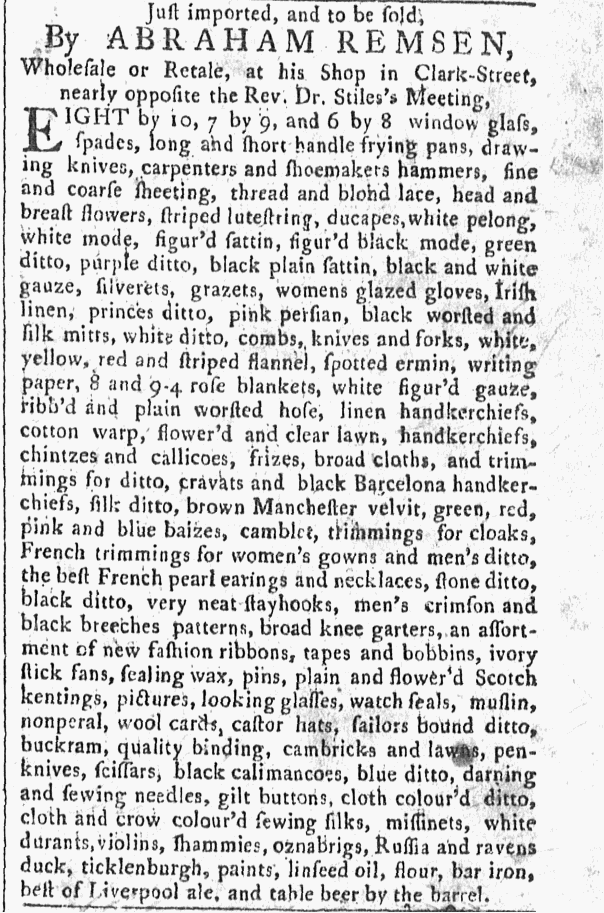
“Spades … black plain sattin … chintzes and callicoes … brown Manchester velvit … the best French pearl earings and necklaces … tapes and bobbins … pen-knives … darning and sewing needles … and table beer by the barrel.”

Abraham Remsen stocked a variety of merchandise to be sold “Wholesale or Retale, at his Shop in Clark-Street” in Newport.  Reading through his list advertisement, which certainly testifies to the assortment of goods so many shopkeepers promoted in eighteenth-century America, can be a bit disorienting.  In response to an advertisement featured a short while ago, one correspondent on Twitter remarked that colonial Americans must have had longer attention spans than their modern counterparts, considering the length, density, and lack of visual images common in many newspaper advertisements of the period.

This prompted me to think about reading habits in the eighteenth century.  Historians have long argued that early Americans read newspapers intensively, that they were read aloud in public spaces (like taverns and coffeehouses) and passed around until they became dog-eared.  Consider that American newspapers in the 1760s were published once a week.  Consider also that each issue was typically a single broadsheet, folded in half to create a four-page newspaper.  It makes sense that subscribers and others would read the news items carefully and perhaps multiple times.

But what about the advertisements?  Would they have been read as intensively as other items?  How would an early American reader have approached this advertisement?