December 23

What was advertised in a revolutionary American newspaper 250 years ago today?

Virginia Gazette [Dixon and Hunter] (December 23, 1775).

“A large and exact VIEW of the late BATTLE at CHARLESTOWN.”

Like other printers, John Dixon and William Hunter sold books, pamphlets, almanacs, stationery, and other merchandise to supplement the revenues they generated from newspaper subscriptions, advertisements, and job printing.  They frequently placed advertisements in their newspaper, the Virginia Gazette, to generate demand for those wares.  The December 23, 1775, edition, for instance, included three of their advertisements, one for “SONG BOOKS and SCHOOL BOOKS For SALE at this OFFICE” and another for the “Virginia ALMANACK” for 1776 with calculations “Fitting VIRGINIA, MARYLAND, [and] NORTH CAROLINA” by “the ingenious Mr. DAVID RITTENHOUSE of Philadelphia,” the same mathematician who did the calculations for Father Abraham’s Almanack marketed in Philadelphia and Baltimore.

Their third advertisement promoted memorabilia related to the hostilities that erupted at Lexington and Concord earlier in the year.  “Just come to Hand, and to be SOLD at this PRINTING-OFFICE,” Dixon and Hunter proclaimed, “A large and exact VIEW of the late BATTLE at CHARLESTOWN,” now known as the Battle of Bunker Hill.  The copies they stocked were “Elegantly coloured” and sold for “one Dollar.”  Dixon and Hunter apparently carried a print, “An Exact View,” engraved by Bernard Romans and published by Nicholas Brooks, rather than a striking similar (and perhaps pirated) print, “A Correct View,” that Robert Aitken included in a recent issue of the Pennsylvania Magazine, or American Monthly Museum and sold separately.  Romans and Brooks had advertised widely and designated local agents to accept subscriptions for the print.  Dixon and Hunter also advertised another collaboration between Romans and Brooks, “an accurate MAP of The present SEAT of CIVIL WAR, Taken by an able Draughtsman, who was on the Spot at the late Engagement.”  The map also sold for “one Dollar.”  Previous efforts to market the map included a broadside subscription proposal that listed local agents in various towns, including “Purdie and Dixon, Williamsburgh.”  Romans and Brooks apparently had not consulted with all the printers, booksellers, and other men they named as local agents when they drew up the list or else they would have known that Alexander Purdie and John Dixon had dissolved their partnership in December 1774.  Dixon took on Hunter as his new partner while Purdie set about publishing his own Virginia Gazette.  Those details may have mattered less to Romans and Brooks than their expectation that printers, booksellers, and others with reputations for supporting the American cause would indeed aid them in marketing and selling a map depicting the conflict underway in Massachusetts.  Whether or not Purdie or Dixon and Hunter collected subscriptions, local agents in Williamsburg did eventually sell the print and the map that supplemented newspaper accounts and encouraged feelings of patriotism among the consumers who purchased them.

November 1

What was advertised in a revolutionary American newspaper 250 years ago today?

Pennsylvania Journal (November 1, 1775).

“A NEAT Mezzotinto print of the Hon. JOHN HANCOCK.”

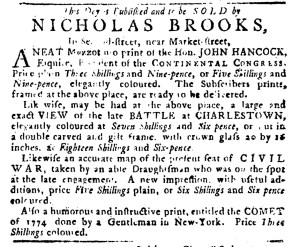
“A large and exact VIEW of the late BATTLE at CHARLESTOWN.”

“An accurate map of the present seat of CIVIL WAR.”

Nicholas Brooks produced and marketed items that commemorated the American Revolution before the colonies declared independence.  In an advertisement in the November 1, 1775, edition of the Pennsylvania Journal, for instance, he packaged together three prints previously advertised separately, each of them related to imperial crisis that had boiled over into a war.  For this notice, Brooks presented them as a collection of prints for consumers who wished to demonstrate their support for the American cause by purchasing and displaying one or more of them.

Brooks announced that a “NEAT Mezzotinto print of the Hon JOHN HANCOCK, Esquire, President of the CONTINENTAL CONGRESS,” that had previously been proposed in other advertisements had been published and was now for sale at his shop on Second Street in Philadelphia.  The subscribers who had reserved copies in advance could pick up their framed copies or arrange for delivery.  Others who had not placed advanced orders could acquire the print for three shillings and nine pence or pay two extra shillings for one “elegantly coloured.”

“Likewise, may be had at the above place,” Brooks reported, “a large and exact VIEW of the late BATTLE at CHARLESTOWN,” depicting what has become known as the Battle of Bunker Hill.  This print competed with an imitation bearing a similar title, “a neat and correct VIEW of the late BATTLE at CHARLESTOWN,” that Robert Aitken inserted in the Pennsylvania Magazine and sold separately.  Brooks, who had long experience selling framed prints, offered choices for his “exact VIEW.”  Customers could opt for an “elegantly coloured” version for seven shillings and six pence” or have it “put in a double carved and gilt frame, with glass 20 by 16 inches,” for eighteen shillings and six pence.  The eleven shillings for the frame, half again the cost of the print, indicated that Brooks anticipated that customers would display the “exact VIEW” proudly in their homes or offices.

He also promoted “an accurate map of the present seat of CIVIL WAR, taken by an able Draughtsman,” Bernard Romans, “who was on the spot of the late engagement.”  Brooks revised copy from earlier advertisements: “The draught was taken by the most skillful draughtsman in all America, and who was on the spot at the engagements of Lexington and Bunker’s Hill.”  The map showed a portion of New England that included Boston, Salem, Providence, and Worcester.   This print, he declared, was a “new impression, with useful additions,” though he did not specify how it differed from the one he previously marketed and sold.  As with the others, customers had a choice of a plain version for five shillings or a “coloured” one for six shillings and six pence.

Brooks added one more item, “a humorous and instructive print, entitled the COMET of 1774, done by a Gentleman in New-York.”  Did this print offer some sort of satirical commentary on current events?  Or was it unrelated to the prints of Hancock, the Battle of Bunker Hill, and the “CIVIL WAR” in New England?  Whatever the additional print depicted, Brooks made the prints that commemorated the American Revolution the focus of his advertisement, gathering together three items previously promoted individually.  In so doing, he not only offered each print to customers as separate purchases but also suggested that they could consider them part of a collection.  Consumers who really wanted to demonstrate their patriotism could easily acquire all three at his shop.

October 4

What was advertised in a revolutionary American newspaper 250 years ago today?

Pennsylvania Journal (October 4, 1775).

“A NEAT MEZZOTINTO PRINT of the HON. JOHN HANCOKC, ESQ; PRESIDENT of the CONTINENTAL CONGRESS.”

On October 4, 1775, Nicholas Brooks took to the pages of the Pennsylvania Journal to announce that he “JUST PUBLISHED … An Exact VIEW of the Late BATTLE at CHARLESTOWN,” now known as the Battle of Bunker Hill.  Brooks had previously distributed subscription proposals for the project that he pursued in collaboration with Bernard Romans.  Brooks and Romans had recently worked together on a map of Boston that depicted the siege of the city following the battles at Lexington and Concord.  Brooks described the new print now ready for purchase as a “Large Elegant PIECE, beautifully Coloured, and much superior to any pirated copy now offered or offering to the public.” Apparently, Brooks had not worked with Robert Aitken in making a version to accompany the Pennsylvania Magazine.  It was not the first time that one colonizer pirated the work of another when producing items that commemorated the imperial crisis that eventually became a war for independence.  Paul Revere had done the same with Henry Pelham’s image of the Boston Massacre, advertising his copy in Boston’s newspapers before Pelham marketed the original.

Despite his frustration with the situation, Brooks must have considered prints commemorating the people and events related to the current crisis viable business ventures.  Immediately below his advertisement for “An Exact View of the Late BATTLE at CHARLESTOWN,” he inserted another advertisement, that one proclaiming, “It is PROPOSED to PRINT, in about ten days, A NEAT MEZZOTINTO PRINT of the HON. JOHN HANCOCK, ESQ; PRESIDENT of the CONTINENTAL CONGRESS.”  Brooks collected subscribers’ names and reserved copies of the print for them at his shop on Second Street in Philadelphia.  Interested parties could also visit the London Coffee House, a popular spot for socializing, conducting business, and talking politics.  Brooks’s advertisement did not give details about what to do at the London Coffee House.  Subscribers may have given their names to an employee who recorded them on a list or they may have signed their own names (and indicated the number of copies they wished to purchase) on a subscription proposal posted alongside other advertisements.  They very well may have perused the names of other patriots who ordered the print as they committed to acquiring their own copy.  Brooks hoped that they would also purchase “Frames and Glasses” to display the prints from his shop, just as he marketed a “Double Carv’d and Gilt Frame … with Crown Glass” for the print depicting the battle.  Brooks certainly wanted commemorative items to become fashionable items that consumers believed that they not only wanted but needed as the imperial crisis intensified.

September 20

What was advertised in a revolutionary American newspaper 250 years ago today?

Pennsylvania Gazette (September 20, 1775).

“A neat and correct VIEW of the late BATTLE at CHARLESTOWN, not inferior to any hithero proposed.”

After appearing in the Pennsylvania Ledger on September 16, 1775, the subscription proposal for “An exact VIEW of the late Battle at Charlestown,” now known as the Battle of Bunker Hill, ran in the Pennsylvania Gazette four days later.  It featured nearly identical copy, including a list of local agents, among them several printers in Philadelphia, who collected the names of subscribers in that city and other towns from New York to Virginia.  The notice named Nicholas Brooks as the “printer of said view,” but did not mention that he collaborated with Bernard Romans, the cartographer and engraver.  An addition at the bottom of the advertisement, “Frames and Glass may be had at the abovesaid N. Brooks’s,” suggested that Brooks managed the marketing of the proposed print.

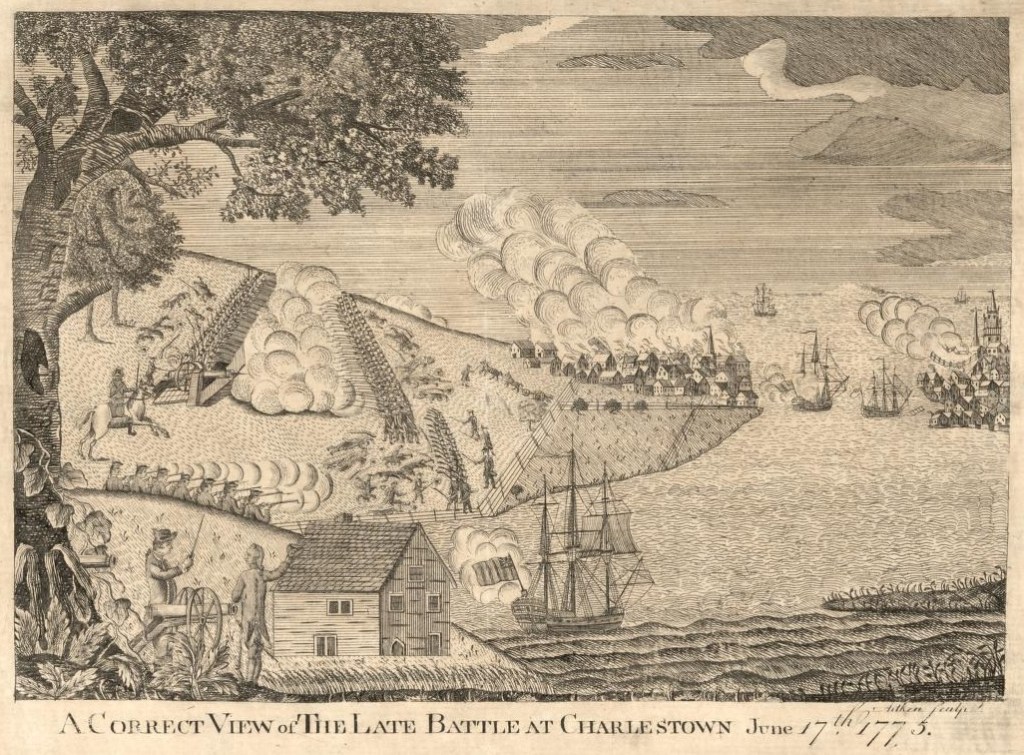
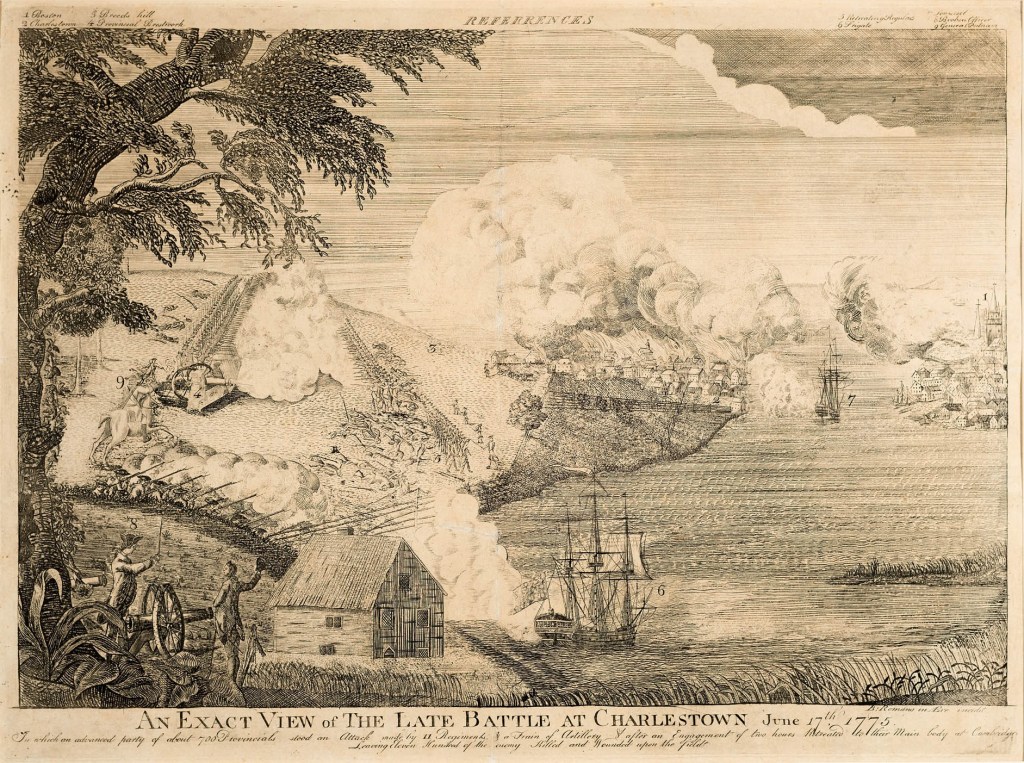
Immediately below that advertisement, Robert Aitken announced, “NOW engraving for the Pennsylvania Magazine, or American Monthly Museum, a neat and correct VIEW of the late BATTLE at CHARLESTOWN, not inferior to any hitherto proposed.”  Aitken, who was not among the printers listed as local agents for the Brooks and Romans print, promoted a competing print!  This one, however, “shall be printed in a size proper for the Magazine.”  The two prints looked strikingly similar, not unlike the competing prints of the Boston Massacre produced by Henry Pelham and Paul Revere in 1770, though one was larger than the other.  Aitken’s print measured 18 x 26 cm (approximately 7 x 10 inches), the right size to tuck it inside the magazine for delivery to subscribers.  Brooks and Romans’s print measured 31.5 x 42.2 cm (approximately 12.5 x 16.5 inches) on a 40.6 x 50.5 cm sheet (approximately 16 x 20 inches), perhaps making it a better candidate to frame and display.

Robert Aitken (engraver and publisher), “A Correct View of the Late Battle at Charlestown” (1775). Courtesy Library of Congress.

Subscribers to the Pennsylvania Magazine received the print as a premium.  Nonsubscribers could purchase the issue for “One Shilling and Sixpence, on account of the great expence of the engraving.”  On other occasions, including the September 16, 1775, edition of the Pennsylvania Ledger, Aitken advertised the price as one shilling per issue.  He now informed “those Gentlemen who incline to purchase this View of the Battle may be furnished with it at the moderate price of Sixpence.”  In effect, he did not give readers who purchased a single issue of the magazine any sort of discount, perhaps hoping to encourage them to subscribe to receive the print as a gift.  Whatever the case, Aitken’s print was slightly more expensive than the five shillings that Brooks and Romans charged for their uncolored print.

Nicholas Brooks (publisher) and Bernard Romans (engraver), “An Exact View of the Late Battle at Charlestown” (1775). Courtesy Massachusetts Historical Society.

Given the similarity of the prints, did Aitken pirate his “VIEW of the late BATTLE at CHARLESTOWN” from Brooks and Romans?  That had been the case with Revere issuing a print based on a drawing by Pelham before the artist managed to publish his own.  Or did Aitken collaborate with Brooks and Romans?  It was not the first time that an image that accompanied his magazine resembled one of their projects.  The July 1775 issue of the Pennsylvania Magazine featured a map, “A New and Correct Plan of the Town of Boston, and Provincial Camp.”  Aitken marketed it at the same time that Brooks and Romans published a map of eastern Massachusetts and northern Rhode Island that featured an inset showing a “Plan of BOSTON and its ENVIRONS 1775.”  The two did not resemble each other as much as the “VIEW” that each advertised.  Whether they collaborated or competed, Aitken and Brooks and Romans all aimed to disseminate a commemorative item that simultaneously kept buyers better informed and inspired them to support the American cause.

September 16

What was advertised in a revolutionary American newspaper 250 years ago today?

Pennsylvania Ledger (September 16, 1775).

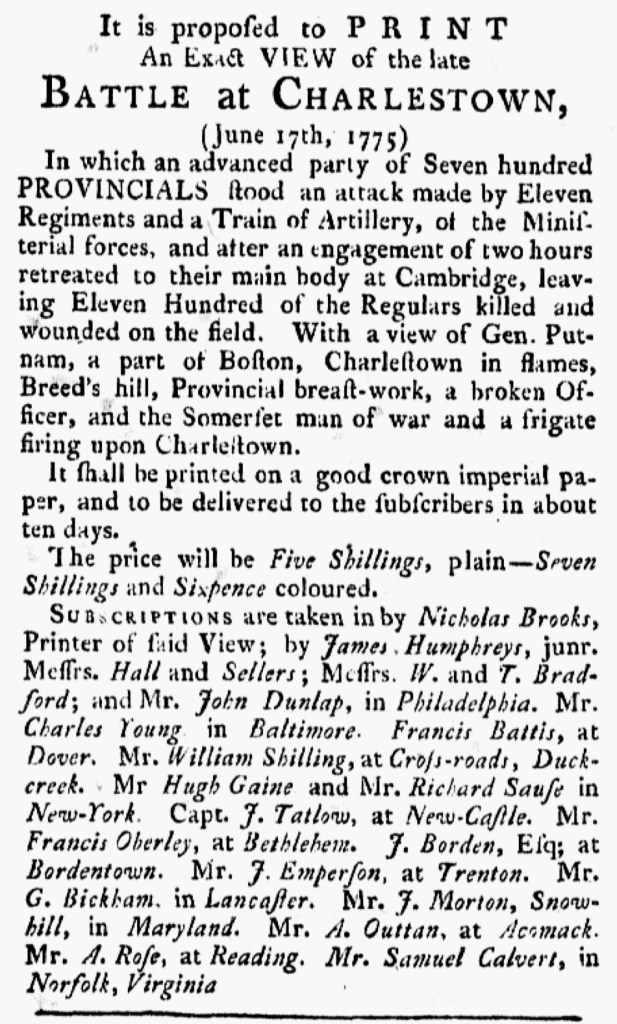
“It is proposed to PRINT An Exact VIEW of the late BATTLE at CHARLESTOWN.”

Bernard Romans, a cartographer, apparently met with sufficient success in marketing and publishing his “MAP, FROM BOSTON TO WORCESTER, PROVIDENCE AND SALEM” in the summer of 1775 that he launched a similar project as fall arrived.  He placed a subscription proposal for a print depicting “An Exact VIEW of the late BATTLE at CHARLESTOWN,” known today as the Battle of Bunker Hill, in the September 16, 1775, edition of the Pennsylvania Ledger.  The proposal stated that it “shall be printed on a good crown imperial paper” at a price of five shillings, “plain,” or seven shilling and six pence, “coloured.”

In promoting the print, Romans summarized the battle, though most readers likely already knew the details.  “[A]n advanced party of Seven hundred PROVINCIALS,” the cartographer narrated, “stood an attack made by Eleven Regiments and a Train of Artillery, of the Ministerial forces, and after an engagement of two hours retreated to their main body at Cambridge, leaving Eleven Hundred of the Regulars killed and wounded on the field.”  Even though the British prevailed, it was such a costly victory in terms of casualties that officers that British General Henry Clinton wrote in his diary, “A dear bought victory, another such would have ruined us.”  The Americans had reason to feel proud despite retreating.  Romans hoped to capitalize on that even as he aimed to publish a print that helped colonizers far from Boston visualize the battle.  The print included “a view of Gen. [Israel] Putnam,” an American officer, “a part of Boston, Charlestown in flames, Breed’s hill, Provincial breast-work, a broken Officer, and the Somerset man of war and a frigate firing upon Charlestown.”

As had been the case with his map, Romans collaborated with Nicholas Brooks, a shopkeeper and “Printer of said View” as well as local agents in several cities and towns from New York to Virginia.  The subscription proposal indicated that the print would be ready “to be delivered to the subscribers in about ten days,” not nearly enough time to disseminate the proposal and collect the names of subscribers before making the first impressions.  In both instances, Romans likely felt confident that consumers would be so interested in purchasing items that commemorated the newest chapter in the struggle against Britain that the demand for the map and the print would justify the expense of producing initial copies as well as prompt him to issue even more as local agents submitted their lists of subscribers.

August 19

What was advertised in a revolutionary American newspaper 250 years ago today?

Pennsylvania Ledger (August 19, 1775).

“Map of Boston … the engagements of Lexington and Bunker’s Hill.”

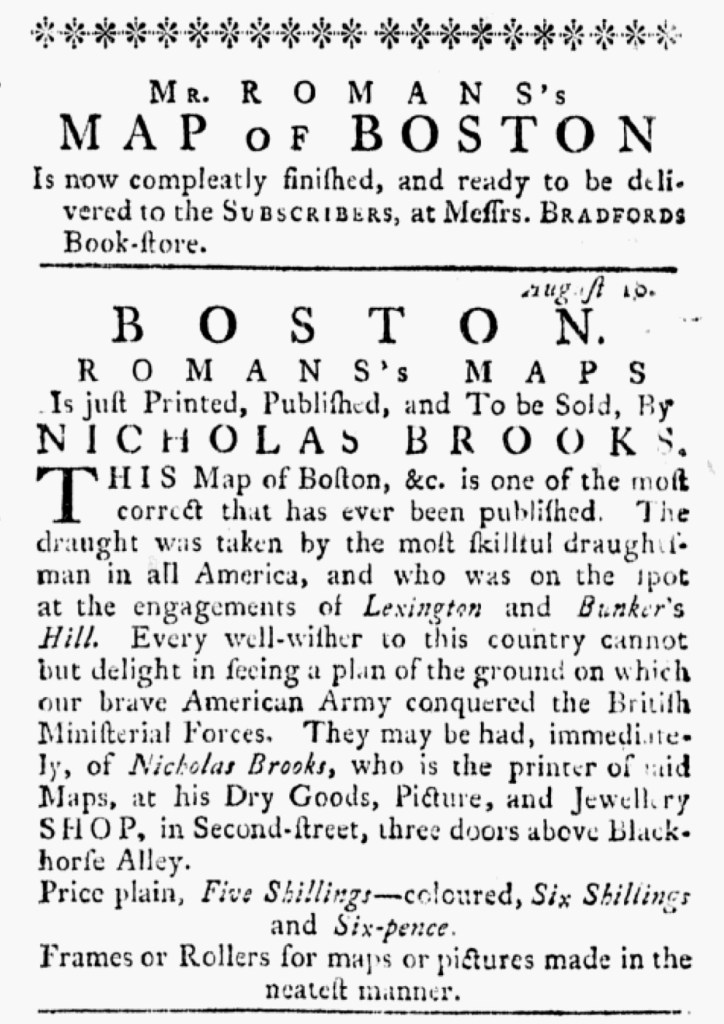
More advertisements for “MR. ROMANS’s MAP OF BOSTON” appeared in the August 19, 1774, edition of the Pennsylvania Ledger.  Bernard Romans, the cartographer who created a “MAP, FROM BOSTON TO WORCESTER, PROVIDENCE AND SALEM. Shewing the SEAT of the present unhappy CIVIL WAR in NORTH-AMERICA,” and Nicholas Brooks, the publisher, previously promoted the project with a broadside subscription proposal that began circulating in the middle of July and scattered references to the map at the end of advertisements in the Pennsylvania Ledger.  Two weeks earlier, for instance, Brooks ran an advertisement that featured an extensive list of merchandise available at his shop and added a nota bene of a single line: “Romans’s map of the seat of war near Boston, &c.”  Robert Aitken mentioned the map in a slightly longer nota bene when he advertised Military Instructions for Officers Detached in the Field.  An advertisement in Rivington’s New-York Gazetteer replicated the copy from the broadside.

Once the map was “completely finished, and ready to be delivered to the SUBSCRIBERS,” as William Bradford and Thomas Bradford put it in their advertisement, or “just Printed, Published, and To be Sold,” as Brooks proclaimed in his own notice, it received greater attention in newspaper notices.  Although many similar projects utilized subscription proposals in newspapers to generate demand attract orders in advance of publication, Romans and Brooks relied on their broadside subscription proposal during their first round of marketing and later added newspaper advertisements once the map was available for sale.

Just four months after the battles at Lexington and Concord, a remarkably short interval for such an endeavor, Brooks advertised copies of Romans’s map of Boston for sale at his “Dry Goods, Picture, and Jewellery SHOP” in Philadelphia.  He touted the quality of the map, declaring it “one of the most correct that has ever been published” and emphasiziong that the “draught was taken by the most skillful draughtsman in all America.”  As if that was not enough to sell it, Romans “was on the spot at the engagements of Lexington and Bunker’s Hill.”  Brooks marketed an eyewitness account of those important battles.  Furthermore, he asserted that consumers had a patriotic duty to examine the map, which they could do by purchasing it.  “Every well-wisher to this country,” Brooks trumpeted, “cannot but delight in seeing a plan of the ground on which our brave American Army conquered the British Ministerial Forces.”  Commemoration and commodification of the American Revolution occurred before the Continental Congress declared independence.

August 5

What was advertised in a revolutionary American newspaper 250 years ago today?

Pennsylvania Ledger (August 5, 1775).

“Romans’s map of the seat of war near Boston.”

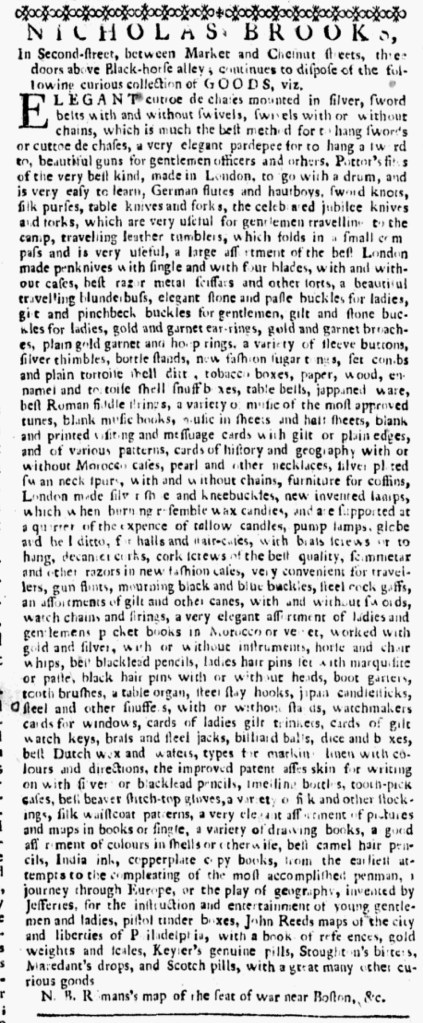
At the end of July 1775, Nicholas Brooks began running a new advertisement in the Pennsylvania Ledger.  It first appeared on July 29 and then again in the next two issues.  In it, Brooks hawked a “curious collection of GOODS” that he sold at his shop on Second Street in Philadelphia.  He listed everything from sword belts and “beautiful guns for gentlemen officers” and “gilt and stone buckles for ladies” to “razors in new fashion cases, very convenient for traveling” and “cork screws of the best quality” to “a very elegant assortment of ladies and gentlemans pocket books in Morocco velvet, worked with gold and silver” and “a variety of music of the most approved tunes.”  He also stocked “a very elegant assortment of pictures and maps in books or single.”  Brooks had already established “PRINTS and PICTURES” as a specialty.

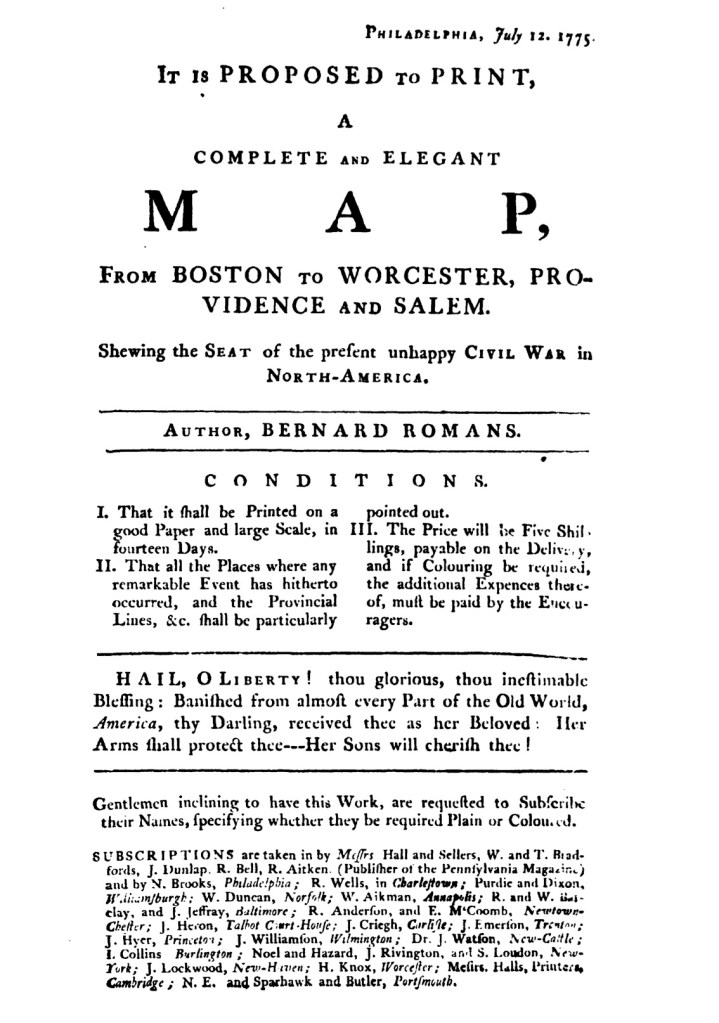
He concluded this advertisement with a nota bene that indicated he sold “Romans’s map of the seat of war near Boston,” but he did not say anything more about that item.  In addition, neither Brooks nor Bernard Romans, the cartographer and “AUTHOR” of the map, previously advertised the project in the Pennsylvania Ledger or any of the other newspapers printed in Philadelphia at the time.  Perhaps Brooks expected that readers were familiar with a broadside subscription proposal, dated July 12, that had been circulating or posted around town and beyond.  The subscription proposal featured the same copy as the advertisement for the map that ran in the August 3 edition of Rivington’s New-York Gazetteer, though the newspaper notice listed only local agents while the broadside gave a much more extensive list of printers, booksellers, and others who collected subscriptions in towns from New England to South Carolina.  James Rivington apparently adapted the broadside rather than composing copy for the advertisement when he inserted it in his newspaper.  That broadside documented a sophisticated network for inciting demand for the map and distributing it to subscribers.  In addition to the five printers and booksellers who collected subscriptions in Philadelphia, twenty-two local agents in eighteen towns in ten colonies collaborated with Brooks and Romans.  That list represented an “imagined community,” a concept developed by Benedict Anderson, of readers and consumers near and far who simultaneously examined the same map “Shewing the SEAT of the present unhappy CIVIL WAR in NORTH-AMERICA.”

Brooks did not limit his marketing of the map to the broadside subscription proposal and the nota bene at the end of an advertisement that cataloged dozens of items available at his shop.  He eventually ran newspaper advertisements devoted exclusively to the map, seeking to generate more interest and demand for such a timely and important work.

Broadside Subscription Proposal: “It Is Proposed to Print, A Complete and Elegant Map” (Philadelphia, 1775). Courtesy Library Company of Philadelphia.

**********

The Massachusetts Historical Society has digitized Romans’s map, accompanied by a brief overview of its significance and a short essay about Romans and other cartographers active during the era of the American Revolution.

May 26

What was advertised in a colonial American newspaper 250 years ago today?

Pennsylvania Journal (May 26, 1773).

“He finds them too numerous to insert in a news-paper, and will therefore furnish the curious with proper catalogues.”

In an advertisement that appeared in both the Pennsylvania Gazette and the Pennsylvania Journal on April 28, 1773, Nicholas Brooks promoted a “LARGE and curious collection of the most modern PRINTS and PICTURES” along with “stationary wares; jewellery, and dry goods.”  He pledged that “an advertisement of the particulars shall be inserted in a future paper.”  While he certainly preferred that prospective customers visit his shop and browse his inventory, Brooks also encouraged readers to look for that “advertisement of the particulars.”  An additional notice in the public prints gave him a second opportunity to entice consumers.

Three weeks later, Brooks placed a lengthy advertisement in the Pennsylvania Journal.  A notation at the end, “3w,” indicated that he intended for it to run for three weeks.  Extending two-thirds of a column, the advertisement listed many of the items from the “curious Collection of various GOODS.”  Brooks stocked everything from “Scotch thread and sewing silk” to “silver plated and other tea urns” to “best London made pen-knives and scissors” to “cards of history and geography, with and without Morocco cases.”  He mentioned “general atlases, containing 36 new and correct maps,” as he had done in his previous advertisement, yet he still did not have space for “the particulars” of that “LARGE and curious collection of the most modern PRINTS and PICTURES.”

Instead, the shopkeeper appended a nota bene at the end of his advertisement, advising that since he “has a very large quantity of elegant pictures, maps, copper plate writing, and music &c. he finds them too numerous to insert in a news-paper.”   Instead, he “will therefore furnish the curious with proper catalogues.”  Perhaps Brooks sent those catalogs to “the curious” who requested them, but he likely hoped that some prospective customers would visit his shop to pick up catalogs and, as long as they were there, examine his selection.  Distributing catalogs had the potential to increase foot traffic in his shop.

What form did that catalog have?  Was it a broadside or handbill with a list of pictures, maps, and other items printed on a single sheet that gave prospective customers an opportunity to glimpse all of the items at once?  Or was it a pamphlet with multiple pages that prospective customers had to flip through?  In different ways, both formats testified to the range of choices that Brooks made available.  How were the contents organized?  Did they have headers to help direct prospective customers to items of interest?  Did the catalog include commentary or blurbs about any of the items to aid in marketing them?  These questions remain unanswered since no copy of the catalog has yet been identified.  That Brooks disseminated catalogs, however, testifies to the wider distribution of advertising in early American than what has been cataloged among the holdings of research libraries, historical societies, and private collections.

April 28

What was advertised in a colonial American newspaper 250 years ago today?

Pennsylvania Gazette (April 28, 1773).

“A LARGE and curious collection of the most modern PRINTS and PICTURES.”

Nicholas Brooks regularly advertised a variety of merchandise available at his shop in Philadelphia in the early 1770s, though he specialized in visual images to adorn homes and offices and often highlighted those items.  Such was the case in his advertisement in the April 28, 1773, edition of the Pennsylvania Gazette.  Brooks promoted a “LARGE and curious collection of the most modern PRINTS and PICTURES” that he recently imported from London.

His new inventory included a “variety of maps of the world, and each quarter,” as well as a “general atlas, containing 36 new and correct maps.”  Those maps helped colonizers in Philadelphia, the largest city in British North America yet also an outpost in a global empire, envision their location in relation to London, other colonies, and faraway places connected via networks of trade that brought vessels from Europe, Africa, and the Caribbean to their bustling port.  Other items at Brooks’s shop also allowed colonizers to contemplate their connections to the empire, especially the cosmopolitan city at its center.  The collection of prints included “the different Macaronies of the present time, now in the greatest vogue in London.”  The term “macaroni” referred to young men, many of whom traveled in Europe, who imitated the extravagant fashions popular on the continent.  These prints gave colonizers in Philadelphia an opportunity to glimpse current fashions adopted by some of the elite in London, providing a guide for dressing themselves to demonstrate their sophistication and gentility.  For others, however, the prints served as a cautionary tale and a means of critiquing the excesses of young men who wallowed in too much luxury.  Satirical prints presented young men as feminized by their attention to fashion and their participation in consumer culture.

Even as Brooks offered such prints for sale at his shop, he also advertised jewelry and dry goods, almost certainly including textiles and garments, for customers to outfit themselves according to the latest fashions.  Colonizers had complicated relationships with consumer culture and the array of goods presented to them by merchants, shopkeepers, tailors, milliners, and other advertisers.  They critiqued even as they indulged, attempting to find the right level of participation that testified to their good taste without impugning their character by going too far.

March 17

What was advertised in a colonial American newspaper 250 years ago today?

Pennsylvania Journal (March 17, 1773).

“NOVELTIES.”

Nicholas Brooks frequently promoted maps, prints, and other products in the pages of Philadelphia’s newspapers in the early 1770s.  In an advertisement in the March 17, 1773, edition of the Pennsylvania Journal, he peddled “NOVELTIES” for the amusement of consumers.  Today, a headline for the same items might instead say “CARDS and GAMES” to attract the attention of prospective customers seeking leisure activities.

Brooks listed three games his notice, one board game and two card games.  In “THE Royal Geographical Amusement, or the European Traveller, designed for the Grand Tour,” players learned about geography as they moved their tokens around a map of Europe.  Brooks indicated that he sold the version of the game “by Doctor Nugent,” suggesting that he stocked a copy produced in 1770 by Carington Bowles in London rather than the original published by Thomas Jefferys in London in 1768.  This board game became the first known case involving maps and copyright infringement.  Copyright and Cartography provides an overview of the case as well as images of both maps/gameboards.  Robert Sayer produced another version, attributed to “Dr. Journey,” in 1774.  The game became popular enough that R.H. Laurie continued to produce it in 1823.  The Victoria and Albert Museum provides both the rules and an image of the map/gameboard. Players apparently read descriptions of each location as they moved their tokens around Europe.

In addition, Brooks sold “Geographical Cards, or a View of the principal Cities of the known World, designed for the recreation of young Gentlemen and Ladies” and “Cards of Antient History.”  John Ryland, who ran a boarding school in Northampton, created both games.  In the full title for the “Geographical Cards,” Ryland recommended their use in boarding schools.  Bowles printed the fifty-two “Geographical Cards” in 1770.  He presumably supplied Brooks with the “Cards of Antient History” as well, sending him several “NOVELTIES” to sell to colonizers in Pennsylvania.

Shopkeepers often included playing cards among the merchandise they listed in their advertisements.  Brooks attempted to distinguish these games from “the depredations daily committed upon all the finest feelings of humanity by the common gambling Cards.”  He presented the history and geography games as an “elegant and chaste invention” that would preserve the “innocence” of those who played them.  As an added bonus, these games educated players as they entertained them.  Given the critiques of luxury and leisure aimed at those who too enthusiastically participated in the transatlantic consumer revolution, Brooks sought to help prospective customers justify purchasing and playing these games.