May 31

What was advertised in a revolutionary American newspaper 250 years ago today?
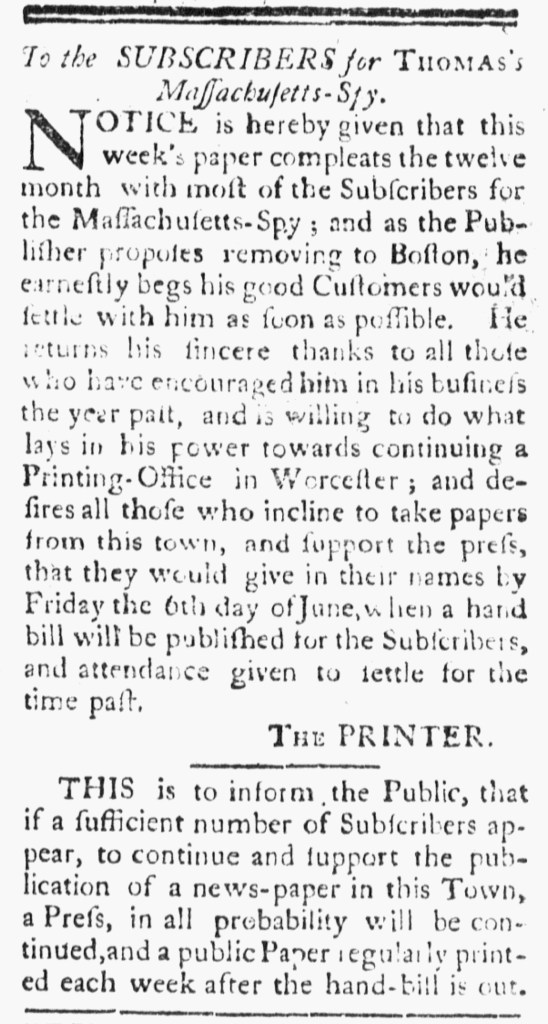
Thomas’s Massachusetts Spy (May 31, 1776).

“A Press, in all probability will be continued, and a public Paper regularly printed each week.”

A notice “To the SUBSCRIBERS for THOMAS’s Massachusetts-Spy” in the May 31, 1776, edition informed that that “this week’s paper compleats the twelve month with most of the Subscribers.”  With the period for an annual subscription coming to an end, Isaiah Thomas “earnestly begs his good Customers would settle with him as soon as possible.”  That was even more imperative because the printer “proposes removing to Boston.”  Thomas had not intended to settle in Worcester.  In the winter and spring of 1775, he advertised plans to open a printing office in that town and set up a junior partner to oversee the business there, including publishing Worcester’s first newspaper.  Events in Boston, however, prompted Thomas to flee to Worcester and run the printing office himself.  He left shortly before the battles at Lexington and Concord and continued printing the Massachusetts Spy in Worcester during the siege of Boston.  After British forces evacuated the city on March 17, 1776, he contemplated returning to Boston.

What did that mean for Worcester?  Thomas expressed appreciation “to all those who have encouraged him in his business the year past” and declared that he “is willing to do what lays in his power towards continuing a Printing-Office in Worcester.”  With most of the annual subscriptions for Thomas’s Massachusetts Spy coming to an end, he needed to assess demand for continuing to publish a newspaper there.  To that end, he requested that “all those who incline to take papers from this town, and support the press, … would give in their names by Friday the 6th day of June.”  At that time, he would publish a handbill “for the Subscribers” with more information and collect subscription fees not yet paid.  Whether the printing office and Worcester’s first local newspaper closed depended on how many subscribers made a commitment to supporting the venture.  “[I]f a sufficient number of Subscribers appear, to continue and support the publication of a news-paper in this Town,” Thomas advised, “a Press, in all probability will be continued, and a public Paper regularly printed each week.”  With the May 31 edition, the printer suspended publication of the newspaper, yet his notice gained that “sufficient number of Subscribers” that three weeks later William Stearns and Daniel Bigelow distributed a new issue on June 21.  They altered the title from Thomas’s Massachusetts Spy to the Massachusetts Spy.  Two years later, Thomas returned to Worcester, resumed his role as printer, and changed the title back to Thomas’s Massachusetts Spy.

April 8

What was advertised in a colonial American newspaper 250 years ago today?

Massachusetts Gazette and Boston Weekly News-Letter (April 8, 1773).

“The American Alarm or the Bostonian Pleas for the Rights and Liberties of the People.”

The headline proclaimed, “THE ALARM.”  As readers of the Massachusetts Gazette and Boston Weekly News-Letterexamined the advertisement more closely, they learned that David Kneeland and Nathaniel Davis published and sold a pamphlet by an author who referred to himself as the “BRITISH BOSTONIAN” and that many residents of Boston knew was John Allen.  In December 1772, Allen and the printers published a subscription notice calling on colonizers to reserve copies of “The AMERICAN ALARM, Or, a Confirmation of the Boston Plea. For the Rights and Liberties of the People.”

In the original notice, Allen stated that the pamphlet was “Humbly addressed to the King and Council, and to the Constitutional sons of Liberty in America.”  While that dedication appeared on the title page, the author and the printers updated the advertisement to include “His Most Sacred Majesty George the Third, … his Excellency the Governor of the Province of the Massachusetts-Bay, … the Honorable the People’s Council, … the Honorable House of Representatives, and … the worthy Sons of Freedom throughout America.”  In both instances, the promoters suggested that a broad audience would benefit from perusing the pamphlet, not just those who already agreed with the British Bostonian’s arguments and conclusions.  Still, addressing “the Constitutional sons of Liberty in America” and “the worthy Sons of Freedom throughout America” targeted the audiences that Allen and the printers considered most likely to purchase the pamphlet.

The advertisement instructed subscribers “to call or send for their Books,” suggesting that customers had indeed submitted their names to Kneeland and Adams after seeing the notice in the newspaper four months earlier.  In the time that elapsed since then, Allen disseminated another political pamphlet, that one also printed by Kneeland and Adams.  Allen’s Oration on the Beauties of Liberty or the Essential Rights of the Americans garnered greater attention in Boston and beyond than the first pamphlet he advertised.  As John M. Bumsted and Charles E. Clark note, the Oration “proved to be one of the best-selling pamphlets of the pre-Revolutionary crisis, passing through seven editions in four cities between 1773 and 1775.”[1]  By the time The American Alarm went to press, colonizers had access to two editions of the Oration.  Even though The American Alarm did not become as popular as the Oration, its publication likely contributed to debates underway in the colonies and, eventually, the decision to declare independence.  Allen advanced a novel argument in The American Alarm in 1773.  According to Bumsted and Clark, “The important point was not that Allen denied the applicability of English law in America, but that he did so with a simple, direct statement of fact rather than through a long rehearsal of legal arguments.  He assumed as given what others in America sought to prove.”[2]  The more moderate tone of the Oration, in contrast, may have made it more popular among readers prior to the skirmishes at Lexington and Concord since it aligned more closely with public opinion in the early 1770s.

**********

[1] John M. Bumsted and Charles E. Clark, “New England’s Tom Paine: John Allen and the Spirit of Liberty,” William and Mary Quarterly, 3rd ser., 21, no. 4 (October 1964): 561.

[2] Bumstead and Clark, “New England’s Tom Paine,” 568.