October 23

What was advertised in a colonial American newspaper 250 years ago this week?
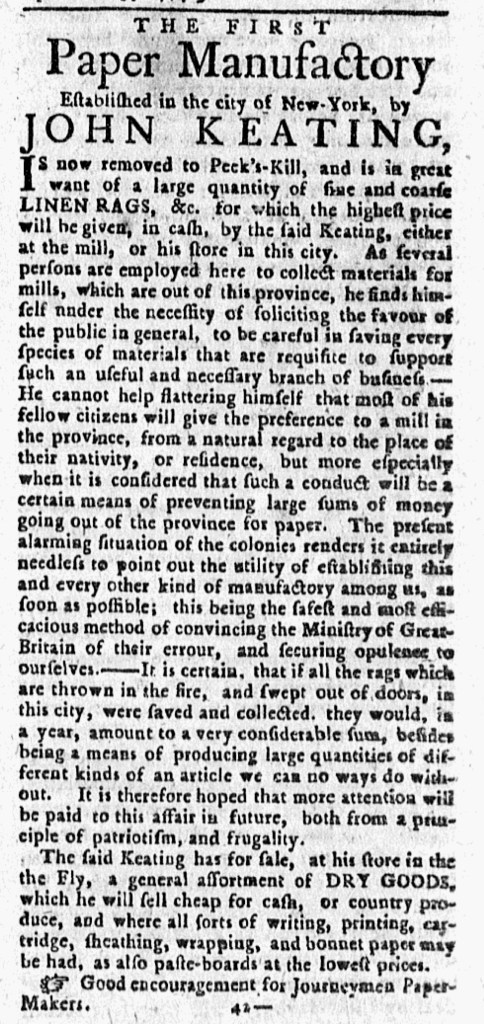
Supplement to the New-York Journal (October 20, 1774).

“This being the safest and most efficacious method of convincing the Ministry of Great-Britain of their errour.”

John Keating frequently advertised the “FIRST Paper Manufactory Established in the city of New-York” in the late 1760s and early 1770s.  He often updated his advertisement, yet he incorporated familiar themes about patriotism and supporting the local economy.  He also encouraged readers to save linen rags to make into paper, underscoring that they could play an important role in the production of paper made in the colonies as well as its consumption.

Such was the case in an advertisement in the supplement that accompanied the October 20, 1774, edition of the New-York Journal.  Keating opened with an announcement that his enterprise “is in great want of a large quantity of fine and coarse LINEN RAGS.”  He encouraged “the public in general, to be careful in saving every species of materials that are requisite to support such a useful and necessary branch of business.”  In previous advertisements, he offered instructions for collecting and saving rags as part of the rituals of household management, entrusting women in particular with supplying the resources necessary for the operation of the local paper mill and, in the process, lauding the patriotic spirit of those who heeded his call.  In this instance, he did not distinguish men and women, instead stating that when it came to choosing which paper to consume “that most of his fellow citizens will give the preference to a mill in the province … when it is considered that such a conduct will be a certain means of preventing large sums of money going out of the province.”  In addition to supporting the local economy, Keating asserted that the “present alarming situation of the colonies renders it entirely needless to point out the utility of establishing this and every other kind of manufactory among us, as soon as possible.”  Such a plan, he declared, was “the safest and most efficacious method of convincing the Ministry of Great-Britain of their error, and securing opulence to ourselves.”  Keating effortlessly connected politics, commerce, and the livelihoods and good fortune of colonizers who benefited from domestic manufactures as alternatives to imported goods.  He did so once again with a plea “that more attention will be paid to this affair in the future, both from a principle of patriotism, and frugality.”  In so doing, Keating presented a multitude of reasons for readers to support American industry and buy American products as the imperial crisis intensified.

March 24

GUEST CURATOR:  Madison Kenney

What was advertised in a colonial American newspaper 250 years ago today?

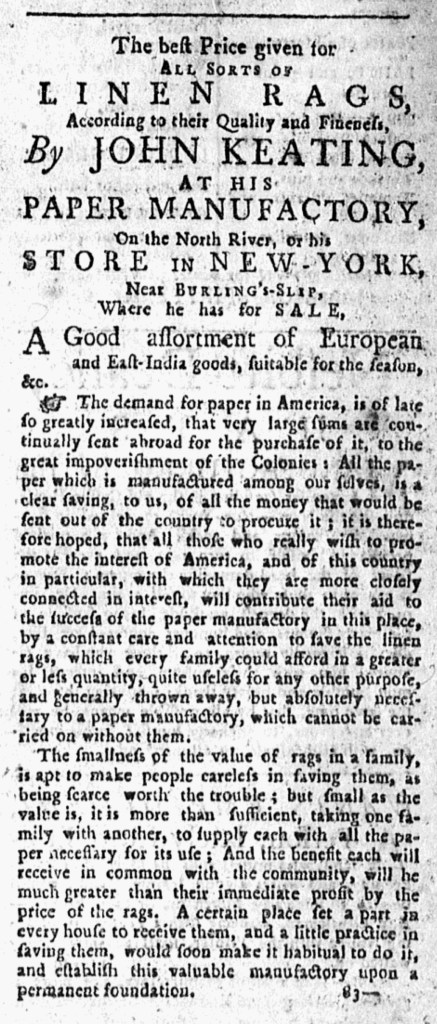
New-York Journal (March 24, 1774).

“The best Price given for ALL SORTS OF LINEN RAGS.”

John Keating, the owner of a “PAPER MANUFACTORY” in New York, uses politics as an advertising strategy. In 1774, “The demand for paper in America, is of late so greatly increased, that very large sums are continually sent abroad, for the purchase of it.” Keating attempted to take advantage of the political tension with Britain by connecting the donation of spare rags to make into paper with patriotism. He argued, “All those who really wish to promote the interest of America … will contribute their aid to the success of the paper manufactory in this place.”

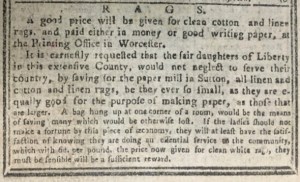
Advertisements asking families to save linen rags to support American printing were not uncommon during the era of the American Revolution. An advertisement printed on the back of Thomas’s Massachusetts, New-Hampshire, and Connecticut Almanack for the Year of our Lord Christ 1779 claims “ fair daughters of Liberty…would not neglect to serve their country, by saving for the paper mill in Sutton, all linen and cotton and linen rags.” Again, entrepreneurs who made paper or printed on it used patriotism to pressure households to support American industry by donating rags. Kayla Haveles argues that printing was “as vital to revolution as guns and gunpowder” because the colonists used it to spread ideology and attack the British.

Thomas’s Massachusetts, Connecticut, and New-Hampshire Almanack for the Year of Our Lord Christ 1779 (Worcester: Isaiah Thomas, 1778).

Additionally, the frequency of these advertisements highlights the contributions of women in the Revolution. Both advertisements focus on saving rags in the home. Keating’s advertisement asked every family to save spare rags in their household. Women were responsible for the housework so Keating’s call to action targeted women. The advertisement on the back of the almanac asked “daughters of Liberty” to save rags. Both advertisements are examples of how women contributed to the Revolution by supporting the American economy.

**********

ADDITIONAL COMMENTARY:  Carl Robert Keyes

John Keating had been placing similar advertisements for the “NEW-YORK Paper MANUFACTORY” for years by the time this advertisement appeared in the March 24, 1774, edition of the New-York Journal.  The Adverts 250 Project first featured one of his advertisements that offered “Ready Money for clean Rags” that ran in that newspaper on February 18, 1768.  During the six years in between, Keating maintained an almost constant presence in the public prints, encouraging colonizers, especially women, to collect rags for paper production and explaining the patriotic benefits of their efforts.  He advertised at times when relationships with Parliament deteriorated, including when nonimportation agreements went into effect to protest various legislation, as well as when the situation cooled and most merchants, shopkeepers, and consumers returned to business as usual.  Keating remained a steady voice in favor of “domestic manufactures” or goods produced in the colonies.

In this instance, Keating ran his advertisement at a time of crisis.  Throughout the colonies, the destruction of the tea in Boston the previous December remained a topic of conversation, including in New York.  The Sons of Liberty anticipated the arrival of the Nancy with a cargo of tea that they did not want landed in their city.  Keating’s advertisement, which had been running since before the Boston Tea Party, appeared on the last page of the March 24 issue, interspersed among other advertisements.  A notice that the Sons of Liberty would meet every Thursday evening “till the Arrival and Departure of the TEA SHIP,” on the other hand, made its second appearance, this time in the first column on the first page.  Only tables showing prices current and sunrise, sunset, and high tide preceded the announcement.  Its placement made it more likely that readers would see it, while also framing how they read other advertisements in the issue.  Most readers likely did not need that notice from the Sons of Liberty to influence their reaction to Keating’s advertisement calling on “all those who really wish to promote the interest of America” to do their part, considering how widely colonizers discussed the politics of tea at the time.  Still, the combination of print culture and public discourse occurring everywhere from the town common to taverns made Keating’s appeals to patriotism even more urgent.

December 5

What was advertised in a colonial American newspaper 250 years ago this week?

New-York Journal (December 2, 1773).

“Those who really wish to promote the interest of America … will contribute their aid to the success of the paper manufactory.”

John Keating, the proprietor of a “PAPER MANUFACTORY” near New York, had a task for every household in the colonies: collect rags to make into paper.  That might seem like an insignificant act, he argued in an advertisement that appeared week after week in the New-York Journal, but it had value beyond measure.  “The smallness of the value of rags in a family, is apt to make people careless in saving them, as being scarce worth the trouble,” Keating acknowledged.  However, “small as the value is, it is more than sufficient, taking one family with another, to supply each with all the paper necessary for its use.”  This endeavor, like so many acts of protest against the abuse of Parliament, depended on colonizers working in unison.  Cooperation yielded strength.  Keating elaborated on his vision: “And the benefit each will receive in common with the community, will be much greater than the immediate profit by the of the rags.”  To achieve that goal, he encouraged every household to designate a spot for collecting rags, noting that “a little practice in saving them, would soon make it habitual to do it, and establish this valuable manufactory upon a permanent foundation.”

True patriots would heed this call to help meet the demand for paper in America, “of late so greatly increased, that very large sums are continually sent abroad for the purchase of it.”  Importing paper instead of producing it locally resulted in “the great impoverishment of the colonies,” an assertion that Keating made in advertisement after advertisement for several years in the late 1760s and early 1770s.  “All the paper which is manufactured among ourselves,” he proclaimed, “is a clear saving, to us, of all the money that would be sent out of the country to procure it.”  Rather than exacerbate a trade imbalance with England, “those who really wish to promote the interest of America … will contribute their aid to the success of the paper manufactory in this place.”  That meant purchasing paper from Keating, yet his advertisements usually emphasized participating in the production of paper rather than the consumption of his product.  Given the demand, he likely assumed that he could sell paper as quickly as he produced it.  He needed the most assistance with procuring the necessary materials, “linen rags, quite useless for any other purpose, and generally thrown away.”  The strength of the local economy depended on the efforts of the members of every household.  According to Keating, wives and mothers, indentured servants and enslaved people, and youths and children all had a role to play in supporting this important industry in New York during the era of the American Revolution.

February 1

What was advertised in a colonial American newspaper 250 years ago today?

New-York Gazette and Weekly Mercury (February 1, 1773).

He most humbly addresses the Fair Sex, requesting their aid.”

John Keating regularly offered “READY MONEY … for CLEAN LINEN RAGS” in the New-York Gazette and Weekly Mercury in the late 1760s and early 1770s.  The papermaker needed as many rags as he could gather to supply his mill with raw materials.  To convince readers to make an effort to collect and submit rags, he developed appeals that emphasized both commerce and devotion to the best interests of the colonies.

In an advertisement that ran on February 1, 1773, for instance, Keating stated that the “advantages that must result to this colony from the establishment of manufactories in it, are so obvious that the subject needs no elucidation.”  Then he elucidated.  “Since paper manufactories were established in Pennsylvania, the money saved and brought into that province, the money saved and brought into the province” amounted to “the many thousand pounds of which is annually drained of[f] by purchasing paper in England.”  Supporting domestic manufactures, goods produced in the colonies, helped to address the trade imbalance with Great Britain.  Keating challenged readers to think about what more they accomplish by working together.  “Might not every shilling of this money be saved?  Have we not materials amongst ourselves?  Is our patriotism all pretence …?

New Yorkers did indeed already have the materials necessary for making paper, clean linen rags.  Keating suggested that women played a vital role in sustaining the patriotic project that he pursued, declaring that he “most humbly addressed the Fair Sex, requesting their aid, without which it will be impossible for him to establish this manufactory upon a respectable or prudent footing.”  He requested that every “frugal matron … hang up a bag … and take care to put every piece of linen that is unfit for any other use, in it.”  When the bag was full, the frugal matron would sell the contents to Keating in an eighteenth-century version of recycling to support a good cause.  The papermaker indicated that in return for the clean linen rags the frugal matron would receive enough money to “supply herself and family with the very essential article of pins.”  Just as significantly, “she will have the satisfaction of being conscious of contributing her part to the advancement of her country.”  Women’s industry served a dual purpose when it manifested patriotism.

The project did not depend solely on those frugal matrons.  Keating also asked “young ladies to co-operate … in saving rags,” though he presented a more romantic rationale to them.  The papermaker asked young women to “observe a very curious remark made by the celebrated Mr. Addison in the Spectator, ‘That a young lady who sends her shift to the paper mill, may very possibly in less than six months, have it returned made into a piece of fair paper, upon which her lover has written a billet doux.’”  Although Keating (and Addision) asked young women to imagine love letters, their shifts and other linen garments may just as likely been transformed into newspapers that kept their households informed about the imperial crisis that faced New York and other colonies.

Women, both “frugal matrons” and “young ladies,” participated in politics and expressed their patriotism when they heeded the call of papermakers who encouraged them to collect clean linen rags.  Similarly, their actions and decisions made an impact when they produced homespun textiles and garments and participated in nonconsumption agreements.  During the era of the American Revolution, both men and women understood that the personal was political.  That included gathering clean linen rags in “a bag in some convenient part of the house.”

July 9

What was advertised in a colonial American newspaper 250 years ago today?

New-York Journal (July 9, 1772).

“Promote the interest of America.”

John Keating operated “PAPER MANUFACTORIES, At and near New-York” in the late 1760s and early 1770s.  He regularly advertised “ALL sorts of paper and paste board,” usually enhancing his newspaper notices with commentary intended to convince consumers to purchase goods produced in the colonies.  In an advertisement in the July 9, 1772, edition of the New-York Journal, for instance, he asserted that his paper “and other articles manufactured here, make a clear saving to this country of all the money that would have been sent out to purchase them from abroad.”  A greater number of advertisers promoted domestic manufactures when nonimportation agreements remained in effect, providing alternatives for consumers who wished for their shopping habits to match their politics, but such appeals tapered off when trade resumed.  Keating, on the other hand, remained adamant in calling on “all those who really wish to promote the interest of America” to “contribute their aid to the success of this undertaking.”

Keating imagined readers as more than consumers who would purchase his paper.  He also envisioned them as partners in producing it.  He needed resources, especially linen rags, “which are generally destroyed or thrown away as useless, tho’ they are absolutely necessary to a paper manufactory, which cannot be carried on without them.”  Colonizers played a vital role in supporting the production of paper in New York, “with which their own interest is closely connected.”  Some colonizers discarded rags that could have been transformed into paper at one of Keating’s “MANUFACTORIES.”  Others sent “considerable quantities … to other colonies,” prompting Keating to lament that the “the legislature have not yet thought proper to prohibit the exportation” of rags.  Even though the colonial assembly refused to act on that matter, colonizers in New York could choose to collect and send rags to Keating on their own.  He expressed his desire that “a due regard to their own interest will incline the inhabitants of this country to supply a manufactory among themselves.”

Keating invited colonizers to participate in both the production and consumption of paper made at his “MANUFACTORIES” in and near New York.  He reiterated that in doing so they not only supported a local business but also attended to “their own interest” in making goods produced in the colonies more widely available at lower prices than imported alternatives.  Doing so corrected trade imbalance that resulted from the colonies exporting resources and importing finished goods.  Keating advocated for the colonies producing more of the goods they consumed, but doing so required widespread cooperation.

March 12

What was advertised in a colonial American newspaper 250 years ago today?

Mar 12 - 3:12:1770 New-York Gazette and Weekly Mercury
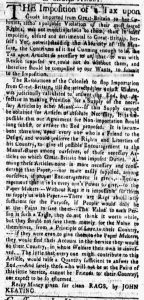
New-York Gazette and Weekly Mercury (March 12, 1770).

“… from a Principle of Love to their Country.”

John Keating became a familiar figure in advertisements that appeared in the New-York Gazette and Weekly Mercury and other newspapers in the late 1760s and early 1770s.  He operated a paper manufactory and presented his enterprise as providing a patriotic alternative to paper imported from Britain.  He objected to the duties that Parliament levied on imported paper in the Townshend Acts while simultaneously noting that consumers could foil such attempts to tax them by purchasing paper made locally.  He also frequently took the pages of the New York’s newspapers to encourage colonists to participate in the production of paper by collecting rags and turning them over to him to be transformed into paper, as he did in the March 12, 1770, edition of the New-York Gazette and Weekly Mercury.

His entreaty commenced with a prologue that could have been part of a political tract rather than a newspaper advertisement: “THE Imposition of a Tax upon Goods imported from Great-Britain to her Colonies, altho’ a palpable Violation of their most sacred Rights, was not more injurious to them, than in itself impolitic, absurd and detrimental to Great-Britain, herself: Yet, notwithstanding the Absurdity of the Measure, the Contrivers of it had Cunning enough to lay the Tax upon Articles of necessary to us, that it was with Reason supposed we could not do without them, and therefore should be compelled by our Wants, to submit to the Imposition.”  From there, Keating outlined the nonimportation agreements that went into effect in several colonies, noting that “Friends to their Country” could play an important role in continuing to make paper available if only they would collect their rags and turn them over to the paper manufactory.  Keating estimated that there “are Rags abundantly sufficient for the Purpose” that colonists should save “from a Principle of Love to their Country.”

Keating frequently made such appeals, but on this occasion his exhortation may have gained additional urgency.  It ran next to a news item dated “BOSTON, March 1” that reported “the melancholy Affair at the North End.”  The Massachusetts Historical Society provides this summary of events that took place on February 22: “Ebenezer Richardson, a customs informer, fired a musket through a broken window in his house at a crowd of young men and boys who had been taunting customers of a store selling British imports.”  In addition to wounding others, Richardson killed Christopher Seider, age eleven.  His funeral on February 26 was a significant event.  According to the report in the New-York Gazette and Weekly Mercury, “a great Multitude of People assembled in the Houses and Streets to see the Funeral Procession, which departed “from Liberty-Tree.”  Killed less than two weeks before the Boston Massacre, Seider could be considered the first casualty of the American Revolution.  News of that “Bloody Massacre,” as Paul Revere labeled it, did not yet appear in the New-York Gazette and Weekly Mercury, but the death of Seider may have been sufficient to put Keating’s calls for colonists to collect rags into new perspective.  He offered a practical means for “Service they would do their Country, in whose Welfare their own is involved.”

**********

For a more complete accounting of the death and burial of Christopher Seider, see the series of articles by J.L. Bell on Boston 1775.

July 9

What was advertised in a colonial American newspaper 250 years ago this week?

Jul 9 - 7:6:1769 New-York Journal
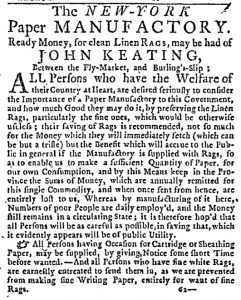
New-York Journal (July 6, 1769).

“Ready Money, for clean Linen RAGS.”

By the first week of July in 1769, John Keating’s advertisement for the “NEW-YORK Paper MANUFACTORY” became a familiar sight in the New-York Journal. Keating called on colonists, especially “ALL Persons who have the Welfare of their Country at Heart,” to collect clean linen rags and turn them over to the paper manufactory to be made into paper. He offered “Ready Money” for rags, but encouraged readers to deliver rags “not so much for the Money they will immediately fetch” but instead for “the Benefit which will accrue to the Public in general” if the manufactory received enough rags “to make a sufficient Quantity of Paper, for our own Consumption.”

This was particularly important in the late 1760s because the Townshend Acts levied duties on imported paper. As part of their resistance efforts, colonists boycotted a vast array of imported goods, not just those subject to the new taxes, and encouraged “domestic manufactures” or local production as an alternate means of acquiring goods while simultaneously bolstering the colonial economy. Keating argued that consumers who purchased paper from the New-York Paper Manufactory kept “Sums of Money” in the colony that were otherwise “annually remitted” across the Atlantic. Furthermore, the manufactory employed “Numbers of poor People” who kept that money “in a circulating State” in the colony, rather than lost to merchants, manufacturers, and Parliament in Britain. Keating deployed a “Buy American” campaign during the imperial crisis, before thirteen colonies declared independence.

In its most recent iteration, Keating’s advertisement appeared in the New-York Journal at least once a month since its first insertion on February 9, 1769. It also ran on February 16, March 23, April 20, May 18, June 8, and July 6. This copy for this iteration, for the most part, replicated a similar advertisement that ran in the summer of 1768. Over the course of a year, Keating was consistent in the message he communicated to colonists, encouraging them to participate in both the production and consumption of paper from the New-York Paper Manufactory.

The sporadic appearance of his advertisement in the New-York Journal raises questions about the arrangements Keating made with John Holt, the newspaper’s printer. Holt and others who worked at his printing office kept the type set over the course of several months, intending to insert the advertisement repeatedly. It ran once a month, but not on a regular schedule, such as in the first issue of the month. Did it appear when Keating ran low on rags and instructed Holt to run the advertisement once again in hopes of obtaining the materials he needed to operate his business? Did Holt insert Keating’s advertisement when running low on other content and needing to fill space? Did the two offer in-kind services to each other, such a supply of paper in exchange for advertising? Did Holt charge reduced advertising rates for Keating? After all, as a printer, Holt had a particular interest in having access to paper that may have prompted him to cultivate a relationship with the proprietor of the New-York Paper Manufactory.

By itself, any insertion of Keating’s advertisement tells a story of politics and the production and consumption of paper when colonists answered the Townshend Acts with nonimportation agreements. The repeated insertion of the advertisement, however, hints at another story about the business practices at both the New-York Journal and the New-York Paper Manufactory. Ledgers and correspondence, if they still exist, might shed more light on Keating’s advertising campaign. Without additional sources, the sporadic yet frequent insertion of the same advertisement for the New-York Paper Manufactory in the New-York Journal over the course of several months testifies to a message regularly communicated to readers while obscuring some of the decisions made by both the printer and the paper manufacturer in the process of presenting arguments in favor of supporting this local enterprise.

February 23

What was advertised in a colonial American newspaper 250 years ago today?

New-York Journal (February 23, 1769).

“The imposition laid upon us in the use of British paper.”

Although colonial printers liberally reprinted news items and editorial pieces from newspaper to newspaper, they only infrequently reprinted advertisements. After all, advertisements usually addressed local and regional audiences. In addition, paid notices were an important revenue stream that made colonial newspapers viable ventures. As a result, printers had few reasons to reprint advertisements from the newspapers they received from their counterparts in other cities and towns. On occasion, some printers did reprint advertisements that they considered either entertaining or instructive. Such was the case for an advertisement from the February 16, 1769, edition of the Pennsylvania Journal that John Holt reprinted just a week later in the February 23 edition of the New-York Journal.

William Bradford and Thomas Bradford had inserted an advertisement offering “Ready MONEY for CLEAN LINEN RAGGS” that Pennsylvania’s “Paper Manufactory” could make into paper, thus supporting the local economy, eliminating dependence on paper imported from England, and avoiding the duties imposed by the Townshend Act. The Bradfords conceived of saving rags as a political act rather than a mundane chore, charging “Ladies” to express “their love of liberty” by taking the lead in supporting this particular act of resistance to Parliament’s overreach.

Holt eliminated any mention of the Bradfords and their “Pennsylvania Writing PAPER,” considering them irrelevant to the lesson he wished to impress on readers of the New-York Journal. He reprinted the rest of the advertisement in its entirety, along with a brief introduction: “For the Encouragement of the Paper Manufactory, the following Advertisement is copied from the Pennsylvania Journal, and being equally applicable to this Province, is earnestly recommended to the Consideration of all who desire its Prosperity and wish to preserve its Freedom.” In making this statement, Holt doubled down on the political message advanced by the Bradfords.

But that was not all Holt did. After reprinting the original advertisement, he inserted an editorial of equal length. He lamented the “great sums of money that are continually sent out of America … for the single article of paper.” He expressed dismay that colonists had not done more to encourage paper production in New York; the industry would garner “a considerable and certain profit” as well as avoid “the unconstitutional imposition exacted upon us” by the duties on imported paper. Encouraging domestic manufacture of paper would “promote the good of our country, and preserve its right and liberties.” Finally, Holt made a bid for supporting paper production in New York rather than Philadelphia, another reason to remove any mention of the Bradfords and their goods from the advertisement. He complained that “[b]esides the money sent from this province to Europe for paper, considerable sums are sent for it to Philadelphia.” He believed that approximately twenty paper mills operated in that city and its environs, compared to only a couple in New York. Not only did Holt promote paper made in America, he wanted his own colony to benefit from its production rather than import from a neighboring province.

Although Holt described this piece as an advertisement and placed it among the paid notices, it might better be considered an editorial. The political valence of the original advertisement in the Pennsylvania Journal merited reprinting in the New-York Journal, but Holt enhanced it with even more extensive commentary.

February 16

What was advertised in a colonial American newspaper 250 years ago today?

Pennsylvania Journal (February 16, 1769).

“Their love of liberty … will induce them to give their assistance in supporting the interest of their country.”

On February 16, 1769, readers of both the New-York Journal and the Pennsylvania Journal encountered advertisements that called on them to save “CLEAN LINEN RAGGS” and turn them over to a local “Paper Manufactory.” John Keating’s advertisement largely reiterated a notice that he inserted in the New-York Journal more than six months earlier. In it, he advanced a political argument concerning the production and consumption of paper, made from linen rags, in the colonies, especially while the Townshend Act remained in effect. Colonists could outmaneuver Parliament and avoid paying duties on imported paper by supporting the “NEW-YORK Paper MANUFACTORY.”

William Bradford and Thomas Bradford made similar appeals in their advertisement in the Pennsylvania Journal. The “British Parliament having made” manufacturing paper “worthy the attention of every one who thinks his own interest, or the liberty and prosperity of this province and country worth his notice,” the Bradfords proclaimed, “it’s therefore hoped, that all those will consider the importance of a Paper Manufactory carried to its full extent.” They then explained that in the past year colonists had collected “a small quantity of fine rags,” but a sufficient supply to make nearly “a hundred reams of good writing paper” that “sold cheaper than English paper of the same quantity.” The Bradfords challenged readers to consider how much production could increase if colonists made concerted efforts to save their rags in support of the local “Paper Manufactory.”

To that end, the Bradfords envisioned a special role for women in this act of resistance to Parliament overstepping its authority. They noted that “the saving of rags will more particularly fall within the sphere of the Ladies.” Those ladies expressed “their love of liberty” in a variety of ways, including altering their consumption practices by participating in nonimportation pacts, producing garments made of homespun cloth, and drinking Labrador tea. Collecting rags, a seemingly mundane task, presented another means for women “to give their assistance in supporting the interest of their country.” The Bradfords outlined a method for efficiently incorporating this practice into the daily household routine. Given how easy that would be to accomplish, the Bradfords issued another challenge, this one directed explicitly to “those ladies who have a regard for their country.” Which women who purported to support the colonies in their clash with Parliament “would decline taking this inconsiderable trouble, to save the sums of money that will annually be torn from us to maintain in voluptuousness our greedy task masters?” The Bradfords concluded by underscoring how much women could achieve by sacrificing only a small amount of time in collecting rags. They would create jobs for “the industrious poor” who labored in the paper manufactory as well as serve “the public” as colonists continued to voice their opposition to the duties levied by the Townshend Act. Everyday tasks like shopping or disposing of rags took on political meaning during the imperial crisis; women vigorously participated in resistance to Parliament through their participating in those activities.

February 18

What was advertised in a colonial American newspaper 250 years ago today?

Feb 18 - 2:18:1768 New-York Journal
New-York Journal (February 18, 1768).

“All those that really have the Welfare of their Country at Heart, are desired to consider seriously, the Importance of a Paper Manufactory to this Government.”

The Townshend Act assessed new taxes on all sorts of imported paper. When it went into effect on November 20, 1767, many colonists vowed to encourage and purchase domestic manufactures, especially paper, as a means of resisting Parliament overreaching its authority. Calls for colonists to collect linen rags and turn them over to local papermakers, not uncommon before the Townshend Act, took on a new tone once the legislation went into effect.

The “Manufacturers of PAPER at Milton” in Massachusetts placed an advertisement in the Boston-Gazette in late November 1767. In it, they addressed “All Persons dispos’d in this Wat to encourage so useful a Manufacture.” The “Manufacturers” aimed to collect enough rags quickly enough to replenish the “large Quantities of Paper” that “fortunately arriv’d from Europe before the Duties could be demanded.” Ultimately, the “Manufacturers” wished to produce so much paper that colonists would never have to purchase imported paper again (and thus avoid paying the new taxes), but that required the cooperation of consumers participating in the production process by saving their rags for that purpose.

In January 1768, Christopher Leffingwell placed a similar advertisement in the New-London Gazette. He issued a call for “CLEAN LINEN RAGS” to residents of Connecticut, calling collection of the castoffs “an entire Saving to the COUNTRY.” He encouraged “every Friend and Lover” of America to do their part, no matter how small. Leffingwell suggested that producing paper locally benefited the entire colony; the economy benefited by keeping funds within the colony rather than remitting them across the ocean as new taxes. With the assistance of colonists who collected rags, Leffingwell could “supply them with as good Paper as is imported from Abroad, and as cheap.”

John Keating joined this chorus in February 1768. In an advertisement in the New-York Journal he even more explicitly linked the production and consumption of paper to the current political situation than Leffingwell or the “Manufacturers of PAPER at Milton.” He opened his notice by proclaiming, “All those that really have the Welfare of their Country at Heart, are desired to consider seriously, the Importance of a Paper Manufactory to this Government.” Purchasing paper made in America represented a double savings: first on the cost of imported paper and then by avoiding “a most arbitrary and oppressive Duty” that “further drain’d” the colony of funds that would never return.

Keating acknowledged that collecting rags might seem small and inconsequential, yet he assured colonists that collectively their efforts would yield significant results. He recommended that they cultivate a habit of setting aside their rags by hanging a small scrap in a visible place “in every House” as a reminder. Readers who followed that advice transformed domestic spaces into political venues; otherwise mundane actions took on political meaning as both members of the household and visitors noticed clean linen rags hung as reminders to encourage domestic production and consumption. In the end, Keating predicted that this “would have the desired Effect, and supply us with Paper at home sufficient for our own Use … whereas now we are obliged to send Money abroad, not only to pay for Paper at a high Price, but an oppressive Duty upon it into the Bargain.” Keating not only advanced a “Buy American” campaign but also encouraged colonists to participate in the production of domestic manufacturers for the common good.