November 9

What was advertised in a colonial American newspaper 250 years ago today?
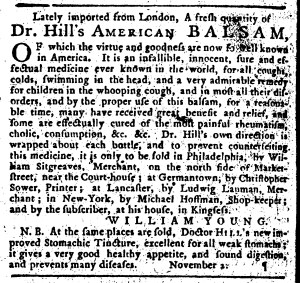
Pennsylvania Journal (November 9, 1774).

“Dr. Hill’s own direction is wrapped about each bottle.”

In the fall of 1774, William Young and his associates offered consumers exclusive access to “Dr. Hill’s AMERICAN BALSAM.”  According to an advertisement in the November 9 edition of the Pennsylvania Journal, this patent medicine “is an infallible, innocent, sure and effectual” cure for “coughs, colds, [and] swimming in the head” as well as a “very admirable remedy for children in the whooping cough, and in most all their disorders.”  Young implied that such recommendations may not have been necessary since the “virtue and goodness” of the medicine “are now so well known in America,” yet figured that trumpeting the efficacy of Dr. Hill’s American Balsam would aid in convincing consumers not yet familiar with this product.

As a means of guarding the reputation of this medicine and “to prevent counterfeiting,” a limited number of local agents stocked and sold this medicine.  Young made it available in Kingsess (or Kingsessing), just outside of Philadelphia.  William Sitgreaves, a merchant in Philadelphia, Christoper Sower, a printer in Germantown, and Ludwig Lauman, a merchant in Lancaster, each sold it as well.  Young also distributed Dr. Hill’s American Balsam to Michael Hoffman, a shopkeeper in New York, to sell there.  He had relied on that method for some time, having placed similar advertisement in May and October 1772.  Unlike some popular patent medicines widely stocked by apothecaries, merchants, shopkeepers, printers, booksellers, and other retailers throughout the colonies, only a select few carried Dr. Hill’s American Balsam.  The medicine came with “Dr. Hill’s own direction … wrapped about each bottle” to instruct patients how to use it to relieve or even cure “the most painful rheumatism, cholic, consumption,” and other maladies.  Such packaging represented another layer of marketing for this product, continuing to promote it to customers after they purchased it and took it home.

Young apparently considered these various strategies effective given that he invested in them on several occasions.  His marketing of Dr. Hill’s American Balsam incorporated the same elements in November 1774 that he deployed two and a half years earlier in May 1772.  That does not demonstrate the impact those methods had on consumers yet does suggest that Young considered them successful enough to repeat when he advertised once again.

February 14

GUEST CURATOR:  Caroline Branch

What was advertised in a colonial American newspaper 250 years ago today?

Boston-Gazette (February 14, 1774).

“KEYSER’s FAMOUS PILLS … eradicating every Degree of a certain Disease.”

The date of this advertisement for “KEYSER’s FAMOUS PILLS” to treat venereal disease is an ironic one, appearing on Valentine’s Day, but advertisements for these pills ran often. This advertisement displays the fear of venereal diseases throughout Europe and the colonies in the eighteenth century. Doctors agreed that mercury was the way to treat the disease, including Jean Keyser, a French military surgeon. According to Micheline Louis-Courvoisier, many doctors prescribed a mercurial ointment that patients rubbed all over their bodies for about forty days. In contrast, Keyser’s Pills “contain[ed] a combination of mercuric acid and acetic acid.”  The pills were an invention to treat venereal diseases better. In 1761 doctors in Geneva tested the two methods. Louis-Courvoisier states that “following that trial, Keyser pills were considered a good treatment.” They were deemed a success due to the improvement of side effects from previous medications. The pills became a common medication to treat syphilis and other diseases in Europe and the American colonies.

**********

ADDITIONAL COMMENTARY:  Carl Robert Keyes

Keyser’s Pills may very well have been the most popular, or at least the most widely advertised and generally recognized, patent medicine marketed in British mainland North America in the 1760s and 1770s.  Apothecaries stocked the pills, as did shopkeepers and even printers.  The Adverts 250 Project traced the competition among apothecaries and printers in New York and Philadelphia in the fall of 1773.  That competition (or was it a coordinated effort?) continued into the winter of 1774, extending to Boston as well.

Hugh Gaine, the printer of the New-York Gazette and Weekly Mercury, continued advertising Keyser’s Pills in his newspaper in the new year.  To corner as much of the market as he could, he had previously advertised in the Newport Mercury, encouraging prospective customers in Rhode Island to submit orders to “his book store and printing-office, at the bible & crown in Hanover-square” in New York.  When Benjamin Edes and John Gill, printers of the Boston-Gazette, advertised “KEYSER’s FAMOUS PILLS” on February 14, 1774, they lifted the copy for their notice directly from Gaine’s advertisement.  Edes and Gill used the same headline, followed by two paragraphs of identical text (with some variations in capitalization and italics).”  Like Gaine, they declared that declared that the remedy was “So well known all over Europe, and in this and the neighbouring Colonies, for their superior Efficacy and peculiar Mildness,” making note of the less severe side effects that Caroline discusses above.  The format continued to replicate Gaine’s advertisement, with a secondary headline distributed over three lines.  It announced, “THESE PILLS ARE NOW SOLD BY / EDES and GILL, / (In Boxes of 7s6 L.M. each, fresh imported).”  They simply traded out Gaine’s name for their own and converted the price into local currency.  In another paragraph, Edes and Gill claimed that they “have in their Hands a Letter from the Widow KEYSER, and a Certificate from under her own Hand of the Genuineness of the above Pills.”  Apothecaries, shopkeepers, printers, and other purveyors of Keyser’s Pills frequently squabbled over who sold the real remedy and who peddled counterfeits.  Edes and Gill invited “any Person” to have a “Perusal” of the letter and certificate at their printing office, once again replicating and only slightly editing as necessary Gaine’s advertisement.

Printers and others competed to sell Keyser’s Pills, sometimes even appropriating advertising copy devised by their rivals.  Edes and Gill may not have needed to resort to consulting an advertisement from the Newport Mercury published a couple of months earlier when they first ran their own notice on January 31 and again on February 7 and 14.  More recently, Gaine ran the same advertisement in his New-York Gazette and Weekly Mercury, commencing on January 17.  (He resurrected copy that previously appeared in both his own newspaper and the Newport Mercury.)  That allowed enough time for Edes and Gill to receive that issue in Boston.  Perhaps Gaine even franchised out Keyser’s Pills to Edes and Gill to sell in New England, providing them with both pills and copy for their marketing efforts.  Whatever the explanation, readers in New York and New England experienced consistent messaging about a product imported from Europe and sold in several American ports.  That likely contributed to the acclaim the pills earned in the colonies.

November 3

What was advertised in a colonial American newspaper 250 years ago today?

Pennsylvania Journal (November 3, 1773).

“Dr. Keyser’s Pills … warranted genuine.”

Townsend Speakman and Christopher Carter, “CHYMISTS and DRUGGISTS,” advertised widely in October and November 1773.  They placed advertisements simultaneously in the Pennsylvania Chronicle, the Pennsylvania Gazette, the Pennsylvania Journal, and the Pennsylvania Packet.  Each of those advertisements promoted raisins, figs, and currants as well as “an Assortment of the freshest DRUGS and PATENT MEDICINES.”  They offered the “most saleable Articles in large Quantities” to shopkeepers and others who planned to retail them.  Printers, for instance, often supplemented revenues from other sources by peddling patent medicines.

On November 1, the Pennsylvania Packet ran an abbreviated version of Speakman and Carter’s advertisement.  In notices in the other three newspapers during that week, the apothecaries highlighted a “Parcel of Keyser’s famous Pills, from the Importer in London, with full Directions for their Use.”  They pledged that “the Public may be assured these Pills are the genuine Sort,” and to demonstrate that was indeed the case “they have inserted the Copy of a Certificate received with [the pills], the Original of which may be seen by any Purchaser.”  The copy of that certificate comprised the final third of the advertisement.  In it, James Cowper, “Doctor of Physic,” declared himself “the only legal Proprietor of a Medicine, called KEYSER’S PILLS, in England.”  Furthermore, he certified that Speakman and Carter, “Chymists and Druggists, in Philadelphia, are my only Correspondents to whom I send the above Pills in that Part of the World.”  Consumers did not need to worry about purchasing counterfeit pills if they acquired them from Speakman and Carter.

According to another advertisement in the Pennsylvania Journal, however, customers in Philadelphia had another option for obtaining Keyser’s Pills without worrying about getting duped by unscrupulous sellers.  That advertisement appeared immediately below Speakman and Carter’s advertisement, a rather cheeky placement considering that it listed William Bradford and Thomas Bradford, printers of the Pennsylvania Journal, as local agents who sold the pills.  Speakman and Carter paid the Bradfords to run their advertisement, complete with the certificate, and they may have expected competition but not efforts to outright undermine their marketing strategy.  The advertisement replicated James Rivington’s “Every One their own Physician” notice from Rivington’s New-York Gazetteer, along with a few additions.  In addition to listing the Bradfords as local agents, a letter from Rivington to the Bradfords followed the testimonials.

Just as Speakman and Carter reprinted Cowper’s certificate in its entirety, the Bradfords published Rivington’s entire letter.  He noted that he saw “an advertisement in the Philadelphia Papers, relating to Dr. Keyser’s Pills, importing that they were procured from Dr. Cowper, of London, and warranted genuine.”  Rivington could do one better.  “I think it very proper the Public should be assured,” he trumpeted, “that the Pills, which you have had from me, and now advertize for sale, were imported by me, immediately from Mr. Keyser himself, at Paris.”  In addition, Rivington offered to show Keyser’s “letters and correspondence for some years past … to any person, who may require a sight of them.”  Furthermore, Rivington was also vigilant about counterfeits, reporting that he “detected a counterfeit sort, exposed to sale in New-York, of which Mr. Keyser has sent me a written declaration.”  Rivington concluded by inviting the Bradfords to insert his letter in their newspaper so “the Public may be once more informed you have the Pills sent directly from Mr. Keyser” to New York and then forwarded to Philadelphia.

It was not the first time that printers who sold Keyser’s Pills became embroiled in disputes over who stocked authentic medicines.  In the summer of 1772, printers in South Carolina pursued a feud in their newspapers, sometimes alluding to notices placed by their competitors and sometimes responding to them directly.  Among the many purveyors of Keyser’s Pills, a great many claimed that they carried genuine medicines and possessed some sort of exclusive right to market them in their town.

December 14

What was advertised in a colonial American newspaper 250 years ago today?

New-York Gazette and Weekly Mercury (December 14, 1772).

“The underwritten certificate, from one well known in New-York, and now in perfect health.”

James Rivington is best remembered today as a Loyalist printer who published a newspaper during the era of the American Revolution.  Before he launches his newspapers, he often placed advertisements for “KEYSER’s PILLS” in other newspapers published in New York in the early 1770s.  Whether or not they published newspapers, printers frequently stocked patent medicines, along with books, stationery, and writing supplies, to generate additional revenues.  That being the case, colonizers would not have considered it unusual to encounter advertisements in which Rivington hawked a medicine to those afflicted with venereal disease.

In an advertisement that ran in the New-York Gazette and Weekly Mercury for several weeks in late November and early December 1772, the printer advised that “Any Person desirous of being made more particularly acquainted” with the efficacy of Keyser’s Pills “than can be decently communicated in an Advertisement” could discuss the remedy with him and then “try a Method the easiest and safest, and so secret that the Patient may be cured” without anyone “harbouring the least Suspicion” of their “lamentable Circumstances.”  Yet Keyser’s Pills had an ameliorative effect on more than just venereal diseases.  Rivington devoted a section of his advertisement to how the pills had “Great Effects” on “THE RHEUMATISM” and concluded by noting that they would “cure a Negro in the worst Stage of the Yeaws.”

On December 14, Rivington placed a new version of his advertisement.  He asserted that Keyser’s Pills were so effective in alleviating “every appearance of the venereal distemper” that “persons tormented with other diseases” made “tryals” of the pills.  Those patients included William Shipman, “well known in New-York,” who “was a long time the verist of cripples” but now, as a result of taking Keyser’s Pills, was “in perfect health.”  Rivington referred readers to a “Copy of W. Shipman’s certificate” or testimonial that provided an overview of his suffering as a result of being “so violently afflicted with the rheumatism,” his disappointment with other medicines, his decision to “make trial of Dr. Keyser’s pills,” and the “suprizing relief” that he began experiencing after only two weeks.  Shipman continued taking the pills “without any other consequence but that happy one of being restored to perfect health and ease.”

Shipman’s testimonial comprised half of Rivington’s advertisement, indicating that the printer believed it would effectively market Keyser’s pills to prospective patients.  Rivington acknowledged that Shipman “took a great many of the pills, which made his cure expensive.”  Yet the effectiveness justified the expense.  The “health, strength and agility” that Shipman “now enjoys,” Rivington argued, “is an ample compensation for the purchase money.”  Consumers could acquire “boxes of Ten, Twenty, and Forty Shillings each” as they made their own “tryals” of the pills and determined how much they wished to invest.  Rivington likely intended that Shipman’s testimonial about taking the pills over a period of several months would convince customers to purchase in larger quantities in hopes of achieving the same results.

October 17

What was advertised in a colonial American newspaper 250 years ago today?

Pennsylvania Chronicle (October 17, 1772).

“It is needless to mention a long list of peoples’ names … [and] what great benefit they have received by the proper use of this Balsam.”

Advertisements for patent medicines frequently appeared in newspapers throughout the colonies.  The Pennsylvania Chronicle carried them, including a notice promoting “Dr. HILL’s American Balsam” on October 17, 1772.  William Young provided a brief and enthusiastic overview of the remedy’s effectiveness, boldly proclaiming that “IT is known, by experiment, that this Balsam is one of the most excellent medicines ever before prepared since the creation of the world, for colds, coughs, consumptions, swimming in the head, rheumatism, pain, gravel, sore throat,” and many other ailments.

Young indicated that he could have produced testimonials, but he considered doing so unnecessary given the reputation of Dr. Hill’s American Balsam.  He reported that “great numbers of people in this and the neighbouring provinces” who had “made trial” of the medicine could confirm its efficacy, yet be believed it “needless to mention a long list of peoples’ names and their residences, who have earnestly desired it might be published for the good of their fellow-creatures.”  Instead, Young underscored “what great benefit they have received by the proper use of this Balsam, when all other medicines have been used in vain.”

That strategy differed from the one deployed by Nicholas Brooks in promoting Maredant’s Drops in the Pennsylvania Gazette earlier in the year.  Brooks published the names of several people “cured by Maredant’s drops” as well as detailed testimonials written by two satisfied customers.  In contrast, Young suggested that there were so many customers whose symptoms had been alleviated by Dr. Hill’s American Balsam that listing their names would have been superfluous.  Whether or not he could have published such a list seemed less important to him than asserting how many people supposedly encouraged him to do so.  That left it prospective customers to imagine for themselves how many patients benefited from the medicine.  In choosing not to publish any specifics, neither names nor testimonials, Young invited readers to envision even grander stories about the effectiveness of Dr. Hill’s American Balsam than he could have compiled in a newspaper advertisement.