May 30

What was advertised in a revolutionary American newspaper 250 years ago today?

Continental Journal (May 30, 1776).

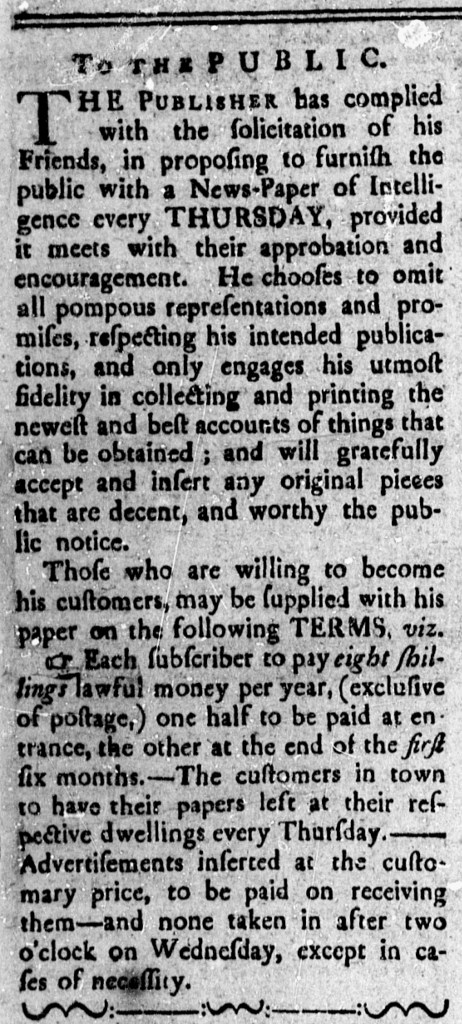
“Proposing to furnish the public with a News-Paper of Intelligence every THURSDAY.”

It was the third newspaper established in New England in just over a week.  Robert L. Fowle distributed the first of the “occasional HAND-BILLS” that became the New Hampshire Gazette in Exeter on May 22, 1776.  Three days later, Benjamin Dearborn published the first issue of the Freeman’s Journal in Portsmouth.  Finally, on May 30, John Gill presented the Continental Journal to readers in Boston and beyond.  Daniel Fowle had suspended his New-Hampshire Gazette in January or February, leaving the colony without any newspaper, so readers likely welcomed the new publications that gave them easier access to news and editorials about current events and forums for disseminating advertising than depending on newspapers from Massachusetts.  After the battles at Lexington and Concord in April 1775, some printers in Boston discontinued or suspended their newspapers and others moved their newspapers to other towns.  That included Benjamin Edes and John Gill, the printers of the Boston-Gazette.  They dissolved their partnership and Edes printed the newspaper in Watertown during the siege of Boston and continued there for many months after British forces evacuated Boston.  Only recently had Samuel Hall moved the New-England Chronicle from Cambridge into Boston.  That made the Continental Journal only the second newspaper published in the city when Edes decided that he once again wished to “furnish the public with a News-Paper of Intelligence,” though he claimed that he “complied with the solicitation of his Friends” in pursuing the venture.

Printers often included an address to the public in their subscription proposals when they announced their plans to publish a newspaper or inserted a message to readers in the first issue.  In his notice “TO THE PUBLIC,” Gill kept it simple by declaring that he “chooses to omit all pompous representations and promises … and only engages his utmost fidelity in collecting and printing the newest and best accounts of things that can be obtained.”  With many years experiences printing the Boston-Gazette, he could rely on his reputation among prospective subscribers.  Gill also outlined the “TERMS” for subscribers.  The Continental Journal cost eight shilling per year, “one half to be paid at entrance, the other at the end of the first six months.”  That was a common model among newspaper printers.  He also advised, “Advertisements inserted at the customary price,” but did not specify that price.  The printer did instruct advertisers that their notices were “to be paid on receiving them.”  Like many other newspaper printers, he depended on advertising revenue.  The printing office accepted advertisements until two o’clock on Wednesdays (and later only “in cases of necessity”), allowing time to set type and print the newspaper in time to distribute it to subscribers on Thursdays.  The Continental Journal met with success, continuing throughout the war and closing in 1787 when Massachusetts imposed a tax on advertisements.

March 15

What was advertised in a colonial American newspaper 250 years ago today?

South-Carolina Gazette and Country Journal (March 15, 1774).

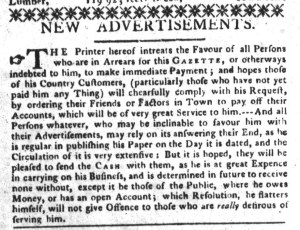
“All Persons whatever, who may be inclinable to favour him with their Advertisements, may rely on its answering their End.”

The “NEW ADVERTISEMENTS” in the March 15, 1774, edition of the South-Carolina Gazette and Country Journalbegan with a notice from the printer, Charles Crouch.  Like his counterparts throughout the colonies, Crouch occasionally issued a call for “all Persons who are in Arrear for this GAZETTE, or otherways indebted to him, to make immediate Payment.”  Recognizing that many of his subscribers lived outside Charleston, he requested that “his Country Customers … will cheerfully comply” by directing “their Friends or Factors in Town to pay off their Accounts.”  In particular, he pointedly suggested that “those who have not yet paid him any Thing” would tend to what they owed.  When they ran notices for similar purposes, some printers asserted that certain customers had not made payments for years, taking advantage of credit extended to them.

How did Crouch and other printers manage to stay in business under such circumstances.  Many, but not all, required advertisers to pay in advance, figuring that advertising generated enough revenue to offset shortfalls from subscriptions.  That was the case for Crouch and the South-Carolina Gazette and Country Journal.  He instructed advertisers “send the CASH” when they submitted copy to the printing office.  After all, “he is at great Expence in carrying on his Business.” Accordingly, Crouch was “determined in future to receive none without,” suggesting that perhaps he had accepted advertisements without “the CASH” in the past.  The printer made an exception for those he “owes Money, or has an open Account,” presumably counting new advertisements against his own debts.

In hopes of attracting new advertisers, Crouch commented on the effectiveness of inserting notices in his newspaper.  Advertisers could “rely on its answering their End” or serving their purpose, whether disseminating information or enticing customers or whatever other reason they had for advertising.  He competed against two other newspapers published in Charleston, the South-Carolina Gazette and the South-Carolina and American General Gazette.  Prospective advertisers should choose the South-Carolina Gazette and Country Journal, Crouch stated, because “the Circulation of it is very extensive.”  In other words, the newspaper reached many readers.  In addition, Crouch bragged that he was “regular in publishing his Paper on the Day it is dated,” taking a swipe at other competitors who sometimes delayed printing and distributing their weekly newspapers.  Advertisers could depend on their notices in the South-Carolina Gazette and Country Journal reaching readers in a timely manner.  At the same time, he tended to settling accounts with existing customers, Crouch sought additional customers who had reason to advertise.

August 8

Who was the subject of an advertisement in a colonial American newspaper 250 years ago today?

Pennsylvania Chronicle (August 8, 1772).

“My wife, HANNAH FREDERICK, did … elope from my bed and board.”

In the eighteenth century, aggrieved husbands often took to the pages of newspapers to warn others not to extend credit to misbehaving wives who “eloped” from them.  Readers regularly encountered “runaway wife” advertisements in newspapers published throughout the colonies.  Those notices continued to appear during the era of the American Revolution and, as Mary Beth Sievens demonstrates, well into the nineteenth century.[1]

Although most notices followed a pattern, each provided details specific to a particular household.  Wives usually “eloped” from their husbands on their own, but in an advertisement in the August 8, 1772, edition of the Pennsylvania Chronicle one husband reported that his wife, Hannah Frederick, “did … elope from my bed and board … with a certain Abraham Hudson.”  The husband believed that the two of them traveled “from Fish-Kills, in Duchess County, in New-York government … to Elizabeth-Town” in New Jersey “and from thence to Philadelphia.”  To aid readers in identifying his wife, the advertiser reported that her “maiden name was Hannah Coleman” and she “served her time,” likely as an indentured servant, “with John Taylor, at Tinicum-Island.”  He concluded with a formulaic statement cutting his wife off from his credit: “these are therefore to forewarn all persons from trusting her on my account, as I shall pay no debts of her contracting after the date hereof.”

Printers published such advertisements without offering commentary of their own, but, in this instance, William Goddard did insert a clarification.  “In the copy of the foregoing Advertisement, which was sent to the Printer,” he explained, “the Advertiser’s name was omitted.”  As a result, the husband’s name appeared as “———- FREDERICK.”  That being the case, how did Goddard handle payment for the advertisement?  Some printers required advertisers to pay in advance, even though they extended credit to subscribers.  After all, advertising comprised a lucrative revenue stream.  Occasional notices in eighteenth-century newspapers, however, make clear that some printers did allow credit for advertisements as well as subscriptions.  This husband may have submitted payment, but not his name, to the printing office … or Goddard may have taken a chance that he would settle up in a timely manner.  Even if that was the case, the printer’s trust only went so far.  The advertisement ran just twice (August 8 and 15), though most newspapers initially published advertisements for three or four weeks for a set fee before charging a lower fee for each insertion.  Goddard may have been carefully managing how much credit he extended to “———- FREDERICK” even as that husband attempted to exert control over his credit when it became clear his wife was beyond his influence.

**********

[1] Mary Beth Sievens, “Female Consumerism and Household Authority in Early National New England,” Early American Studies:  An Interdisciplinary Journal 4, no. 2 (Fall 2006):  353-371.