What was advertised in a revolutionary American newspaper 250 years ago today?
Continental Journal (September 26, 1776).
“Keeping up a Correspondence with our inveterate enemies … is in direct violation of the laws of this State.”
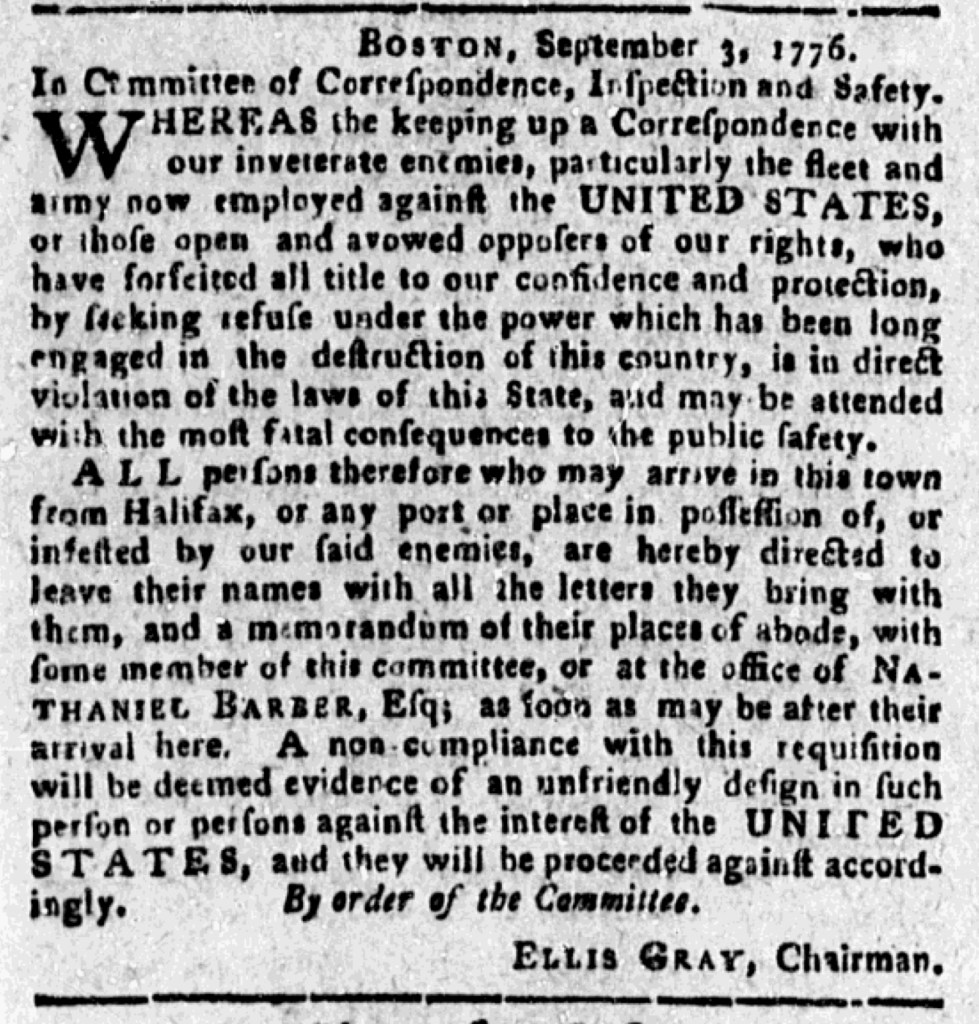
The Committee of Correspondence, Inspection, and Safety had a message for new arrivals in Boston. They used an advertisement in the Continental Journal to let them know that they needed to identify themselves to the committee and surrender any letters they carried with them.
“WHEREAS the keeping up a Correspondence with our inveterate enemies,” Ellis Gray explained on behalf of the committee, “is in direct violation of laws of this State, … ALL persons theretofore who may arrive in this town from Halifax, or any port or place in possession of, or infested by our said enemies, are hereby directed to leave their names with all the letters they bring with them … with some member of this committee.” That included contact with “the fleet and army now employed against the UNITED STATES,” referring to British forces, and “those open and avowed opposers of our rights, who have forfeited all title to our confidence and protection, by seeking refu[g]e under the power which has long been engaged in the destruction of this country,” referring to Loyalists, especially those who joined the British when they evacuated from Boston to Halifax. In addition to turning over the letters they carried with them, new arrivals had to leave “a memorandum of their place of abode” so the committee knew where to find them. They were to do so “as soon as may be after their arrival here.” Gray warned that “non-compliance with this requisition will be deemed evidence of an unfriendly design … against the interest of the UNITED STATES” and those in violation “will be proceeded against accordingly.”
This important message appeared as an advertisement, first in the September 5, 1776, edition of the Continental Journal and again in the September 26 edition. The printer interspersed it among paid notices placed for a variety of purposes rather than featuring it as a news item. Like many other advertisements that ran in American newspapers during the era of the American Revolution, this notice from Boston’s Committee of Correspondence, Inspection, and Safety delivered news that did not appear elsewhere in the newspaper. Readers perused advertisements as well as articles and editorials to learn about current events, including, on occasion, new regulations enacted in their communities.
What was advertised in a revolutionary American newspaper 250 years ago today?
Continental Journal (September 19, 1776).
“The second edition of An easy PLAN of DISCIPLE for a MILITIA.”
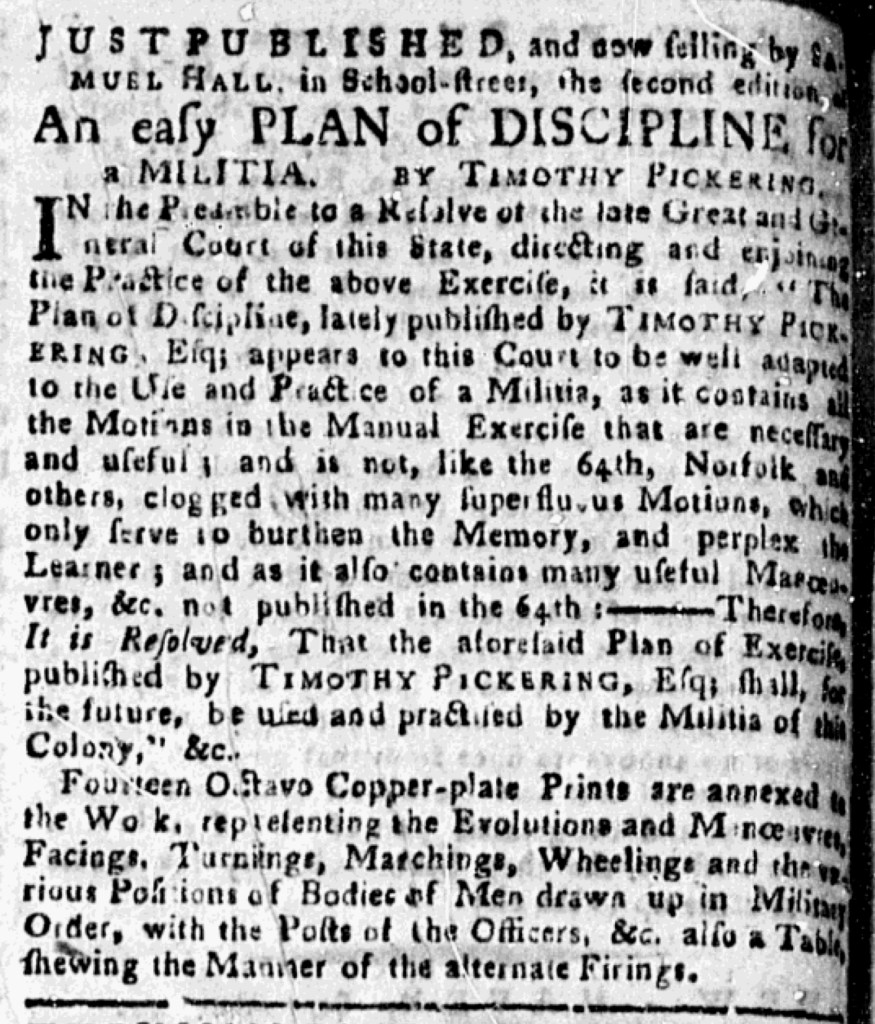
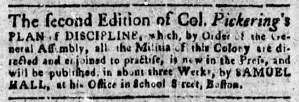
In June 1776, Samuel Hall advertised that the “second Edition of Col. Pickering’s PLAN of DISCIPLINE,” a popular military manual by Timothy Pickering first published in the summer of 1775, “is now in the Press” and would be published soon. In his initial advertisement for the second edition, Hall noted that “by Order of the General Assembly, all the Militia of this Colony are directed and enjoined to practise” Pickering’s Easy Plan of Discipline for a Militia. The companies from towns throughout Massachusetts would benefit from the directions in the manual and the uniformity of consulting a common source for their instruction.
When Hall advertised that he “JUST PUBLISHED” the second edition in September 1776, he included a blurb from the “Preamble to a Resolve of the late Great and General Court of this State, directing and enjoining the Practice of [Pickering’s] Exercise,” deploying it as an endorsement for the manual he now sold at his printing office on School Street in Boston. “The Plan of Discipline,” the preamble stated, “appears to this Court to be well adapted to the Use and Practice of a Militia, as it contains all the Motions in the Motions in the Manual Exercise that are necessary and useful.” Unlike other manuals, Pickering’s Easy Plan of Discipline for a Militia was not “clogged with many superfluous Motions, which only serve to burthen the Memory, and perplex the Learner.” Furthermore, Pickering’s manual “contains many useful Manœuvres … not published” in other manuals.” The General Court made clear its determination that Pickering’s manual was superior to others. George Washington, commander-in-chief of the Continental Army, apparently agreed. Pickering’s Easy Plan of Discipline for a Militia was one of his preferred manuals before Baron von Stueben’s Regulations for the Order and Discipline of the Troops of the United States became first official manual of the Continental Army in 1779. Hall also included the resolution itself in his advertisement for the second edition: “It is Resolved, That the aforesaid Plan of Exercise, published by TIMOTHY PICKERING, Esq; shall, for the future, be used and practised by the Militia of this Colony.”
In case such an endorsement was not enough to make a sale, Hall highlighted the “Fourteen Octavo Copper-plate Prints … annexed to the Work.” They depicted “the Evolutions and Manœuvres, Facings, Turnings, Marchings, Wheelings and the various Positions of Bodies of Men drawn up in Military Order.” The manual also featured “a Table, shewing the Manner of the alternate Firings.” The Continental Army’s siege of Boston dislodged British forces in March 1776, but the war continued. Hall presented a new edition of Pickering’s manual to officers and soldiers to aid them in continuing to fight for the American cause and defend their families, homes, and communities.
What was advertised in a revolutionary American newspaper 250 years ago today?
Continental Journal (July 18, 1776).
“WHEREAS the Great and General Court …”
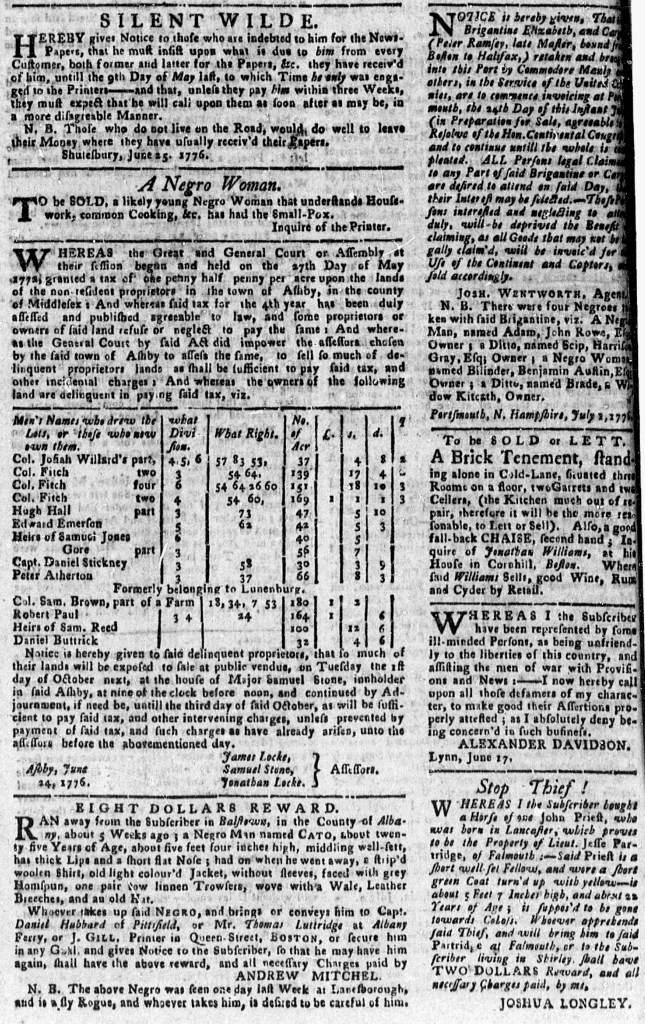
John Gill, the printer of the Continental Journal, faced the same dilemma as his former partner, Benjamin Edes, the printer of the Boston-Gazette, when he received a legal notice with so many columns that its width exceeded that of the columns in his newspaper. Edes had rotated some advertisements to run perpendicular to the rest of the text on the page, thus maximizing space while also eliminating the need to reset type for other advertisements that followed the standard column width. Gill made a different decision in his effort to cover every inch of the page with content. He opted for the same wider width for news and advertising that appeared in the same column as the legal notice the first time that it ran on July 4, 1776, and a narrower width for news and advertising in another column on the same page.
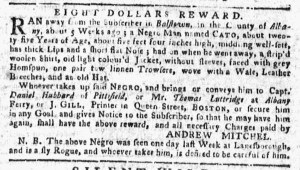
Three advertisements had wider widths: one placed by Silent Wilde, a post rider, calling on customers to make payment for his services, another in which Andrew Mitchel offered a reward for the capture and return of Cato, an enslaved man who liberated himself by running away, and an anonymous notice describing an enslaved woman for sale with instructions for interested parties to “Inquire of the Printer.” Those three advertisements remained in a block of text with the legal notice for each of its three appearances, though sometimes in different order. One advertisement that accompanied the legal notice the first time it appeared had a narrower width. Beneath a headline that exclaimed “Stop Thief!” Joshua Longley described a man who sold him a stolen horse. That advertisement also remained in the same block of text with the legal notice. Gill did not need to publish news that appeared in the narrow column a second time. Instead, he reset the type for three advertisements that previously appeared with the standard width, making them narrower but longer. This did not save time and effort as Edes had done in the Boston-Gazette, but it did have all the text on the page printed in the same direction instead of rotating some advertisements to run perpendicular to the rest of the content. Both solutions filled every inch of the page, an especially important consideration considering the shortages of paper during the Revolutionary War.
Who was the subject of an advertisement in a revolutionary American newspaper 250 years ago today?
Maryland Gazette (July 4, 1776).
“RUN AWAY … [a] negro fellow named WILL.”
On July 4, 1776, the delegates to the Continental Congress in Philadelphia voted to approve a revised version of a declaration of independence written by Thomas Jefferson, John Adams, Benjamin Franklin, and others appointed for that task. In the 250 years that have passed since that momentous event, the document they approved has become known as the Declaration of Independence and July 4 has been celebrated as the day the colonies, now states, declared their independence from Great Britain. Celebrations and commemorations of that event often overlook other declarations of independence made on July 4, 1776. On that day, American newspapers published more than half a dozen advertisements concerning enslaved people who declared their independence by running away from their enslavers.
Maryland Gazette (July 4, 1776).
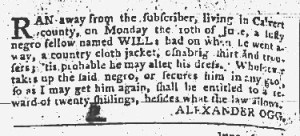
The Maryland Gazette, published in Annapolis, carried two such notices. In one, Alexander Ogg of Calvert County offered a reward for the capture and return of Will, a “negro fellow” who liberated himself three weeks earlier on June 10. Ogg described what Will wore when he departed, but he also reported that “‘tis probable he may alter his dress” to avoid detection. In so doing, Ogg acknowledged that Will was clever as well as courageous. In the other advertisement, Anne Gaither of Annapolis sought the return of “a negro fellow named FLANDERS.” She mentioned that he “has been used to go by water,” indicating that he had experience working on boats or ships just like many other enslaved men who lived on or near the Chesapeake Bay. Gaither also reported that Flanders “has no toes,” though she did not elaborate on that detail. Flanders, no doubt, would have told a much more robust story about who he was and what he had experienced if given the opportunity.
New-York Journal (July 4, 1776).
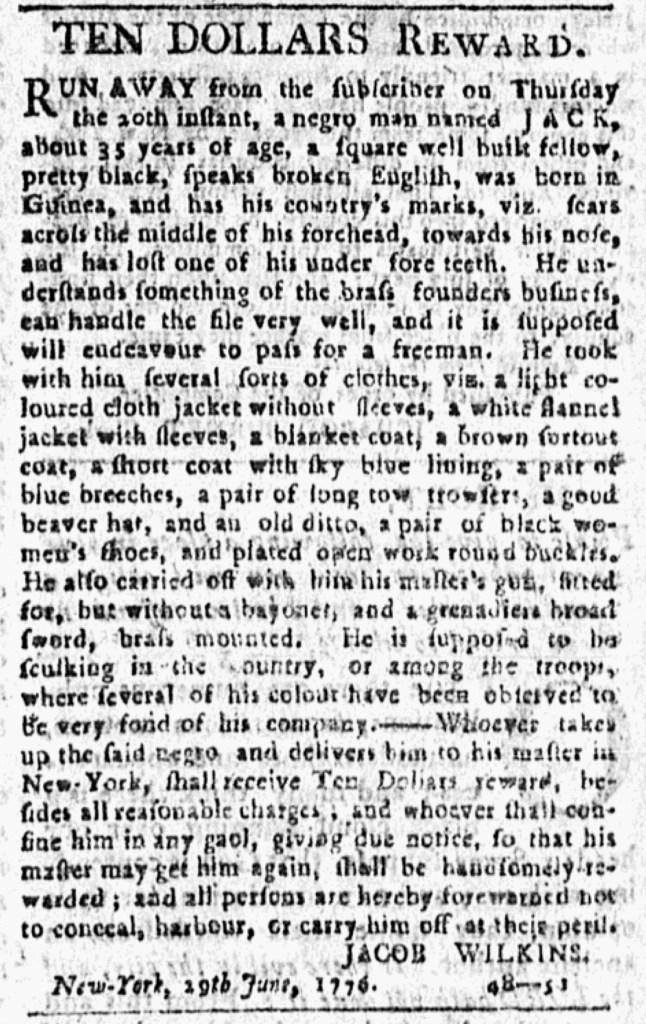
Enslaved people in southern colonies were not the only ones who liberated themselves by running away at the same time that the Continental Congress voted to declare independence. The New-York Journal carried Jacob Wilkins’s advertisement regarding “a negro man named JACK” who liberated himself from his enslaver on June 20. Jack “carried off with him his master’s gun, fitted for, but without a bayonet, and a grenadiers broad sword, brass mounted.” Wilkins suspected that Jack made his way out of the city and was “sculking in the country, or among the troops, where several of his colour have been observed to be very fond of his company.” The many disruptions caused by the war presented opportunities for enslaved people to free themselves by fleeing from their enslavers. To help readers recognize Jack, Wilkins gave his age, “about 35 years,” and mentioned some distinguishing physical characteristics. Having been “born in Guinea,” Jack had “his country’s marks” or ritual scarring “across the middle of his forehead, [and] towards his nose.” At some point, he “lost one of his under fore teeth.” During his enslavement, Jack learned to speak “broken English.” He also developed valuable skills: he “understands something of the brass founders business, [and] can handle the file very well.” Many enslaved people were skilled artisans. Wilkins lamented that Jack “will endeavour to pass for a freeman.” Jack made himself a free man with his decision to escape from Wilkins.
New-York Packet (July 4, 1776).
The New York Packet carried another advertisement, this one regarding “a Negro Man, named BEN,” placed by John Taylor of “New Germantown, Hunterdon county, West Jersey.” Ben liberated himself on June 5 and had evaded capture for a month. Taylor focused primarily on describing Ben and his clothing, noting the young man’s height, age (“twenty-two years old”), and a left leg “considerably larger than the other, with a large scar on the small of said leg.” Ben wore a blue coat, red jacket, black breeches, and “calf skin shoes, [with] a pair of carved silver buckles,” though he also took another coat and jacket, “a fine shirt with ruffles at the bosom, a pair of woollen trowsers, [and] a half worn wool hat” in a bag “marked I.T. near the mouth.” Given a chance to write about himself, Ben certainly would have chosen to a tell a different story than the one that Taylor relayed. If readers detected a young black man carrying a bag with his former enslaver’s initials, Taylor offered a reward for securing him in any jail until he could retrieve him.
Continental Journal (July 4, 1776).
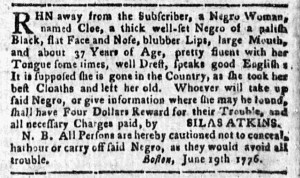
The Continental Journal, published in Boston after the siege of that city ended, carried two advertisements about enslaved people who liberated themselves. Silas Atkins described Cloe, “a Negro Woman” who was “likely gone in the Country, as she took her best Cloaths and left her old.” Atkins gave Cloe’s age (“37 Years’), provided a physical description, and noted that she “speaks good English,” all characteristics that would aid readers in identifying her. Cloe had been gone since the middle of June. Atkins promised that anyone who “will take up said Negro, or give information where she may be found, shall have Four Dollars for their Trouble” as well as any expenses they incurred. In a nota bene, he added a standard warning that appeared in many such advertisements: “All Persons are hereby cautioned not to conceal, harbour or carry off said Negro, as they would avoid all trouble.” The “trouble” would not come from Cloe but rather from legal action undertaken by Atkins.
Continental Journal (July 4, 1776).
The other advertisement in the Continental Journal concerned “a Negro Man named CATO, about twenty-five Years of Age,” who liberated himself from Andrew Mitchel of “Balstown [Ballston], in the County of Albany, about 5 Weeks ago.” Mitchel described Cato’s features and clothing, but he did not provide other details. He devoted nearly as much space to the network of associates who agreed to aid him by holding Cato until he could retrieve him if a reader managed to capture him. Those seeking the reward could deliver Cato “to Capt. Daniel Hubbard of Pittsfield, [Massachusetts], or Mr. Thomas Luttridge at Albany Ferry, or J. GILL, Printer in Queen Street, BOSTON, or secure him in any Goal [Jail]” and notify Mitchel. In a nota bene, the enslaver reported that Cato “was seen one day last Week at Lanesborough [in western Massachusetts], and is a sly Rogue, and whoever takes him, is desired to be careful of him.” Mitchel meant “sly Rogue” as an insult, not intending to compliment Cato on the ingenuity and perseverance he expected the young Black man to demonstrate in attempting to escape if captured.
New-England Chronicle (July 4, 1776).
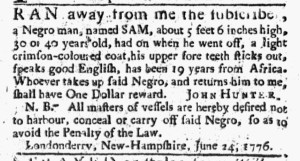
One more advertisement in a newspaper published in Boston, the New-England Chronicle, identified an enslaved man who liberated himself by running away from his enslaver. This one concerned Sam, “a Negro man” who escaped from John Hunter of Londonderry, New Hampshire, in late June. Hunter did not know Sam’s age, estimating that he was “30 or 40 years old,” but he did know that Sam “has been 19 years from Africa” and in that time learned to speak “good English.” Readers might recognize Same from his “upper fore teeth” that stuck out or by the “light crimson-coloured coat” that he wore. Hunter inserted a nota bene with a warning like the one that appeared in Atkins’s advertisement about Cloe: “All masters of vessels are hereby desired not to harbour, conceal or carry off said Negro, so as to avoid the Penalty of the Law.” Hunter included an evocative phrase when he said that Sam “has been 19 years from Africa.” What kind of stories would Sam have told about his own life and his decision to liberate himself after so many years of bondage?
The men who gathered in the Pennsylvania State House (now known as Independence Hall) to declare independence from Great Britain are often called the founders of the nation, yet they were not the only ones who envisioned freedom from oppression. They were members of a founding generation that included soldiers and farmers, women and youth, and many others from diverse backgrounds who contributed to the American cause. Will, Flanders, Jack, Ben, Cloe, Cato, and Sam were all founders as well. They made their own declarations of independence during the era of the American Revolution and their former enslavers published those declarations of independence on July 4, 1776. Will, Flanders, Jack, Ben, Cloe, Cato, and Sam joined countless other enslaved men and women who seized their liberty during the seventeenth, eighteenth, and nineteenth centuries. Those courageous and resilient men and women sought freedom long before the American Revolution and continued seeking freedom long after the American Revolution. Their stories matter and must be told alongside the stories of other founders as we celebrate and commemorate 250 years of independence.
For other stories of enslaved people liberating themselves originally published on July 4 during the era of the American Revolution, see:
What was advertised in a revolutionary American newspaper 250 years ago today?
Continental Journal (June 20, 1776).
“Col. Pickering’s PLAN of DISCIPLINE, which … all the Militia of this Colony are directed and enjoined to practise.”
When he transferred the New-England Chronicle to Edward E. Powars and Nathaniel Willis in June 1776, Samuel Hall informed the public that “PRINTING in general will be continued at the Subscriber’s Office in School-street [in Boston], and performed with accuracy and dispatch.” Although he would no longer publish a newspaper, Hall continued to earn his livelihood through job printing and other projects. One of those projects was a second edition of Timothy Pickering’s Easy Plan of Discipline for a Militia. Hall and his brother, Ebenezer, published and advertised the first edition nearly a year earlier. As the war continued, the American army needed more copies military manuals, including Pickering’s manual.
On June 20, Hall inserted advertisements in both the Continental Journal and the New-England Chronicle, the only newspapers published in Boston at the time. “The second Edition of Col. Pickering’s PLAN of DISCIPLINE, which by Order of the General Assembly, all the Militia of this Colony are directed and enjoined to practise,” Hall announced, “is not in the Press, and will be published, in about three Weeks.” The advance notice gave interested parties an opportunity to reserve copies. That, in turn, helped Hall determine how many copies to print. After all, he did not publish the manual solely as a service. He aimed to generate revenue with the venture. He did not want an excessive number of surplus copies to eat into profits.
That an “Order of the General Assembly” directed the colony’s militia to consult Pickering’s military manual no doubt helped sales. Yet Pickering received yet another important endorsement for his Easy Plan of Discipline for a Militia. He sent a copy to George Washington following his appointment as commander-in-chief of the Continental Army by the Second Continental Congress. In turn, according to the American Revolution Institute, “Washington promoted the use of several published works, including Timothy Pickering’s An Easy Plan of Discipline for a Militia and Thomas Hanson’s The Prussian Evolutions” in the years before the Baron von Stueben’s Regulations for the Order and Discipline of the Troops of the United States became the first official manual of the Continental Army in 1779. With such support, Hall could feel confident that a second edition of Pickering’s military manual would meet with success.
What was advertised in a revolutionary American newspaper 250 years ago today?
Continental Journal (May 30, 1776).
“Proposing to furnish the public with a News-Paper of Intelligence every THURSDAY.”
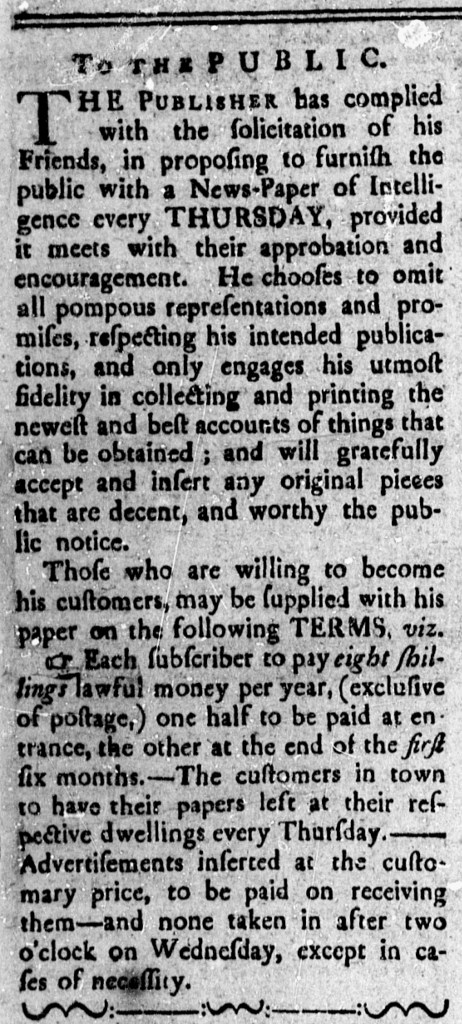
It was the third newspaper established in New England in just over a week. Robert L. Fowle distributed the first of the “occasional HAND-BILLS” that became the New Hampshire Gazette in Exeter on May 22, 1776. Three days later, Benjamin Dearborn published the first issue of the Freeman’s Journal in Portsmouth. Finally, on May 30, John Gill presented the Continental Journal to readers in Boston and beyond. Daniel Fowle had suspended his New-Hampshire Gazette in January or February, leaving the colony without any newspaper, so readers likely welcomed the new publications that gave them easier access to news and editorials about current events and forums for disseminating advertising than depending on newspapers from Massachusetts. After the battles at Lexington and Concord in April 1775, some printers in Boston discontinued or suspended their newspapers and others moved their newspapers to other towns. That included Benjamin Edes and John Gill, the printers of the Boston-Gazette. They dissolved their partnership and Edes printed the newspaper in Watertown during the siege of Boston and continued there for many months after British forces evacuated Boston. Only recently had Samuel Hall moved the New-England Chronicle from Cambridge into Boston. That made the Continental Journal only the second newspaper published in the city when Edes decided that he once again wished to “furnish the public with a News-Paper of Intelligence,” though he claimed that he “complied with the solicitation of his Friends” in pursuing the venture.
Printers often included an address to the public in their subscription proposals when they announced their plans to publish a newspaper or inserted a message to readers in the first issue. In his notice “TO THE PUBLIC,” Gill kept it simple by declaring that he “chooses to omit all pompous representations and promises … and only engages his utmost fidelity in collecting and printing the newest and best accounts of things that can be obtained.” With many years experiences printing the Boston-Gazette, he could rely on his reputation among prospective subscribers. Gill also outlined the “TERMS” for subscribers. The Continental Journal cost eight shilling per year, “one half to be paid at entrance, the other at the end of the first six months.” That was a common model among newspaper printers. He also advised, “Advertisements inserted at the customary price,” but did not specify that price. The printer did instruct advertisers that their notices were “to be paid on receiving them.” Like many other newspaper printers, he depended on advertising revenue. The printing office accepted advertisements until two o’clock on Wednesdays (and later only “in cases of necessity”), allowing time to set type and print the newspaper in time to distribute it to subscribers on Thursdays. The Continental Journal met with success, continuing throughout the war and closing in 1787 when Massachusetts imposed a tax on advertisements.