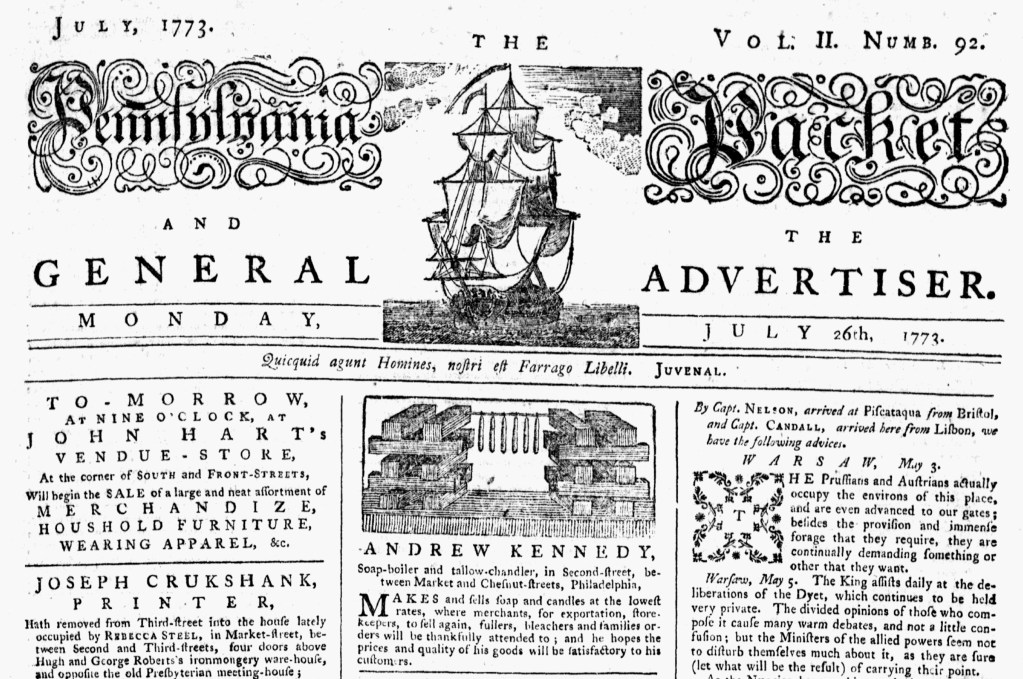
What was advertised in a colonial American newspaper 250 years ago this week?

“The following advertisements … may serve as models for some of your correspondents.”
At a glance, they looked like authentic advertisements in the first column on the first page of the Pennsylvania Packet, but on closer examination readers discovered that an anonymous correspondent submitted a series of notices “extended to more of the different arts, professions, wants, losses, &c. of mankind.” The author explained that he or she had recently read “a little essay upon NEWS-PAPERS” and realized “the public benefit of ADVERTISEMENTS” among “other advantages of these periodical papers.” While some people engaged in “complaining of [advertisements] being so common in all business,” a testament to the dissemination of broadsides, handbills, trade cards, billheads, and catalogs in addition to newspapers, “S.T.” wished to see advertising applied to other purposes. To that end, he or she composed nineteen advertisements “as models for some of [the printer’s] correspondents who have more leisure and inclination to pursue this valuable branch of public intelligence.”
Some of those advertisements commented on everyday events or misfortunes familiar to readers. For instance, one declared, “WAS LOST, A MEMORY. The person who met with this misfortune has received innumerable benefits which he cannot recollect so as to thank his benefactors for them.” Readers could have interpreted that notice as bittersweet, but the one above it was certainly more pointed: “WAS LOST, A FRIEND. He disappeared immediately after asking a favour of him.”
Others mocked or critiqued women. Playing on both runaway wife advertisements and notices about enslaved people who liberated themselves, the headline for one proclaimed, “MADE THEIR ESCAPE.” The remainder of the counterfeit advertisement explained, “AN husband’s affections. They disappeared immediately after seeing his wife with her face and hands unwashed at breakfast.” Another offered even more strident commentary about the role women were supposed to fill in the household. “WERE LOST,” it alerted readers, “THE seven last years of a lady’s life. They were seen frequently in the Play-house—in the stress—an in the Assembly room.” Rather than tending to her home and family, this imaginary lady frivolously spent her leisure time at the theater and exposed to all sorts of vices on the street as she went from shop to shop and, perhaps worst of all, attempting to usurp the authority of husbands and fathers within and beyond the household by taking an active interest in politics. Despite such denunciations, the roster of counterfeit advertisements included a lewd “WANTED” notice for “AN house-keeper for a batchelor—She must understand housewifery perfectly well, and be able to turn her hand to any thing.” Readers could imagine for themselves what “any thing” meant.

The last two advertisements trenchantly commented on the imperial crisis. Modeled after formulaic runaway wife advertisements, the first one, signed by “LOYALTY,” addressed the public: “WHERAS my wife AMERICAN LIBERTY, hath lately behaved in a very licentious manner, and run me in debt; this is to forwarn all persons from trusting her, as I will pay no debts of her contracting from the date hereof.” Women who were the subjects of actual runaway wife advertisements only occasionally had the resources to respond. In contrast, “AMERICAN LIBERTY” published an even longer rebuttal than the allegations made in the first advertisement. “WHEREAS my husband Loyalty hath, in a late advertisement, forwarned all persons form trusting me on his account,” the aggrieved American Liberty asserted, “this is to inform the public that he derived all his fortune from me; and that by our marriage articles, he has no right to proscribe me from the use of it.—My reason for leaving him was because he behaved in an arbitrary and cruel manner, and suffered his domestic servants, grooms, foxhunters, &c. to direct and insult me.” Astute readers recognized the allegory and the parallels to the charges that colonizers made against Great Britain as Parliament attempted to take a more active role in regulating commerce throughout the empire. Anticipating arguments that Thomas Paine would advance in Common Sense, American Liberty claimed that Loyalty (Great Britain) needed American Liberty (the colonies) more than American Liberty (the colonies) needed Loyalty (Great Britain). The colonies represented the most significant of the empire’s (the marriage’s) “fortune.” Furthermore, through charters and other practices, a long history of “marriage articles” gave colonies the right to oversee their own affairs.
These counterfeit advertisements ran in columns next to advertisements promoting “HAMILTON AND LEIPER, TOBACCONISTS,” “FRANCIS, DANCING MASTER,” “KEYER’s FAMOUS PILLS,” and “JAMES LOUGHEAD’s VENDUE” or Auction. Other advertisements included one from Frederick Weaker instructing the public not to extend credit to his wife because she “eloped from him without any just cause” and another in which Samuel Finch described “a negro man called JACK” and offered a reward for his capture and return to enslavement. The models proposed by the anonymous correspondence took formats quite familiar to readers of the Pennsylvania Packet and other newspapers, demonstrating that advertising was so widespread and many of its conventions so broadly recognized that colonizers could adapt advertising to deliver satirical and political messages about everyday life and current events.