June 18

What was advertised in a colonial American newspaper 250 years ago today?
Providence Gazette (June 18, 1774).

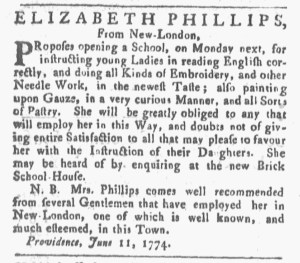
“Mrs. Phillips comes well recommended from several Gentlemen that have employed her in New-London.”

References upon request.  That was part of the marketing strategy deployed by Elizabeth Phillips when she relocated from New London to Providence.  Upon her arrival in Rhode Island, she placed an advertisement in the Providence Gazette to inform her new neighbors that she “PRoposes opening a School … for instructing young Ladies in reading English correctly, and doing all Kinds of Embroidery, and other Needle Work, in the newest Taste.”  Her curriculum also included “painting upon Gauze, in a very curious Manner, and [making] all Sorts of Pastry.”  Her pupils learned a variety of feminine arts.

The schoolmistress declared that she “will be greatly obliged to any that will employ her in this Way, and doubts not of giving entire Satisfaction to all that may please to favour her with the Instruction of their Daughters.”  Yet the newcomer realized that the public in Providence did not know her and lacked familiarity with her reputation for running a school. Phillips sought to counter that with a nota bene in which she claimed that she “comes well recommended from several Gentlemen that have employed her in New-London.”  Parents of prospective students did not have to take her word for it since “one of which is well known, and much esteemed, in this Town.”  Phillips did not reveal the identity of this gentleman in the public prints, but readers could learn more “by enquiring at the new Brick School-House.”  When they did, that gave the schoolmistress opportunities to share examples of the embroidery and painting she taught in addition to revealing who could speak on her behalf.  She likely supposed that engaging with the parents of prospective students in person would garner enrollments just as effectively as recommendations from previous employers, so offering references on request served as a means of initiating those interactions.
March 25

What was advertised in a colonial American newspaper 250 years ago today?

Massachusetts Spy (March 25, 1773).

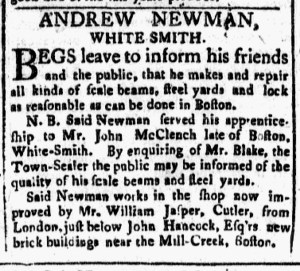
“By enquiring of Mr. Blake, the Town-Sealer the public may be informed of the quality of his scale beams and steel yards.”

Andrew Newman offered his services as a whitesmith in an advertisement in the March 25, 1773, edition of the Massachusetts Spy.  In addition to the usual sort of work undertaken by that trade, such as filing, lathing, burnishing, and polishing iron and steel, Newman declared that he “makes and repair[s] all kinds of scale beams, steel years and lock[s].”  Furthermore, he confidently stated that customers would find the quality and prices for such work “as reasonable as can be done in Boston.”

Many artisans included some sort of reference to their credentials, whether formal training or long experience, in their newspaper notices.  Newman did so in a nota bene.  He advised the public that he “served his apprenticeship to Mr. John McClench late of Boston, White-Smith.”  Newman likely hoped that colonizers who previously patronized McClench or were familiar with his reputation would consider hiring McClench’s former apprentice.  Even for those who did not know of McClench, Newman figured that giving information about completing an apprenticeship in the city recommended him to prospective customers.

He also encouraged them to consult “Mr. Blake, the Town-Sealer,” for an endorsement.  According to Newman, “the public may be informed of the quality of his scale beams and steel yards” when speaking with that local official.  Prospective customers did not have to rely on Newman’s word alone; instead, they could learn more and ask questions of a third party that they might consider neutral and thus more trustworthy when it came to assessing the materials that Newman produced and sold.  Short of a testimonial inserted in his advertisement, Newman likely considered such referrals the next best option.

Throughout the colonies, artisans often highlighted their credentials in their advertisements.  In his efforts to bolster his business, Newman did so, incorporating two strategies.  First, he gave details about his apprenticeship, hoping that his training with McClench would resonate with prospective customers familiar with his former master’s work.  Then, he directed the public to a local official who could provide an endorsement of Newman’s own skill and the quality of the items he made in his workshop.  Invoking both McClench and Black enhanced Newman’s assertions about the quality of his work.

March 20

What was advertised in a colonial American newspaper 250 years ago today?

Providence Gazette (March 20, 1773).

“WANTED immediately, A SCHOOLMASTER.”

Dr. Jonathan Arnold needed an instructor “to take Charge of the School at Whipple Hall, Providence, North End” in March 1773.  Even though he wished to hire a schoolmaster immediately because he had “a large Number of Scholars being now ready to enter” the school, Arnold refused to settle for just anyone who could teach reading, writing, and other subjects.  Instead, any prospective schoolmaster had to be “temperate and exemplary, in Life and Manners,” in addition to possessing “Ability in his Profession.”  In the era of the American Revolution, advertisements seeking schoolmasters as well as those placed by schoolmasters and -mistresses emphasized manners and morals as much as they did classroom instruction.

Arnold underscored that he was serious about screening applicants.  In a nota bene, he declared, “It is expected, that whoever applies will produce sufficient Testimonials of his Qualifications as above, from Persons of undoubted Credit and Character.”  To make the point even more clear, he added, “None but such need apply.”  Arnold demanded references.  The “Testimonials” that they provided had to cover all of a prospective schoolmaster’s qualifications, including his skill and experience in the classroom and his morals and demeanor.  Furthermore, those giving recommendations had to be beyond reproach themselves.

Although Arnold aimed to hire a suitable instructor as quickly as possible, his advertisement had audiences other than prospective candidates for the position.  He indirectly addressed parents and guardians of current and prospective pupils as well as the entire community.  Arnold made clear that he did not entrust any of the children and youth under his charge to just any schoolmaster.  Parents and the general public could depend on him recruiting instructors who were both effective teachers and good role models.  The notice served an immediate purpose, filling an opening at the school, while also fulfilling a secondary purpose of informing the public, especially parents and guardians of the “Scholars,” about the standards maintained at the school.

November 11

What was advertised in a colonial American newspaper 250 years ago today?

Pennsylvania Journal (November 11, 1772).

“Would be much obliged to any merchant or others for employment.”

Employment advertisements regularly appeared among advertisements for consumer goods and services, legal notices, and other advertisements in early American newspapers.  Colonizers placed notices seeking work while prospective employers alerted readers about opportunities.  On November 11, 1772, for instance, the Pennsylvania Journal carried both sorts of notices.

One had a headline that proclaimed “WANTED” in larger font.  The anonymous advertiser sought a “Single man, that understands driving a carriage and taking care of horses.”  Any candidate “must be well recommended for his honesty and sobriety, as none other need apply.”  To learn more, including the identity of the potential employer, the advertisement instructed readers to “enquire of the Printers” of the Pennsylvania Journal or “at the Bar of the London Coffee-House.”  Both places served as clearinghouses for information that did not appear in the public prints.

A notice placed by a “YOUNG MAN” who “WANTS EMPLOYMENT” advised that the advertiser considered himself qualified for various positions, including “an assistant in a store, bar-keeper, or steward of a ship.”  He boasted that he was “well acquainted with Arithmetick” and “can be well recommended for his honesty and sobriety.”  The young man requested that anyone interested in hiring him contact “Mr. Allen Moore, tavern-keeper, Mr. Fegan, store-keeper, store-keeper in Water-Street, Mr. John Cunningham, at the Center-House, on the Commons, or the Printers of this paper.”  In so doing, he did the eighteenth-century equivalent of listing his references.

The most extensive of the employment advertisements attempted to play on the sympathy of prospective employers.  An anonymous “PERSON residing in this city” reported that he “lately met with real and unavoidable misfortunes.”  Furthermore, he had “a large family to support,” compounding his difficulties.  To meet his responsibilities, he would be willing to “travel to any part of the continent, or even to the West-Indies, to settle accompts, collect money, &c. &c. for the sake of his family.”  The advertiser claimed that he had experience “serv[ing]a respectable body of merchants” in Philadelphia “as their clerk” for several years.  He also offered to provide references, declaring that he could “bring sufficient testimonials for his integrity and abilities from some of the first merchants in the city.”  He demonstrated his familiarity with how merchants conducted business by instructing prospective employers to “Enquire at the bar of the Coffee-House.”  His advertisement, longer than the others, reflected his experience and, likely, his anxiety to secure a position in order to provide for his family.