November 27

What was advertised in a colonial American newspaper 250 years ago today?

Providence Gazette (November 27, 1773).

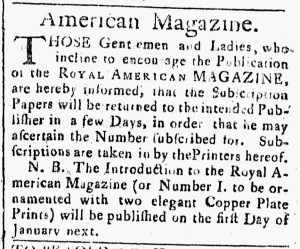
“The Introduction to the Royal American Magazine … will be published on the first Day of January next.”

Isaiah Thomas’s efforts to promote the Royal American Magazine in the public prints intensified in November 1773.  The Adverts 250 Project has traced his marketing efforts, starting with an announcement, in May, that he would soon publish proposals for the magazine and the first insertion of those proposals in Thomas’s newspaper, the Massachusetts Spy, at the end of June.  The printer ran ten advertisements in July, thirteen in August, fourteen in September, twenty in October, and forty-three in November.

Boston Evening-Post (November 1, 1773).

The month began with the Boston-Evening Post running Thomas’s “To be, or not to be” update for the first time and the Massachusetts Gazette and Boston Post-Boy carrying it a second time on November 1.  Every newspaper then discontinued that notice, likely an acknowledgement of a note at the end of the version in the Boston Evening-Post: “by the appearance of the Subscription Papers in [Thomas’s] possession, there is great probability of [the magazine] going forward.”  Three days later, Thomas published an advertisement that appeared only three times, each time in his own Massachusetts Spy.  That brief notice called on local agents to send lists of subscribers to Thomas: “THOSE gentlemen, in this and the other provinces, who have subscription papers in their hands for the ROYAL AMERICAN MAGAZINE, are earnestly desired to return them.”

Massachusetts Spy (November 4, 1773).

An advertisement that made its first appearance in some newspapers in the final week of October accounted for most of the notices that ran in November.  That advertisement advised “gentlemen and ladies, who incline to encourage the publication of the ROYAL AMERICAN MAGAZINE” that “Subscription Papers will be returned to the intended Publisher in a few Days.”  That notice ran thirty-two times in November, supplementing its five appearances in October.  It became Thomas’s most widely disseminated newspaper advertisement for the proposed magazine.  The Maryland Gazette, published in Annapolis, carried the notice four times in November, the first time any of Thomas’s advertisements ran in the public prints that far south.  Previously, only newspapers in New England, New York, and Pennsylvania carried it.  The Norwich Gazette, a newspaper established in Connecticut in October, also ran the advertisement in late November.  It may have featured the advertisement earlier, but the first issues of that newspaper have not survived.  This advertisement did not appear in any newspapers published in Massachusetts.  Thomas relied on his other advertisements there.  Overall, the “Subscription Papers will be returned” advertisement ran in fourteen newspapers published in ten cities and towns in six colonies.

Thomas devised one more advertisement in November 1773.  It first appeared in the Massachusetts Spy, but by the end of the month the Boston-Gazette and the Massachusetts Gazette and Boston Post-Boy both heeded Thomas’s plea for “PRINTERS of all the Public Papers in America … to insert this Advertisement.”  In it, Thomas stated that the first issue of the Royal American Magazine “will undoubtedly appear on the first of January next.”  He solicited essays to include in the new publication.  He also made another appeal to prospective subscribers to send their names “if they chuse not to be disappointed” by missing the first issue.

Launching the only magazine published in the colonies at that time was a significant undertaking.  That Thomas would eventually take the magazine to press was not inevitable.  He needed to cultivate a community of subscribers that extended beyond Boston.  To achieve that goal, he devised an extensive advertising campaign, one surpassed only by Robert Bell in his efforts to create an American literary market.

**********

Newspaper Advertisements for November 1773

To be, or not to be” Update

  • November 1 – Boston Evening-Post (first appearance)
  • November 1 – Massachusetts Gazette and Boston Post-Boy (second appearance)

“Subscription Papers will be returned” Update

  • November 1 – Newport Mercury (first appearance)
  • November 1 – Pennsylvania Chronicle (first appearance)
  • November 1 – Pennsylvania Packet (first appearance)
  • November 2 – Connecticut Courant (first appearance)
  • November 3 – Pennsylvania Journal (first appearance)
  • November 4 – Maryland Gazette (first appearance)
  • November 4 – New-York Journal (second appearance)
  • November 8 – Newport Mercury (first appearance)
  • November 8 – New-York Gazette and Weekly Mercury (first appearance)
  • November 8 – Pennsylvania Chronicle (second appearance)
  • November 8 – Pennsylvania Packet (second appearance)
  • November 9 – Connecticut Courant (second appearance)
  • November 10 – Pennsylvania Gazette (first appearance)
  • November 10 – Pennsylvania Journal (second appearance)
  • November 11 – Maryland Gazette (second appearance)
  • November 11 – New-York Journal (third appearance)
  • November 12 – New-Hampshire Gazette (second appearance)
  • November 12 – New-London Gazette (second appearance)
  • November 15 – Newport Mercury (second appearance)
  • November 15 – New-York Gazette and Weekly Mercury (second appearance)
  • November 15 – Pennsylvania Chronicle (third appearance)
  • November 18 – Maryland Gazette (third appearance)
  • November 18 – Norwich Packet (first known appearance)
  • November 20 – Providence Gazette (first appearance)
  • November 22 – New-York Gazette and Weekly Mercury (third appearance)
  • November 22 – Pennsylvania Chronicle (fourth appearance)
  • November 24 – Pennsylvania Gazette (second appearance)
  • November 25 – Maryland Gazette (fourth appearance)
  • November 25 – Norwich Packet (second appearance)
  • November 26 – New-Hampshire Gazette (third appearance)
  • November 27 – Providence Gazette (second appearance)
  • November 29 – Pennsylvania Chronicle (fifth appearance)

“subscription papers in their hands” Update

  • November 4 – Massachusetts Spy (first appearance)
  • November 11 – Massachusetts Spy (second appearance)
  • November 18 – Massachusetts Spy (third appearance)

“generous Patrons” Update

  • November 18 – Massachusetts Spy (first appearance)
  • November 22 – Boston-Gazette (first appearance)
  • November 22 – Massachusetts Gazette and Boston Post-Boy (first appearance)
  • November 26 – Massachusetts Spy (second appearance)
  • November 29 – Boston-Gazette (second appearance)
  • November 29 – Massachusetts Gazette and Boston Post-Boy (second appearance)
October 31

What was advertised in a colonial American newspaper 250 years ago this month?

Boston-Gazette (October 25, 1773).

“American Magazine. ‘To be, or not to be.’”

In the summer and fall of 1773, Isaiah Thomas advertised widely in his efforts to attract subscribers for the Royal American Magazine, a proposed publication that would become the only magazine published in the colonies at the time if the printer managed to generate enough interest to make it a viable venture.  On October 25, he placed advertisements in the Boston-Gazette and the Massachusetts Gazette and Boston Post-Boy with a secondary headline that proclaimed “To be, or not to be,” a familiar quotation from Shakespeare’s Hamlet, to indicate that the prospects of the publication remained uncertain.  In both newspapers, Thomas requested that anyone who recruited subscribers return the subscription papers with the lists of names by the middle of November “as by that Time he shall be able to determine, whether the said Magazine will be Published or not.”  The advertisement in the Boston-Gazette also included a nota bene in which Thomas confided that “by the Appearance of the Subscription papers, in his Possession, there is the greatest Probability of its going forward.”  Thomas would indeed publish the first issue in January 1774, though the magazine lasted only sixteen months due to the disruptions of the imperial crisis and, eventually, the war that began with the skirmishes at Lexington and Concord in April 1775.

The Adverts 250 Project has traced the advertising campaign that promoted the Royal American Magazine in June, July, August, and September.  An even greater number of advertisements appeared in colonial newspapers in October than in any previous month, a total of twenty advertisements in ten newspapers in eight towns in six colonies.  Three of those advertisements ran in Thomas’s own Massachusetts Spy, while other newspapers carried the vast majority of them. Fourteen of the advertisements appeared in newspapers published beyond Boston.  Thomas sought subscribers who read newspapers published in Salem, Massachusetts; Portsmouth, New-Hampshire; Newport, Rhode Island; New Haven and New London in Connecticut; and New York and Philadelphia.  Previously, the Connecticut Courant, published in Hartford, and the Providence Gazette also carried the subscription proposals for the Royal American Magazine.  Thomas knew the number of prospective subscribers in Boston alone would not justify an investment of the time and resources required to publish a magazine.  He devised an advertising campaign that extended to all of the colonies in New England as well as New York and Pennsylvania.

Newport Mercury (October 4, 1773).

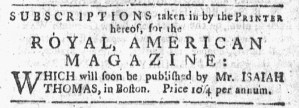
In October 1773, the subscription proposals appeared once again in the Connecticut Journal and the Pennsylvania Journal.  The printer’s update addressed “To the Public made additional appearances in the Boston-Gazette and the Massachusetts Spy.  It also ran for the first time in the Essex Gazette, published in Salem, and had two more insertions during the month.  Having published the subscription proposals in July and August, the Newport Mercury carried a unique advertisement, likely devised by Solomon Southwick, the printer and Thomas’s local agent for collecting the names of subscribers, rather than by Thomas himself.  It announced, “SUBSCRIPTIONS taken in by the Printer hereof, FOR THE ROYAL AMERICAN MAGAZINE: WHICH will soon be published by Mr. ISAIAH THOMAS, in Boston.  Price 10s4 per annum.”

Connecticut Journal (October 22, 1773).

That advertisement expressed greater certainty about the prospects for the magazine than Thomas’s “To be, or not to be” notice that ran in Boston later in the month, as did another update that Thomas placed in newspapers in Connecticut, New Hampshire, and New York near the end of the month.  That advertisement informed “Gentlemen and Ladies, who incline to encourage the Publication of the ROYAL AMERICAN MAGAZINE … that the Subscription Papers will be returned to the intended Publisher in a few Days, in order that he may ascertain the Number subscribed for.”  Those who had not yet submitted their names to the local printing office had only a limited time to do so.  As an enticement to those still contemplating whether they wished to subscribe, a nota bene promoted “two elegant Copper Plate Prints” that would accompany the first issue of the magazine.  The nota bene also indicated a publication date, “the first Day of January next.”  Along with the magazine, prospective subscribers did not have much time to qualify for these premiums.  If they decided to subscribe at some time in the future, they would miss out on the gift given to those who supported the magazine even before the first issue went to press.

Thomas hoped to publish the Royal American Magazine, but first he needed to determine if a market existed to support it.  His subscription proposals and other advertisements served a dual purpose: they incited demand for the magazine while also assessing interest and determining the total number of subscribers willing to pay for the publication.  Some subscription proposals, no matter how widely they circulated, never resulted in publishing the proposed book, magazine, map, or other item.  Over the course of several months, Thomas managed to identify and incite sufficient demand to publish the Royal American Magazine.

**********

Newspaper Advertisements for October 1773

Subscription Proposals

  • October 8 – Connecticut Journal (second known appearance; fourth possible appearance)
  • October 20 – Postscript to the Pennsylvania Journal (second appearance)

To the PUBLIC” Update

  • October 4 – Boston-Gazette (third appearance)
  • October 7 – Massachusetts Spy (third appearance)
  • October 12 – Essex Gazette (first appearance)
  • October 14 – Massachusetts Spy (fourth appearance)
  • October 19 – Essex Gazette (second appearance)
  • October 21 – Massachusetts Spy (fifth appearance)
  • October 26 – Essex Gazette (third appearance)

“SUBSCRIPTIONS” Notice

  • October 4 – Newport Mercury (first appearance)
  • October 11 – Newport Mercury (second appearance)
  • October 18 – Newport Mercury (third appearance)
  • October 25 – Newport Mercury (fourth appearance)

“Subscription Papers will be returned” Update

  • October 22 – Connecticut Journal (first appearance)
  • October 22 – New-Hampshire Gazette (first appearance)
  • October 22 – New-London Gazette (first appearance)
  • October 28 – New-York Journal (first appearance)
  • October 29 – Connecticut Journal (second appearance)

To be, or not to be” Update

  • October 25 – Boston-Gazette (first appearance)
  • October 25 – Massachusetts Gazette and Boston Post-Boy (first appearance)

October 1

What was advertised in a colonial American newspaper 250 years ago today?

Connecticut Journal and New-Haven Post-Boy (October 1, 1773).

“WATCHES are restored to their pristine vigour, and warranted to perform well, free of expence for one year.”

Thomas Hilldrup, “WATCH MAKER from LONDON,” apparently considered his advertising campaign effective.  On October 1, 1773, his notice with the dateline, “Hartford, July 20, 1773,” once again appeared in the Connecticut Journal and New-Haven Post-Boy and the New-London Gazette.  Four days later, the same notice ran once again in the Connecticut Courant, the only newspaper printed in Hartford at the time.  When Hilldrup first arrived in Hartford in 1772 he commenced advertising in the Connecticut Courant, but it did not take long for him to surmise that he might benefit from advertising more widely.  He soon placed notices in the other two newspapers published in the colony.  Other watchmakers inserted their own advertisements in hopes of maintaining their share of local markets, but none of them advertised in multiple newspapers.  Hilldrup’s competitors also discontinued their advertisements after a few insertions, while the newcomer’s notices became a consistent feature in the three newspapers.

Hilldrup likely thought he made a wise investment by marketing his services in all three newspapers.  After all, those publications circulated widely throughout the colony.  Even if residents of New Haven or New London were unlikely to send their watches to Hilldrup at “the sign of the Dial” in Hartford, the watchmaker may have believed that prospective customers in other towns served by the Connecticut Journal and the New-London Gazette would find it as convenient to hire his services as those of his competitors … but only if Hilldrup made the effort to inform the public of his “constant diligence” in restoring watches “to their pristine vigour.”  In addition, his repeated advertisements in the three newspapers highlighted the guarantee he extended to clients, a promise that watches he fixed were “warranted to perform well, free of any expence for one year.”  In placing advertisements so widely and so often, Hilldrup reasoned that he could entice prospective clients beyond Hartford to give him a chance to serve them when they needed “Repeating, Horizontal and plain WATCHES” cleaned and repaired.

July 24

What was advertised in a colonial American newspaper 250 years ago today?

Providence Gazette (July 24, 1773).

“Best ANCHORS … In NEW-YORK.”

For quite some time in 1773, William Hawxhurst “In NEW-YORK” advertised widely, seeking customers for the “Best ANCHORS, Made of Sterling Iron,” among mariners in several colonies.  Consider the notice that appeared in the Providence Gazette on Saturday, July 24.  During the previous week, the same advertisement ran in the Newport Mercury on Monday, July 19, the Connecticut Courant (published in Hartford) on Tuesday, July 20, and the Connecticut Journal and New-Haven Post-Boy and the New-London Gazette on Friday, July 23.  Curiously, Hawxhurst did not place notices in any of the newspapers published in New York.  Perhaps he relied on personal connections and the visibility of the anchors “in a Yard between [Burling’s] Slip and Byvank’s Store, on the Dock,” to market them to prospective customers in that busy port.  The publications he did choose for his advertisements represented every newspaper in Connecticut and every newspaper in Rhode Island, suggesting that he carefully crafted a regional marketing campaign.

In addition to the anchors, Hawxhurst advertised other goods.  Several years earlier, he “erected a Finer and great hammer, for refining the Sterling pig iron, into bar” in New York.  He continued to produce and sell “the best Sterling-refined Iron, warranted good” and “Pig-Iron of the Sterling new Mine, cast in Cinder, warranted good” as well as “Scythe [Iron]” and “Keen’s best Bloomery Iron.”  Hawxhurst also made clear that he was willing to barter, accepting several commodities, including “pickled Cod Fish, Mackarel, Liver-Oil, and New-England Tobacco,” in exchange for anchors and iron.  That list of commodities certainly reflected what mariners operating from ports in Connecticut and Rhode Island could offer as payment.  While he had the attention of readers of several newspapers, Hawxhurst also announced that he sought to hire a “Person well qualified to manufacture Steel from Pig Iron, in the German Way.”  Like many advertisements that appeared in early American newspapers, this one served multiple objectives that defied classification for a single purpose.  It ranged widely in terms of both distribution and the results that the advertiser wished to achieve.

March 21

What was advertised in a colonial American newspaper 250 years ago this week?

Massachusetts Gazette and Boston Weekly News-Letter (March 18, 1773).

“PROPOSES to publish a Weekly NEWS-PAPER.”

James Rivington continued to expand his marketing campaign to gain subscribers for his new newspaper, “RIVINGTON’s NEW-YORK GAZETTEER; OR THE CONNECTICUT, NEW-JERSEY, HUDSON’s-RIVER, AND QUEBEC WEEKLY ADVERTISER,” with an advertisement in the March 18, 1773, edition of the Massachusetts Gazette and Boston Weekly Mercury.  Nearly a month earlier, he commenced advertising in newspapers with a brief notice in the Newport Mercury on February 22.  That same day, he placed a longer notice in the Pennsylvania Chronicle.  That version became the standard that Rivington published, with minor variations, in other newspapers, including the Pennsylvania Gazette and the Pennsylvania Journal on February 24, the Connecticut Journal on February 26, and the Pennsylvania Packet on March 1.  On March 8, he informed readers of the New-York Gazette and Weekly Mercury that the “first Number” of Rivington’s New-York Gazetteer “shall make its Appearance in the month of April” and requested that “Gentlemen who may be inclined to promote the Establishment of this Undertaking” send their names “as soon as convenient, which will determine the Number he shall print of the first Paper.”

For prospective subscribers in Massachusetts, Rivington provided directions for contacting local agents.  “Subscriptions taken,” he declared, “by Messrs. Cox and Berry and Dr. M.B. Goldthwait, at Boston.”  Otherwise, the proposal in the Massachusetts Gazette and Boston Weekly Mercury replicated those that ran in the newspapers published in Philadelphia.  For some reason, that initial notice in the Newport Mercury differed significantly from those that ran in half a dozen other newspapers in New England, New York, and Pennsylvania.  The overall consistency of those subscription proposals amounted to a regional advertising campaign that delivered the same content to prospective subscribers in several colonies.  Members of the book trade – printers, booksellers, and publishers – devised the vast majority of advertising campaigns that extended beyond a single town in the eighteenth century.  Merchants and shopkeepers frequently placed advertisements in multiple newspapers published in their town; the purveyors of goods, rather than the products they sold, defined the geographic scope of their markets since most producers did not advertise the items they made.  Even when merchants and shopkeepers in several towns sold the same items, such as patent medicines, they did not participate in centralized advertising campaigns coordinated by the producers of those items.  Markets confined to colonial cities and their hinterlands, however, often could not support printed items, such as books and pamphlets, so printers, booksellers, and publishers developed advertising campaigns that placed the same notices in newspapers throughout a region or even throughout the colonies.  Rivington adopted that model in marketing a newspaper that he also intended would serve readers far beyond his printing office in New York.

October 9

What was advertised in a colonial American newspaper 250 years ago today?

New-London Gazette (October 9, 1772).

“Staffordshire and Liverpool Warehouse, in Kingstreet, BOSTON.”

Ebenezer Bridgham continued his efforts to create a regional market for his “Staffordshire and Liverpool Warehouse” in Boston with an advertisement in the October 9, 1772, edition of the New-London Gazette.  That advertisement featured copy identical to a notice in the October 2 edition of the New-Hampshire Gazette, though the compositors in the two printing offices made very different decisions about the format of the advertisements.  Bridgham’s advertisement ran a second time in the New-Hampshire Gazette (less the headline announcing “Crockery Ware”) the same day that it first appeared in the New-London Gazette.  He likely dispatched letters to the printing offices on the same day, but, given the distance, the New-London Gazette received its letter later and published his advertisement in the next edition after its arrival.

With advertisements in newspapers in Connecticut and New Hampshire in the fall of 1772, Bridgham continued a project that commenced more than a year earlier with advertisements in the Connecticut Courant, the Essex Gazette, and the Providence Gazette in September 1771.  He added the New-London Gazette the next month.  He placed a subsequent notice in the Connecticut Courant in June 1772, but he did not pursue the same coordinated campaign that he launched in the fall of 1771.  Although his “Crockery Ware” advertisement appeared in both the New-London Gazette and the New-Hampshire Gazette in early October 1772, it did not run in the other newspapers at that time.

That may have been the result of Bridgham learning which advertisements in which newspapers generated orders from country shopkeepers and other customers … and which did not.  His prior experience may have constituted a rudimentary form of market research that guided his decisions about where to focus his advertising efforts.  Alternately, Bridgham may have been delinquent in submitting payment for his advertisements, causing printers not to run them until he settled his debts.  His “Crockery Ware” advertisement eventually ran in Hartford’s Connecticut Courant on November 17.  In February 1772, Ebenezer Watson, printer of the Connecticut Courant, inserted a notice that “No Advertisements will for the future be published in this paper, without the money is first paid.”  The delay in publishing Bridgham’s “Crockery Ware” advertisement may have been due to waiting for payment.  Beyond these possibilities, Bridgham may have been haphazard in submitting his “Crockery Ware” advertisement to various printing offices.  If so, that deviated from the coordination he demonstrated in the fall of 1771.

October 2

What was advertised in a colonial American newspaper 250 years ago today?

New-Hampshire Gazette (October 2, 1772).

“His customers may depend on having their ware packed in the best manner.”

Ebenezer Bridgham sold “Crockery Ware” and other goods at his “Staffordshire and Liverpool Ware House” on King Street in Boston in the early 1770s.  In an advertisement in the October 2, 1772, edition of the New-Hampshire Gazette, he declared that he imported his merchandise “directly from the Pot-Houses in Staffordshire and Liverpool” rather than purchasing from English merchants.  Fewer links in the supply chain meant fewer markups for his inventory.  Bridgham passed along the savings to his customers, making bold claims about his prices.  He trumpeted that he sold his wares “as low as they can be bought in London,” adding that he was “determined not to be UNDERSOLD by any person in America.”

Bridgham made that assertion in the midst of his attempts to create a regional market for the “Staffordshire and Liverpool Ware House.”  In a sense, every newspaper advertiser engaged a regional market since newspapers circulated far beyond the cities where they were published, usually serving entire colonies before the American Revolution.  Bridgham, however, intentionally placed advertisements in newspapers throughout New England.  In addition to Portsmouth’s New-Hampshire Gazette, he also advertised in Salem’s Essex Gazette, the Providence Gazette, Hartford’s Connecticut Courant, and the New-London Gazette.  Bridgham aimed to provide shopkeepers throughout the region with an assortment of merchandise for their own shops.  He expected that his “resolution” not to be “UNDERSOLD by any person in America” resonated with “his former good customers” who he hoped would “continue to favour him with their custom.”  In turn, invoking former customers signaled to new customers that Bridgham merited their orders since he already established and successfully served a clientele.

As evidence of his attention to the needs of his customers, he emphasized more than low prices for an incredible array of choiuces among the “full & complete assortment of Delph, Flint and Glass Ware” at the “Staffordshire and Liverpool Ware House.”  In a nota bene, Bridgham announced that he “lately procur’d packers from England” so “his customers may depend on having their ware packed in the best manner.”  They did not need to worry about receiving broken goods shipped to their towns throughout New England.  Bridgham believed that this ancillary service aided his efforts to serve a regional market, one that extended beyond Boston and beyond Massachusetts.

June 23

What was advertised in a colonial American newspaper 250 years ago today?

Connecticut Courant (June 23, 1772).

Country Traders may depend on having their Ware pack’d in the best Manner.”

In the early 1770s, Ebenezer Bridgham operated the “Staffordshire & Liverpool Ware-House in King-Street, BOSTON,” where he stocked “a very large and compleat Assortment of China, Glass, Delph & Stone WARE.”  The merchant advertised in newspapers published in Boston, but he also sought to cultivate customers far beyond the city.  In the fall of 1771, he inserted advertisement in the Essex Gazette, the Providence Gazette, the Connecticut Courant, and the New-London Gazette.  He likely believed that those advertisements generated business because he once again placed advertisements in the Connecticut Courant in the summer of 1772.

Bridgham informed residents of Hartford and others who read the Connecticut Courant that his inventory of “China, Glass, Delph & Stone WARE” constituted “the greatest Variety to be met with in any Store in America, or perhaps in the whole World.”  If that was the case, then how could he confine himself to serving solely customers in Boston and its hinterlands?!  In addition, he negotiated with the “several manufacturers in Staffordshire and Liverpool” to acquire his inventory “on such Terms” that he could match the prices in London rather than marking up prices after transporting his goods across the Atlantic.  Furthermore, Bridgham vowed that “he will not be undersold by any person in America.”  In a regional advertising campaign, he made a bold claim that applied throughout the colonies, signaling to prospective customers in Connecticut that they did not need to look to merchants beyond New England, especially in nearby New York, for better bargains.

In particular, Bridgham hoped that retailers in small towns would respond to his advertisement.  He concluded with a nota bene advising that “Country Traders may depend on having their Ware pack’d in the best Manner, there being Packers provided from England for that Purpose” at his store.  Bridgham assured shopkeepers and others that their orders would arrive intact, free from damage and ready to sell to their own customers.  Orders from just a few “Country Traders” may have sufficiently offset the costs to justify running an advertisement in the Connecticut Journal.  Colonial newspapers circulated far beyond the cities and towns where they were published, disseminating advertisements as well as news.  Many merchants considered that sufficient to meet their marketing needs, but that was not the case for Bridgham when he decided to become a regional supplier of “China, Glass, Delph & Stone WARE” manufactured in Staffordshire and Liverpool.  Instead, he placed advertisements in newspapers published in several towns in New England in his effort to expand his share of the market.

October 11

What was advertised in a colonial American newspaper 250 years ago today?

New-London Gazette (October 11, 1771).

“The Staffordshire and Liverpool WARE-HOUSE In KING-STREET.”

Ebenezer Bridgham launched a regional advertising campaign for his “Staffordshire and Liverpool WARE-HOUSE In KING-STREET” in Boston in the fall of 1771.  Beyond his own city, he began by placing advertisements in the Essex Gazette, published in Salem, and the Providence Gazette, published in the neighboring colony.  Many of the readers of those newspapers resided in the hinterlands around Boston, making them as likely to order merchandise from shops in that busy port as from shops in Salem or Providence.

Bridgham, however, sought to enlarge his market to include prospective customers who resided at much more considerable distances.  Over several weeks, he inserted advertisements in most of the newspapers published in New England outside of Boston.  On October 11, 1771, Bridgham’s advertisement ran in the New-London Gazette, a newspaper just as likely to carry notices from New York as from Boston.  Indeed, another advertisement in that issue promoted the “Passage-Boat” or passenger ferry that Clark Truman operated between New London and Sag Harbor, a village on Long Island, once a week.  That service helped residents of New London other parts of Connecticut keep better connected to New York, facilitating commerce and purchasing goods from merchants and shopkeepers there.

In each instance that Bridgham’s notices ran in additional newspapers, they featured identical copy but unique formats designed by the compositor who labored in the local printing office.  That copy included a pledge that Bridgham was “able and fully inclin’d to sell” his wares “at least as low as they were ever Sold in America.”  In attempting to create a regional market in which he competed with merchants and shopkeepers beyond Boston, Bridgham considered it imperative to assure prospective customers that he offered prices as good as any they might find locally.  In stating that his prices were “at least as low” as others, he hinted at even better bargains for consumers in distant towns and villages who sent away to Boston for their “China, Glass, Delph, and Stone WARE.”

September 10

What was advertised in a colonial American newspaper 250 years ago today?

Connecticut Courant (September 10, 1771).

“The Staffordshire and Liverpool Ware House, In King Stret BOSTON.”

As summer turned to fall in 1771, Ebenezer Bridgham, the proprietor of the “Staffordshire and Liverpool Ware House” on King Street in Boston, attempted to cultivate a regional reputation for his store.  Not content seeking customers in Boston and the surrounding towns, he also placed advertisements in newspapers published in other places in New England. On September 7, for instance, he inserted an advertisement in the Providence Gazette, informing prospective customers that he stocked “a very large and elegant Assortment of China, Glass, Delph and Stone Ware” that he imported “directly from the several Manufacturers in Staffordshire and Liverpool.”  Three days later, the same advertisement also ran in the Connecticut Courant, published in Hartford, and the Essex Gazette, published in Salem.  Bridgham disseminated information about the Staffordshire and Liverpool Warehouse far more widely than if he had placed his notice solely in the several newspapers published in Boston.  To entice customers in towns throughout New England to place orders from his store, he pledged to part with his wares “as low as they were ever sold in America.”

Essex Gazette (September 10, 1771).

The appearance of Bridgham’s advertisement in several newspapers demonstrated a division of responsibilities in the creation of marketing materials in the eighteenth century.  As the advertiser, Bridgham supplied the copy.  The composition, however, made decisions about the format.  In each newspaper, the graphic design of Bridgham’s advertisement looked consistent with other paid notices in that publication.  In the Essex Gazette, for example, the advertisement promoted “a very large and elegant Assortment of CHINA, GLASS, DELPH and STONE WARE,” the various categories of goods in capital letters.  Other advertisements in the Essex Gazette also featured key words in all capitals.  On the other hand, notices in the Connecticut Courant did not tend utilize that means of drawing attention to particular goods, reserving capitals for names of advertisers and towns.  Similarly, “Staffordshire” and “Liverpool” appeared in italics in the headline in the Essex Gazette, but “King Street” appeared in italics in the Connecticut Courant.  The compositors made decisions independently when they set type.  As a result, Bridgham’s advertisement had variations in design, but not copy, when it ran in multiple newspapers.