March 3

What was advertised in a revolutionary American newspaper 250 years ago this week?
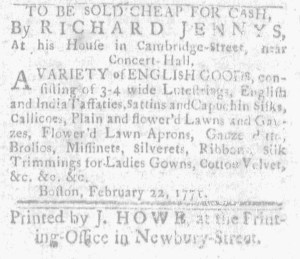
Massachusetts Gazette and Boston Weekly News-Letter (February 29, 1776).

“TO BE SOLD CHEAP FOR CASH … A VARIETY of ENGLISH GOODS.”

After more than seventy years, the Massachusetts Gazette and Boston Weekly News-Letter ended its run with one last advertisement and a colophon that stated, “Printed by J. HOWE, at the Printing-Office in Newbury-Street.”  John Campbell, the publisher, and Bartholomew Green, the printer, distributed the first issue of the Boston News-Letter, as the newspaper was initially named, on April 24, 1704.  It became the first weekly newspaper published in the colonies, preceded only by a single issue of Publick Occurrences, a newspaper quickly shut down by authorities in 1690.

The first issue of the Boston News-Letter concluded with an “Advertisement” soliciting advertisements: “THis News Letter is to be continued Weekly; and all Persons who have any Houses, Lands, Tenements, Farmers, Ships Vessels, Goods, Wares or Merchandizes, &c. to be Sold or Lett; or Servants Run away; or Goods Stoll or Lost, may have the same Inserted at a Reasonable Rate; from Twelve Pence to Five Shillings.”  Over the next seven decades, the Boston News-Letter carried countless advertisements, many of them promoting goods and services to readers experiencing a transatlantic consumer revolution.  The notices concerning “Servants Run away” included enslaved men and women who liberated themselves by fleeing from their enslavers.  Many other advertisements about enslaved people for sale also appeared in the pages of the Boston News-Letter alongside those promoting goods and services or placed for the various other reasons outlined in that first “Advertisement.”

Ownership of the newspaper changed several times.  The Massachusetts Gazette and Boston Weekly News-Letter briefly suspended publication after the battles at Lexington and Concord in April 1775.  When it resumed, it was the only newspaper that continued in Boston.  All the others either closed or relocated to other towns.  New issues sometimes came out sporadically (or “PUBLISHED OCCASSIONALLY,” according to the masthead of the October 13, 1775, edition), often as half sheets with two pages of content instead of the usual full sheets with four pages.  Sometime in late September or early October, John Howe became the final printer of the newspaper.  In his History and Bibliography of American Newspapers, 1690-1820, Clarence S. Brigham indicates that the last known issue was the February 22, 1776, edition, yet a quotation from the February 29 issue appeared in the Boston-Gazette on March 4.[1]  Since publication of Brigham’s History and Bibliography in 1947, a copy of the February 29 issue has been located, digitized, and made accessible via Readex’s America’s Historical Newspapers.  That last known issue consisted of only two pages.  Most of the content consisted of news from London with some local updates from Boston.  Half a dozen advertisements also appeared, including a final notice from Richard Jennys for a “VARIETY of ENGLISH GOODS.”

**********

[1] Clarence S Brigham, History and Bibliography of American Newspapers, 1690-1820 (Worcester: American Antiquarian Society, 1947), 328.

August 22

What was advertised in a colonial American newspaper 250 years ago today?

Massachusetts Gazette and Boston Weekly News-Letter (August 22, 1771).

“As low a Price, as … can be purchased for at any Shop in th[i]s Town.”

In the summer of 1771, Richard Jennys sold a “Variety of English, Scotch and India Goods” at his shop across the street from the “Old Brick Meeting-House, in Cornhill” in Boston.  His inventory included “a Parcel of beautiful and newest Fashion Apron Gauzes, Gauze Handkerchiefs and Aprons” as well as “a few Pieces of handsome Lutestring and Mantua Silks.”  Like many purveyors of goods who advertised in the Massachusetts Gazette and Boston Weekly News-Letter and other colonial newspapers, Jennys made an appeal to price in his effort to incite demand and convince prospective customers to visit his shop.  He described his prices for the lutestring and silk as “very cheap.”

Yet Jennys did more than merely promise low prices.  In a nota bene that concluded his advertisement, he offered a price match guarantee to consumers.  “His Customers,” the shopkeeper declared, “may depend on having any Article at as low a Price, as the same can be purchased for at any Shop in th[i]s Town.”  Jennys certainly had plenty of competitors in Boston, a bustling port and one of the largest cities in the colonies, but that did not prevent him from vowing that he would not be undersold.  In such a crowded marketplace, he attempted to distinguish his shop from the many others that carried similar goods “IMPORTED from LONDON.”  Although he made a point of noting his low prices for certain textiles, his price match guarantee suggested that the bargains did not end there.  Instead, comparison shoppers could get a deal on every single item that Jennys had in stock.  Jennys leveraged every other advertisement that promised “the very lowest Rate” or “a very low Price” by alerting customers that he would offer the same deals.  Some retailers have made this practice a cornerstone of their marketing strategy in the twenty-first century, but they certainly did not invent the price match guarantee.  Entrepreneurs like Jennys deployed it centuries earlier.

August 30

What was advertised in a colonial American newspaper 250 years ago today?

Aug 30 - 8:30:1770 Massachusetts Gazette and Boston Weekly News-Letter
Massachusetts Gazette and Boston Weekly News-Letter (August 30, 1770).

“They were all imported before the Non-Importation Agreement commenced.”

As fall approached in 1770, Richard Jennys ran advertisement for a “Variety of English, India and Scotch Goods” in the August 30 edition of the Massachusetts Gazette and Boston Weekly News-Letter.  He informed “his Customers and others” that he intended to sell his entire inventory “at the very lowest Rates.”  From “Black, white, and crimson plain Sattin” to “Very handsome Apron Gauz” to “Mens & Womens Hose,” Jennys promised bargains.

He also appended a short note about when these imported goods arrived in the colonies.  “They were all imported,” he declared, “before the Non-Importation Agreement commenced.”  The merchants and traders of Boston and other towns and cities throughout the colonies previously agreed to boycott imported goods in response to duties imposed on certain goods by the Townshend Acts.  They aimed to use economic leverage for political purposes, vowing not to import goods until Parliament repealed all of the duties.  Near the end of spring the residents of Boston received word that most of the duties had been repealed, tea excepted.  That left them in a quandary.  Having mostly achieved their goal, could they relent and resume importing?  Or, should the nonimportation pact remain in place until Parliament eliminated the duty on tea as well?  Merchants in New York very quickly reverted to their previous practices in May, but debates continued in Boston and Philadelphia.  The agreement remained in place in Philadelphia well into September and in Boston into October.

Jennys alerted prospective customers and the entire community that he continued to abide by the agreement while it remained in effect, but he advertisement also suggested that he suspected that trade would resume in the near future, that it was only a matter of time before Boston followed the example of New York.  One reason that he offered such low prices was his determination “to sell off his whole Stock in Trade this Fall.”  Jennys likely sought to clear out his inventory of goods imported quite some time earlier in order to make room for new goods that he anticipated would be arriving in Boston before the end of the year.  His advertisement demonstrated both political savvy and a practical approach to change that Jennys sensed coming.