April 23

What was advertised in a revolutionary American newspaper 250 years ago this week?
Rivington’s New-York Gazetteer (April 20, 1775).

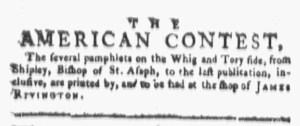
“Several pamphlets on the Whig and Tory side.”

Many Patriots did not care for the editorial stance that James Rivington took in his newspaper.  They considered him a Loyalist even though he declared in the masthead that he operated an “OPEN and UNINFLUENCED PRESS” that represented all views.  Similarly, he printed, advertised, and sold political pamphlets about “THE AMERICAN CONTEST … on the Whig and Tory side.”  Rivington aimed to keep colonizers informed and intended to generate revenue while doing so, believing that controversy could be good for business during the imperial crisis.

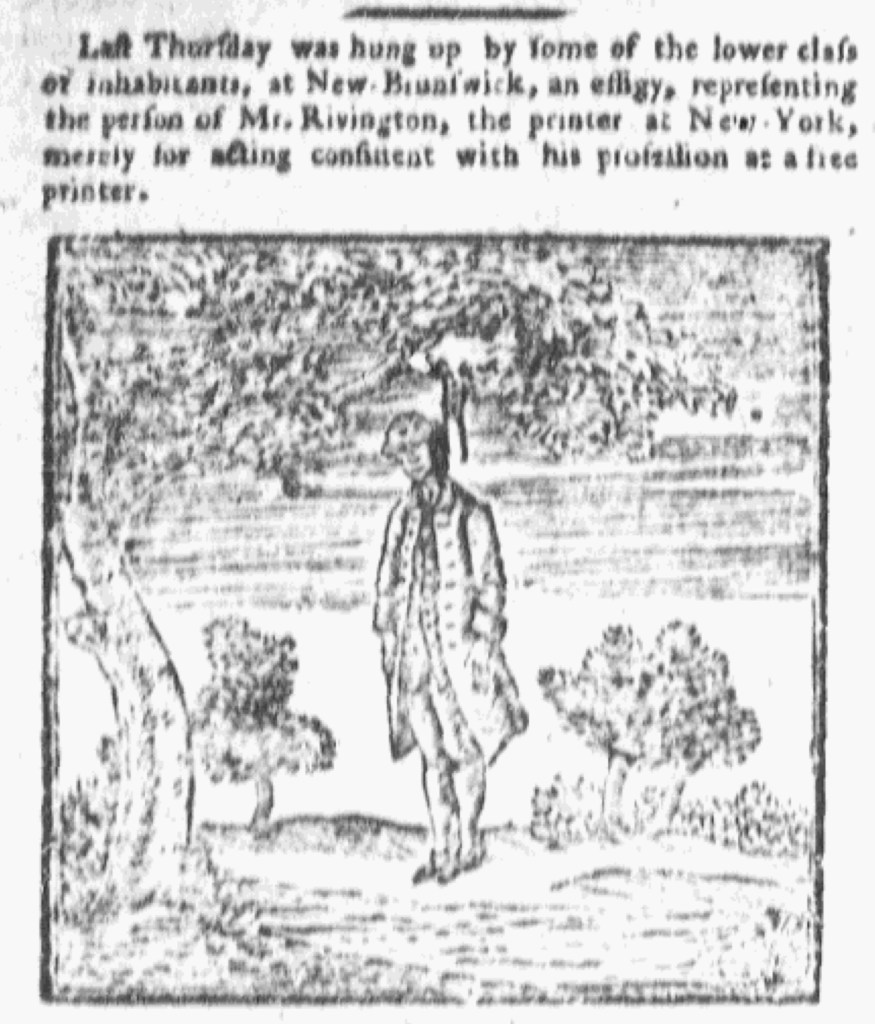
Late in 1774 and throughout the first months of 1775, Rivington regularly ran advertisements that listed the variety of political pamphlets available at his printing office.  He inserted an abbreviated version in the April 20, 1775, edition.  Colonizers in New York had not yet received word of the events at Lexington and Concord the previous morning.  Rivington instead published other news, including a recent instance of “some of the lower class of inhabitants, at New-Brunswick” hanging “an effigy, representing the person of Mr. Rivington … merely for acting consistent with his profession as a free printer.”  He not only covered that story but also illustrated it with a woodcut depicting the effigy hanging from a tree.
Rivington’s New-York Gazetteer (April 20, 1775).

The image almost certainly attracted attention, in part because news items in eighteenth-century newspapers so rarely featured illustrations of any sort.  Elsewhere in the same issue, readers encountered only five other images.  The masthead contained the coat of arms of Great Britain, as usual, and the drop cap for a letter to the editor appeared within a smaller version of the coat of arms.  A stock image of a ship adorned an announcement that the Earl of Dunmore would soon sail for London.  Similarly, a stock image of a horse being led by a man helped promote the stud services of Lath, Match ‘Em, Pilgrim, and Bashaw.  Abraham Delanoy’s woodcut depicting lobster traps was the only other image created to match the content of an advertisement or a news item.

The scarcity of images made the scene of the effigy even more conspicuous.  Rivington wrote a sarcastic description of the event and then affirmed “that his press has been open to publications from ALL PARTIES.”  He challenged “his enemies to produce an instance to the contrary,” noting that he treated his role as printer like “a public office” and reasoned that “every man has a right to have recourse” via his press.  “But the moment he ventured to publish sentiments which were opposed to the dangerous views and designs of certain demagogues,” Rivington asserted, “he found himself held up as an enemy to his country.”  His support for “LIBERTY OF THE PRESS” made him a target for “a most cruel tyranny,” as demonstrated by “very recent transactions” that included the effigy in New Brunswick.  His description of how some Patriots comported themselves along with his insistence on continuing to sell political pamphlets “on the Whig and Tory side” did not endear Rivington to “his enemies.”  Within in a month, a mob of Sons of Liberty would attack his printing office and destroy his press.  Rivington escaped, seeking refuge on a British naval ship in the harbor.

April 16

What was advertised in a colonial American newspaper 250 years ago this week?

Rivington’s New-York Gazetteer (April 13, 1775).

“Being fully determined not to be undersold by any person whatever.”

A “NEW ADVERTISEMENT BY RICHARD DEANE, Distiller,” ran in the April 13, 1775, edition of Rivington’s New-York Gazetteer.  Even though it had a dateline from two months earlier, “Feb. 10, 1775,” and had been running for several weeks, it still merited being called a “NEW ADVERTISEMENT” because it displaced another advertisement that Deane regularly placed in New York’s newspapers for many months.

The distiller took to the pages of the newspaper with some fanfare to inform “the public, my friends and customers” that he would not be undersold by any of his competitors who marketed their own “brandy, Geneva, and cordials.”  He believed that he had lost some customers to other distillers, prompting him to proclaim that he “can afford to sell said liquors on as cheap terms as any others can theirs, of an equal quality.”  Moreover, he deserved special consideration because “it cannot be denied, that I was the first distiller that ever made brandy and geneva, for sale in this province, … introducing a business, whereby the country saves annually large sums of money, that must otherwise have gone to foreign parts.”  Consumers should purchase his liquor, he asserted, to support local industry and, especially, the entrepreneur who took the risk of establishing the trade in the colony.  In turn, they could depend on what they spent supporting the local economy.

At the same time, Deane made appeals to quality.  He declared that even though he lowered his prices considerably, he still made “brandy and geneva of a full quality, and a high proof, as usual.”  He also pledged that he would not “diminish the goodness of my cordials, in any respect whatever.”  Furthermore, the “great demand for my liquors in most parts of North-America … is sufficient proof of their excellence.”  Consumers should trust existing customers, the distiller reasoned.  To encourage them to do so, he offered a price match guarantee.  He listed the prices the prices per gallon of brandy, gin, and several cordials, but also declared “that if any other person sells liquors of an equal quality with mine, cheaper than the rates underneath, I will immediately sell at the same price, being fully determined not to be undersold by any person whatever.”  Deane recognized that he lost customers because other set lower prices, but he aimed to win them back and gain new ones in the process.

February 9

What was advertised in a colonial American newspaper 250 years ago today?

Rivington’s New-York Gazetteer (February 9, 1774).

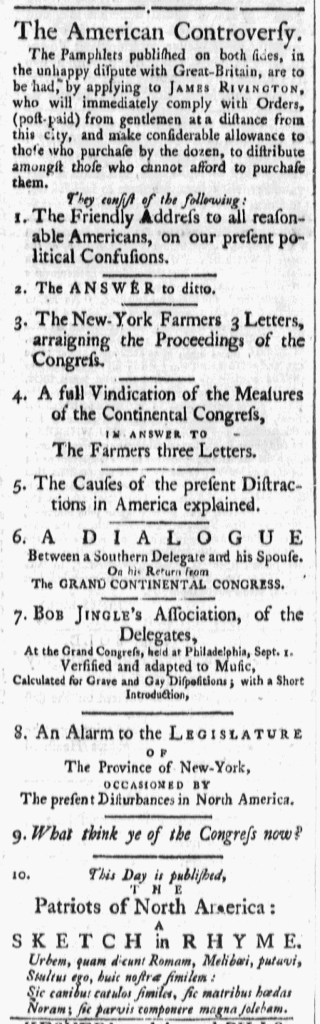
“Pamphlets published on both sides, in the unhappy dispute with Great-Britain.”

As the imperial crisis intensified in the winter of 1775, James Rivington continued to print a newspaper “at his OPEN and UNINFLUENCED PRESS” in New York.  He also ran a bookstore, peddling “Pamphlets published on both sides, in the unhappy dispute with Great-Britain.”  Both Patriot and Tory printers professed to operate free presses that delivered news and editorials from various perspectives, yet the public associated most newspapers with supporting one side over the other and even actively advocating for their cause.  Tory printers invoked freedom of the press as a means of justifying their participation in public discourse rather than allowing Patriot printers to have the only say.  When it came to advertising books and pamphlets about current events, Tory printers, especially Rivington, took the more balanced approach.

For Rivington, it was a matter of generating revenue as much as political principle.  He saw money to be made from printing and selling pamphlets about “The American Controversy.”  That was the headline he used for an advertisement that listed ten pamphlets in the February 9, 1775, edition of Rivington’s New-York Gazetteer.  He previously ran a similar advertisement for “POLITICAL PAMPHLETSon the Whig and Tory Side of the Question” and another about “The American Contest” that included some of the same pamphlets as well as others.  In his “American Controversy” advertisement, Rivington once again offered some familiar titles and new ones.  He made clear that the first two represented different positions, “The Friendly Address to all reasonable Americans, on our present political Confusions” and “The ANSWER to ditto,” though he did not indicate which took which side.

The printer positioned this venture as a service that kept the public better informed of the arguments “on both sides.”  He sought to disseminate his pamphlets beyond New York to “gentlemen at a distance from this city,” promising to “immediately comply with Orders.”  In turn, customers could do their part in making the pamphlets available far and wide since Rivington made “considerable allowance” or deep discounts “to those who purchase by the dozen, to distribute amongst those who cannot afford to purchase them.”  Though he portrayed himself as a fair dealer who marketed pamphlets “on both sides,” he did not express any expectation that customers would purchase or distribute both Patriot and Tory pamphlets.  Rivington presented readers with the freedom to consume (and further disseminate) the ideas they wished, seemingly hoping the public would allow him the same freedom in printing the content that he wished.  Whether he was sincere in such idealism or sought to justify printing editorials and pamphlets that many found objectionable, Rivington increasingly ran afoul of Patriots who did not share his outlook on freedom of the press when it came to disseminating news and opinion that favored the Tory side in “the unhappy dispute with Great-Britain.”

January 26

GUEST CURATOR: James “Jack” Driscoll

Who was the subject of an advertisement in a colonial American newspaper 250 years ago today?

Rivington’s New-York Gazetteer (January 26, 1775).

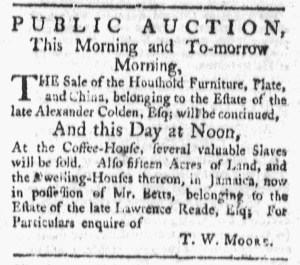
“PUBLIC AUCTION … several valuable Slaves will be sold.”

In this advertisement in Rivington’s New-York Gazetteer from January 26, 1775, T.W. Moore advertised a public auction being held “This Morning and To-Morrow Morning” to sell off the possessions of the late Alexander Colden to the highest bidder. In addition to these household items up for sale, Moore held another auction “this Day at Noon” for several enslaved people. This especially stood out to me because this shows public auctions, a competitive method, was a primary method of buying and selling goods, land, and even enslaved people in Revolutionary America. While people who were involved in the open market used auctions to sell off belongings and estates, enslavers used them as a way to reach a wider range of buyers in their efforts to make a profit off of enslaved people.

This advertisement shows that slave auctions happened even in New York.  In “The Forgotten History of Slavery in New York,” Andrea C. Mosterman declares, “New York’s slavery past is still relatively unknown.”  However, we can see by this advertisement, that these slaves for sale were an important part of Moore’s auctions. There was a high demand for enslaved people in New York before, during, and after the American Revolution. In 1788, Mosterman states, “Close to 75% of the free, white Kings County families enslaved people within their home.”  The American Revolution did not result in freedom for everyone.  Instead, some people would stand and look at other human beings being sold against their will along with everyday items like furniture and China dishes.  By participating in these auctions, they treated enslaved people as property instead of as human beings.

**********

ADDITIONAL COMMENTARY: Carl Robert Keyes

In addition to selecting an advertisement to examine for the Adverts 250 Project, Jack is serving as guest curator for the Slavery Adverts 250 Project this week.  Beyond this advertisement for “several valuable Slaves” up for bids at Moore’s auction on January 26, 1775, he identified eight other advertisements about enslaved people that appeared in the New-York Journal and Rivington’s New-York Gazetteer on the same day.  As Jack makes clear, that auction was not an isolated incident.  Instead, slavery was widely practiced in New York on the eve of the American Revolution and continued after thirteen colonies secured independence as a new nation.

Auctioneers like Moore represented part of the infrastructure for perpetuating slavery and the slave trade in New York.  The printers who generated revenue by publishing these advertisements made significant contributions as well.  Brokers, like William Tongue, played an important role as well.  Tongue placed a lengthy advertisement enumerating “SLAVES,” “LANDS,” “HOUSES,” and “GOODS” for sale at his office “near the Exchange” in both the New-York Journal and Rivington’s New-York Gazetteer as well as the New-York Gazette and Weekly Mercury four days later.  He listed and gave prices for ten enslaved men, women, and children, ranging in age from five to forty.  They included a young woman who was “an useful domestic,” a man who was “a good farmer,” and a woman “with or without her son, 5 years old.”  Tongue also noted that he “has likewise orders to purchase slaves of both sexes.”

Yet auctioneers and brokers were not alone in enlisting the services of printers in publishing advertisements for the purpose of buying and selling enslaved people.  An anonymous advertiser offered a “LIKELY and handy Mulatto Boy” for sale in the New-York Journal.  That youth had experience “waiting at Table” and could “attend a Gentleman on traveling.”  The advertisement instructed reader to “Inquire of the Printer” for more details.  Another advertisement featured an enslaved woman, “twenty-six Years of Age,” and an enslaved boy, “of twelve Years of Age,” for sale, again with directions to “Enquire of the Printer.”  Still another described a “HEALTHY young Negro Girl … that can do all Kinds of House Work.”  While auctioneers and brokers earned their livelihoods through buying and selling enslaved people, other colonizers made purchases and sales of one or two enslaved people at a time.  Collectively, they made slavery a prevalent aspect of life in New York during the era of the American Revolution.

January 8

What was advertised in a colonial American newspaper 250 years ago this week?

Rivington’s New-York Gazetteer (January 5, 1775).

“We being heartily disposed to comply with the association entered into by the late continental congress …”

After it went into effect on December 1, 1774, the Continental Association had an impact on some advertisements that appeared in colonial newspapers.  The tenth article of this nonimportation, nonexportation, and nonconsumption agreement enacted by the First Continental Congress allowed for the sale of goods that arrived between December 1, 1774, and February 1, 1775, but specified that local Committees of Inspection would oversee such transactions, not the importers.  In turn, the importers would be reimbursed for the cost of the goods, but any profits would be earmarked for the relief of Boston while its harbor remained closed because of the Boston Port Act.  The tenth article asserted that “a particular Account” of those goods would be “inserted in the publick Papers.”

That was the case for sales in Plymouth, Massachusetts, near the end of December.  In early January, Thomas Ellison, Jr., Henry Remsen, and several other importers in New York published their own account of goods they ordered the previous spring and summer and the upcoming sale overseen by Joseph Haller, Nicholas Hoffman, and other members of the Committee of Inspection.  Ellison, Remsen, and the others provided an inventory of the imported items.  They also carefully documented when they placed the orders for each item to demonstrate that they had submitted them before the First Continental Congress commenced its meetings in Philadelphia in September and certainly before delegates issued the Continental Association near the end of October.  Still, even though the ship that carried their orders left New York in July, it had returned on January 2, 1775.

The importers recognized their obligation: “we being heartily disposed to comply with the association entered into by the late continental congress, give this public notice, that the said goods will be sold at the Merchants Coffee-house.”  They listed the time and date of the sale and named the members of the Committee of Inspection.  They also provided a succinct inventory, such as “1 case checks, buttons, &c.” and “6 cases Manchester goods,” but did not compose the elaborate descriptions that appeared in many other advertisements before the Continental Association went into effect.  In that regard, their advertisement resembled those for the sales in Plymouth.  Importers who surrendered their goods to Committees of Inspection did not incorporate the marketing strategies commonly used under other circumstances.

January 1

What was advertised in a colonial American newspaper 250 years ago this week?

Rivington’s New-York Gazetteer (December 29, 1774).

“The American Contest.”

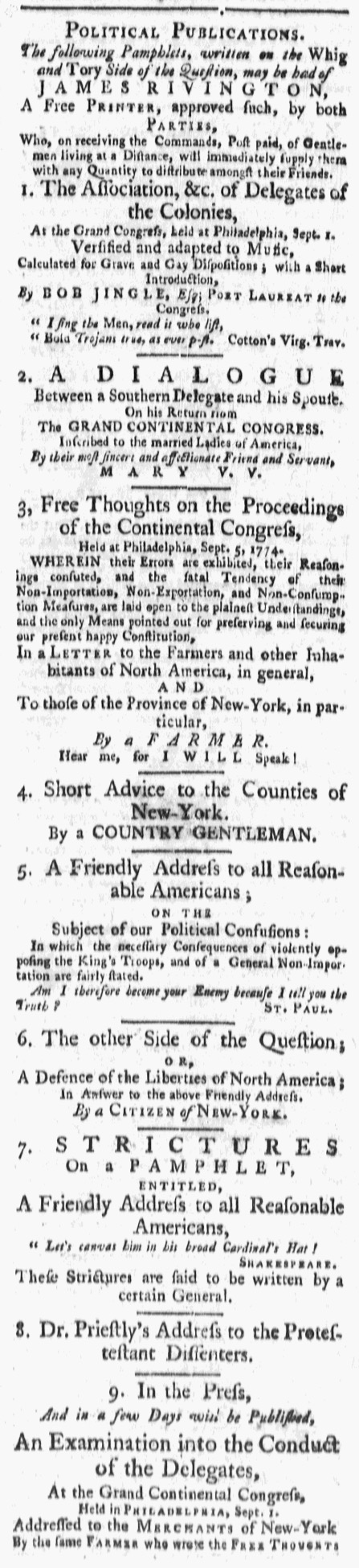
In the final issue of Rivington’s New-York Gazetteer for 1774, James Rivington continued advertising pamphlets “written on the Whig and Tory Side of the Question.”  He inserted an advertisement similar to the “POLITICAL PUBLICATIONS” catalog that he ran on December 15.  Both listed nine tracts that Rivington sold to readers or to “Gentlemen living at a Distance … to distribute amongst their Friends.”  Some of the titles appeared a second time.  Rivington eliminated some, added others, and reorganized the order accordingly.

For instance, a pamphlet documenting the Continental Association, a nonimportation agreement adopted by the First Continental Congress had been first in the previous iteration, but Rivington listed it fourth in the new one.  A new entry led the catalog: “The Congress Canvassed, OR, An Examination into the Conduct of the Delegates, At the Grand Continental Congress, Addressed to the Merchants of New-York, By the FARMER, A.W.”  Rivington had previously advertised that he would soon publish that piece, having included “Free Thoughts on the Proceedings of the Continental Congress” among the “POLITICAL PUBLICATIONS” in his earlier catalog.  That item appeared once again, paired this time with “A full Vindication of the Measures of the Continental Congress IN ANSWER TO Free Thoughts on the Proceedings of the said Congress.”  Again, Rivington had previously advertised “A full Vindication” separately, but collated together “Free Thoughts” and the pamphlet that responded to it in the new catalog.  The enterprising printer aimed to help prospective customers craft a narrative when selecting among his offerings.

Rivington gave this catalog a new headline.  Instead of “POLITICAL PUBLICATIONS,” he called it “The American Contest.”  That dramatic flourish did not exaggerate the tensions in New York and other colonies as the imperial crisis intensified.  Within months, the Revolutionary War would commence with battles at Lexington and Concord in Massachusetts.  As Rivington reported on current events and political debates, he often took a more balance approach than many of his fellow printers who made their support for the Patriot cause very plain.  The masthead for his newspaper proclaimed that it was “PRINTED at his OPEN and UNINFLUENCED PRESS.”  Rivington enacted the same policy for the pamphlets he printed, marketed, and sold.  No other American printer so vigorously represented both perspectives in “The American Contest” in the advertisements in their newspapers.

**********

January 1, 1775, fell on a Sunday.  Colonial printers distributed newspapers every day except Sunday.  The Adverts 250 Project will commence examining advertisements from 1775 tomorrow.

December 18

What was advertised in a colonial American newspaper 250 years ago this week?

Rivington’s New-York Gazetteer (December 15, 1774).

“POLITICAL PUBLICATIONS … written on the Whig and Tory Side of the Question.”

In chronicling the momentous events of 1774, the Adverts 250 Project has frequently featured advertisements for books, pamphlets, and other items related to the imperial crisis as it intensified following the Boston Tea Party and the Coercive Acts passed by Parliament in retaliation.  Most printers increasingly privileged the Patriot’s perspective, both in terms of the news and editorials they selected for their newspapers and the works that they published, advertised, and sold.  Yet they did not uniformly do so.

James Rivington, a Loyalist, proclaimed in the masthead of Rivington’s New-York Gazetteer that his newspaper was “PRINTED at his OPEN and UNINFLUENCED PRESS.”  In Revolutionary Networks: The Business and Politics of Printing the News, 1763-1789, Joseph M. Adelman notes that “Rivington’s bookselling career was about making money rather than promoting a political ideology, so much so that he wanted to capitalize on relatively popular anti-imperial political tracts.”[1]  One of his advertisements in the December 15, 1774, edition of his newspaper listed nine “POLITICAL PUBLICATIONS” that he sold.  He explained that he stocked pamphlets “written on the Whig and Tory Side of the Question.”  He demonstrated that was the case in the descriptions of some of those tracts.  For instance, he carried “A Friendly Address to all Reasonable Americans; ON THE Subject of our Political Confusions: In which the necessary Consequences of violently opposing the King’s Troops, and of a General Non-Importation are fairly stated” and “The other Side of the Question; OR, A Defence of the Liberties of North America; In Answer to the above Friendly Address.”  Debates over current events extended beyond the town common and newspaper editorials into pamphlet wars during the imperial crisis.

Those nine “POLITICAL PUBLICATIONS” included “Free Thoughts on the Proceedings of the Continental Congress,” in which “a FARMER” commented on the widely published and advertised account of the meetings held in Philadelphia in September and October.  In that pamphlet, “their Errors are exhibited, their Reasonings confuted, and the fatal tendency of their Non-Importation, Non-Exportation, and Non-Consumption Measures, are laid open to the plainest Understandings, and the only Means pointed out for preserving and securing our present happy Constitution.”  On the first page of the same issue, Rivington advertised “A full Vindication of the Measures of the Continental Congress, IN ANSWER TO Free Thoughts on the Proceedings of the said Congress.”  The advertisement mocked “a FARMER” and his pamphlet, stating that in this response “his Sophistry is exposed, his Cavils confuted, his Artifices detected, and his Wit ridiculed.”  Rivington added his own note: “The Printer, with humble Deference, presumes that this answer will meet with a gracious reception at the hands of every reader who has expressed disapprobation to the Freethoughts of Farmer.”  For those who appreciated that pamphlet, however, Rivington announced that he would soon publish “THE CONGRESS CANVASSED; OR, An Examination into the Conduct of the Delegates … By the FARMER … Who wrote Free Thoughts on their Proceedings.”  Rivington believed that political controversy meant business as he published, advertised, and sold works “on the Whig and Tory Side of the Question.”  Seeking to maximize revenues, he suggested that “Gentlemen living at a Distance” submit orders for “any Quantity to distribute amongst their Friends.”

Rivington simultaneously asserted that he was “A Free PRINTER, approved such, by both PARTIES,” yet many observers did not care for his “OPEN and UNINFLUENCED” approach that undermined the Patriots’ perspective.  Adelman explains that “Patriots eventually targeted Rivington and intended to destroy his business, by force if necessary.”  In December 1774, as Rivington published these advertisements, an anonymous group of Patriots sent a letter to Stephen Ward and Stephen Hopkins in Newport.  They “urged Ward and Hopkin to obtain a general agreement in Rhode Island not to purchase his New-York Gazetteer or deal with anyone advertising in it.”[2]  Less than a year later, a contingent from the Sons of Liberty marched from New Haven to New York to capture Loyalist leaders and silence Rivington.  They seized his types, reportedly melting them down for shot, and destroyed his press.  Seeking to represent both sides (and generate revenues while doing so) came with consequences for the printer.

**********

[1] Joseph M. Adelman, Revolutionary Networks: The Business and Politics of Printing the News, 1763-1789 (Baltimore: Johns Hopkins University Press, 2019), 127.

[2] Adelman, Revolutionary Networks, 129.

December 8

What was advertised in a colonial American newspaper 250 years ago today?

Rivington’s New-York Gazetteer (December 8, 1774).

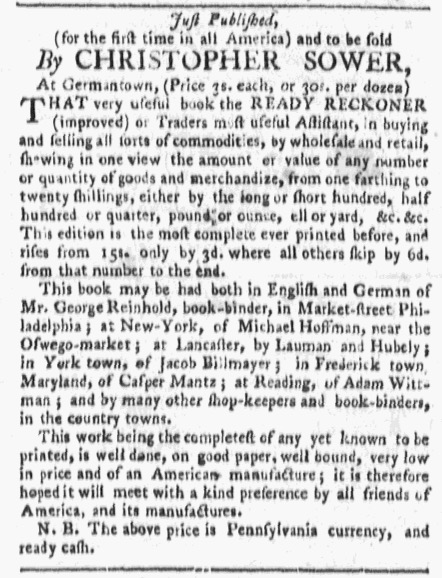
“It is therefore hoped that it will meet with a kind preference by all friends of America, and its manufactures.”

As the final days of 1774 approached, Christopher Sower, the printer of the Germantowner Zeitung, advertised an American edition of Daniel Fenning’s The Ready Reckoner; or Trader’s Most Useful Assistant, in Buying and Selling All Sorts of Commodities Either Wholesale or Retail.  The handy reference volume had been through several London editions, published it “for the first time in all America” and established a network of local agents to sell copies “both in English and German” in several cities and towns.  His advertisement in the December 8, 1774, edition of Rivington’s New-York Gazetteer listed his own printing office in Germantown, Pennsylvania, and named associates in Lancaster, Reading Philadelphia; New York City; Fredericktown, Maryland; and Yorktown, Virginia.  In addition, Sower claimed that “many other shop-keepers and book-binders, in the country towns” stocked the volume.  For those interested in selling copies at their shops, he offered a discount, thirty shilling for a dozen copies compared to three shillings for a single copy.  In other words, those who bought ten copies received two additional copies for free.

Sower declared that he issued an “improved” edition, “the most complete ever printed.”  The table it contained were supposed to save time and avoid errors in calculations, as the lengthy subtitle explained: “shewing at one view the amount or value of any number of quantity of goods from one farthing to twenty shillings … in so plain and easy a manner, that persons quite unacquainted with arithmetic may hereby ascertain the value of any number … at any price whatever.”  Sower considered it the “most complete” edition because it featured increments of three pence instead of six pence.  Yet that element alone did not recommend the book to prospective customers.  The publisher described it as “well done, on good paper, well bound and of an American manufacture.”  He did not specify whether “American manufacture” referred to the “good paper” as well as the labor undertaken in setting type, working the press, and binding the book.  Still, he expected that an American edition “will meet with a kind preference by all friends of America, and its manufactures” who might otherwise opt for a London edition published in 1773.  Sower’s call to purchase the American edition likely had even greater resonance given that the Continental Association, a nonimportation agreement adopted in response to the Coercive Acts, had recently gone into effect.

October 20

What was advertised in a colonial American newspaper 250 years ago today?

Rivington’s New-York Gazetteer (October 20, 1774).

“We [were] suddenly and unwarily drawn in to sign a certain paper published in Mr. Rivington’s Gazetteer.”

Abraham Miller, William Crooker, James Jameson, and a dozen other men from the town of Rye had second thoughts about signing their names to an open letter that appeared as the first item on the first page of the October 13, 1774, edition of Rivington’s New-York Gazetteer.  That letter, initially endorsed by more than eighty men, stated, “WE … being much concerned with the unhappy situation of public affairs think it our duty to our King and country to declare, that we have not been concerned in any resolutions entered into, or measures taken, with regard to the disputes at present at present subsisting with the mother country.”  As other colonizers had participated in protests or proposed responses to the Coercive Acts, these men claimed that they had remained neutral, not taking any action or expressing any views on the matter.  Furthermore, they did not appreciate what they had observed happening in their communities and in the public prints.  “[W]e also testify,” the letter continued, “our dislike to many hot and furious proceedings, in consequence of said disputes, which we think are more likely to ruin this once happy country, than remove grievances, if any there are.”  In conclusion, they declared “our great desire and full resolution to live and die peaceable subjects to our gracious sovereign King George the third, and his laws.”

That letter apparently elicited responses that at least some of the men who affixed their signatures did not expect … and they experienced those unhappy responses very quickly.  Just four days after the letter appeared in print, Miller, Crooker, Jameson, and others signed another letter, that one backpedaling on the sentiments expressed in the first one.  The new letter ran as an advertisement, not a letter to the editor, in the October 20 edition of Rivington’s New-York Gazetteer.  The men who signed it moved quickly to submit it in time to appear in the first issue published after the one that carried the initial letter.  In addition, they paid to make sure that it found a place in the newspaper.  They claimed that they had been “suddenly and unwarily drawn in to sign a certain paper published in Mr. Rivington’s Gazetteer.”  When he published an advertisement in the Boston-Gazette to apologize for signing an address to Governor Hutchinson a few months earlier, Thomas Kidder claimed that he had sone so “suddenly and inadvertently.”  Colonizers who regretted expressing Tory sympathies suggested that they did not hold those views but had only signed their names in haste without taking the time to read and contemplate what they were signing.  After “mature deliberation,” Miller, Crooker, Jameson, and others realized “that we acted preposterously, and without adverting properly to the matter in dispute, between the mother country and her colonies.”  They apologized, asserting that they “are therefore sorry that we ever had any concern in said paper,” the original letter, “and we do by these presents utterly disclaim every part thereof, except our expressions of loyalty to the Kind, and obedience to the constitutional laws of the realm.”  They calculated that disavowal would be sufficient to satisfy most patriots who had made their lives difficult.  After all, few clamored for declaring independence in the fall of 1774.  Most colonizers still wanted a redress of their grievances with Parliament and looked to the king to intervene on their behalf.  They believed that the “constitutional laws of the realm” supported their cause, if applied appropriately.  Miller, Crooker, Jameson, and others did not go as far as endorsing “any resolutions entered into, or measures taken” in protest, but they did run an advertisement to advise the public that they did not discourage or disdain such actions.

October 13

What was advertised in a colonial American newspaper 250 years ago today?

Rivington’s New-York Gazetteer (October 13, 1774).

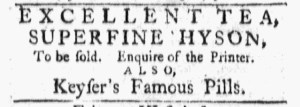
“EXCELLENT TEA, SUPERFINE HYSON.”

Advertisements for tea did not disappear from American newspapers immediately following the Boston Tea Party, nor did they disappear in anticipation of nonimportation agreements enacted in protest of the Coercive Acts that Parliament passed in response.  In Tea: Consumption, Politics, and Revolution, 1773-1776, James R. Fichter notes, “Printers Isaiah Thomas (Patriot) and James Rivington (Loyalist) used their newspapers to advertise their own tea.”[1]  Rivington did so in the October 13, 1774, edition of Rivington’s New-York Gazetteer, offering both “EXCELLENT TEA, SUPERFINE HYSON,” and “Keyser’s Famous Pills,” one of the most famous patent medicines of the era.

Yet that was not only advertisement for tea in that issue.  In the next column, Abraham Duryee provided an extensive list of imported merchandise that concluded with a familiar list: “sugar, tea, coffee, corks, &c. &c. &c.”  On the next page, tavernkeeper Edward Bardin once again inserted his advertisement that promoted “TEA and COFFEE every afternoon” among the amenities available at his establishment.  In the two-page supplement, filled entirely with advertisements, William Parsons included “Green Tea” among the wares in stock at his store.  Peter Elting sold “best Hyson and Bohea tea” along with other groceries.  Fichter reports that Rivington’s New-York Gazetteer “carried tea ads until early 1775, reaching colonies where local tea advertising had already ended.”[2]  Colonial newspapers tended to circulate across regions, including Rivington’s New-York Gazetteer; or, the Connecticut, Hudson’s Rivers, New-Jersey, and Quebec Weekly Advertiser.

Rivington’s editorial stance as well as the advertisements for tea in his newspaper caught the attention of Patriots in New York and beyond.  They often burned Rivington’s New-York Gazetteer, both along with tea and separately.  Furthermore, Fichter identifies “[c]ommittees in at least twenty communities from Rhode Island to South Carolina called for boycotts of his Gazetteer” and “also pressed Rivington’s advertisers” by “urg[ing] ‘Friends of America’ to avoid Rivington and his advertisers.”[3]  Even as tea became the subject of news coverage and editorials and advertisements for tea no longer appeared in some colonial newspapers, other continued to publish advertisements for tea for more than a year after the Boston Tea Party.  The commodity was hotly contested, even as Patriots attempted to impose a boycott of the problematic beverage.

**********

[1] James R. Fichter, Tea: Consumption, Politics, and Revolution, 1773-1776 (Ithaca: Cornell University Press, 2023), 144.

[2] Fichter, Tea, 154.

[3] Fichter, Tea, 208.