What was advertised in a revolutionary American newspaper 250 years ago today?

“THE following new ACTS and LAWS, past at the last Session of the General-Court of this State.”
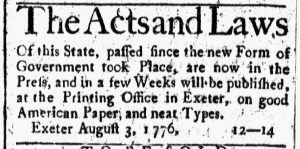
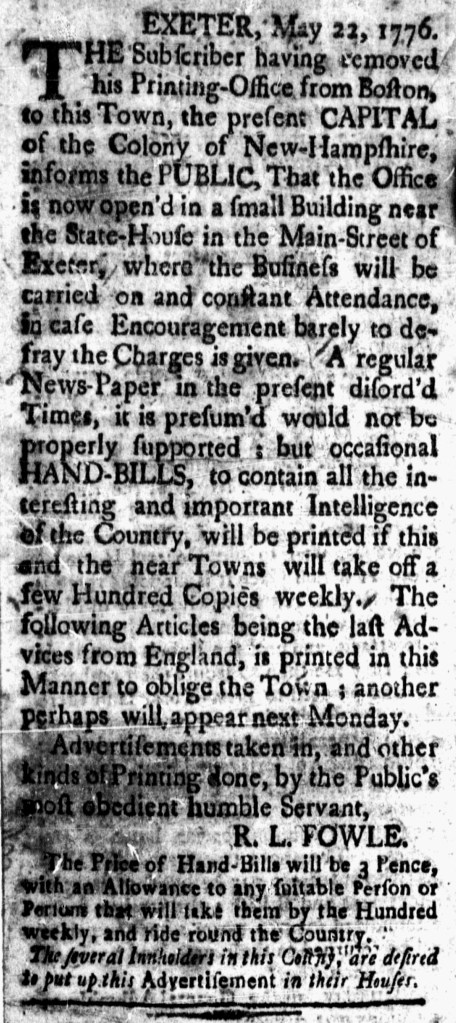
On August 10, 1776, the Freeman’s Journal, printed in Portsmouth, New Hampshire, carried an advertisement that announced that the “Acts and Laws OF this State, passed since the new Form of Government took Place, are now in the Press, and in a few Weeks will be published at the Printing Office in Exeter.” That town served as New Hampshire’s capital during the Revolutionary War. Provincial congresses met there before the war during its first year. The assembly continued meeting there after the Continental Congress declared independence. Three weeks after the first advertisement, a new advertisement appeared in the Freeman’s Journal. It informed readers that the “following new ACTS and LAWS, past at the last Session of the General-Court of this State” was “Just Published at the Printing Office in EXETER.” Robert L. Fowle, the printer in Exeter, offered for sale “A few Copies exclusive of what the Assembly take off.”
Most of the advertisement consisted of a list of the various acts, including “An Act for establishing Courts of Law for the Administration of Justice within this Colony,” “An Act to establish an equitable Method of making Rates and Taxes, and determining who shall be legal Voters in town and Parish Affairs,” “An Act to prevent the Forgeing & altering Bills of pubic Credit, and for preventing the Depreciation thereof; and for making the Bills of Credit of the United Colonies, and the Bills of this Colony a Tender in all payments.” Even though Fowle stated that the acts had been passed by the “General-Court of this State,” many of them referred to New Hampshire as a colony. The provincial congress adopted a new constitution in January 1776, removing the colony from British authority, yet the colonies had not yet declared independence. Those last colonial laws soon became the first laws of the new state.
When Fowle listed the acts in a newspaper advertisement in hopes of selling surplus copies that the assembly did not “take off,” he also reported the news. Readers did not have to purchase the acts to learn what kind of work the assembly had undertaken in Exeter, though the list might have prompted some to learn more about those acts that interested or affected them. The advertisement supplemented the coverage of state government that appeared in newspapers.