May 14

Who were the subjects of the newspaper advertisement in a colonial American newspaper 250 years ago today?

May 14 - 5:14:1768 Providence Gazette
Providence Gazette (May 14, 1768).

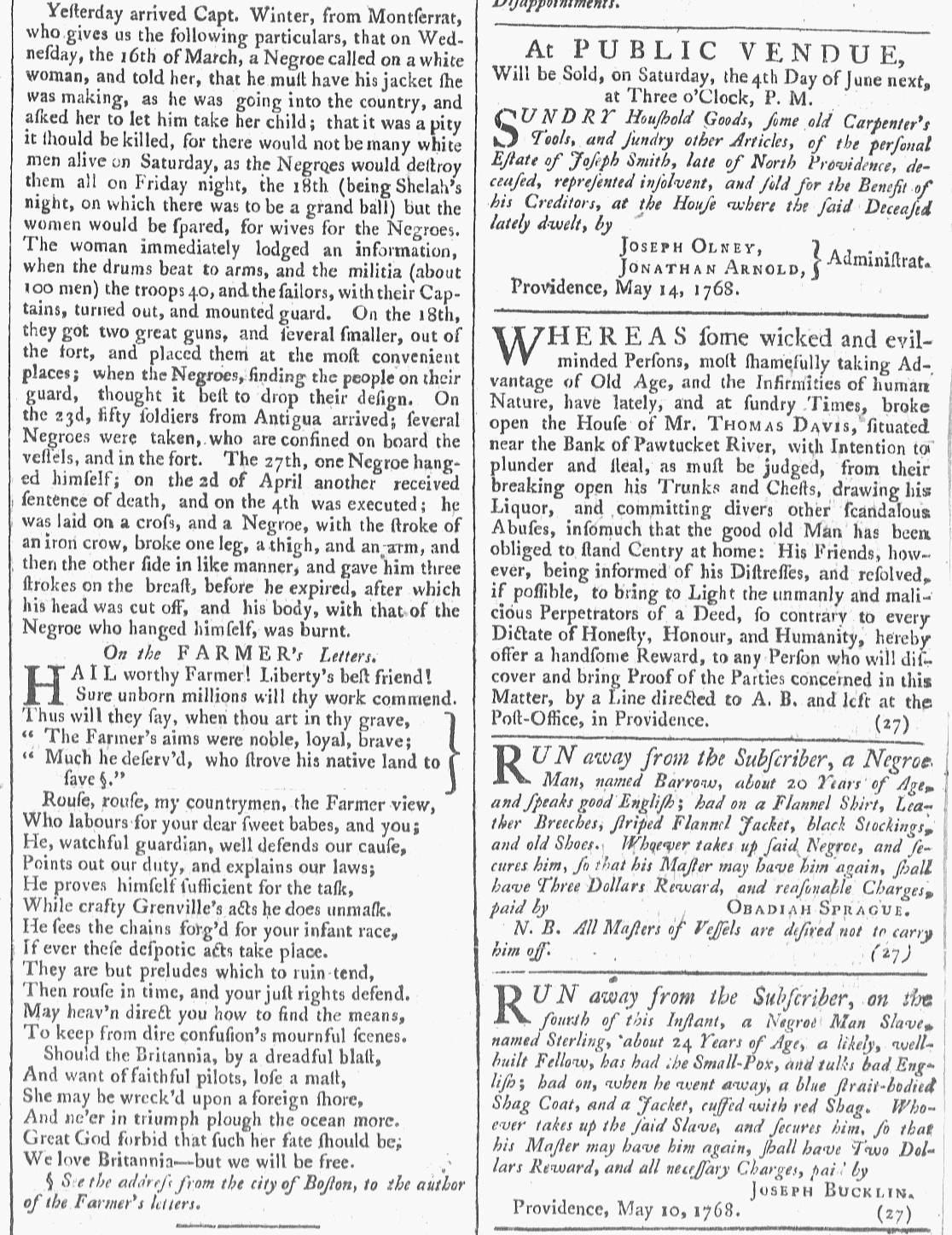
“RUN away … a Negroe Man Slave, named Sterling.”

Most of the advertisements in the May 14, 1768, edition of the Providence Gazette had appeared in at least one previous issue, but Obadiah Sprague and Joseph Bucklin inserted two new notices. Both notified readers about runaway slaves, providing descriptions and offering rewards for capturing and returning them. A “Negro Man Slave, named Sterling” who “talks bad English” ran away from Bucklin. A “Negroe Man, named Barrow” who “speaks good English” ran away from Sprague.

Considered on their own, each of these advertisements testifies to the choices made by many enslaved men and women, even though their stories have been filtered through narrators who held them in bondage. Sterling and Barrow did not accept their lot; instead, they took action to gain their freedom rather than remain enslaved. Sprague suspected that Barrow might even attempt to board a ship and make good on his escape by putting as much distance between himself and his former master as possible.

Considered in relation to other items on the same page, these advertisements reveal juxtapositions in colonists’ understandings of liberty at the time of the imperial crisis that preceded the American Revolution. These notices concerning runaway slaves appeared immediately to the right of a poem, “On the FARMER’s Letters.” The ode honored John Dickinson, the pseudonymous “Farmer,” who had written a series of letters defending the colonies against abuse by Parliament in the wake of the Townshend Act. The letters had been reprinted in newspapers throughout the colonies. The poem described the “Farmer” as “Liberty’s best Friend!” It concluded by proclaiming, “We love Britannia – but we will be free.” To modern eyes, such declarations seem starkly contradictory when positioned next to advertisements inserted expressly for the purpose of returning runaway slaves to bondage. Yet they reveal that most colonists did not think of their freedom in the same terms that they considered the condition of enslaved men, women, and children.

This contrast seems even more stark when taking into account the news item printed immediately above the poem. In a paragraph comprised of approximately the same number of lines of text, the printers reported on news that had just come to hand via “Capt. Winter, from Montserrat.” It told of an attempted slave revolt, one that required fifty soldiers from Antigua to put down. The narrative of events concluded with a gruesome description of the torture and execution of one of the insurrection’s leaders. With no transition at all, this tale gave way to the poem extolling the Farmer’s efforts to protect colonists’ liberty.

Most colonists held contradictory views when it came to their own liberty compared to the liberty of slaves. Barrow, Sterling, and other runaways, on the other hand, were not conflicted in their views on the matter. They did not need a series of letters from the “Farmer” to explain enslavement to them, yet some likely felt bolstered in their decisions to determine their own fates as they listened to debates about liberty that intensified during the imperial crisis. They likely also heard about the brutal measures taken to quell slave revolts, making their choice to escape from their masters all the more courageous for knowing the consequences that others faced when they engaged in acts of resistance.
May 14 - Slave Revolt 5:14:1768 Providence Gazette
Providence Gazette (May 14, 1768).

March 2

Who was the subject of an advertisement in a colonial American newspaper 250 years ago today?

Mar 2 - 3:2:1768 Georgia Gazette
Georgia Gazette (March 2, 1768).

“Any person that may bring me his head, hand, or foot, after that time, shall be rewarded.”

To one extent or another, each newspaper advertisement concerning slaves testified to a horrific system of bondage, but Joseph Gibbons’s notice concerning Limus, a runaway, exhibited even greater brutality than most. In several consecutive issues of the Georgia Gazette, Gibbons presented a proposition for the fugitive: “If the said Limus will return to his duty in ten days he shall not be whipped, but if not, any person that may bring me his head, hand, or foot, after that time, shall be rewarded.” Most slaveholders called on others to assist in the capture of runaways, promising rewards for the safe return of their human property. They did not usually mention any consequences the runaways might eventually endure. Gibbons, on the other hand, did not reserve inflicting punishments on Limus as his sole domain. Instead, he encouraged the dismemberment or even murder of the runaway.

That Gibbons extended an alternative to this ruthless punishment indicates that he expected that Limus had some sort of access to information that appeared in the colony’s only newspaper. Why attempt to strike a bargain that if Limus “will return to his duty in ten days he shall not be whipped” unless he believed that some combination of reading and conversation would eventually transmit his terms to the runaway? The merciless threat of rewarding “any person that may bring his head, hand, or foot” after the deadline had passed also would have worked more effectively if Gibbons anticipated that Limus would become aware of it. These stark choices were designed to terrorize and persuade the fugitive to return of his own accord, but they depended on overlapping networks of white and black colonists spreading news via print and word of mouth. Even though the vast majority of slaves were not literate, they still had means of acquiring and sharing news in early America. Even though white colonists may not have always been aware or attempted to downplay how much slaves knew about the contents of newspapers, some of them did acknowledge that slaves did indeed have access to information that appeared in the public prints.

January 28

What was advertised in a colonial American newspaper 250 years ago today?

Jan 28 - 1:28:1768 New-York Journal
New-York Journal (January 28, 1768).

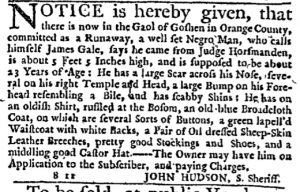
“Committed as a Runaway … 8 11.”

In most instances it is impossible to determine what happened as the result of advertisements for runaway slaves or captured fugitives. Some runaways likely made good on their escapes, but the odds were stacked against them. Many slaveholders likely reclaimed their human property after seeing notices that they had been committed to jail or the workhouse, though the dates in those advertisements sometimes indicated that inmates remained for weeks or months without an owner collecting them.

In the case of “a well set Negro Man, who calls himself James Gale” who had been thrown in jail in Orange County on suspicion that he was a runaway, however, the notations inserted into the advertisement by the compositor suggest that the notice had its intended effect. Gale’s master likely claimed him shortly after the advertisement first appeared in the New-York Journal on January 28, 1768.

Consider the notation at the conclusion of the advertisement: “8 11.” These numbers appear unrelated to the content of the advertisement. Instead, they indicate which issues of the newspaper needed to include the advertisements. The “8” referred to the first issue that contained the advertisement, “NUMB. 1308,” published on January 28, 1768. The “11” referred to when the compositor should discontinue the advertisement, removing it from “NUMB. 1311” scheduled for publication on February 18. The notation indicates that it was slated to run in three issues, numbers 1308, 1309, and 1310.

Examination of other advertisements from the January 28 issue suggests that this was indeed the case. Mark Feely, an attorney, placed an advertisement for his legal “WRITINGS” that also featured the notation “7 10.” This advertisement originated in number 1307 and ran in the next two issues, but did not reappear in number 1310. Similarly, an advertisement announcing the auction of a “Corner House and Lot of Ground” had a notation that read “8 12” on the final line. As expected, it first ran in number 1308, continued for the next several issues, but disappeared with the publication of number 1312.

That being the case, the advertisement concerning the suspected runaway being held in jail in Orange County should have been in the three issues indicated by the notation “8 11.” However, it only ran for two weeks. Why? James Gale’s owner most likely became aware of the advertisement and made arrangements for the fugitive’s return quickly enough that John Hudson, the sheriff who placed the notice, requested that the printer discontinue it. This unfortunate conclusion demonstrates the power that print played in policing black men and women in eighteenth-century America.

January 26

Who was the subject of an advertisement in a colonial American newspaper 250 years ago today?

Jan 26 - 1:26:1768 South-Carolina Gazette and Country Journal
South-Carolina Gazette and Country Journal (January 26, 1768).

“She was with child when she went away.”

Every advertisement about a runaway slave tells a story of resistance and the struggle to claim the same liberty enjoyed by the slaveholder who placed the advertisement. Yet these advertisements contain much more. They often reveal family histories or suggest bonds of affection among enslaved men, women, and children. As much as slaveholders may have wished to pretend otherwise, such stories embedded in advertisements intended to reclaim their property testified to the humanity of men, women, and children held in bondage.

Consider Sampson and Miley. The two ran away from the same plantation at the same time, quite likely departing together. Alexander Kerr described both of them in an advertisement. Sampson, approximately thirty, was missing two of his front teeth. Miley, a “slender made wench,” may have been even more recognizable by her “yellow complexion” and the “country marks on her face.” In addition, she was “with child” when she ran away. Her pregnancy would only become more apparent until she delivered the baby. After that, caring for an infant would continue to distinguish her from other black women.

What was Sampson and Miley’s relationship? He may have been the father of Miley’s child. Perhaps they made a decision that as parents they needed to escape together rather than allowing their child to be born into bondage. Perhaps Sampson and Miley had been in a relationship that their master refused to recognize. Miley’s child may have been the result of sexual assault by their master or an overseer, in which case Sampson could have aided her escape as a means of providing more protection for both mother and child than he previously had been capable of providing for Miley. Perhaps Sampson and Miley were friends, siblings, or otherwise related. They may have determined that they had better chances to make good on their escape if they assisted each other.

Despite all the details included in the descriptions of Sampson and Miley, Alexander Kerr did not specify their relationship to each other. It simply may not have mattered to him. After all, the stakes were much different for him than for the fugitives. Kerr demanded the return of his property, but the pregnant Miley and her companion sought freedom for themselves and a child on its way. Unwillingly, Kerr’s advertisement for runaway slaves revealed bonds of affection that would extend to another generation upon the birth of Miley’s child. Unintentionally, he gave voice in print to the sincerest desires of slaves that he otherwise attempted to keep silent.

December 28

Who was the subject of an advertisement in a colonial American newspaper 250 years ago today?

Dec 28 - 12:28:1767 Boston-Gazette
Boston-Gazette (December 28, 1767).

“RAN-away … a stout Molatto Negro Slave.”

Step, “a stout Molatto Negro Slave,” ran away “from his Master Lieut. Mathew Caldwell” at the end of November in 1767. In his attempt to capture the fugitive, Caldwell made every effort in the public prints to alert his fellow colonists. He provided a description of Step, offered a reward, and warned others against assisting Step in any way. In addition to the reward, Caldwell pledged to reimburse “all necessary Charges” incurred in securing and returning the runaway slave. He publicized all of this information as widely as possible, inserting the notice in all four newspapers published in Boston at the time. On December 28, it appeared in the Boston Evening-Post, Boston-Gazette, and Boston Post-Boy. Four days earlier, the same advertisement ran in the Massachusetts Gazette. Considering the reward, expenses, and advertising, Caldwell made a significant investment in his search for Step.

This advertisement seems a stark contrast to many of the other paid notices and news items in Boston’s newspapers during the final months of 1767. All four newspapers published accounts of the town meeting at the end of October, noting the general discontent about an imbalance of trade between Britain and the colonies that contributed to an economic recession and scarcity of hard money. Bostonians voted to encourage production and consumption of local alternatives to imported goods. Other towns in Massachusetts and neighboring colonies then passed their own resolutions calling for increased local industry combined with nonimportation agreements. All of this coincided with resistance to the Townshend Act and new duties on certain imported goods. Advertisements for consumer goods and services reflected the concerns expressed at town meetings. Some advertisers underscored that they made certain goods or sold items produced locally. Other advertisers once again used the Liberty Tree as a landmark when listing directions to their shops.

Colonists in Massachusetts and elsewhere in New England expressed concerns about infringements on their liberty and devised plans for resistance in 1767. They reacted to an imperial crisis that eventually resulted in the American Revolution. Step ran away from Caldwell amid ongoing public discussions about the meaning of liberty. He engaged in his own acts of resistance to unjust authority in the era of the revolution.

November 24

Who was the subject of an advertisement in a colonial American newspaper 250 years ago today?

Nov 24 - 11:24:1767 South-Carolina Gazette and Country Journal
South-Carolina Gazette and Country Journal (November 24, 1767).

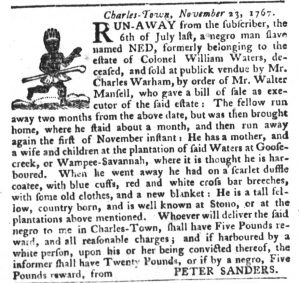
“The fellow run away two months from the above date.”

This runaway slave advertisement includes a truncated family history of “a negro man slave named NED.” Although Peter Sanders, the slaveholder who placed the advertisement, did not indicate the origins of Ned’s parents, he did report that the fugitive had been born in South Carolina. Sanders also revealed that Ned had a wife and children, though he did not name them, give ages for any members of the family, or specify how many children. Along with several of his relatives, Ned previously belonged to Colonel William Waters, but he had been separated from them when the executor of Waters’s estate sold him at a public auction. While the white community mourned the death of Waters, the members of at least one enslaved family experienced the emotional trauma of having their fates determined by the division and settling of the estate, a process that treated them as property rather than people.

Yet Ned did not abide by the outcome of the auction that separated him from his family. Instead, he made repeated attempts to reunite with them. Sanders noted that Ned’s mother, wife, and children remained “at the plantation of said Waters at Goose-creek, or Wampee-Savannah,” which led him to believe that accomplices “harboured” him there. Ned’s new master suspected that black men and women, either family or friends, hid the runaway, but he did not dismiss the possibility that Ned, who was “well known at Stono, or at the plantations above mentioned,” had enlisted the aid of sympathetic white colonists. Racial lines did not necessarily overrule personal relationships in every situation. That being the case, Sanders offered a reward to any informers upon the conviction of anyone who assisted Ned: five pounds for a black accomplice and twenty pounds for a white person.

In the time since Sanders had purchased Ned, the enslaved man spent as much time on the run as laboring for his new master. Ned escaped in order to rejoin three generations of his family. Every advertisement for runaway slaves implicitly testifies to a thirst for freedom from bondage, but the advertisement for “a negro man slave named NED” also explicitly tells a powerful story about one of the many reasons why freedom was as important to enslaved men, women, and children as it was to white colonists.

October 7

What was advertised in a colonial American newspaper 250 years ago today?

Oct 7 - 10:7:1767 Georgia Gazette
Georgia Gazette (October 7, 1767).

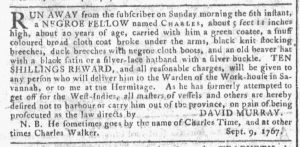
“He has formerly attempted to get off for the West-Indies.”

In the 1760s the pages of the Georgia Gazette often included far more advertising concerning slaves – slaves for sale, runaway slaves, captured slaves – than advertising for consumer goods and services. These advertisements told the story of enslaved men, women, and children reduced to commodities to be bought and sold, but they also told stories of resistance to that dehumanization and commodification. Runaway advertisements testified to the agency, perseverance, and ingenuity of slaves who seized their freedom when they saw opportunities.

Much to his chagrin, David Murray told the story of one of those bold slaves, “A NEGRO FELLOW named CHARLES.” Although he was a young man, only “about 20 years of age,” Charles had previously attempted to escape from his master. While some slaves ran away with the intention of returning after a brief respite from their bondage, Charles had other plans. He did not seek temporary freedom but instead wished to permanently alter his situation. To that end, he had previously attempted “to get off for the West-Indies.” Murray did not offer any speculation to explain why Charles chose that destination; perhaps the young slave hoped to be reunited with family there. Whatever his reasons, Charles aimed to put considerable distance between himself and Murray, prompting the slaveholder to instruct “all masters of vessels” not to “carry him out of the province.” He also cautioned others “not to harbour” Charles, threatening to prosecute anyone who aided the fugitive.

To evade detection and capture, Charles adopted aliases, sometimes calling himself “Charles Time” and other times “Charles Walker.” Such resourcefulness may have aided in his escape and his ability to remain free for at least the month that had passed since Murray first placed his advertisement.

Between changing his name and making new efforts to escape even after his first attempt had been discovered, Charles demonstrated that he would not be subdued easily. While other advertisements treated enslaved men, women, and children as commodities – such as the “SIX FIELD NEGROES” or the “Young NEGROE WENCH” advertised for sale in the same issue of the Georgia Gazette – Murray’s advertisement about a “NEGROE FELLOW named CHARLES” underscored that slaves did not passively acquiesce to lives of perpetual servitude. Although certainly not Murray’s intent, his advertisement about a runaway slave told a powerful story of one man’s determination to fight to free himself from the injustices he experienced in colonial Georgia.

September 30

What was advertised in a colonial American newspaper 250 years ago today?

Sep 30 - 9:30:1767 Georgia Gazette
Georgia Gazette (September 30, 1767).

“RUN AWAY … a NEGROE FELLOW, named LONDON.”

Hundreds of advertisements for runaway slaves appeared in colonial American newspapers every year throughout the 1760s, documenting one form of resistance to the institution of slavery. From New Hampshire to Georgia, readers would have recognized them as a familiar component of the public prints, published alongside advertisements for consumer goods and assorted legal notices. Many runaway advertisements focused solely on the experiences of particular runaways, but some also told stories about other members of colonial communities.

Grey Elliott inserted such an advertisement in the September 30, 1767, issue of the Georgia Gazette. In it, he reported that London, a “NEGROE FELLOW … well known in and about Savannah” ran away a month earlier. Elliott offered a reward, ten shillings, to whoever captured London and delivered him either to Elliott or “the Warden of the Work house in Savannah.” In addition, he detailed two other awards. Suspecting that London had assistance from accomplices, Elliott announced rewards for anyone “who shall discover him or her by whom the said negroe is harboured.” In other words, he was interested in learning where London was hiding out and who concealed him from his master and colonial authorities. The awards varied: “TWENTY SHILLINGS if a slave” (twice as much as the reward for capturing London) and “FIVE POUNDS … if a white person” (ten times as much as the reward for capturing the runaway). The wording makes it difficult to determine definitively if Elliott meant a slave informant would receive twenty shillings and a white one five pounds or of he meant that the rewards would depend on whether London received aid from a fellow slave or a white accomplice.

Either way, Elliott’s advertisement demonstrates that runaways did not always go it alone when they absconded from their masters. Instead, they benefited from assistance provided by other slaves and, perhaps, sometimes even sympathetic white colonists. Other runaway advertisements provided even more specific information, sometimes noting family relationships that might have drawn runaways to particular places or influenced others to provide aid and comfort. Running away was an act of resistance undertaken by many slaves, but it also had ripple effects. Those who provided assistance to runaways engaged in their own acts of resistance as member of a community allied against the power and authority of slaveholders.

July 15

Who was the subject of an advertisement in a colonial American newspaper 250 years ago today?

Jul 15 - 7:15:1767 Georgia Gazette
Georgia Gazette (July 15, 1767).

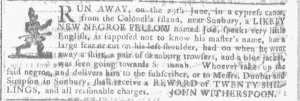
“RUN AWAY … NEGROE FELLOW named Joe.”

Joe, “a LIKELY NEW NEGROE FELLOW,” made a run for it in the summer of 1767. At the end of June, he took a canoe and attempted to make his escape from John Witherspoon. The slaveholder stated that the fugitive “was seen going towards Savannah,” perhaps heading for Savannah from Sunbury, perhaps heading toward the largest settlement in the area in hopes of attracting less attention among larger numbers of people. It may have been hard for Joe to avoid detection, however, because he “speaks very little English.”

Among enslaved men and women in Georgia, Joe was not alone in desiring his freedom. In another advertisement, David Cutler Braddock reported that his slaves had “TAKEN UP … a CANOE with TWO RUNAWAY NEGROES, a man and a woman.” Braddock advertised that he would hold the canoe until its owner came to collect it. “The negroes,” on the other hand, “were sent to the work-house” (where they joined Sharper and Tom, two captured runaways listed in the final advertisement in the July 15 issue of the Georgia Gazette).

These brief advertisements told intriguing yet incomplete stories about enslaved men and women. In addition to noting that he spoke little English, Witherspoon described Joe as “NEW.” How long had he been in Georgia? Had he recently survived the Middle Passage from Africa to the Americas? Given that he was headed toward Savannah, how familiar was he with the local geography? Did he hope to reunite with friends or relatives there? Or was he on his own? What was the source of the “large scar or cut on his left shoulder”? Was it the result of some sort of punishment that may have strengthened his resolve to make an escape?

How about the runaways in the canoe? What was their relationship? Husband and wife? Brother and sister? Friends or acquaintances connected by little more than their bondage and mutual agreement to seized an opportunity to take a canoe and depart when no one was looking? What role did Braddock’s slaves play in capturing them? What was their motivation for the part they played? Did they participate willingly? Did they turn in the runaways because they expected some sort of reward? Did they turn over the fugitives and their canoe to the slaveholder reluctantly only to avoid trouble because others observed them?

Advertisements for runaway slaves have been called the first slave narratives. They certainly tell important stories about the agency exercised by enslaved men and women, but since slaveholders composed them they lack some of the perspective and insight that likely would have been present in first-person narratives. These advertisements tell rich stories, but the questions they raise can sometimes be as revealing about the experiences of enslaved people in colonial America.

July 4

Who was the subject of an advertisement in a colonial American newspaper 250 years ago today?

Jul 4 - 7:4:1767 Providence Gazette
Providence Gazette (July 4, 1767).

“RAN away … a Negro Man named Caesar.

Today citizens of the United States commemorate the 241st anniversary of their independence. To mark that occasion, I have selected an advertisement that tells the story of one man’s efforts to secure his own freedom during the era of the imperial crisis that gave way to the Revolution.

Caesar (almost certainly not the name bestowed on him by his parents) was “a Negro Man” enslaved to Ebenezer Sweet in North Kingston, Rhode Island. Near the beginning of June 1767, he ran away from his master. Nearly a month later he still had not been captured and returned, despite the generous reward advertised in the Providence Gazette.

Why did Sweet offer “Eight Dollars, and all reasonable Charges” (in other words, any expenses incurred in capturing and transporting the fugitive) for this particular slave? In part, he likely wished to recover some of the consumer goods Caesar carried away with him, including “a Pair of Silver Shoe Buckles” and “almost a new Beaverrit Hat.” Beyond those items, Caesar was an especially valuable slave because of the skills he possessed. Not only could he read and write, he was also a skilled artisan. Sweet acknowledged that Caesar was “by Trade a Blacksmith,” although he “principally follows Anchor-making.” This constellation of skills would have made Caesar particularly valuable to Sweet, especially since he could have hired out his services for much more than a common laborer.

Yet Caesar had other ideas. The advertisement does not indicate how well he could read. Perhaps he was literate enough to read the Providence Gazette and other newspapers that reported on recent efforts by Parliament to “enslave” the colonies by charging stamp duties and quartering troops. Even if he did not read the newspapers, he likely overheard discussions and witnessed protests against Parliament’s schemes. Like many other slaves in the 1760s through the 1780s, Caesar could have applied the rhetoric of liberty to his own situation and sought to change it by taking action on his own.

Yet the imperial crisis and the Revolution were not absolutely necessary for Caesar or any other slaves to chafe at their subjugation. They did not need colonists to teach them the value of freedom. Advertisements for runaways populated the pages of colonial newspapers long before the rupture with Great Britain as thousands of enslaved men and women determined on their own that they wanted more than to be held in bondage.

As celebrations of Independence Day take place, remember that the founding generation consisted of many, many more people than just the prominent political and military leaders whose names have been memorialized for nearly a quarter millennium. “A Negro Man named Caesar” was also a member of the founding generation. Using the means available to him, he waged his own campaign for freedom and liberty.