November 10

What was advertised in a revolutionary American newspaper 250 years ago this week?
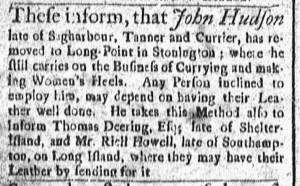
Connecticut Gazette (November 8, 1776).

“John Hudson, late of Sagharbour, … has removed to Long-Point in Stonington.”

The November 8, 1776, edition of the Connecticut Gazette, published in New London, carried an advertisement for the purpose of informing readers that John Hudson, “late of Sagharbour” on Long Island, “Tanner and Currier, has removed to Long-Point in Stonington” on the Connecticut coast.  At his new location, he “still carries on the Business of Currying” or processing leather “and making Women’s Heels.”  New to the area, he assured prospective customers that “Any Person inclined to employ him, may depend on having their Leather well done.”  Hudson hoped to build a clientele in the region.

At the same time, he also used the advertisement to communicate with customers who had hired him when he still lived and worked in Sag Harbor.  “He takes this Method,” he added to his notice, “also to inform Thomas Deering, Esq; late of Shelter-island, and Mr. Riell Howell, late of Southampton, on Long Island, where they may have their Leather by sending for it.”  That Deering was “late of Shelter-island” and Howell was “late of Southampton,” just as Hudson was “late of Sagharbour,” suggested that all three had moved to other places because of the British invasion of Long Island.  In addition to capturing New York City, the British also occupied Sag Harbor and used it as a base for monitoring Long Island Sound.  Hudson may have attempted to contact Deering and Howell directly before he moved his shop from Sag Harbor to Stonington, but he could not locate them in the turmoil caused by the war.  Whether or not he had dispatched messages to those customers, Hudson expected that an advertisement in the Connecticut Gazette had a reasonable chance of coming to the attention of Deering and Howell.  At the very least, the tanner and currier could assert that he had not absconded with the leather entrusted to him for processing without making some attempt to let his customers know where they could collect it.

Following the battles of Lexington and Concord and the siege of Boston in the spring of 1775, newspapers published in other towns in New England carried advertisements by former residents of Boston who introduced themselves to prospective customers in their new communities.  Similar advertisements began appearing in newspapers in New England and Pennsylvania once the British took possession of New York City and Long Island.
January 28

What was advertised in a colonial American newspaper 250 years ago today?

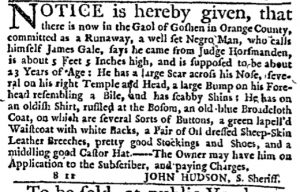
Jan 28 - 1:28:1768 New-York Journal
New-York Journal (January 28, 1768).

“Committed as a Runaway … 8 11.”

In most instances it is impossible to determine what happened as the result of advertisements for runaway slaves or captured fugitives. Some runaways likely made good on their escapes, but the odds were stacked against them. Many slaveholders likely reclaimed their human property after seeing notices that they had been committed to jail or the workhouse, though the dates in those advertisements sometimes indicated that inmates remained for weeks or months without an owner collecting them.

In the case of “a well set Negro Man, who calls himself James Gale” who had been thrown in jail in Orange County on suspicion that he was a runaway, however, the notations inserted into the advertisement by the compositor suggest that the notice had its intended effect. Gale’s master likely claimed him shortly after the advertisement first appeared in the New-York Journal on January 28, 1768.

Consider the notation at the conclusion of the advertisement: “8 11.” These numbers appear unrelated to the content of the advertisement. Instead, they indicate which issues of the newspaper needed to include the advertisements. The “8” referred to the first issue that contained the advertisement, “NUMB. 1308,” published on January 28, 1768. The “11” referred to when the compositor should discontinue the advertisement, removing it from “NUMB. 1311” scheduled for publication on February 18. The notation indicates that it was slated to run in three issues, numbers 1308, 1309, and 1310.

Examination of other advertisements from the January 28 issue suggests that this was indeed the case. Mark Feely, an attorney, placed an advertisement for his legal “WRITINGS” that also featured the notation “7 10.” This advertisement originated in number 1307 and ran in the next two issues, but did not reappear in number 1310. Similarly, an advertisement announcing the auction of a “Corner House and Lot of Ground” had a notation that read “8 12” on the final line. As expected, it first ran in number 1308, continued for the next several issues, but disappeared with the publication of number 1312.

That being the case, the advertisement concerning the suspected runaway being held in jail in Orange County should have been in the three issues indicated by the notation “8 11.” However, it only ran for two weeks. Why? James Gale’s owner most likely became aware of the advertisement and made arrangements for the fugitive’s return quickly enough that John Hudson, the sheriff who placed the notice, requested that the printer discontinue it. This unfortunate conclusion demonstrates the power that print played in policing black men and women in eighteenth-century America.