March 29

GUEST CURATOR: Sean Duda

Who was the subject of an advertisement in a colonial American newspaper 250 years ago today?
Georgia Gazette (March 29, 1769).

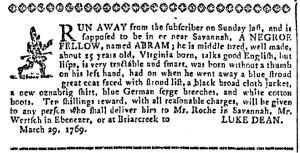
“RUN AWAY … A NEGRO FELLOW, named ABRAM.”

This advertisement contains the description of a runaway slave named Abram, including what he was wearing and distinguishing marks, and a reward for returning him. In running away, Abram participated in an his own act of resistance during a time of growing tensions between the British and the colonists. Unsurprisingly, many slaves were always looking for ways to become free. Noticing this sentiment, the governor of Virginia issued Lord Dunmore’s Proclamation on November 7, 1775. This proclamation offered freedom to slaves that belonged to people that were supporting or taking part in the war against the British, so long as they took up arms with the British against their masters. Many slaves took up this offer; according to Maya Jasanoff in Liberty’s Exiles: American Loyalists in the Revolutionary World, approximately 20,000 slaves joined up with the British. As for the Americans, many people who owned slaves had reservations against arming those that they had held in bondage. Jasanoff says only around 5,000 slaves fought for the colonists.[1] According to Ray Raphael, “Some who fought for the patriots were sent back into slavery at war’s end. … Patriot leaders in the South offered enslaved people as bounties to entice white recruits.”[2] It is not hard to see that slaves may have thought that their best shot at freedom would have been with the British instead of the colonists, who were not above using them as currency to entice more people to join their cause.

**********

ADDITIONAL COMMENTARY: Carl Robert Keyes

At a glance, the pages of the Georgia Gazette may appear rather static to modern eyes. Like most other colonial printers, James Johnston filled his newspaper with dense text and very few visual images. Yet careful attention to the issues published in early 1769 reveals variations in organization and typography that suggest Johnston and others who worked in his printing office experimented with how they presented the news and other content in the Georgia Gazette.

The March 29, 1769, edition, for instance, included another advertisement with the advertiser’s name in large gothic font, replicating an innovative visual element adopted by other advertisers in recent weeks. This time, John Johnston called on prospective customers to purchase bread.

Johnston also distributed advertisements throughout the entire issue, an organizational strategy repeated from other recent issues. Paid notices, along with the usual colophon, filled both columns of the last page. Every other page featured at least one advertisement. Two appeared at the bottom of the second column on the first page. Another, Johnston’s advertisement, ran at the top of the second column on the second page. Perhaps those on the first page served, in part, as filler to complete the column. Even so, Johnston made a choice not to continue with news coverage. The first item on the next page, news from Corsica, would have fit in the remaining space on the first page if Johnston had wished to continue with news rather than switch to advertising. Similarly, it would be difficult to argue that Johnston’s advertisement on the second page appeared there solely to neatly complete a column. Its position at the top of the column forced Johnston to continue the last item on the page, a moral tale, on the following page.

The advertisement about Abram making his escape ran in the first column on the third page, immediately following the conclusion of the moral tale. News from Savannah, including the usual lists from the customs house, appeared below it. Advertisements completed the column and the rest of the page. On the third page, Johnston switched between paid notices and other content multiple times rather than grouping all of the advertisements together. Readers holding open the newspaper to peruse the second and third pages encountered a hodgepodge of content, with advertisements in three of the four columns.

Some colonial printers chose to reserve advertising for the final pages of their newspapers, inserting paid notices only after all other content appeared. That was often Johnston’s strategy when he had only enough advertising to fill the last page. On occasions that he had more than would fit on the final page, however, he experimented with interspersing advertisements among news and other content throughout the rest of the issue. This strategy likely increased the chances readers noticed some of those advertisements since they were not consigned to space reserved solely for paid notices. Anyone seeking just the news had to make more effort to distinguish among the various types of content in the Georgia Gazette when Johnston spread out the advertisements.

**********

[1] Maya Jasanoff, Liberty’s Exiles: American Loyalists in the Revolutionary World (New York: Penguin, 2011), 361.

[2] Ray Raphael, Founding Myths: Stories that Hide Our Patriotic Past, rev. ed. (New York: New Press, 2014), 216.
March 8

GUEST CURATOR: Olivia Burke

Who was the subject of an advertisement in a colonial American newspaper 250 years ago today?

Georgia Gazette (March 8, 1769).

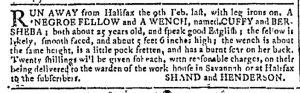
“RUN AWAY … CUFFY and BERSHEBA.”

Slavery advertisements were common in eighteenth-century newspapers, especially in the Georgia Gazette and other newspapers in southern colonies,. In the advertisement, Shand and Henderson offered a monetary reward for two of their slaves who ran away: Cuffy and Bersheba. They offered twenty shillings for each of them. This was one of six advertisements concerning slavery in this issue. In the Georgia Gazette, advertisements for slaves were just as common as advertisements for tea, household goods, and property for sale.

In a chapter on “Runaway Advertisements in Colonial Newspapers,” Victoria Bissell Brown and Timothy J. Shannon discuss how colonists saw slaves as material goods, not as human beings. “One of the great advantages to reading these advertisements in their original context is to comprehend how casually colonial Americans bought and sold human laborers.”[1] Based on the look inside colonial society that newspapers give us, we are able to see how colonists in the eighteenth century did not think twice about seeing an advertisement for a runaway slave next to one for a stray horse. As revolution drew closer to becoming a reality, slavery began to decline in the north but it remained strong in the south, where advertisements like this one were very common.

**********

ADDITIONAL COMMENTARY: Carl Robert Keyes

Olivia notes that in addition to Shand and Henderson’s notice about Cuffy and Bersheba making their escape, five other advertisements concerning enslaved men, women, and children appeared in the March 8, 1769, edition of the Georgia Gazette. Two of them reported on runaways that had been captured. Two offered enslaved people for sale, wile the final one offered an enslaved woman “To be hired out” as a domestic servant. When it came to such advertisements in the Georgia Gazette, this was actually relatively few compared to most issues. That newspaper often featured a dozen or more advertisements related to enslavement. They constituted an important source of revenue for James Johnston, the printer.

Olivia challenges us to consider how unremarkable white colonists found these advertisements that appeared week after week throughout the colonial period. This certainly reveals something significant about the attitudes of most colonists, but these advertisements also tell important stories about the experiences of enslaved people. Consider not only Cuffy and Bersheba but also their counterparts in the advertisements reporting Africans and African Americans who had been “TAKEN UP” or “”Brought to the Work-house.” Cuffy and Bersheba were both approximately twenty-five years old. Both spoke “good English,” indicating that they were either born in the colonies or had been transported there quite some time ago. When they made their escape, Cuffy had “leg irons on” (and Bersheba may have as well, though the wording of the advertisement does not make it clear). Shand and Henderson made every effort to keep them around, but Cuffy and Bersehba were determined to free themselves. Sampson, Molly, and an unnamed infant were discovered “on the Indian Country Path,” making their escape from a “master [who] lives near the salt water.” Sampson “speaks such bad English as scarcely to be understood,” suggesting that he may not have been enslaved his entire life. Michael, a “TALL STOUT ABLE NEGROE FELLOW” who had been confined to the workhouse in Savannah definitely had not been born into slavery in Georgia. He spoke little English. The advertisement reported that he was “of the Coromantee country” and had “his country marks thus ||| on each side of his face,” referring to ritual scarification.

Each of these advertisements provides a miniature and incomplete biography of enslaved people who attempted to seize their own liberty in the era of the American Revolution. White colonists placed them for one reason, recovering their human property, but these advertisements ultimately served an unintended purpose. They testified to the agency and resistance of enslaved men and women. Although not in their own words, these advertisements tell the stories of people who had few opportunities to create documents that recorded their own experiences.

**********

[1] Victoria Bissell Brown and Timothy J. Shannon, Going to the Source: The Bedford Reader in American History (Boston: Bedford/St. Martin’s, 2004), 48.

March 1

GUEST CURATOR: Chloe Amour

Who was the subject of an advertisement in a colonial American newspaper 250 years ago today?

Georgia Gazette (March 1, 1769).

“He is branded on the breast IW in small letters.”

In this particular advertisement for a runaway slave, the vivid description suggests the desperation to find him. Including a reward made the search that much more enticing. A key detail in the advertisement states the slave, named Bristol, was “Angola born.” He was brought to the West Indies, then eventually to Georgia. This implies the slave has been sold multiple times. Coming from the West Indies with a brand also became a telltale sign he had previous masters. In addition, Bristol speaks “pretty good English,” which implies he had been enslaved long enough to learn the language. With the demand for slave labor and the revenue it produced, masters circulated their slaves for profit. The amount of information and detail provided in the advertisement allows for readers to reconstruct the story of Bristol.

The brand on Bristol’s breast, “IW in small letters,” helped to identify him. Betty Wood examines the practice of branding enslaved people: “If they had not been branded before leaving Africa, then there was a good chance that it would happen to them upon their arrival in America.”[1] Branding, using a “red-hot iron,” was a common technique to leave an imprint upon the bodies of slaves. Typically, the brand was stamped on the chest, shoulder, or cheek. The act of branding by slave owners made a bold statement; it displayed complete ownership and possession of the slave. The visual image of a brand made a statement, to deny the humanity of people of African origin. To put branding in perspective, this type of treatment was used on animals, such as cattle and horses, to keep track of them if they became lost. Similar to the runaway slave Bristol, the origins of other enslaved people could be traced through the symbol branded upon their body.

**********

ADDITIONAL COMMENTARY: Carl Robert Keyes

By the time George McIntosh’s advertisement concerning Bristol ran in the March 1, 1769, edition of the Georgia Gazette, the runaway had been absent for nearly seven weeks. McIntosh reported that Bristol “WENT AWAY” on January 13. Also by early March the advertisement would have been familiar to colonists who regularly read the Georgia Gazette. Dated “17th January, 1769,” it appeared in its sixth consecutive issue. McIntosh apparently submitted it to the printing office too late for inclusion in the January 18 edition, but starting on January 25 the advertisement appeared every week. By then, Bristol had been “AWAY” from McIntosh’s plantation for nearly two weeks. In the several weeks since, he continued to make good on his escape. Perhaps he had learned from a previous failed attempt and crafted a better plan. McIntosh stated that Bristol had been “taken up once before” in the area of Sunbury and Midway.

The longevity of McIntosh’s advertisement describing a man who had escaped from bondage was hardly unique, at least not compared to other advertisements that described runaways and offered rewards for their capture and return. Some ran for as long as six months before being discontinued. When such advertisements disappeared from the pages of the Georgia Gazette after so long, it most likely indicated that slaveholders decided not to make further investments in alerting the public about the runaways. After seeing the same advertisements for months, readers were probably well aware of the descriptions of the runaways and the circumstances of their escapes.

In contrast to the constant republishing of runaway advertisements, other sorts of paid notices usually ran for a much more limited time. Advertisements for consumer goods and services, for example, typically ran for three or four weeks. Merchants and shopkeepers did not make the same investment in notifying the public about their wares as slaveholders made in their attempts to reclaim their human property. Advertisements for runaway slaves were an important revenue stream for the Georgia Gazette not only because colonists placed so many of them but also because those advertisements ran for so much longer than any others.

**********

[1] Betty Wood, Slavery in Colonial America, 1619-1776 (New York: Rowman and Littlefield, 2005), 28.

January 21

What was advertised in a colonial American newspaper 250 years ago today?

Providence Gazette (January 21, 1769).

“RUN away from his Master … a well-set Negro Manm Slave, named Isaac.”

By the time the January 21, 1769, edition of the Providence Gazette was published, Samuel Rose had been placing an advertisement offering a reward for “a well-set Negro Man Slave, named Isaac,” who had run away in late November of the previous year for an entire month. Isaac had “a Scar on his Forehead” and a “thick Beard.” According to Rose, the enslaved man could “play on a Fiddle, and loves strong Drink,” though savvy readers likely realized that many slaveholder exaggerated when it came to that latter detail. Rose also warned “Masters of Vessels, and others” against providing assistance, whether “carrying off or harbouring” Isaac.

The tone of this advertisement advanced starkly different rhetoric than other items published on the same page and elsewhere throughout the issue. John Carter’s advertisement for “A NEW EDITION” of Abraham Weatherwise’s “New-England TOWN and COUNTRY Almanack” filled the entire column immediately to the right. The notable contents of the almanac promoted in the advertisement included “a beautiful poetical Essay on Public Spirit, wrote by an American Patriot” and a Portrait of the celebrated JOHN WILKES, Esq.,” the radical English politician and journalist considered friendly to the American cause during the imperial crisis that led to the Revolution. In the upper left corner of the page, a poem entitled “ADDRESS to LIBERTY” by “AMERICANUS” appeared before any of advertisements. The poem lamented recent encroachments on colonists’ liberty by “tyrant Lords,” but it addressed only the position of white colonists and not enslaved men, women, and children. The poem did not make room for Isaac the justice that was supposed to be extended to English sons who had “cross’d th’atlantic Seas / To Climes unknown.” News filled most of the rest of the issue, including a “humble Address of the House of Commons to the KING.” Parliament stated that it would “be ever ready to hear any real grievance of Your Majesty’s American subjects,” but insisted it was “one of our most important duties, to maintain entire and inviolate the supreme authority of the legislature of Great-Britain, over every part of the British empire.” Colonists considered this enslavement.

Amidst all of this rhetoric circulating in conversations and the public prints, Isaac determined to seize his own liberty. Although Rose did not recognize it, the enslaved man put into action the ideals that so many of his white neighbors espoused in the late 1760s.

November 22

What was advertised in a colonial American newspaper 250 years ago today?

Nov 22 - 11:22:1768 South-Carolina Gazette and Country Journal Supplement
Supplement to the South-Carolina Gazette and Country Journal (November 22, 1768).

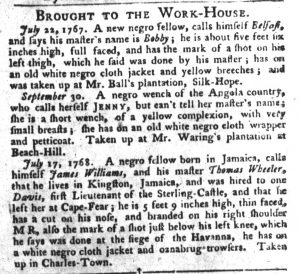
“A negro fellow born in Jamaica, calls himself James Williams.”

An advertisement listing fugitive slaves who had been captured and “BROUGHT TO THE WORK-HOUSE” was a regular feature in newspapers published in South Carolina and Georgia in the late 1760s. The supplement that accompanied the November 22, 1768, edition of the South-Carolina Gazette and Country Journal, for example, included an advertisement that described three such runaways: Belfast, a “new negro fellow” who “has the mark of a shot on his left thigh, which he said was done by his master,” Jenny, a “negro wench of the Angola country … of a yellow complexion, with very small breasts,” and James Williams, a “negro fellow born in Jamaica” who had been “branded on his right shoulder.” The notice indicated where each had been “taken up” before being delivered to the workhouse.

Other details hinted at more complete stories that each captured runaway could tell. That James Williams identified himself by both first and last name, for instance, was notable. He certainly had not adopted the surname of Thomas Wheeler of Kingston, the man who currently held him in bondage. What circumstances had prompted Williams to adopt that surname? What meaning did it hold for him? Which experiences had shaped his life and convinced him to seize an opportunity to make an escape? According to the notice, Williams had been “hired to one Davis, first Lieutenant of the Sterling-Castle,” but he ran away when the ship was at Cape Fear. In addition to the brand on his shoulder, he also had “the mark of a shot just below his left knee, which he says was done at the siege of the Havanna” near the end of the Seven Years War. The brief description of James Williams in the “BROUGHT TO THE WORK-HOUSE” notice was an incomplete narrative of his life, as was the case for both Belfast and Jenny.

These truncated narratives stood in stark contrast to the poem, “To LIBERTY,” printed immediately to the right. Charles Crouch, printer of the South-Carolina Gazette and Country Journal, presented one notion of liberty for his readers to consider as colonists grappled with their deteriorating relationship with Parliament. Probably quite inadvertently, Crouch provided a companion piece with the “BROUGHT TO THE WORK-HOUSE” notice. Most likely very few readers acknowledged the juxtaposition, in part because white narrators framed the experiences of runaway slaves. Given the opportunity to tell their own stories, Belfast, Jenny, and James Williams would have advanced their own understandings of liberty. Enslaved men, women, and children did not need poets or printers to teach them any lessons about what it meant to be free. Through the act of running away, they testified that they already understood.

September 19

What was advertised in a colonial American newspaper 250 years ago today?

Sep 19 - 9:19:1768 South-Carolina Gazette
South-Carolina Gazette (September 19, 1768).

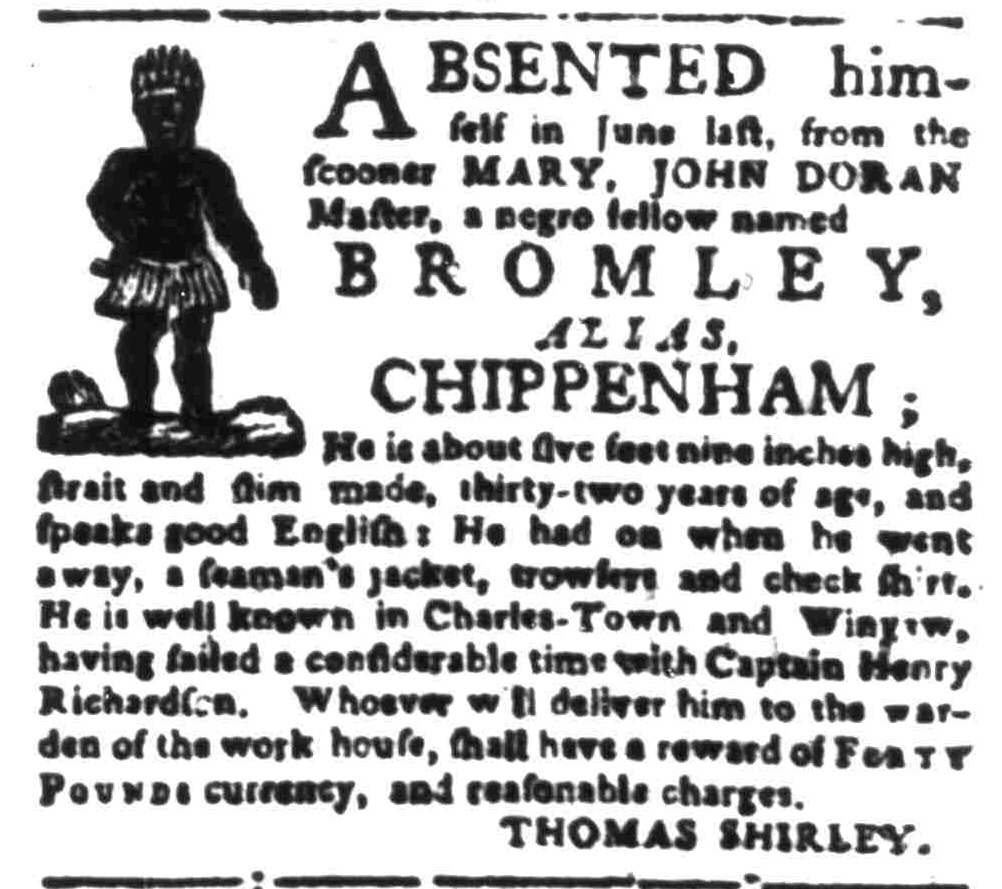
“ABSENTED himself … a negro fellow named BROMLEY.”

Throughout the summer of 1768 Thomas Shirley inserted the same advertisement in all three newspapers published in Charleston, South Carolina. Dated June 8, Shirley’s notice had two parts. In the shorter first portion Shirley described a yawl either “DRIFTED or STOLEN from the Brigantine Prince-of-Wales, Thomas Mason, Master.” He offered a “TWO DOLLARS reward” for its return. In a much lengthier second portion Shirley described Cyrus and Bromley, two enslaved men, who had “ABSENTED themselvesfrom the Schooner Mary, John Doran, Master.” Shirley did not suspect that the runaways had stolen the yawl but instead reported that he suspected “they went off in a Canoe for Ponpon, where Bromley has a wife who belongs to William Harvey.” Shirley provided approximate ages and heights for both fugitives. He also noted that Cyrus “has both his ears cropt” and “his cheeks branded,” likely as punishment for prior acts of disobedience. The enslaved man must have earned some notoriety in the area. Shirley determined that he was “so well known as to need no further description.” As for Bromley, Shirley indicated that he sometimes went by the name Chippenham and “speaks good English.” He concluded by offering rewards for the capture and return of the runaways as well as rewards for information leading to the conviction of anyone who provided them assistance.

That advertisement appeared for the last time in early September. Starting with the September 19 edition of the South-Carolina Gazette, a much shorter notice replaced it. Shirley no longer advertised the missing yawl or the infamous Cyrus, but he continued to seek the capture and return of Bromley. He offered a little more information to help readers recognize the fugitive, noting the clothing he wore when he made his escape: “a seaman’s jacket, trowsers and check shirt.” Shirley also stated that Bromley was “well known in Charles-Town and Winyaw, having sailed a considerable time with Captain Henry Richardson.”

What promoted theses revisions to an advertisement that ran for nearly three months? Had Cyrus been captured? Did Shirley receive information indicating that Cyrus was somehow beyond his reach? Had something else happened that caused Shirley to cease advertising Cyrus? The new advertisement no longer mentioned Bromley’s wife in Ponpon. Why not? Had she undergone so much interrogation and surveillance that Shirley determined that his assumption that Bromley would make his way to her was a false lead? What kinds of experiences did she have after her husband and an accomplice fled from Shirley? Perhaps the slaveholder placed too much emphasis on Bromley’s possible attempt to seek refuge with his wife. In the new advertisement he acknowledged that Bromley previously experienced a fair amount of mobility when hired out as a sailor with Captain Richardson. That may have given Bromley more room to maneuver and make good on his escape rather than placing his wife in greater danger by drawing her into a conspiracy.

Like every other runaway advertisement, this one tells a truncated story filtered through the perspective of the slaveholder who composed and placed the notice in the public prints. Unlike most other runaway advertisements, this one provides a second chapter, yet it still raises as many questions as it answers. It does confirm that Bromley continued to elude Shirley, at least for the moment, but it does not definitively reveal anything more about Cyrus or Bromley’s unnamed wife.

September 14

What was advertised in a colonial American newspaper 250 years ago today?

Sep 14 - 9:14:1768 Georgia Gazette
Georgia Gazette (September 14, 1768).

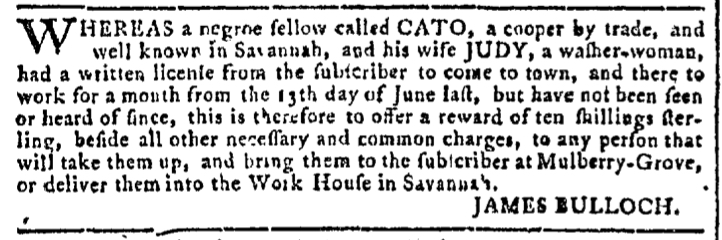
“A negroe fellow called CATO … and his wife JUDY … had a written license … to come to town.”

James Bulloch’s advertisement concerning an enslaved man and woman who tricked him into issuing them a pass so they could hire themselves out in Savannah for a month and then ran away became a regular feature in the Georgia Gazette in 1768. Dated July 6, it first appeared in the July 13 edition. It then ran every week, with the exception of August 3, for the next six months, making its final appearance on January 4, 1768, in the first issue of the new year. Overall, Bulloch inserted this advertisement in the Georgia Gazette twenty-five times. It would have been impossible for regular readers to remain unaware of Cato and Judy’s subterfuge and flight, but Bulloch published the notice often enough that even those who read the Georgia Gazette only occasionally were likely to encounter the story of the runaway cooper and laundress.

In that regard, Bulloch’s advertisement did not differ from many other notices about runaway slaves in the Georgia Gazette and other newspapers printed throughout the colonies. The account of Cato and Judy’s escape appeared alongside other advertisements for runaway slaves that also ran for months at a time, including one about “THREE NEW NEGROE MEN, called NEPTUNE, BACCHUS, and APOLLO … and ONE STOUT SEASONED FELLOW, called LIMERICK” who ran away from a plantation near Pensacola, Florida, and were suspected of making way “through the Creek nation.” Bulloch and others made significant investments as they attempted to reclaim runaway slaves. In addition to the “reward of ten shilling sterling, beside all other necessary and common charges” that he offered for the capture and return of Cato and Judy, Bulloch financed an advertising campaign that lasted for six months.

Why did these advertisements cease on January 4, 1769? Had Cato and Judy been captured? Or had they successfully made their escape, at least for the moment, having used the “written license” they finagled from Bulloch to move freely and as far away as possible before he even realized they were gone? The slaveholder may have decided to cut his losses by suspending the advertisements. By then, however, colonists throughout Georgia and beyond would have been familiar with Cato and Judy’s story because they saw it repeated in the Georgia Gazette so many times. Even though the advertisements did not continue, the runaways were not safe. Bulloch had used the power of the press for months to encourage others to engage in the surveillance necessary to bring and end to Cato and Judy’s flight for freedom.

September 1

What was advertised in a colonial American newspaper 250 years ago today?

Sep 1 - 9:1:1768 Virginia Gazette Purdie and Dixon
Virginia Gazette [Purdie & Dixon] (September 1, 1768).
“RUN away … Negro woman named GRACE … appears to be young with child.”

In many instances, newspaper advertisements for runaways may be the only documents that testify to the experiences of some enslaved men and women. Each runaway advertisement tells a story of someone who might otherwise have disappeared from the historical record, but these are only partial stories told by aggrieved masters rather than by the fugitive slaves themselves. Still, these truncated narratives allow us to reconstruct the past, granting insight into the thoughts and experiences of enslaved people even though they do not provide direct testimony.

Consider the story of Grace, described by James Johnson as “a likely Virginia born Negro woman … of a very black complexion.” When Grace ran away in early August 1768, Johnson placed an advertisement offering a reward for her capture in Purdie and Dixon’s Virginia Gazette. He provided a short biography, though it likely did not include the details that Grace would have chosen were she telling her own story about her life. The young woman had been born in Virginia, like most of the other enslaved men, women, and children advertised in the same the Virginia Gazette at the time she made her escape. She was not a “new negro” who had survived the Middle Passage from Africa and then transshipment within the colonies, but she had not always resided with the same master in the same town. Johnson reported that she ran away from Amelia, well inland, and would “endeavour to get on board some vessel in James river, or make for Hampton town” on the coast. Johnson was at least her third owner, having acquired Grace from James Machan who “said she had lived with Mr. Collier” near Hampton.

Johnson provided one other important detail about Grace, reporting she was “somewhat fat, middling large, and appears to be young with child.” Every fugitive had good reason for running away, but Grace may have had more motivation than others. She was probably aware that she could be separated from her child at any time. Another advertisement in the same issue listed several prizes in a lottery, including “a likely breeding woman named Agnes” valued at fifty pounds as one prize and “Agnes’s child, named Rose, 18 months old” valued at fifteen pounds as another. Mother and daughter were almost certain to be separated when the tickets were drawn and the so-called “Prizes” awarded. In addition to Agnes, the “Prizes” included another “likely breeding woman named Ruth.” Grace may not have fled merely to avoid being separated from her child. She may have been escaping sexual abuse and exploitation that led to her pregnancy, whether perpetrated by Johnson or others. In a society that treated her as a “likely breeding woman,” Grace may have been attempting to assert control over her own body and reproductive choices.

It is impossible to know for certain the precise reasons that Grace chose to run away or why she ran at the time she did, but Johnson’s advertisement suggests some likely possibilities. He did not acknowledge the abuses Grace may have suffered, but readers can fill in those silences by imagining Johnson’s narrative of the enslaved woman’s life had it been told by Grace herself.

July 13

What was advertised in a colonial American newspaper 250 years ago today?

Jul 13 - 7:13:1768 Georgia Gazette
Georgia Gazette (July 13, 1768).

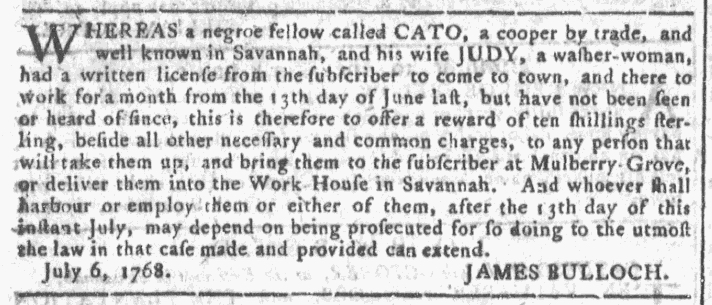
“A negroe fellow called CATO … and his wife JUDY … have not been seen or heard of.”

James Bulloch, a slaveholder, regretted trusting “a negroe fellow called CATO … and his wife JUDY.” The two took advantage of that trust, at least from Bulloch’s perspective, when they decided to run away after he had issued them a pass to go to Savannah. Cato and Judy, for their part, likely had little sympathy when it came to betraying the trust of a man who held them in bondage. Bulloch briefly told their story in an advertisement he inserted in the July 13, 1768, edition of the Georgia Gazette.

Cato and Judy were both skilled workers. Bulloch described Cato as “a cooper by trade” and Judy as “a washer-woman.” Cato had apparently practiced his trade in the colony’s largest port town; Bulloch indicated that he was “well known in Savannah.” That being the case, it may not have been difficult for Cato to find work when he wished, providing that Bulloch allowed him to participate in the hiring out system. Judy also possessed a skill often in demand, especially in ports. Hiring out his slaves accrued certain benefits for Bulloch, especially if he did not have sufficient work to keep them occupied. By hiring out the cooper and laundress, allowing them to seek their own employment for a specified period, Bulloch reduced his responsibilities for providing food and shelter. He also generated additional income since their wages belonged to him. Slaveholders who thought of themselves as generous sometimes gifted a small portion of the wages to the enslaved men and women who earned them, but usually little more than a token.

Bulloch apparently had no misgivings about this system, at least not as far as Cato and Judy were concerned. Perhaps they had cultivated his trust over time, anticipating when they might have an opportunity to make their escape. Bulloch issued he couple “a written license … to come to town, and thee to work for a month from the 13th day of June last.” He expected them to return after a month, with their wages to hand over to him. To Bulloch’s dismay, however, Cato and Judy “have not been seen or heard of since.” Apparently the couple did not make any pretense of arriving in Savannah and seeking work. Instead, they fled at the earliest opportunity in order for their disappearance to go unnoticed as long as possible, increasing their chances for making good on their escape. Bulloch eventually discovered the subterfuge and offered a reward for their capture and return.

Although filtered through the perspective of slaveholders, advertisements for runaway slaves present striking stories of survival and resistance by enslaved men and women. The same issue of the Georgia Gazette that first provided an account of Cato and Judy’s escape also included three other advertisements for runaway slaves: Pedro “of the Angola country,” who “has the upper part of his right ear cut off,” possibly as a disciplinary measure; Chloe, who “has her country marks on both her cheeks” and spoke little English; and Ben, who “has been for some time sickly.” The advertisements do not provide as much information about any of these fugitives, making it more difficult to reconstruct their stories. Still, these advertisements demonstrate that enslaved men and women did not meekly accept their fate but instead sought to change their condition.

July 4

Who was the subject of an advertisement in a colonial American newspaper 250 years ago today?

Jul 4 - 7:4:1768 Pennsylvania Chronicle
Pennsylvania Chronicle (July 4, 1768).

“RAN away … a Mulatto Slave, named HARRY.”

July 4 is the day Americans celebrate their independence from Britain. It is a familiar story about campaigns of resistance to abuses by Parliament that steadily intensified and ultimately led to a revolution against the king, a revolution that created a new nation. In the Declaration of Independence the founders asserted “that all men are created equal, that they are endowed by their Creator with certain unalienable Rights, that among these are Life, Liberty and the pursuit of Happiness.” The founding generation, however, applied these ideals unevenly to various constituencies within the new United States of America. The American Revolution launched a struggle to achieve those ideals, a struggle that has unfolded over nearly a quarter of a millennium and continues to this day. As a nation, the United States has certainly made progress, but those ideals have not been universally achieved. Unfortunately, much of that progress has come under attack in the twenty-first century, making it clear that Americans must be vigilant in safeguarding not only their own liberty but also the liberty of others as they continue to strive to achieve those ideals endorsed in Independence Hall in 1776 and promulgated throughout the new nation.

As Americans once again tell the story of their independence today, consider another story of an American who seized his freedom in the era of the Revolution. Harry, “a Mulatto Slave … about 40 years of age,” ran away from Levin Crapper on September 13, 1767. More than nine months later he had not been captured or returned, prompting Crapper to place an advertisement in the Pennsylvania Chronicle. According to Crapper, Harry possessed a variety of talents that would allow him to make a living on his own: “He was bred a miller, and understands very well how to manufacture flour.” Crapper also acknowledged, grudgingly, that Harry “understands the carpenter’s and mill-wright’s business middling well.” To offset those indications of his competence at those trades, Crapper accused the fugitive of being “much given to strong drink.”

That was not the entirety of Harry’s story. Crapper also reported that Harry “has a free Mulatto wife, named Peg, and two children.” Of all the motivations that could have prompted Harry to make his escape, reuniting with his family was probably the most compelling. Even though Peg and the children did not depart at the same time as Harry, Crapper stated that he believed “they will endeavour to get together” and flee “to the province of East New-Jersey.” Crapper suspected that Harry had a forged pass that would aid him in his flight from the man who held him in bondage.

Thomas Jefferson had not yet penned the phrase “Life, Liberty and the pursuit of Happiness” when Harry determined to make himself a free man. The Declaration of Independence had not yet been printed in newspapers throughout the colonies or read aloud in churches and town commons. Yet the Revolution had begun. Colonists had protested the imposition of the Stamp Act in 1765 and celebrated its repeal in 1766. At the time that Harry made his escape in 1767 white colonists complained about their impending enslavement via the Townshend Act and other laws passed by Parliament. Harry knew something about enslavement. He had likely heard other colonists talking about liberty and the necessity of resistance to an oppressive Parliament. In that environment, he made his own choice to seize his freedom, for himself and for his family.

There are many stories to celebrate on Independence Day. Harry managed to remain free for at least nine months. Hopefully he and Peg and the children made it to safety and he eluded capture for the rest of his life. Harry’s story is one of determination and an individual commitment to “Life, Liberty and the pursuit of Happiness” in the era of the American Revolution, a story that deserves to be told and celebrated alongside so many of the familiar stories that so many already know so well.